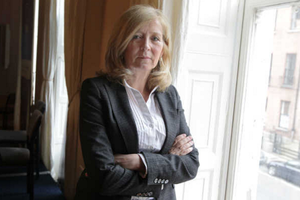
European Ombudsman Emily O’Reilly
European Ombudsman Emily O’Reilly spoke to Seán O’Rourke on RTÉ Radio One earlier today about the fallout of Brexit.
Unlike some of her colleagues, she was expecting the Leave side to win.
During the interview, she explained:
A lot of people here in Brussels were completely shocked and surprised by the result. I wasn’t that surprised. I was in the UK a few weeks ago and the atmosphere, to me, was much more Brexit-y if I could put it that way, rather than Remain. And I thought the narrative seemed to be going in a particular direction.
Those people that I spoke to, who might have been sort of on the sidelines or on the fence if you like, weren’t finding the arguments of the Remain people very convincing and I think they felt that, after years of the EU being blamed for virtually every ill that the UK was suffering that the people who are now urging them to Remain, they lacked credibility.
But also, mind you, closer to the actual day of the referendum and certainly in the wake of the murder of Jo Cox, I thought that that might change things and perhaps it changed the margin for the result but, obviously, ultimately it didn’t change things.
On the day of the referendum itself, putting my old political correspondent’s hat on, I noticed the turnout was very high and that generally means that people who are more excited or more involved, or more engaged on one particular side of the debate are more likely to vote and I judged that that would be people who wanted to leave the EU.
And also the weather was bad and, again people who aren’t that bothered to vote are likely to be swayed by that so, on that basis, I wasn’t really too surprised.
I think if you’re in Brussels for too long, I think a sense of dislocation happens and most people here, who work in the EU institutions obviously have skin in the game. And they’re not always looking completely rationally at the reasons why people vote in a particular way.
I know I’ve often said to my colleagues and I based it on our experience when the financial crash happened, and things changed so much and particularly I suppose for people who mightn’t have been expecting the outcome in terms of their incomes and so on and that would be the public servants and civil servants in Ireland and the degree to which their living standards plummeted and so on.
I said to my colleagues on a number of occasions, ‘don’t take anything for granted’, you know, ‘explore what’s happening in the UK, there is a possibility that the vote could go a particular way.
But I think because, when you come to Brussels, people get so wrapped up in the project, and some of them fall so much in love with the project that they find it incomprehensible that people, outside, the bubble might not be as in love with it either.
I think also there is a lack of awareness of the degree to which inequality still remains as a big issue, increasingly in many countries, including in the UK.
Of course the mistake is to blame the EU or what the EU does because very often it’s member state’s policies themselves, or globalisation generally that has created that.
But I think there is a lack of understanding and very often a lack of empathy for people who are on their uppers and who feel, certainly in some places in the UK, that they are competing for reduced public services with migrants – be they migrants from other EU countries or immigrants, people who are seeking asylum or refugee status in the UK.”
When I came here, people would talk about the second narrative. The first narrative sort of started in Auschwitz and ended with the creation of the EU if you like.
But that was a narrative for an older generation and I often make the point that young Irish women, like myself as I was in the 1970s, for my generation of young people but particularly young women, that the EU was a liberation for us because they brought in certain laws that made us more equal in the workplace and got rid of the ban on women, married women working in the workplace and so on and so forth.
So my experience and the experience of our generation, shall I say, was generally very positive. But that experience, if it isn’t being replicated among the young generations in eastern Europe, central Europe, even in the UK, then they’re going to become disillusioned with it.
But I thought it was interesting that one of the first meetings, in the flurry of meetings that have taken place all over Europe since last Thursday was one of the foreign ministers of the six founding countries of the EU and I think that was sort of sending out a signal perhaps, hinting at what you’re suggesting there that maybe the whole project has become a little bit strained that something has to happen, something has to give, a more modest union, a smaller union, whatever.
But that Brexit has been the key, perhaps, looking at it in the positive way, to reform that and is going to be positive and, you see, I’ve thought it so difficult now, when anybody mentions a Treaty change, a possible Treaty change, even over something trivial, everybody shivers because the idea that you would get 28 member states to agree on anything seems impossible. So you wonder how you can continue give that sort of strain on a process.
There’s always been a tussle here between the ever closer union people, the federalists and those who say, ‘look, let’s have a much narrower and less ambitious sort of, trading and humans rights and all of that, but let’s not try and strain this too far’ and that will continue.
But I think what we’re going to have over the next few months: a lot of politics has to happen on all sorts of levels before we can see what’s actually going to emerge at the end and no one can tell you definitively what that is.
You have the politics in the United Kingdom, the politics in Northern Ireland, in Scotland, we have our own skin in the game, very obviously and at the moment, Ireland is sort of like in a ‘torn between two lovers’ situation between the UK situation and membership of the European Union.
You also have the French presidential election next year, as you say, what’s happening in Germany, and all of that and then you have the general, ideological struggles or squabbles or whatever, political debate that goes on in relation to how Europe should develop.
But I had felt, personally, over the last while, since coming here, when you have the migration crisis and the financial crisis, you had Greece, you had this, you thought at some point, something had to give in order to rebuild, recast perhaps in a different way.
I made the point recently that, when people don’t understand, they feel stupid and when people feel stupid, the feel hostile towards those people who, inadvertently or otherwise, have made them feel stupid and so they resile and so they become much more isolated and I think the EU has an awful lot of work to do in relation to its transparency, its accountability, how it communicates with the 500 million citizens…
Listen back to the interview in full here
Previously: Everything Must Change
Rollingnews