


This afternoon.
At Doyle’s Cottage, Lawson Terrace, Sandycove, Co Dublin.
The birthplace of Roger Casement (1 September, 1864 – 3 August, 1916).
Thanks Glass Dublin



This afternoon.
At Doyle’s Cottage, Lawson Terrace, Sandycove, Co Dublin.
The birthplace of Roger Casement (1 September, 1864 – 3 August, 1916).
Thanks Glass Dublin
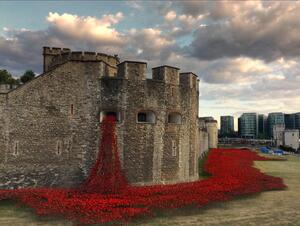

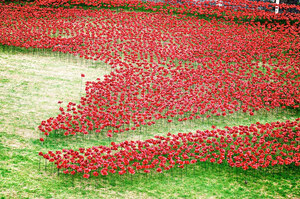
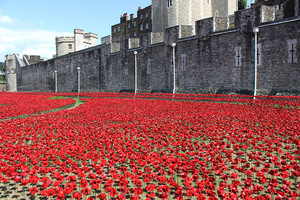


An cascade of ceramic poppies commemorating the dead of WW1 by ceramic artist Paul Cummins.
Entitled Blood Swept Lands and Seas of Red, the work (still under construction) will ultimately comprise 888,246 red ceramic flowers planted in the dry moat around the Tower Of London.
The final symbolic poppy will be planted on November 11th, at which point the display will end.


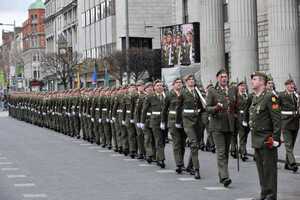


The commemoration of the 1916 Easter Rising this morning.
(Laura Hutton/Photocall Ireland)


 Dr Margaret MacCurtain, feminist historian, speaking at the unveiling of a plaque to commemorate the founding of the Irish Women Workers’ Union more than 100 years ago and its role in the 1913 Lockout.
“We are actually at the end of those 100 years, a very unequal society. It’s not our fault. It’s the whole idea of capitalism. Extreme capitalism has divided society into the very rich and those who are hanging on really by the bootstraps. But it would be a wonderful contribution to the 21st century if again we united and tried to make our society in Ireland a more equal one.”
Watch here

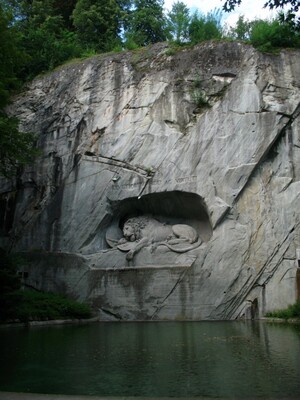
 The Lion Monument in Lucerne, Swtizerland – designed by Bertel Thorvaldsen and sculpted by Lukas Ahorn in 1820-21 – commemorates the massacre of Swiss Guards in 1792 during the French Revolution during the storming of the Tuileries Palace in Paris.
In his 1880 book A Tramp Abroad, Mark Twain called the work ”the most mournful and moving piece of stone in the world.” He continued:
The Lion lies in his lair in the perpendicular face of a low cliff — for he is carved from the living rock of the cliff. His size is colossal, his attitude is noble. His head is bowed, the broken spear is sticking in his shoulder, his protecting paw rests upon the lilies of France. Vines hang down the cliff and wave in the wind, and a clear stream trickles from above and empties into a pond at the base, and in the smooth surface of the pond the lion is mirrored, among the water-lilies.
Around about are green trees and grass. The place is a sheltered, reposeful woodland nook, remote from noise and stir and confusion — and all this is fitting, for lions do die in such places, and not on granite pedestals in public squares fenced with fancy iron railings. The Lion of Lucerne would be impressive anywhere, but nowhere so impressive as where he is.
Beyond mmf.
