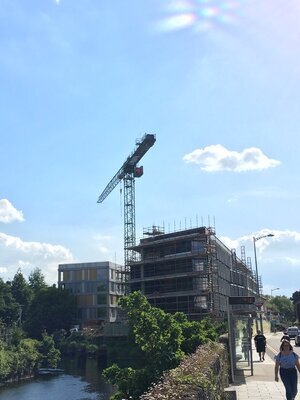



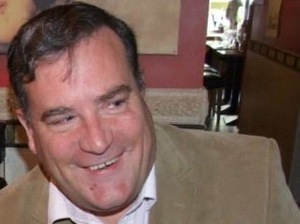
The street named after Cork Lord Mayor Tomás MacCurtain, killed by the RIC during the War of Independence. (right) lies in the city’s so-called ‘Victorian Quarter’; Dan Boyle
I had the privilege this week of seeing the excellent Paul Brady. The highpoint was a moving rendition of his song ‘The Island‘. I was particularly taken with the line, “Still trying to carve tomorrow from a tombstone”.
At the most recent Cork City Council meeting a discussion occurred about Cork’s imminent entry into the national decade of commemorations.
1920 was the year where Cork became the epicentre of the story of Ireland. Much of the narrative revolved around the two martyred (Lord) Mayors, MacCurtain and MacSwiney. They were two of the four men who held the office that year.
The year was to end with the evident war crime that was the burning of Cork’s city centre.
Cork City Council has been discussing how these events should be marked. Obviously they should be, but also in a context where what wasn’t talked about then and hasn’t been talked about since, can be addressed openly now.
The obvious omission has been the role of women in the War of Independence, or indeed with the development of the State since.
At least in committee the City Council has been trying to construct a programme of events that could be put in place that address such omissions and carry an awareness of sensitivities.
That had been the hope.
Last Monday’s public city council meeting descended into farce, as councillors sought to out-republicanise each other.
Greatest umbrage was being taken at the branding of a part of the city as the Victorian Quarter. It’s a branding that I have been somewhat indifferent too, although it doesn’t offend me.
The branding has certainly offended some on Cork City Council. They see it as being acceptance of everything and anything her name has ever been associated with.
From Famine Queen to arbiter of social mores to being Empress of India, the very existence of a Victorian Quarter in Cork is seen as a confirmation of an anglocentric view of history.
But it really isn’t. In the case of Cork it highlights a collection of buildings whose architectural sense can be described as Victorian.
My fear is that a year of commemoration, that can be and should be dignified, will instead be open to hundreds of reinterpretations, all based on offence.
What the decade of commemorations has succeeded in doing has been to help us understand that there is no single, definitive version of Irish history.
Not only are there nuances, we should also be more understanding in realising that the same set of circumstances can be looked at differently through different perspectives.
Through knowledge of complexities we can begin to understand. It is more of a loosening rather than a letting go. Both being difficult in the context of Irish history.
We need to get away from a my history right or wrong approach as quickly as possible. It is the important next step in our maturing as a country.
Dan Boyle is a former Green Party TD and Senator and serves as a Green Party councillor on Cork City Council. His column appears here every Thursday. Follow Dan on Twitter: @sendboyle