

Tag Archives: Dan Boyle

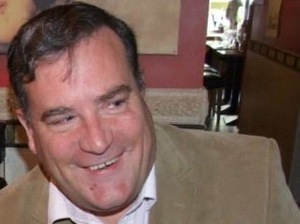
From top: Fine Gael’s Director of Elections for the 2013 Seanad Abolition Referendum Richard Bruton  (right) with Regina Doherty and Simon Harris on September 9, 2013; Dan Boyle

The constitutional referendum held in 2013 on the government’s proposal to abolish The Seanad was lost through indifference.

Certainly it wasn’t defeated by any overwhelming affection in which our second chamber of parliament was held. Less than 40% of voters participated in the referendum dividing on a 52% No 48% Yes vote (sound familiar?).

I took an active role in that campaign. As a former member of the Seanad I could see it had value, even if it has never operated to anything like its potential throughout its existence.

To be honest I much preferred my time as a Senator to that I had spent as a TD. I found the debates more engaging. I found the scrutiny of legislation to be more thorough. The pity is that too few Senators allow the Seanad to be the powerful parliamentary tool it can be.

The Seanad has been allowed to develop into a filter for the wider political system. A crèche for those not yet fully immersed in the ‘real’ World politics of the Dáil, a place of sanctuary for those left homeless by the Dáil electorate, or a rest home for those left battered by a system depriving them of being where they want to be.

I would say that about a fifth of the membership of The Seanad works to make the House a living, active parliamentary chamber it should be. For most of the others it is somewhere where prestige does not require responsibility.

This disconnect is something I sadly see being maintained through many of the candidates being presented to us, a privileged and select electorate, for the election to the next Seanad.

Since 1992 I have participated in every Seanad election (with the exception of 2007, my fallow period between being a TD and a Senator). Disappointingly, for the most part, there has been no great improvement in the calibre of many coming into the Seanad. That said after the 2016 election there have been a few flickers of light that this is beginning to change.

Due to changes we have seen in the composition of the Dáil itself, and before that as a result of the local elections in 2019, we are now likely see in the next Seanad a more diverse chamber than has ever existed to date.

However a more qualified membership of the Seanad will mean nothing unless it is accompanied by long avoided reform to The Seanad itself. The template for that change already exists. It is easily implementable. The coming government, however it is composed, should make it its priority.

A reformed Seanad should be mostly elected by the general public. The Taoiseach’s nominees (of which I was once one) should be maintained but on a smaller scale.

I would suggest no more than five nominees, whose purpose should not be to contrive a Seanad majority for the government of the day, but to help ensure that those elements of society not represented in the political system, begin to be so recognised.

We should place the election of the Seanad on a different electoral cycle to that of The Dáil, impeding the ability of those who seek to jump from one house with the expectation of being able to jump back to the other at the soonest possible opportunity.

When this happens, if this happens, I might be tempted to go back.

Dan Boyle is a former Green Party TD and Senator and serves as a Green Party councillor on Cork City Council. His column appears here every Thursday. Follow Dan on Twitter: @sendboyle

Rollingnews

From top: Sinn Féin President Mary Lou McDonald  (right) with TDs David Cullinane (left) and Pearse Doherty at a rally in the Rochestown Park Hotel, Cork on Monday

A number of people I know attended the first of the Sinn Féin’s ‘I can’t believe it’s not an election’ rallies.

Some went out of curiosity. Others were converts to the idea that Sinn Féin, of itself represents the change that is needed in Irish society.

For the most part the overwhelming number, among a very impressiave audience, there were those already part of Sinn Féin family. A cursory look at registration plates in the hotel car park showed many had travelled considerable distances to be there.

It was a rallying of the troops (if you excuse the military analogy) meant to celebrate what had been achieved and tantalise about what could be.

Nuremberg it wasn’t. Nor was it anything new or novel in Irish politics.

On losing power in 1948 De Valera engaged in a nationwide (and international) tour to solidify and strengthen his party’s support. The chimera was that the meetings were tagged as being anti partition events.

The coming into being of Fine Gael in 1932 was pressaged by a series of open air rallies held under the auspices of the Army Comrades Association/National Guard (The Blueshirts) led by the infamous Eoin O’Duffy (first leader of Fine Gael, since written out of the party’s history).

New parties established between elections, like the Progressive Democrats and more recently Aontú, have engaged in nationwide tours, attracting significant attendances, when trying to establish themselves.

Large gatherings didn’t always ensue, but seeds were sown in ways that showed that another Ireland was possible.

Before I began thinking of becoming politically involved, I was impressed when two friends of mine joined the Democratic Socialist Party, developed by the much missed Jim Kemmy TD, after a low key not very well attended meeting in Cork.

A more justified criticism of the current Sinn Féin exercise is its implied theme of victors as victims.

The only clear result from the 2020 election is that there has been no winner. There are parties that have been more successful than others, but no party has been given the ability, of itself and by itself, to determine what happens next.

What has happened in this election is a rejection of traditional ways of practicing and expressing our politics. The difficulty that has arisen, and it should just as well be seen as an opportunity, is that the direction of change while significant has not been sufficient not to have government that also doesn’t include one or other (and maybe both) of our civil war parties.

The contrived angst of castigating other political parties for having the audacity of engaging with the public, is an example of the many ways we have practiced politics in the past having failed.

The same is true is about the somewhat empty concerns of shadowy figures indirectly influencing the process of government. As far as I am concerned this is a critique that could be applied as much to the Construction Industry Federation as it would to any self styled Army Council.

We are a representative democracy with many participatory elements. Our undervalued Constitution obliges us to politically behave like this.

The problem has been that our representative system has behaved for too long on the basis that elections are the consultation. Further consulations, by this logic, would be further elections.

This why the much vaunted talk about change has to be about more than a change of personnel. It has to be more than a change of practice.

Ultimately it has to be about a change of culture.

Dan Boyle is a former Green Party TD and Senator and serves as a Green Party councillor on Cork City Council. His column appears here every Thursday. Follow Dan on Twitter: @sendboyle

Pic: Twitter/SF

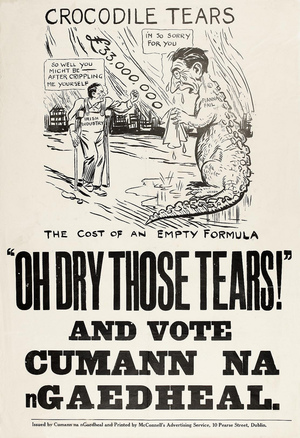
From top: June 1927 General Election poster for Cumann na nGaedheal; Dan Boyle

Much in politics is rarely new. What seems novel very often is a variation on a theme. As earthquake seeming as the 2020 election seems, there are parallels with previous elections.

The 1948 general election springs immediately to mind. Then Clann na Poblachta were the surprise packet. Part of the surprise was that party didn’t do as well as expected.

Led by by a former Chief of Staff of the IRA, Sean McBride, the newly formed party had won two of the three preceding by elections, by playing on growing discontent on poorly performing public services being badly delivered by a jaded and too long ensconced government.

However, unlike Sinn Féin in 2020 which ran too few candidates, Clann na Poblachta in 1948 ran far too many. The party finished a distant third to Fianna Fáil and Fine Gael.

Despite this the party went into government at the first time of asking, and would never recover its peak level of electoral support.

In 1989 the Progressive Democrats were contesting a second general election. The party experienced a significant loss of votes and seats in 1989 from what would prove its peak support in 1987.

Fianna Fáil continued to be led by Charlie Haughey, ostensibly the reason why the Progressive Democrats existed.

In the aftermath of the election it was constantly stressed that Haughey and Des O’Malley, the PD leader, could never be in the government with each other. They were.

By the next election in 1992, Haughey’s reign as Fianna Fáil leader would be over. The PDs would have another twenty years of existence, more often in government than not.

It is the June 1927 general election that most reminds me of the current situation.

It was the first election contested by the Fianna Fáil party, then little more than a year in existence. The party had absorbed much of the then Sinn Féin members in its ranks.

Despite dividing from Sinn Féin on whether abstentionism was a tactic or a principle, Fianna Fáil contested the election on an abstentionist platform.

The party won a similar share as Republicans had won in 1923, ending up with 44 TDs.

This put Fianna Fáil quite close to Fine Gael’s predecessor party, Cumann na nGaedheal, which ended up with 47 TDs, thirteen down from the number won in 1923.

Labour had quite a good election electing 22 TDs. A number of other parties also elected significant numbers of TDs, The Farmers’ Party winning eleven seats, the National League electing eight.

The League was also a new party, but was actually a hangover from the old Irish Parliamentary Party at Westminster.

Rump Sinn Féin won five seats, none of which would ever be sat on. That version of the party would not take part in Irish elections for a further 30 years.

Fianna Fáil’s abstentionism would soon be tested. One of its TDs, Paddy Belton (soon to sire a Fine Gael dynasty) went on a solo run taking the dreaded oath and his seat in Dáil Éireann.

For his troubles he would be immediately expelled from Fianna Fáil. However he would soon be followed in the Dáil chamber by high profile War of Independence figure, Dan Breen.

After that the jig was up. Fianna Fáil declared that the oath of allegiance was but an empty formula, then entering the Dáil chamber. Such formulations are likely to be referred to many times as we seek to address our current situation.

Once in the Dáil the ability of the minority Cumann na nGaedheal government to continue was threatened.

Discussions took place, and the possibility existed that a Labour/National League government (supported by Fianna Fáil) could be formed.

Cumann na nGaedheal survived after a National League TD, the unfortunately named John Jinks, failed to appear for the vote of confidence.

Legend has it that he was being plied with alcohol at the time. The more likely reason was that he was uncomfortable about being in government with Labour.

C na G leader, William Cosgrave, called a new election held in September 1927. This saw Cumann na nGaedheal and Fianna Fáil solidify their positions, at the expense of all the other political groupings.

Lessons from this? Change when it happens needs to be responded to quickly. If not it can just as quickly fade away.

Dan Boyle is a former Green Party TD and Senator and serves as a Green Party councillor on Cork City Council. His column appears here every Thursday. Follow Dan on Twitter: @sendboyle

Rollingnews

President of Sinn Féin Mary Lou McDonald arriving at the General Election 2020 count centre in the RDS, Dublin 4, last Sunday; Dan Boyle

The only thing that can be said about the current situation with Irish politics is that the normal laws of political physics no longer apply.

The fall in support for Fine Gael and Fianna Fáil is part of an ongoing and continuing trend. The speed and depth to which that happens will depend on how each party responds to its current status.

At the start of the campaign Sinn Féin’s strategy would have been to hold on to as many of the Dáil seats it had won in 2016, thus the relatively low number of candidates that were put forward by the party.

We have seen a level of volatility never seen before in an Irish general election. We had been given some indication of this in the presidential election in 2017. Peter Casey rose from an opinion poll rating of 1% to an eventual 23% achieved vote, gained over a seven to ten day period.

That though was a free hit. It gave a means to protest helped with the knowledge that it would not affect the eventual result. The volatility in this general election has been informed by something different. This time a desire for change is as much about a change of approach as it is about a change of personnel.

The issue of housing, particularly for younger and first time voters, has been the issue that has provided the trigger that has informed this desire for change.

Kudos should be given to Eoin Ó Broin as Sinn Féin spokesperson on the issue. He helped win considerable support from the electorate, whose confidence in a strictly market led approach had evidentially evaporated.

So can a government be formed with the arithmetic the electorate has given us? It ain’t going to be easy.

What isn’t likely to work is any kind of confidence and supply arrangement. There can’t be an us and them situation where in opposition you can’t criticise what they do, because it has been enabled by us.

Nor is there likely to be any coalition of the left. This is because there are some on the left who don’t want to be anywhere near government.

This for them is an article of faith. You can’t be the vanguard for a class revolution when you become a mudguard for the establishment.

There could, and may yet be, a Fianna Fáil/Fine Gael coalition that would need the support of up to ten independents. It is not an impossibility.

Eyes may be fluttered towards The Greens and or Labour/Social Democrats to bring about a more stable government. It is hard to see any progressive party agreeing to such an arrangement, with the two traditional parties that have been so roundly rejected by the voters.

The only other possible government would be Fianna Fáil, Sinn Féin with a third and possibly fourth party.

There’s no guarantee that this will happen. There are many factors conspiring against it happening.

Fianna Fáil will continue to struggle with the knowledge that old certainties no longer exist.

The new reality is that the result of the election is that Sinn Féin should be in government. The party has earned the right to be in government. That right is now greater than the right of either Fianna Fáil or Fine Gael.

To secure government Sinn Féin itself needs to compromise. Its hunger for office means it is likely to engage. Whether others are prepared to compromise will determine whether a new government can come into being or not.

Dan Boyle is a former Green Party TD and Senator and serves as a Green Party councillor on Cork City Council. His column appears here every Thursday. Follow Dan on Twitter: @sendboyle

Rollingnews

From top; an artist’s impression of The Railway Gardens development on Cork’s South Link which was approved under the fast tracked Strategic Housing Development (SHD) scheme; Dan Boyle

A feature of being an elected councillor again, is the capacity to attend workshops and seminars on policy areas pertinent to local government.

I attended one such seminar, organised by the Irish Planning Institute, on the subject of increasing urban densities, something of which I would be very much in favour.

Making presentations at the seminar were officials of the Department of Housing and Bord Pleanala. They were there to laud the success of Strategic Housing Development zones, in helping to bring about fast track planning.

SHD zones work where developments of 100 or more housing units get to bypass local planning, being sent to directly to Bord Pleanala for adjudication.

In making its decision on such applications Bord Pleanala can, and more often will, ignore the development plan of the local authority where the development is to be located.

Part of the presentation given was extolling a proposed development recently given permission, but yet to begin construction, in my electoral area.

It is for a 17 storey built to rent facility comprising of 118 apartments. Such has been the developer led enthusiasm for SHD zones that critical evaluation of this application was altered from a 15 storey to a 17 storey building mid process, encouraged by Bord Pleanala itself.

This was against the views of Cork City planners, elected public representatives and the surrounding local community. The SHD process contains a veneer of consultation but the experience is that submissions are for the most part ignored as being inconvenient to the process.

Lack of democratic engagement is the prime victim of the SHD process. None of its supposed benefits are being achieved either.

Quicker planning is not leading to quicker development. One of the major contributing factors to the housing crisis in Ireland has been the hoarding of land in order to increase its value.

Having planning permission, sometimes available for a ten year period, has increased the practice of land hoarding.

The other failure of SHD zones is that they are utterly incapable of bringing about better affordability in housing. This is especially true of high rise private property developments.

Buildings over six storeys in height become subject to diminishing returns in cost benefits, resulting in higher construction costs. Higher costs bring higher prices thus less affordability.

This results in a further reduction in the acquiring of social housing units. Legislation allows local authorities to purchase, at market value, 10% of any private housing development for the purpose of social housing.

At one stage 20% was what was allowed for in legislation. For some strange reason this has been diluted in recent tears.

The reduced percentage is somewhat moot as the combination of land hoarding, increased construction costs and no little amount of price gouging, have made purchasing such units beyond the reach of most local authorities.

The most recent response of Cork City Council has been to acquire what are known as Part Five properties, not through purchase, but by way of 25 year leases. This provides a short term benefit to house some people more quickly, but offers no long term solution towards increasing the local authority housing stock.

If we are to have a new broom new government, one of its first priorities should be to immediately reform the SHD zone process.

It would be the best way of getting our house(s) in order.

Dan Boyle is a former Green Party TD and Senator and serves as a Green Party councillor on Cork City Council. His column appears here every Thursday. Follow Dan on Twitter: @sendboyle

From top: Fianna Fáil leader Micheal Martin (left) and Fine Gael leader, Taoiseach Leo Varadkar, at the seven way RTÉ leaders’ debate at the National University of Ireland Galway campus last Monday; Dan Boyle

One of the more curious aspects of the number of candidates contesting the general election is the relatively few who are contesting on behalf of Fianna Fáil or Fine Gael.

Fianna Fáil are running an additional thirteen candidates but that is from the historically low figure of 71 in 2016. Fine Gael is running seven fewer candidates this time, although that is still much higher than its historic low of 51 candidates way back in 1944.

If either succeeded in having all their candidates selected, a bare majority Dáil would be achieved. Between them FF and FG are running 164 candidates nearly 100 down the historic collective high of 264 in 1981.

Traditionally the overwhelming majority of candidates in any general election would have been either FF or FG. This hasn’t been the case during the last number of elections, as the electorate has been offered a more varied choice.

Only at two general elections has a third Irish political party offered enough candidates to seek to to be able to govern in their own right.

In 1948 Clann na Poblachta ran 94 candidates winning ten seats. In 1969 the Labour Party, wanting the Seventies to be socialist, stood 99 candidates winning eighteen seats.

It may be the case that by the time of the next General Election, no Irish political party will be presenting enough candidates to be a single majority government.

Perhaps this has been inevitable. A single party majority government hasn’t been elected in Ireland since 1977. A stand alone single party government, without a majority, hasn’t been  brought into being since 1987.

Despite this our traditional political parties have not changed their culture all that much, still intent on practicing a winner takes all approach.

For this we can be thankful we have a voting system that is far fairer than those found in the UK or the US. The more political choice that exists the more fair our voting system becomes.

The likelihood is that future Irish governments will be made up of three, four or more parties – making government formation more and more difficult.

Of course this might be all be stymied if a grand coalition were to be agreed between FF and FG, or even if the long awaited merger between the two were ever to come about.

This remains unlikely.

While in terms of principles, such as they are, and certainly in terms of policies there is nothing that distinguishes one party from another. They also know that the only reason they are not one party is that neither could not exist without the separate existence of the other.

They also know that if they ever were to join together that the sum of them together will be less than the value of them apart. The union would also be subject to diminishing returns, at a far quicker pace than their duopoly has been.

So, somewhat pathetically, both parties will avoid any coming together on the grounds that neither wants to become just another ‘ordinary’ party.

Our future political maturity depends on this coyness being overcome.

In the meantime it is also unlikely to be matched by a coming together of the centre left any time soon. The insistence of not being able to match the moral purity of each other, means that the over contested progressive vanguard will remain weak.

There stands the moribund dynamic of Irish politics. A receding uncertain centre right there to be overtaken by a non assertive progressive left that continues to argue about whether or not it wants to be government.

We deserve better.

Dan Boyle is a former Green Party TD and Senator and serves as a Green Party councillor on Cork City Council. His column appears here every Thursday. Follow Dan on Twitter: @sendboyle
Top pic: Niall Carson/PA Wire

From top: then Fine Gael Leader Enda Kenny and then Taoiseach and Leader of Fianna Fail Bertie Ahern in the RTÉ Prime Time studio for the General Election 2007 TV Debate, May 18, 2007; Dan Boyle

Head to head debates during election campaigns rarely have the consequences they are portrayed as having. The format is unsuitable for the collective short term attention span we have evolved in having.

The winning is in perception, often informed by the superficial, and when it is by anything said it is by the glib soundbite than by any profound truth spoken.

The Kennedy/Nixon debate in 1960 launched the template of modern political intercourse, a template that has barely altered since.

Kennedy was deemed to have won the debate by virtue of appearing younger and more vibrant. Those who listened to the debate on radio, where greater consideration could be given to tone and content, marked the debate a draw.

Since then most set pieces seem to have become reduced to an incessant search for a zinger. The telling phrase, as short as possible and easily remembered.

Even when achieved they often have little effect on the eventual outcome.

When Lloyd Bentsen put down the embarrassingly ineffectual Dan Quayle in 1988, it didn’t stop George Bush Snr. becoming US President, nor Quayle his Vice President.

If the format has varied very little and its effect has been largely oversold, there have been examples when changing numbers taking part in a debate has had some effect.

In the US in 1992 and the UK in 2010 the introduction of third candidates did seem to affect voter behaviour.

Ross Perot and Nick Clegg took advantage of their participation in debates to gain greater support for their political platforms.

What third candidate participation achieved after these debates was not the breakthrough of a competing ideology, rather it identified a receptacle for the plague on both your houses vote.

While both Perot and Clegg achieved significant votes, because of the electoral college in the US, and first past the post in the UK, neither achieved an impact their votes would have had under a more proportionate system.

The history of head to head candidate debates in Ireland has hardly been littered with stellar moments. Because of that it can’t be claimed that such debates have been campaign defining or changing.

The last such significant debate was held between Bertie Ahern and Enda Kenny in the general election campaign of 2007. Neither had ever had been thought of as skilled debaters. Those expectations were met.

Modern politics has ‘developed’ to such an extent that, through an army of consultants and advisors, image has become paramount; content a potential trip zone.

If the main protagonists look the same, sound the same, behave the same and largely believe in the same things; how are they meant to be differentiated?

In the Ahern/Kenny 2007 debate Ahern was perceived to have had won because he was thought to be the more competent manager. Managing to keep a smooth running economy perform to expectation. That was what it was thought the electorate wanted.

Ironic I know.

We learn little from these debates. At best they confirm whether momemtum exists and can be sustained.

Despite protestations during every election campaign that many voters have yet to make up their minds up, most have. It is thought that on election day of those who vote, eighty per cent of those voters vote as they would do on day one of an election campaign.

Except under our system it is how votes subsequently transfer that determines the third, fourth and fifth seats in most constituencies. That is well worth continuing to argue over.

Dan Boyle is a former Green Party TD and Senator and serves as a Green Party councillor on Cork City Council. His column appears here every Thursday. Follow Dan on Twitter: @sendboyle

Rollingnews

From top: Green Party Deputy Leader Catherine Martin (left) with Green Party leader Eamon Ryan (centre) and Senator Pippa Hackett at the Royal Society of Antiquaries Ireland Dublin for the Green Party General Election Campaign Launch yesterday; Dan Boyle

For the first time in my political life I find myself involved in a general election, where I am still very much emotionally invested, if not psychologically so.

In 2016 I was lucky to have had the distraction of working in Wales to help me to avoid sulking at not being on a ballot paper for the first time in twenty five years.

Like all Greens I was pleased to see the party move towards recovery. On my return from Wales I re-engaged to play my own, small, part in taking the party’s recovery further.

The local and Election results in 2019 were truly astounding. No one was more surprised than me.

Success brings its own problems. Among those being how to manage expectation. We know from experience that Irish voters have been more inclined to vote Green in local and European elections than in general elections. There is a hope that this may not be the case this time.

I’m so glad not to be a candidate on this occasion. I’m not saying that should the circumstances have demanded it I would not have stepped into the breach, but I would have done so with less enthusiasm or energy.

Having someone of great ability, and with a far stronger skill set, to be there instead is a source of great relief to me.

Being a candidate, seeking to represent any party or none, is hard. It places huge constraints upon your personal time and resources. It turns you into a paranoic, not knowing whether you are behaving, speaking or doing anything that would make any voter think less kindly of you.

In a smaller party there is certainly some licence to be associated with some beliefs or values. However the Irish political system has been dominated by catch all parties that seek to be everything to everyone at all times. Every deviation from the norm is punished.

Whether we have a new politics, or have finally rid ourselves of civil war politics, may be what this general election helps us resolve. Or maybe not.

It is our fifth general election of the twenty first century. A trend can be identified where the old order, if it hasn’t actually collapsed has certainly been significantly chipped away at.

Its diminution has created a chasm that has yet to be filled. Than is unlikely to be closed after this vote, which will be another transition election.

My preference has always been for evolution rather than revolution. For some, even within my own party, this puts me into a category of being ideologically impure. But I am old and I have heard these arguments many, many times before.

I’ve learned that it is possible to be pragmatic while seeking radical change. Where progressives have failed in the past has been the desire to achieve all necessary change immediately. The failure to prioritise through agreeing what can be done when and how, has in the past delayed change.

I envy the passion of those coming through. The confidence of certainty can sustain such passion to help bring about change. Making that change last. Making it real. Making it help fuel future change is the challenge of the next generation.

They might think about those of us who have tried while they are doing so.

Dan Boyle is a former Green Party TD and Senator and serves as a Green Party councillor on Cork City Council. His column appears here every Thursday. Follow Dan on Twitter: @sendboyle

Rollingnews

From top: Bishop of Cork & Ross John Buckley (holding cross), taking part in the Eucharistic Procession in Cork city last Summer; Dan Boyle

One of the more pleasurable aspects of being back in City Hall is being asked, occasionally, to deputise for the Lord Mayor. It’s always an honour to be asked.

The last time l had the opportunity was to celebrate the last day of Hanukkah while presiding at an art installation at Shalom Park, then inviting those attending, members of Cork’s Jewish community, back for refreshments.

At City Hall, as well as the lighting menorahs, two musicians armed with a fiddle and an accordion played Yiddish folk tunes.

The uber liberal in me fleetingly wondered if religion should be civicly endorsed like this. Of course it should, answering my own question. This is a celebration of community not doctrine.
Cork City Council organises similar events for other religious events like Eid and Diwali.

The Christian churches also get included. Our national holiday is a celebration of a Christian saint. In Cork members of the Council start the day by attending services at the Church of Ireland and Catholic cathedrals. Truth to tell I prefer the service at Saint Fin Barre’s Cathedral It has a less going though the motions feel.

Less acceptable has been the tradition of City Council participation in the annual Eucharistic Procession. Historically this was once a massively attended event with tens of thousands participating. Then it might have seemed politic for city councillors to take part.

These days the crowds are much reduced, as are the number of councillors who turn up. Time perhaps to delink the civic presence with this event.

Because the events of religious communities occur at different times of year, it is important that the State takes time to acknowledge these events as occasions of importance for the communities concerned. As celebrations of diversity they give hope that what is different can also be good.

It isn’t religious events that threaten secularism, the bigger threat is found with religious symbols, or more particularly their permanence.

Lighting menorahs in City Hall is a fleeting thing. Even cribs in public buildings over the Christmas period should cause no offence.

However our council chamber, like the chambers of many local authorities throughout Ireland, permanently displays a crucifix. While it is an important and evocative symbol of christendom, it should not be on permanent display in a civic building.

I have no intention of seeking its removal. There are many issues that are far more important to me. What I hope might happen is that other council members would begin to realise that this doesn’t fit and that we should end this practice.

It’s a fine line but it is one we are addressing better than we have been. More appropriate relations between faith and State are still to be determined. We need at least to believe they can be different.

Dan Boyle is a former Green Party TD and Senator and serves as a Green Party councillor on Cork City Council. His column appears here every Thursday. Follow Dan on Twitter: @sendboyle

Pic via EchoLive


From top: The River Lee at Cork city centre. Air quality in Cork city is currently one of the worst in Europe.; Dan Boyle

It was twenty five years ago. I was a candidate for a by-election and had been campaigning to extend the bituminous coal ban, which had been in existence for a number of years in Dublin, to Cork City.

John Gormley had been very involved in the earlier Dublin campaign, which eventually saw Mary Harney legislate for a smoke free zone in Dublin.

Smog Free Cork was established to extend the legislation. As a local councillor I supported this goal.

The by-election was held in November. Temperatures dropped with chimneys chiming their bilious smoke. Inversion in the valley of the city magnified the effect.

During the campaign the then Minister for the Environment, Michael Smith, announced that Cork City would also be covered by the bituminous coal ban. Hoping I suspect for the type of kudos won by Mary Harney.

It wasn’t good enough for me. I had always thought that the initial, and subsequent bans, being based on the sale but not on the use of bituminous coal, could not be effective.

In Cork this meant coal could be bought two miles outside the ban zone, and then be burned with impunity. This was true of all subsequent extensions of the ban to other urban areas.

Our current government had been committed to introducing a nationwide wide ban, the only way to make sense of a sales ban.

However under pressure from coal distributors that they would legally contest such an order on restraint of trade grounds, the government has relented.

This weekend our Minister of the moment has announced a further extension of the ban to all urban areas with populations over ten thousand people. Another absolute cop out.

That this government is reluctant to regulate any market has never been a surprise. That it is failing to do so now sees it veering into the territory of negligence.

In recent months Cork has been experiencing some of the worst recorded air pollution in Europe.

There is an irony in this. This has coincided with a trial that Cork City Council has been undertaking in conjunction with University College Cork.

This has seen an increase in monitoring stations throughout the city, along with more pollutants being measured. The irony being that the more we monitor our air quality the more polluted we are discovering it is.

The Environmental Protection Agency is responsible for the official air monitoring in the city. What this trial is revealing is that we have too few monitoring stations and that they are badly located. The same is probably true throughout the country.

To be fair the science and technology of all this is difficult to keep up with. We are learning more about which pollutants that are most damaging and at what concentrations. Technology is helping us measure these risks more accurately.

Domestic fires represent only part of the risk to our air quality. The expediential growth of vehicular traffic represents another significant area of risk. All we have succeeded in doing with much our new road infrastructure has been to move air pollution pinch points to new locations.

The biggest failure has been any real, sincere attempt to address fuel poverty. Our poorest households continue to rely on the least expensive, least heat efficient fuels.

Without massive retrofitting we will to condemn those with least to suffer the highest concentration of air pollution. Reducing the need of many to get up early in the morning….

Dan Boyle is a former Green Party TD and Senator and serves as a Green Party councillor on Cork City Council. His column appears here every Thursday. Follow Dan on Twitter: @sendboyle