
Tag Archives: Dr Rory Hearne

90391514
rory

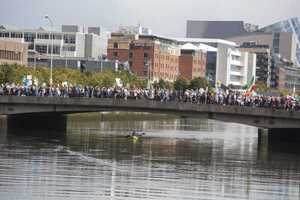
From top: Water protesters arrive in Dublin for a Right2Water rally in August, 2015; Dr Rory Hearne

The water protests and Right2Water have changed Ireland. They have helped people realise that we do not just have to accept everything that we are told, that there are alternatives.

Dr Rory Hearne writes:

Again they will come to Dublin this Saturday in their tens of thousands – from every corner of the country and from all parts of Dublin.

Another tidal wave of the ‘ordinary’ men, women and children of Ireland – taking to the streets to make their voice heard against austerity, the ‘unjust’ water charge, the unequal recovery and to have ‘a government for the people’.

It could be the biggest water protest yet.

And this one is even more significant because it takes place just a few days away from the general election. This is because the water protest movement, the largest protest movement in Ireland since the 1913 lockout, is changing the course of politics in Ireland.

The government and mainstream media have never fully understood or wanted to understand why so many people took part in the water protests and how they are changing how people think about politics.

The water protesters have become like the irritating fly that buzzes around a nice quiet room. We were supposed to be in recovery and austerity finished yet the protests just got bigger and bigger. They upset the cosy consensus. And so the government sent out Alan Kelly and the Gardai as their swat to try kill it.

But they have failed.

There will be tens of thousands of people in Dublin on Saturday saying to the entire political establishment, ‘we are the Irish people awakened from our slumber of passivity – we are saying ‘no more’, we want our country back to be run for the welfare of its people, and we are going to vote for politicians who have stood with us’.

This is a profound statement that will have a major bearing the outcome of the election because it shows that the Irish people are not just lying down as they did at the start of the crisis in 2008 and when the Troika rolled into Dublin to takeover in 2010.

Remember all the questions about why didn’t the Irish protest at the imposition of austerity, the bailout of the banks and the Troika (IMF, ECB and EU) taking over the country?

Remember when the former Minister for Finance, Brian Lenihan, said in April 2009 that other European countries were ‘amazed’ at the extent of austerity inIreland and that there would be “riots” if these were introduced in any other European country.

Remember Enda Kenny, smil the cover of Time magazine in October 2012 where he explained to the world that there had been no large-scale demonstrations in Ireland because “(Irish) people understand that you have to do difficult things to sort out our own public finances”.

They thought they had convinced the Irish people to stay quiet by getting us to blame ourselves for ‘partying to hard’ in the boom years.

They thought the election was going to be the Irish people sensibly choosing stability over chaos.

But the government never learned from their mistaken attitude to the water protests. They didn’t listen to the people then and they still aren’t listening now.

Through the water protests and the Right2Water/Right2Change movement –made up of communities, trade unions and Left political parties – the Irish people found their voice of protest. They found their dignity and decided to take a stand.

Water was the issue people could take action on. They could stop a water meter being installed outside their house in a way they couldn’t stop a cut to the local hospital or community centre.

They could protest on the street at a water protest. And through that people could express their anger at all the injustices of austerity, the bank bailouts and the debt. And while there had been smaller on-going protests such as the Ballyhea Says No against the Bondholder Bailout in Cork, against local hospital closures – the water campaign united everyone.

This is why the water campaigners are a key force that is making this election like no other in the history of the state. They are a key influencing factor in the decline in support for the establishment parties of Fine Gael, Fianna Fail and Labour and rise of the independents, Sinn Fein, Social Democrats and the AAA/PBP.

This is because the water movement, and particularly the communities who first started opposing the installation of water meters, took a stand to defend the Irish people against austerity when no one else would do it.

And their constant presence in communities and again on the streets this Saturday reminds people of this simple fact – that when the Irish people’s backs were to the wall – the establishment parties of Fine Gael, Fianna Fail, Labour and the Greens prioritised the bondholders, vulture funds, the ECB, developers and corporations – and made the ordinary joe soap pay the price.

It is interesting to compare the huge numbers of Gardai deployed to enforce the installation of water meters in the face of local community protests with the lack of policing available for communities being overrun by drug gangs.

And of course who benefits from the installation of water meters? Siteserv – the company belonging to Fine Gael’s favourite oligarch – Denis O Brien. It says it all about the government and Irish state’s priorities and who they actually represent – and it’s not ordinary people. And when it comes to voting next Friday week the people will not forget that.

The power and influence of the water movement is shown in its ability to involve people who were never involved or interested in politics or activism before.

And we know this because myself and some of my students in a module on social movements I was teaching in Maynooth last year undertook a survey of over 2000 water protestors. We found that over 55% of water protestors had never protested before (see findings of the research here).

The water movement has also successfully used new forms of media – particularly social media – to play a key role in providing a means of communication of a different analysis of issues and information that people would not have received before from the mainstream media.

This change is being translated into the election as the Right2Water/Right2Change campaigners have worked on getting people to register vote. Also through the Right2Change list of candidates they are encouraging people who never voted before out to vote (delivering 200,000 newspapers outlining this in the next week).

Just as with the Marriage referendum that motivated young people to register and vote in greater numbers than before so too the water issue and Right2Change candidates give people, particularly in disadvantaged areas with traditionally low turnout, a reason to be bothered to vote.

They see in the independents and Left parties politicians who have protested with them and who will stand up for them. That increased turnout of anti-establishment voters will have a big bearing on the election.

On top of that not only are people voting for alternatives, they are no longer giving preference transfers to the establishment parties. So after voters vote 1,2,3 for their favourite Independent, Sinn Fein, PBP-AAA, Social Democrat, they are stopping. In the past they would have filled out the whole ballot paper. Fianna Fail and Fine Gael will lose from this reduced number of transfer votes.

But the water protests have done even more to change Ireland. For years people have been talking about the decline of community and active citizenship and that people in Ireland had just stopped caring about their neighbours and society.

Now the water protests have brought people together in local community campaigns. It has moved from the water issue to people getting together to see how they can address homelessness and the housing crisis, to local hospital issues, to educating themselves about politics, to looking for community centres and space for people to meet their neighbours and see how they can improve their community.

It has brought back a sense of solidarity and cooperation with people seeing how they can work together to build a better country.

The protests and Right2Water have changed Ireland. They have helped people realise that we do not just have to accept everything that we are told, that there are alternatives.

Make sure you bring your rain coat and umbrella on Saturday. It looks like rain.

Dr Rory Hearne is a Senior Policy Analyst with TASC, the Think-Tank for Action on Social Change. His column appears here every Wednesday. Rory is an independent candidate for the Seanad NUI Colleges Panel. Follow him on Twitter: @roryhearne

Right2Water rally information here

UPDATE:

Meanwhile…

Previously: Joan Collins TD Arrested

90407810rory

From top: Taoiseach Enda Kenny at Bega’s Barbers, Enniscorthy, County Wexford last night; Dr Rory Hearne.

Things are not going to plan for King Kenny and Fine Gael in General Election 2016.

But where is the alternative?

Dr Rory Hearne writes:

King Kenny, Michael Noonan and the fiscal space invaders appear to be losing the election. The opinion poll last week in the Irish Times showed that 63% wanted a change of government and only 30% wanted to see the current government returned!

But it wasn’t supposed to be like this for Fine Gael.

This was supposed to be King Kenny’s coronation with the election just a formality where the Irish people obediently went into the election booths and ticked ‘yes, your majesty’ in the boxes beside Fine Gael and Labour candidates.

The Irish people were supposed to choose the stability of King Kenny and his court jesters over the chaos of the rabble rousing Sinn Féin, Independents and others who were going to ‘wreck the economy’.

And then the Taoiseach and Minister for Finance got found out, again. This time by the Fiscal Advisory Council and Sinn Fein – the government’s economic figures were plucked from outer space.

But there was something else happening in the public mood even before this latest incident of attempted manipulation.

Ireland has changed, and the people are no longer the passive sheep of the past. People are not as easily fooled or bribed by cute hoorism, spin and false promises. They have been fooled too many times by the establishment parties and they have suffered dearly from broken promises.

Irish People no longer vote the same way as their parents or family did. They no longer vote for who can ‘fix the potholes’. We are no longer an obedient subservient society doing what the church, state, government and establishment political parties tell us to do.

We have our own minds and we will decide ourselves what is best for us – for everyone, as a society of Irish people – not just an economy of individuals.

And that’s why the wheels have fallen off the government’s re-election wagon.

The people were supposed to have been bought off by promises of tax and USC cuts – the ‘few bob’ back in your pocket. To say thank you for paying the price of austerity, bailing out the developers, bondholders and banks.

But people realise that cutting taxes is ‘boom-bust’ false economics. They realise we need taxes such as the USC to fund proper public services.

King Kenny is very wrong in thinking as he arrogantly said at his party’s economic policy launch that “the vast majority of people don’t understand” economic jargon.

Recent opinion polls show the people understand very well that if you cut taxes and the USC it will mean longer hospital waiting lists, a worse trolley crisis, more homelessness, less guards on the streets, more expensive college fees etc.

They know that if the USC goes – it will mean a €3.7bn hole in the public finances every year – and that is some serious austerity budget cut.

The graph below shows that if the USC is abolished next year we will lose as much from public spending as any of the austerity budgets during this government’s term of office. Abolishing the USC will give us permanent austerity.

graph

Of course this suits the wealthy top 20% as they can easily afford private health care, childcare, rent, mortgages etc – unlike the majority of people.

Most people would get more benefit from having a universal health system, publicly provided affordable childcare, actually free education and affordable housing, than they would from a few hundred quid from tax cuts.

And the people know this – that’s why in the latest poll in the Sunday Independent, for example, more people chose improving public services over tax cuts.

They also realise that cutting taxes and the USC benefits the top earners more.

They are wondering where the mythical recovery is because they aren’t seeing it.

They know we are a deeply unequal country where half the households in the country have just 5% of the total wealth. But the top 20% have 70% of the wealth.

And what the government have ignored to their peril is that the water protests, the Marriage Referendum and the Repeal the 8th campaign are part of a grassroots and generational shift in views of people looking for real, substantive, change.

My research into the water movement, for example, found that people are not just protesting about the water charges but even more so about the devastating impact of the recession and austerity, the injustice of the banking debts, and growing inequality. They are protesting for a more equal Ireland – for Ireland to be a caring society and not just an economy.

They are angry at the political establishment for not standing up to Europe and the bondholders on the saddling of the bankers and developers debt on to the Irish people. Noonan and the government laugh and scorn at Syrizia, the Greek government, for failing in its attempt to stand up and challenge Europe.

But the Irish people have more respect for Syrizia than the Irish government because even though Syrizia might not have succeeded this time, at least they stood up for the Greek people.

Now the question is. Is there an alternative to King Kenny?

The answer is yes, and no.

Fianna Fáil are clearly not an alternative. They wrecked the economy and showed they are no different -while the Green Party were their supportive side-kick, just like Labour is now with Fine Gael. Fianna Fáil are also likely to go into coalition with Fine Gael after the election.

As for Renua – well they are even more right-wing than Fine Gael and most of them are ex-Fine Gaelers who all voted for austerity budgets until the abortion issue came along. Then they decided Fine Gael were not conservative enough for them. They are also likely to support a Fine Gael Government

That leaves Sinn Féin, Independents, the Social Democrats and the Anti-Austerity Alliance-People Before Profit.

These are offering an alternative. They will substantially increase their vote and the polls show that they could get up to 50 or 60 TDs in the election. But that is still short of the 80 TDs needed to form a government.

Unfortunately they are divided, fragmented and do not appear as a coherent alternative government.

The Right2Water/Right2Change campaign tried to get them to unite around a set of really good common policies and a vision for an Ireland of ‘equality, democracy and justice’ (you can see the policy principles here).

Unfortunately they all didn’t row in behind that initiative.

But there is still time.

I wrote in the Irish Examiner in December 2014 that “it is very possible that in the next general election, whether it is in 2015 or 2016, the Irish people will vote for the most dramatic transformation in politics since the foundation of the State”

I still believe it is possible. But I think it depends on whether people are presented with a coherent alternative. One way would be for the Sinn Fein, Independents, the Social Democrats and the Anti-Austerity Alliance-People Before Profit to unite and present themselves as an ‘alliance for change’.

Imagine a press conference with Mary Lou McDonald, Gerry Adams, Stephen Donnelly, Catherine Murphy, Paul Murphy, Richard Boyd Barrett, Finian McGrath and Clare Daly – where they state that they have put aside their differences and have come together to offer the people of Ireland a real alternative government.

That would be a game changer.

Dr Rory Hearne is a Senior Policy Analyst with TASC, the Think-Tank for Action on Social Change. His column appears here every Wednesday. Follow Rory on Twitter: @roryhearne

Pic: Fine Gael

90406950
DrRoryHearne

From top: Construction of modular homes, Ballymun; Dr Rory Hearne

What to ask candidates on the doorstep about housing.

Should they come to your home.

Should you have a home.

Dr Rory Hearne writes:

The election has been called – so now you are probably thinking about who you might for and what are the issues you should think about in deciding how to vote…(And of course you are going to vote – the future of the country is at stake…well, maybe not quite but it is a bloody important election to decide who runs the country for the next five years!) .

When it comes to thinking about why and how you might vote – shouldn’t the current housing crisis be a key deciding factor?

You are probably affected by it yourself – either as a renter, someone looking to buy, already paying a huge mortgage or maybe you are homeless and living in emergency accommodation.
Despite all the talk of a ‘recovery’ the housing crisis is getting worse. It should be a national emergency.

Having a home (and particularly fair rent and home ownership) are issues that have defined this country from the colonial times and the famine evictions to the Celtic Tiger and property crash that busted the country. Today housing is again is an issue that is defining us as to what type of country we are and what we want to be.

The housing crisis is a scandal that the government wants to ignore but it could be the very thing that stops them from being re-elected. The failure to address the housing crisis could very well be Fine Gael & Labour’s Achille’s heel.

Here are some of the groups affected by the housing crisis:

Renters facing high rents (at the moment in Dublin there are reports of ‘bidding’ wars between renters trying to find a place to live)

Young people and families unable to buy a home due to rising house prices (couples are being forced to put off having children while they try get a home)

People in mortgage arrears or mortgage distress (there are still 37,000 homeowners in long term arrears and facing repossession – we don’t hear much of their plight – do we? But then they might interfere with all the positive talk of ‘recovery’!
Over 90,000 on social housing waiting lists –stuck in poor quality or unaffordable private rented accommodation

1,500 children and their families are homeless. At the current rate of families becoming homeless there will be more than 6,000 children in emergency accommodation by 2017.

Travellers left in substandard accommodation & asylum seekers left in poor conditions in Direct Provision

Here are three questions you might want to ask the politicians about the housing crisis when they come knocking on your door:

Question 1: What has the government done about the housing crisis in their five years of power?

Question 2. What could a new government do to solve the housing crisis?

Question3. Will a new Fine Gael and Labour government do what is needed to be done?

To help you give them a grilling after they’ve given you their ‘wishy-washy’ response I will now give you some detailed answers to challenge them.

My answer to Q 1.

The Fine Gael/Labour government actually made a bad housing crisis worse. Here’s how they did it:

They wouldn’t stand up to the landlords and so they didn’t control private rent increases or sufficiently strengthen tenant’s rights to longer leases. The two year ‘freeze’ is doing nothing to stop new rental property price increases and when it finishes next year rents will sky rocket again.


graph

They cut the budgets for social housing/local authority building which meant that over the period of government they had the lowest level of social housing building in over 40 years (even lower than the recession in the 1980s) (see graph above).

They didn’t increase the rent allowance to match rising rents which forced families and children into homelessness

They left 100,000s struggling in mortgage arrears with huge personal stress and facing repossession.

They wouldn’t challenge the property industry and so allowed developers and builders sit on vacant land. The government introduced a vacant site tax but it doesn’t come into force until 2019! So builders can keep supply low to force prices to rise so they can increase their profits.

They failed to use NAMA to provide affordable or social housing. The government continued to support NAMA (created by Fianna Fail) to sell off housing (such as the promised 20,000 ‘starter homes’) and land to international vulture funds rather than for Irish people who need the housing

They privatised social housing provision onto the private rented sector– which has reduced private rental supply. Three quarters of the housing in the governments ‘social housing’ strategy is to come from the private rented sector.

They have helped create the ‘shoe box’ tenement apartments of the future. They reduced housing building standards by lowering the apartment size regulations.

They have opposed the new Central Bank mortgage lending rules that are keeping house prices affordable. The new rules are the one positive change that has been implemented – it has slowed down house prices rising and thus keeping them more affordable. Yet this is the very policy the government (and Michael Noonan in particular) opposed.

Answer to Q 2.

So what could a new government do differently to solve the housing crisis?

The core of an alternative housing policy would be for the government to do six key things:

1) Implement rent control/certainty –where rent increases are linked to inflation and/or affordability & quality indexes) & give tenants the right to long term secure leases

2) Create a new Homes and Housing Agency (NAMA could be changed into this) to build affordable and social housing.

3) Create a new State Housing Bank to finance housing and provide affordable mortgages for people.

4) Hold a referendum to put The Right to housing and a home in the constitution

5) Change NAMA’s mandate to invest in social and affordable housing rather than offices and selling to vulture funds.

6) Bring forward the vacant site tax to force builders and developers use vacant land to build and introduce the famous 1974 Kenny Report to control the speculation on the price of land

This would create a housing system that is based on meeting people’s need for a home and not based onrelying on the private market – which is the property industry and speculators – which has failed over and over to provide affordable and secure housing. The private housing market just provides super profits for developers, banks, estate agents, solicitors and speculators.

We need to move away from mortgaged home ownership and housing being an asset of wealth, a commodity, a speculative piece of ‘property’. Instead the housing market should be strongly regulated with price and profit controls and there should be a new approach to funding provision of affordable, ‘not for profit’, cooperative and social housing.

That will mean standing up to the property development industry, landlords and all those who currently profit from the existing housing mess. It also means Irish people changing their attitude to property and ownership and understanding that the current obsession with home ownership mainly benefits the wealthy, the banks and property industry.

Irish housing system should, in the first instance, ensure affordable, high quality, homes are available to every citizen.

Answer to Q 3.

These housing problems didn’t start with this Government. Governments during the Celtic Tiger boom years lead by Fianna Fail also caused the crisis by prioritising the ‘mortgaged home ownership’ developer-led housing system. When the crash happened they created NAMA to bail out developers, bondholders and the banks but left ordinary people to pay for it all.

But Fine Gael and Labour continued Fianna Fail’s housing policies and have shown they won’t do anything radically different on housing policy. It just shows there is no real political difference between these three establishment parties.

Fine Gael is a party of the landlords, the wealthy and property industry. Interestingly, it has the highest number of TDs who are landlords with 24 TDs. Fianna Fáil has 12 landlords, Labour has ten, while Minister for Environment Alan Kelly is also a “landlord”.

Fine Gael who are strong believers in the ‘right-wing’, laissez-faire, ‘free-market’ approach to economics don’t believe in interfering with landlords and land owners ‘right’ to profit from property speculation and ownership. So who’s interests will they represent?

The Labour party have shown that they are either unable or unwilling to do anything different (the best example of this is Labour Minister for Environment, Alan Kelly’s failure to achieve rent control in the face of Michael Noonan’s opposition).

Of course they will blame the Irish people for voting for these policies.

So when they come knocking this time tell them you want something different – you want housing to be a human right, provided to meet people’s needs and not the greed and profits of estate agents, developers, landlords and vulture funds. And vote with who you think will do that.

Maybe then we will get a government that actually does something positive about Ireland’s permanent (and repeating) housing crisis.

Dr Rory Hearne is a Senior Policy Analyst with TASC, the Think-Tank for Action on Social Change. His column appears here every Wednesday. Follow Rory on Twitter: @roryhearne

Top pic: Rollingnews

90402284

Estonian Ambassador to Ireland Mrs Kristi Karelsohn (left) with Lucinda Creighton TD and Eddie Hobbs at the Renua Flat Tax symposium, December 2015.

Can you handle it?

Our taxes are not ‘stolen’ from us – they pay for nurses, guards, building schools and Michael Noonan’s salary.

Dr Rory Hearne writes:

As part of a debate I took part in on Renua’s ‘Flat Tax’ on the Pat Kenny show on Newstalk yesterday, both Pat Kenny and Eddie Hobbs (who made the case for Renua) referred to the situation where “if you are paying over 50% of your income on tax then you are working 6 months for Michael Noonan and the next 6 months you are working for yourself”.

This once more highlights the need for a reshaping of the discussion around tax.

Tax is not ‘taken away’ from you, ‘stolen’ or a ‘burden’ – we get our taxes back through the schools our children go to, the roads we drive on, the buses we use, the hospital we go to.
Renua has put its 23% ‘flat tax’ proposal as the corner stone to its Election Manifesto for the coming General Election.

Analysis of the figures show that it is a policy that will benefit the most higher income earners and wealthy.

The results from Renua’s tax calculator shown in the graphs below highlight that if their flat tax (plus graduated income benefit) was introduced:


1

A single person on a gross salary of €20,000 will increase their take home pay by 2.4% (€451) per annum.

2

While a single person earning a gross salary of €200,000 will increase their take home pay by a massive 42% (€45,000 per annum) – from the changes.

This change would significantly worsen our already serious problem of income inequality where over half of all income goes to top 20% of earners.

In regard to the tax revenue base for public services – the 23% flat tax proposal would decimate public services and usher in another round of austerity budgets.

KPMG’s supportive analysis of the flat tax, which Renua has drawn on, states that the flat tax would result in an initial shortfall of between four and five billion in tax revenue. While the Revenue have calculated that it would lead to a shortfall of €9bn.

Renua and KPMG argue that the shortfall would be made up relatively quickly as a result of the increase in economic activity and spending from the tax cuts which would feedback through increased consumption and employee tax.

However, both the IMF and OECD in studies on countries that have implemented the flat tax have found that such an increase in revenue has not been consistently found.

Introducing such a flat tax will therefore undermine the (already low) tax base in Ireland (as will other tax cut proposals such as cutting the USC). It is repeating the mistakes of the Celtic Tiger tax cuts that lead to austerity when unreliable taxes such as stamp duty collapsed in the economic crash.

So where will the much needed tax revenue to pay for high quality public services and infrastructure come from? Where will we fund the additional nurses, guards, teachers, hospitals, social housing, elderly care, roads, flood defences, schools that we all know needs substantial increase in public spending and investment?

Currently we have the lowest investment in capital infrastructure in the history of the state. On the basis of planned cuts to the USC and the current government policies then by 2019 we will end up with the lowest government expenditure in the EU. Renua’s proposals would make this crisis situation even worse.

It is also worth pointing out that the countries that Renua point to as models for Ireland to follow are Estonia, Latvia and Singapore. Lucinda Creighton writes in their opening introduction to their Manifesto that Renua’s aim is for Ireland ‘to become the Hong Kong of Europe’.

But the graphs below show that Hong Kong is one of the most unequal places in the world. Their levels of inequality are double that of Ireland –and worse than the grossly unequal US.

3

As for Estonia and Latvia, these are the two most unequal countries in Europe. These countries follow the free market, laissez faire, economic models which see the top and wealthy gain the most.

4

Hardly the models Ireland wants to follow?

It also important to highlight that income tax is only one part of the tax people pay. There are also indirect (consumption or stealth) taxes such as VAT, motor tax, A & E charges, water charges etc. VAT takes in a third of all taxes. And lower income households pay a 5 times higher rate of their gross income on these consumption and stealth charges than those on higher incomes.

Lower income households pay between 27 and 18% of their gross income on indirect taxes in contrast to between 5 and 8% of higher incomes. That is why lower income households have opposed the water charges so intensely. Because they are hit much harder by such consumption charges.

So we can see that the focus on reducing income tax and USC benefits higher income households more. And they know this.

In an Opinion Poll for the Irish Times in September last year – which social class group was most in favour of a cut to the USC? You guessed it – it was the highest social class AB.

Which begs the question – are the political parties clear that they are shouting loudest in favour of the interests of the top 20% when they argue for these tax cuts?

The opinion polls also show that this obsession with tax cuts by Renua (and most of the other political parties) is not what the public is looking for.

In fact, the polls show that a majority favour investment in public services rather than cutting taxes.

The recent Eurobarometer poll shows that in Ireland people’s main concerns are housing (34%), health and social security (29%) and unemployment (32%) – with tax much less of a concern (9%). While the Behaviour and Attitudes survey commissioned by TASC in June 2015 showed that almost 70% of people felt the government should prioritis investing in public services rather than spending money to cut income taxes.

5

Eurobarometer survey 2014

Of course our tax also goes to pay for Michael Noonan’s salary (which, as with all politicians – is way too high) but that is not the point. The point is that the argument of tax being ‘stolen’ from us or ‘taken’ – or the phrase the ‘tax burden’ – distorts the truth about tax.

The truth is that we get our tax back through public services – when we use a hospital, go to college, drive on a road, take the bus.

And that is why rather than cutting taxes – we should be finding ways to fairly raise the taxation base (such as introducing a third higher rate of tax on incomes over €100,000 or a wealth tax on financial assets).

Hopefully this truth will see some light during the noise of the election debate.

Dr Rory Hearne is a Senior Policy Analyst with TASC, the Think-Tank for Action on Social Change. His regular column appears here on Wednesday mornings. Follow Rory on Twitter: @roryhearne

90397852rory

From top: Pro choice activists take the ‘abortion pill bus’ in September, 2015; Dr Rory Hearne

Time to end Ireland’s ‘out of sight, out of mind’ hypocrisy on abortion, bring us into the 21st Century and Repeal the 8th Amendment.

Dr Rory Hearne writes:

Ten women (and some with their partners) will have to take a plane or ferry today and travel to England to have an abortion.

Last year over 3,700 women had to travel to the UK while over 150,000 have had to take a plane or boat to England or another country to have an abortion so that Catholic Ireland can remain guilt free while her traumatised women and their partners are forced to take the journey of shame to another country

This is the reality of hypocrisy Ireland.

Women and their partners and families face a personal crisis; whether it is a deeply tragic pregnancy such as fatal foetal abnormalities or becoming pregnant because of rape or a crisis pregnancy, this ‘great little nation’ deals with it by offering no support but to export the ‘problem’.

The Irish constitution and the failure of the state and governments to provide supportive legislation has turned our personal difficulties into a criminal act. It is the Eighth Amendment (Article 40.3.3 of the Constitution) which criminalises abortion as it gives the right to life to the foetus and places it on equal footing with that of the woman.

It is actually illegal for a woman in Ireland to have an abortion even if the foetus she is carrying will not survive outside the womb.

· In 2014, 140 Irish women travelled to the UK to have abortions for this reason.

It is also illegal for a woman who gets pregnant from rape to have an abortion in Ireland.

A total of 197 women and girls who went to rape crisis centres in 2013 were pregnant as a result of rape. One in four chose to have an abortion. They had to travel abroad for an abortion or take abortion pills illegally in Ireland.

Up until 2013, women had no legal right in Ireland to an abortion even if their life was at risk. We saw the result of this when Savita Halappanavar was allowed to die in October 2012. After the public outcry and protests the Government responded by enacting the Protection of Life During Pregnancy Act but this retained the criminalisation of abortion on all but one ground (when a woman’s life is at risk). So women having an abortion or a doctor, or anyone helping a woman have an abortion outside of that circumstance faces a prison sentence of up to 14 years.

The right to travel abroad for abortion allows official Ireland to get on with business as usual irrespective of the mental, financial and sometimes physical suffering imposed on these women and their partners.

They add layer after layer of control and punishment because those who travel to have an abortion can’t talk about it – not even to closest friends and family – not even amongst themselves.

But thankfully this is changing. The silence is being broken The stigma of abortion is being broken down as more and more people such as journalists like Roisin Ingle and comedian Tara Flynn speak publicly, to their friends and family about their experience.

New websites are being set up to share stories about abortion (for example ShareYourAbortionStory) or the X-ile project which is an ongoing online gallery to give a much-needed face to women who have effectively been exiled from Ireland and ignored due to unduly strict abortion laws and demonstrate that those who choose to travel to have an abortion are responsible, ordinary women and are our neighbours, friends, colleagues, mothers, daughters and partners.

Kitty Holland has written in the Irish Times about women undertaking abortions at home with imported medication from a website in the Netherlands.

One women she spoke to explained how she was ‘working part time and trying to get college projects finished’ and ‘the thought of having a child on a meagre wage, living in an apartment I share with my mother . . . I wouldn’t be able to finish my education or look for work. What kind of start would that be for a baby?”  She was afraid to seek follow-up medical advice after taking the abortion medication at home.

A few weeks ago, Fergal Malone, the head of the Rotunda Maternity Hospital spoke on the RTÉ’s Late Late Show about the tragedy of parents of babies with fatal foetal abnormalities having to “courier” their child’s remains home because of Ireland’s restrictive abortion laws.

Opinion polls (including Newstalk’s latest poll last week) are consistently showing that a majority (67%) favour decriminalising abortion and a substantial majority (80%) in cases of foetal abnormalities or rape while a majority (75%) also favour holding a referendum to repeal the Eighth Amendment.

Those favouring access to abortion as women chose has doubled in the last decade (with a majoring of 25-34 year olds in favour) while those opposed in all circumstances has halved and is now down to just 7%.

op1

Changing attitudes to abortion in Ireland: Various Opinion Polls 1997-2015

Amnesty’s #notacriminal campaign (see below) shows how difficult it is to get a legal abortion in Ireland.They highlight that the lack of legal abortion is a denial of women’s human rights and the choice to have an abortion should be an entirely private matter decided between a girl or woman and her doctor.

op2

An important factor in building support for the Repeal the 8th Amendment is for men to speak out in support and tell their stories about experiences of abortion.

Restriction of abortion is a broader human rights issue that discriminates and hurts men as well.Men face criminalisation for helping their partner or are often unable to travel with and support their partner due to difficulties paying for a second set of flights. The Irish constitution denies them the ability to be with the person they love, and playing an active role in being present to support their partner during a medical procedure.

This change in the public mood in favour of de-stigmatising and decriminalising abortion and ‘Repealing the 8th Amendment’ is being led by thousands of pro-choice activists and campaigners across the country.

The numbers attending the Annual ‘March for Choice’, held in September for four years now, have been growing with 10,000 attending in September 2015. While The Coalition to Repeal the 8th Amendment, includes over 50 organisations including feminist, human rights and pro-choice organisations, NGOs, trade unions, and political groups. It has written to all General Election candidates to pledge to calling for a referendum to repeal the 8th Amendment.

Ireland is changing.

We are realising that equality means actually implementing equal rights for everyone.

And that includes women’s reproductive rights to have control over her own body – including the right to abortion in Ireland.

So when a politician comes knocking on your door in the next few weeks make sure you ask them what their position is. Let them know Ireland is changing and that its time for safe and legal abortion in Ireland so that women’s lives, health and choices are respected and protected.

Dr Rory Hearne is a Senior Policy Analyst with TASC, the Think-Tank for Action on Social Change. He is also an independent candidate for the Seanad NUI Colleges Panel. His column appears here every Wednesday and he writes in a personal capacity. Follow Rory on Twitter: @roryhearne

You can sign the petition in support of a referendum to repeal the 8th Amendment to the Constitution of the Republic of Ireland here

00158934rory

From top: Enda Kenny at the Fine Gael Ard Fheis; Dr Rory Hearne

Economic growth rates of 7%, thousands of new jobs, falling unemployment, traffic jams on the M50, queues at high-end stores on Grafton Street and rising property prices.

All the evidence that Ireland is in strong economic recovery?

Not so fast.

Dr Rory Hearne writes:

All those years of austerity (cuts to public services and new taxes) and wage cuts worked, right?

Yes, austerity ‘worked’ and we are in ‘recovery’ – but only if you ignore the sacrificing of a generation that has paid (and will continue to pay for many decades) the price of ‘recovery’ – particularly the tens of thousands of children pushed into poverty and deprivation and the almost quarter of a million forced to emigrate. It is only a ‘recovery’ if you ignore the multiple crises that are going on now from housing to the health service.

And only if you ignore the very shaky foundation of our economic growth with half of it based on dodgy profit shifting by multinationals.

What I’m saying here – unpopular and all as it may be – or as much as you may not want to hear it – is that there is a dark truth to our so-called ‘recovery’.

Much of the commentary about the recovery is hype and spin, which at times descends into plain lies and ignorance. Ireland is no ‘success’ story for austerity or economic growth.

What we are is a country that sacrificed the welfare of its younger generations in order to pay for a crash caused by neoliberal (free market) economic policies, corrupt and crony politics and the decisions of the generation in power and the wealthy to prioritise protecting themselves

If you don’t believe me – just look at the facts. Take children for example. The number of children aged 0-6 (the most vulnerable age) suffering from deprivation in Ireland doubled from 55,000 in 2007 to 105,000 children suffering deprivation in 2014. Ireland now has the third highest deprivation rate for children aged 0-6 in the EU15 – at 25%. This is over 8 times Norway’s level.

1

Levels of Deprivation for Children Age 0-6 in EU15, 2014

While one of the most shameful scandals affecting this country is the rise in number of homeless families with children. The numbers below show that by September last year there were almost 1,500 children living in emergency homeless accommodation.


2

Rise in numbers of homeless children nationally

Then there is that issue no one in the corridors of power wants to talk about – emigration. Despite the ‘recovery’ 35,000 young Irish people emigrated from Ireland last year. Just under a quarter of a million – 250,000 left between 2010 and 2015. If they had stayed then our unemployment rate would be double what it is now.

Our ‘recovery’ wouldn’t look as rosy with 16% unemployment – would it? The graph below shows that the emigrants are all in the under 40s generations.

They left and continue to leave not just because of the lack of jobs but because the lack of quality jobs and quality of life in Ireland. Because as, Blindboy put it, we can’t afford houses or children.


3

Our disadvantaged communities also paid a heavy price as community development organisations had their funding slashed and housing regeneration projects were abandoned.

I saw first-hand as a community worker the impacts of harsh austerity in a Dublin inner city social housing estate of Dolphin House where residents were left living in horrendous conditions with mould, damp and sewage in their flats.

Of course all of this was not accidental, or unfortunate ‘collateral damage’.

It resulted from a political decision by those in power to prioritise the already privileged and powerful over the younger generations. So they ensured the German and French banks and the billionaire bondholders were repaid while community and child services were cut, a recruitment embargo was put on the public sector thus cutting out a major area of employment for young people and graduates.

And for anyone who did get a job they cut the pay of new entrants.

Public spending was cut in social housing, public transport, flood defences, hospitals, schools– leaving us with a housing crisis and one of the lowest stocks of public infrastructure in Europe that will take decades to make up for.

New charges were introduced into water, property, health care (a visit to A & E is now a €100 charge if you don’t have a medical care or private health insurance. I found this out when I had to pay it when I brought my six month old baby to hospital recently). While Bus Fares have also risen.

In addressing the housing crash they created NAMA which took the developer’s toxic loans off the banks (to allow them return to profit), gave the developers and big business write-down’s on their debt and are selling that housing and land to international property speculators and vulture funds. There was no debt-write down for us ordinary joes.

Some of us were left with our massive mortgages (many of whom went into arrears –with over 30,000 facing repossession of their home) while others face rising rents and no possibility of ever owning a home.

Those in power knew the impact their policies would have. They showed who they are prepared to stand up and be courageous for. While they thumped the table at European meetings to defend multinational corporations paying a 12% (and lower) tax rate they were silent about the doubling of the numbers of children in poverty.

They would rather allow children be made homeless than to disturb the privileged and powerful by introducing a wealth tax on Ireland’s richest who grew their wealth by €34bn since 2010. The top 20% of households now have 70% of the wealth in Ireland.

I am one of the generation under the age of 40 who is straddled with a massive mortgage, paying huge childcare costs, and experiencing precarious work for years due to the public sector embargo and cuts.

My friends and family have emigrated because they can’t get a decent job. I know families struggling to get by each week, children sleeping with their parents in cars because their parents can’t afford the rent. Is this the Ireland we want?

Is this the Republic we are proud to commemorate in 2016? Ireland is no austerity success story. The recovery has been built on sacrificing younger generations.

It’s time to tell the truth about the Phoney Celtic Phoenix.

Dr Rory Hearne is a Senior Policy Analyst with TASC, the Think-Tank for Action on Social Change. He is also an independent candidate for the Seanad NUI Colleges Panel. His column appears here every Wednesday. He writes here in a personal capacity. Follow Rory on Twitter: @roryhearne

Geography-Rory-Hearne-NUI-Maynooth

Dr Rory Hearne

Dr Rory Hearne, a lecturer in political and economic geography at National University of Ireland, Maynooth, has looked at Budget 2016.

And his verdict is in…

“Firstly, it is to be welcomed that, rather than further austerity, the government has decided to increase public spending and investment, particularly in the area of childcare, education and the extension of free GP care.”

“However, the increase in spending is insufficient to address the various social crises and austerity related under-investment and the indication is that this is just a once off ‘stimulus’ in an election year with government estimates showing no similar expenditure increases in coming years.”

“The increase in spending in this Budget of €750 million should also be put in the context of the €21bn reduction in expenditure over the period of 2008 to 2014. The increase in Budget 2015 is just 1/30th (just under 4%) of the austerity cuts to spending.

“…Social housing is a good example of the size of the catch-up required as a result of the lost years of austerity. Over the period of austerity, we effectively lost 25,000 social-housing units. Indeed those in housing distress (at least half a million households – most noteably those reliant on rent supplement, in emergency accommodation, in mortgage arrears, those in housing waiting lists, substandard accomodation and in light of the recent tragedy, Traveller accommodation and halting site services) are the biggest ‘losers’ in this Budget.”

In addition…

“The delivery by NAMA of 20,000 housing units is being put forward as a positive measure to address supply. However, these were planned anyway and as Minister Noonan stated will be developed on a commercial basis with aim of maximising return to the taxpayer. This means they will be neither social nor affordable. “

Budget 2016: Opportunity missed to address social crisis, particularly housing, as chronic under-investment in infrastructure continued (Rory Hearne, Progressive Economy

PODEMOS-crowdSign

water_charges_march_sat_oct11_photo2_right2waterPodemos rally in Madrid, Spain (top) last year and Irish Water protests at the GPO in January.

Hope.

We don’t ‘do’ that.

But we know a man who does.

Dr Rory Hearne writes:

Hope has been in short supply in this country in recent years but, thankfully, it has emerged in recent months. But this hope has not come in the so-called ‘recovery’ which is deeply uneven across the country and from which the majority of people remain excluded from.

No, the real hope emerged, first in the water protests, and now in the possibility of a new political movement built from the grassroots of these unprecedented protests.

Since independence in 1921 the overwhelming majority of Irish governments have been composed of the tweedle-dee, tweedle-dum, parties of Fine Gael/Fianna Fail/and Labour. What have they achieved for ordinary people? Corruption, inequality and austerity are now the hallmarks of the Irish Republic, a centenary after its founders aimed for a Republic of equality.

But an alternative is rising. The first steps have been taken with the launch of a set of ‘policy principles for an alternative democratic and progressive government’ by the trade unions involved in the Right2Water campaign.

Their proposals for a new government are broad ranging and visionary. They include holding a referendum to enshrine in the constitution that water remains in public ownership and management, introducing the right to gainful employment and a living wage through a Decent Work Act, enshrining the right to housing in the constitution, rent control and a state-led national home building programme.

Other proposals include the creation of a universal healthcare system free at the point of entry, a European Debt Conference to restructure sovereign debt throughout the Eurozone; the introduction of a Financial Transaction Tax in order to repay states for the private bank debt they assimilated; and a state led and democratically accountable programme of restructuring and writing down of mortgage debt.

Outlining the need for “real and meaningful reform of our local and national democratic processes which would put citizens at the heart of decision making” they propose that citizens should have the capacity to recall elected members of parliament before the end of term and the ability to propose changes to the constitution or call a referendum in relation to legislation introduced by the Oireachtas.

It is clear to many people that a real change is needed and, what is most significant about the current time, is that increasing numbers are now seeking alternatives to the traditional, establishment, political parties.

The most recent opinion polls showed that the traditional establishment parties could only achieve a combined core vote of 40% (Fine Gael, 20, Fianna Fail, 14, Labour, 6,) with Sinn Fein at 20, Independents 18 and 20% undecided. Recent polls have also shown that almost half of voters want a new party to be formed and two thirds do not trust the current party political system.

My own research into the views of those who have protested against water shows that an overwhelming majority believe that there is a need for a new political movement/party in Ireland.

This is radically challenging the conventional conservative assumptions and analysis of Irish politics and citizen engagement. There is a clear opportunity for a new political party to emerge.

However, the question to be answered is whether or not this current wave of anti-establishment sentiment can be converted into a process of political change. That depends ultimately on what type of new political party/movement emerges and whether it can be done in time to have an impact on the coming general election.

Key to the success of such a new party will be achieving the support of the people in the currently ‘undecided’ and ‘independent’ category. How could this be done? We can look to the example of the new Podemos (Yes We Can) party that has spectacularly emerged in Spain.

They have created a new party that is winning large support through a platform of broad anti-corruption and-austerity policies, declaring that it is neither Left nor Right but for the ordinary people against the elite in Spain, Europe and the financial markets.

They have involved people who do not normally engage in traditional politics through local community meetings and online processes of voting on party policy. This is important as it is clear that people want new ways of doing politics that is inclusive and democratic.

The Right2Water unions’ policy proposals are hopeful in this regard. They are clearly aiming at a broad audience and want to try achieve unity amongst a diverse coalition of Left parties, independents, and community groups.

They have even developed their policy principles, not as a completed election manifesto as is traditionally the case, but are currently looking for submissions from the general public on the proposals to feed into a conference they are organising on June 13. This is a real opportunity for ordinary citizens to contribute to a process that could dramatically change this country.

While the government and media are claiming the growth figures (at least half of which are based on multinational activity that has no relation to the real Irish economy) point to a ‘recovery’ the reality for most people is on-going suffering from debt, a housing crisis that has become an emergency (from overburdening rent, mortgage, homelessness repossessions), low pay, casualisation and zero hours contracts, major problems accessing health services, worsening long term unemployment, rural decline, and the continued poor housing and community facilities for people living in disadvantaged areas.

Meanwhile the Siteserv controversy has just confirmed what many people are feeling – that there is little difference between the Fine Gael/Labour administration and the cronyism and corruption of the Fianna Fail years.

Podemos in Spain has developed a new language and approach to politics that has tapped into, and mobilised, widespread citizen disgust and opposition to the establishment elite.

Much work is required to develop a similar type political alternative in Ireland but the political atmosphere at the grassroots amongst ordinary citizens suggests that the appetite is there for it.

Dr Rory Hearne is the author of Public Private Partnerships in Ireland: Failed Experiment or Way Forward for the State? (Manchester University Press) and is a lecturer at Maynooth University.

Irish-WaterGeography-Rory-Hearne-NUI-Maynooth

Dr Rory Hearne, a lecturer in political and economic geography at National University of Ireland, Maynooth

You may recall a post concerning dreamboat egghead Dr Rory Hearne who spoke to Keelin Shanley on Today with Sean O’Rourke last month about the Irish Water protests.

He said he believed the protests emerged because of a ‘cumulative impact of austerity’ and that ‘[the protesters] were holding back on the basis of shock, of collective guilt and a fear, and a sense of powerlessness and now that’s all changed’.

Well.

Frank writes:

“I see heart-throb geographer Dr Rory Hearne (NIUM) is doing a Water Protest survey but it’s been very badly advertised. Could you see if BS readers would fill it out as it would be no use without a representative sample.”

The 20-multiple choice question survey can be done here.

Previously: Sinister Fringe? They Wish

90362076Geography---Rory-Hearne---NUI-Maynooth

Protesters in Donaghmede, Dublin yesterday (top) Dr Rory Hearne, a lecturer in political and economic geography at National University of Ireland, Maynooth

Dr Rory Hearne spoke to Keelin Shanley on Today With Sean O’Rourke this morning about the protests that have taken place since the Fine Gael and Labour coalition were elected into Government in February 2011.

Keelin Shanley: “Rory, how do you explain the way in which the protests have grown and, you know, the apparent lack of understanding from the Government and the establishment of what’s driving them?”

Dr Rory Hearne: “Well, I think that the protesters have emerged as a result of a cumulative impact of austerity. And, you know, we can’t get away from this and, you know, Enda Kenny is right when he says, they’re [the protests] not about water. To a certain extent, they’re not because people are saying, you can hear there in the interviews with people who are protesting, they can’t take anymore. And I think it’s, the narrative that came out, when the Troika left was, ‘well, we’re now in recovery’ and, for the majority of people, they’re not seeing any recovery. And if we look at, you know, there’s structural problems within the Irish economy – things like low wages, housing crisis, mortgage arrears, child poverty, these have not gone away, they’re still there and they’re going to, the likelihood is they will get worse.
And, essentially, and I’ve been analysing this for a number of years now, there was this idea that the Irish people didn’t protest during the crisis and it’s not actually true. There was a number of protests that emerged after the Labour/Fine Gael government was elected in and that is significant. I think that was a significant moment. When Labour and Fine Gael were elected, on the promise of a democratic revolution and this idea that they were going to radically reform the State, that bondholders would be burned, that the recovery, and you know that it was the end of the way that politics was done, there was a sense that this was a new republic but they absolutely failed to do that.
And so people, in response to that started protesting. We’d a small group in Cork, called the Ballyhea Says No, who were protesting about the bondholder bailouts and the Anglo debt. There was the groups that protested against the sell-off of the forests who were actually successful in that, there was a lot of community groups and disadvantaged areas who have been, where their communities have been disproportionately affected by cuts. And there was a number of protests that were growing, and then of course we had the household charge campaign and we must remember that 50%, half the population, refused to pay that charge initially, that was a significant protest. And, obviously, that was defeated, when the Revenue Commissioners came in and I think it’s also interesting that when people comment about when, you know, what happened in Ireland during the austerity, why wasn’t there, you know, protests, and Lenihan went over to Europe and ministers in Europe were asking, ‘how are you doing all these adjustments and people aren’t protesting?’
And similarly, Enda Kenny was on the front of Time magazine, saying ‘I’ve got us through all this austerity, we’ve made vast adjustments and there hasn’t been protests’. And to a certain extent, I think people were holding back. They were holding back on the basis of shock, of collective guilt and a fear, and a sense of powerlessness and now that’s all changed. People feel now that they have a power to stop these water charges, that they can actually do it. And they also see that they’ve been through the worst, they can’t get any worse for most of these people. And there’s also an injustice, there is an injustice that’s lingering about the bailout of the banks and the role in which Ireland played in bailing out the European financial system and the fact that we were left with the highest cost, €64billion, of any other European country. And while the government tries to say that, ‘well that’s not significant’, well, it is for people. They feel the pain of it everyday and I think what’s happening is that you could describe this as a fracturing of the social contract of the Republic. The Republic was, since independence, was based on the idea of, you know, we’re all in it together, that there’s no real divisions – whereas that’s completely…”

Shanley: “That’s been broken at this point…”

Hearne: “That is broken and I think that we’re seeing the emergence of a new type of politics, of people feeling that they can’t rely on the political system, they have to take action themselves and with the water charges protests, you can see that they’re right – they’ve achieved more with these protests than electing a government.”

Listen back in full here

Earlier: Are You In The Sinister Fringe

Rory Hearne

(Sasko Lazarov/Photocall Ireland)