Tag Archives: Dr Rory Hearne

00158110
rory

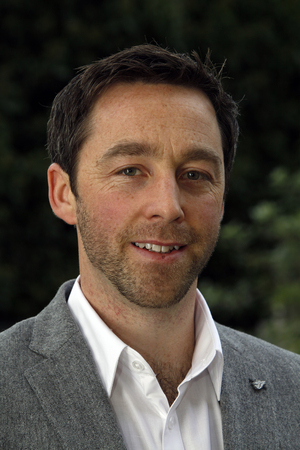
From top: Brendan McDonagh (left) and Frank Daly, CEO and Chairman of the National Assets Management Agency (NAMA) respectively; Dr Rory Hearne

NAMA is worsening our housing crisis by selling  housing and land to vulture funds.

Dr Rory Hearne writes:

So the rich are just getting richer in Ireland while the poor remain poor. But the wealth at the top in Ireland is really staggering.

The latest Sunday Times Rich list shows that Ireland’s 250 richest people now hold €72.6bn. Their combined wealth is equivalent to a third of Ireland’s GDP. The top 12 individuals have a combined wealth of €34bn.Their wealth rose by 3.3% in the last year (€1.8bn).

Why this matters is because lower income and middle classes are getting a smaller slice of the pie as increasingly the wealth being created in society is going to the top. The result of this unequal distribution of wealth is our huge rates of poverty.

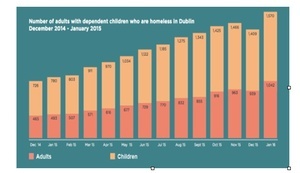
There are now 138,000 children living in poverty in this country. There are 912 families with 1,881 homeless children. Surely it is time to ensure a more equal distribution of wealth that would involve an increase in tax on the top wealthy in order to pay for housing for our homeless or higher welfare for our poorest families to lift them out of poverty?

Another area where wealth is being accumulated by the already super rich on the backs of ordinary Irish people is through buying up and selling on property from NAMA.

The vulture funds such as Goldman Sachs and Lone Star are lining up to buy NAMA property and loans.

NAMA is selling two portfolios of loans and assets which have a combined value of €4.7 billion.

These include, according to the Irish Times, 950 residential properties, mainly apartments, 650 of which are occupied by tenants and a further 300 vacant.

So hang on a minute! Yes, you read that right. NAMA is currently selling 950 apartments to the vulture funds. And what’s worse 300 of them are vacant.

Surely the government should stop NAMA selling these off or Compulsory Purchase them in order to use them instead to address our homeless crisis? The 300 vacant properties could be immediately used to address the crisis for 300 families.

There is a need for a spotlight to be put on NAMA and how it is currently worsening our housing crisis by selling much needed housing and land to vulture funds.

Remember we own NAMA! It is a state owned body. So there is no reason why we can’t direct NAMA to use its housing and land to address our housing crisis.

We are again giving away our assets, just like we gave away our gas and our fisheries to international corporates.

What is it about us? Do we want to be a permanent colony of international finance?

Do we have something in us that has no confidence in our own capacity and capability to provide for our citizens?

We have got to the point of dependence on international investment that we can’t do the most basic things ourselves like use our assets (land and housing) held by NAMA to house our people who need homes?

The vulture funds buying up our housing, property and land have been more active in developing countries for a number of decades. If you are interested in finding out more about the dangers and problems associated with vulture funds there is a public talk being held on the topic by the Debt and Development Coalition on Wednesday next week.

Mick Byrne, will present the findings of a new Report that looks at the risks posed by vulture funds in Ireland, the experience of the Global South and the role that is being played by the Irish Government.

Tony Romano of the US housing rights organisation Right to the City will also be there to talk about how tenants in the US have been affected by the vulture funds who have bought their buildings. Details here

Dr Rory Hearne is a policy analyst, academc, social justice campaigner. He writes here in a personal capacity. Follow Rory on Twitter: @roryhearne

Related: Julien Mercille: Swoop Of The Vulture

Meanwhile…

rory

We have no social housing strategy, an unaffordable  private rental sector and little prospect for the delivery of affordable housing for those who wish to buy a home.

Independent Seanad candidate Dr Rory Hearne writes:

So the housing crisis continues. Another week, another report showing homelessness rising, issues with evictions in the private rental sector and the failure to provide social housing.

It’s another week where hundreds of thousands of families, children and individuals across this country are suffering because of the failure of successive governments to deliver a most basic human need for its citizens. That most basic need (and human right) is affordable, secure and decent quality housing.

Last week we found out that in February this year there were 912 families, including 1,881 children, without a home and living in emergency accommodation.

This means that there is now one family per day being made homeless in Ireland!
It also means that the number of homeless children has more than doubled in the space of a year. In January 2015 there were 539 families and 865 children homeless.

The current figure of 1,881 children is a 117% increase in just a year.

On top of that the Private Residential Tenancies Board found that there were 320 ‘unlawful termination of tenancy’ or illegal eviction cases in the private rented sector last year. This was a huge 40% increase in the number of such cases in 2014.

Then there is the reality of the huge stress of the 88,000 households in mortgage arrears and debt (37,000 of which are in arrears over two years).

The Irish Mortgage Holders Association (IMHO), who works with up to 20,000 homeowners who are in mortgage arrears or are struggling to pay their mortgage undertook a survey of the psychological impact of this debt on people’s lives.

Based on a sample of 500 people affected by debt they found that more than 40pc said they felt depressed either “all of the time” or “most of the time” and over 30pc said they had had suicidal thoughts in the last four weeks.

While the Irish Times reported yesterday that one of the key government and state providers of affordable (social) housing, Dublin City Council, is set to halve the number of social housing units being provided.

Last year 1,689 additional social homes were provided by Dublin City Council but by the end of 2016, this figure is expected to reach just over 700.

These figures highlight a major flaw at the heart of the Social Housing Strategy announced in November 2014.

This strategy included €4 billion in funding, and set out how it would provide 110,000 social housing units by 2020.

But over three quarters of the units (75,000) are to come from the private rented sector (which is not credible given the lack of availability of private rented accommodation for low income families particularly those using HAP and the Rental Accomodation Scheme.

But even worse, only 12,000 units (just over 10%) of the plan are to be direct new build by local authorities or housing associations.

The remaining 23,000 are to be provided through some form of Public Private Partnership ‘off-balance’ sheet private financed delivery.

There are major problems with this approach.

The table below sets out clearly the numbers of actual new social housing units delivered last year and the numbers planned in the overall Social Housing Strategy.

It shows that it is only a ‘social housing strategy’ in name, because only a tiny proportion of it involves building actually new permanent social housing by local authorities and housing associations.

graph1

It is clear that the housing crisis is an unprecedented social, humanitarian and economic crisis.

We have a social housing strategy that has no social housing, no end in sight to the misery for families being evicted, in mortgage arrears, on the social housing waiting lists and being made homeless, and no coherent strategy for making the private rental sector an affordable and secure tenure for those who are reliant on it, and little prospect for the delivery of affordable housing for those who wish to buy a home.

Based on my extensive academic and policy research, practical experience from being a community worker with Barnardo’s in Dublin’s inner city, and from my campaign experience with housing rights campaigns,I have identified eight solutions that could address the housing crisis which are outlined in the table below.

I have made these the core of my campaign to try and get elected to the Seanad on the NUI Colleges Panel.

graph2

It wasn’t an easy decision to stand in the Seanad Election and it hasn’t been an easy campaign for me. I have struggled to try and run the best campaign I can (and thanks to all those who have supported me and got involved!) while also working a full time job and looking after my three young children.

But I believe it has been worthwhile. I know the Seanad is elitist and undemocratic and it is time that all citizens were given a vote in Seanad Elections.

But I have tried to use the campaign to highlight the issues like the housing crisis (see, for example, the short video I made above), issues of poverty, inequality and community disadvantage, Living Wages and quality jobs, the importance of local community and youth services, quality and accessible public health and education systems and affordable childcare.

In short I have tried to highlight the policies that could address poverty and inequality and make Ireland a more socially just and economically fairer and more sustainable country.

Whatever the outcome of the Seanad Election (and there is still time for those with a Seanad NUI Vote to post their vote by next Monday, April 25th), I will continue to highlight these issues.

There are also many groups and organisations (including NGOs and charities like Simon Communities, Peter McVerry Trust, Focus, Inner City Helping Homeless, and active campaigning grassroots groups like the Irish Housing Network, Housing Action Now and homeless campaigners like Erica Fleming) who are doing incredible work to address the escalating housing crisis by supporting those made homeless, providing housing or campaigning for the housing crisis to be addressed.

If elected I will raise their issues and concerns to a national level in the Seanad.

A major reason why the Seanad has not been reformed to give all citizens a vote and why it is seen as irrelevant by most people is that the majority of Senators have been part of the political establishment and have failed to prioritise radical reforms and progressive social change.

So those of you who have a vote in the Seanad NUI face a choice.

You can use your vote for a candidate like me who has demonstrated his long term commitment to challenging the consensus and campaigning for social justice. Or you can allow a conservative establishment politician to fill that space. It’s your choice!

Finally, I’ll be at a very important housing and homeless protest this Sunday from 12.30 noon at the GPO as part of a citizen’s day of action and protest to mark the actual commemoration date of the Easter Rising.

It’s a genuine commemoration of the spirit and vision for a Republic of Equality outlined in the 1916.

Dr Rory Hearne is a policy analyst, academc, social justice campaigner and  independent candidate for the Seanad NUI Colleges Panel. He writes here in a personal capacity. Follow Rory on Twitter: @roryhearne

90389454
rory

From top: Health Minister Leo Varadkar with the proposed site of the Children’s Hospital with Nathan Evans (left) and his sister Olivia; Dr Rory Hearne

Ours is a deeply unequal health system where sick children who are reliant on the public system are left waiting for months and even years while children whose families can afford it are avoiding the waiting lists and accessing care through the private system.

Dr Rory Hearne writes:

The numbers of people on hospital waiting lists in this country are truly shocking. There are now almost half a million (that’s ten per cent of our entire population!) waiting for various forms of treatment or assessment in our public hospital system.

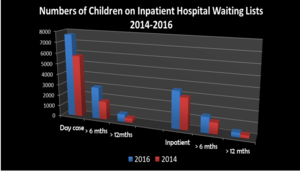
If we look at children specifically we can see that the numbers of children waiting to be seen in hospital day cases has risen by a third (33.7%) in just over a year (from December 2014 to March 2016).

Meanwhile the number of children on inpatient (often surgery) waiting lists has increased by 18% in the same period.

This shows just how far away we are from putting in place the aspirations of the 1916 Proclamation that aimed to cherish “all children of the nation equally”.

So while the state splashed out on the recent celebrations and commemorations over ten thousand sick children (11, 145 to be exact) are waiting to be seen for an appointment in our public hospitals.

What a Republic to be proud of!

While most of the media coverage so far has looked at the overall waiting lists numbers, including both adults and children, I have analysed the waiting list figures released by the National Treatment Purchase Fund to look specifically at the numbers of children who are waiting to be seen in our hospitals. I also looked back at the figures for 2014 to see how the waiting lists have changed.

The graph below shows that things have worsened considerably in quite a short space of time. We can see that the numbers of children waiting over six months on day case lists has increased by three quarters (75%) from 1675 to 2944. While there was an increase by 40% of children waiting longer than six months for inpatient care.

Just stop and think about this for a moment. Six months is a substantial length of time in a child’s life. As a parent I know about the reality of waiting for health care (in particular for dental treatment) but fortunately my children have not required to be on a waiting list for something very serious.

I can only imagine the stress and worry on those parents and the needless suffering of children waiting month after month and in some cases, over a year, to be seen in a hospital for illnesses relating to Ear Nose and Throat, Respiratory illnesses, Cardiology, Surgery, Orthopaedics and even Radiology.

childrencarenumbers

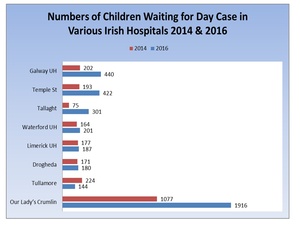
The waiting lists differ from hospital to hospital. In the graph below I show the hospitals with the highest waiting lists in 2016. We can see that for hospitals like Our Lady’s Hospital Crumlin the numbers of children waiting for day cases increased by 43%.

Some of our regional hospitals like Galway and Waterford are also notable for their high waiting lists and significant increases over the last year.

2

The reasons for waiting lists are complex but there is no doubt that the austerity cuts and the failure to provide sufficient funding to our public health system is a large part of it.

There has been some debate in the media recently about the “high” level of spending on our health services and the resultant claim that the system is the problem.

But the system is in chaos – with underpaid staff, closed beds, inadequate facilities – not because of the lack of effort or capabilities from the people working in the health system but due to its chronic under resourcing.

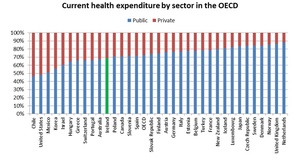
If we look at the actual numbers we can see from the graph below that Ireland’s spending on health as a % of GDP at 8.1% is below the OECD average of 8.9%.

And most importantlyy only 68.5% of health spending in Ireland is public (i.e. 31.5% is private) versus the OECD average of 72.7% and countries such as the Denmark where it is 84.3% and the UK where public spending is 86.6%.

This means that only 5.5% of GDP is spent on public health care in Ireland versus 7.3% in the UK.

3

We can see that a relatively high proportion of spending on health in Ireland is private. This means that access to health care in Ireland is strongly influenced by private individuals’ and families’ ability to pay for it privately.

The public health system in Ireland does not provide universal comprehensive accessible healthcare like the National Health Service in the UK. So those who can afford it are clearly buying a greater access to healthcare than lower income households in Ireland through the private hospitals and clinics (who highlight this point in their advertising).

Also people who don’t have a medical care or health insurance are charged for use of the public system as well.

This is a deeply unequal health system which results in these massive waiting lists and the inequality whereby sick children who are reliant on the public system are left waiting for months and even years while children whose families can afford it are avoiding the waiting lists and accessing care through the private system.

This can be classed as nothing other than an apartheid health system. This is grossly unfair and unequal. It is reinforcing an already unequal society for tens of thousands of children.

The waiting lists show that we need a properly funded universal public health system that can provide equal and timely access to high quality treatment for all our citizens.

The public demonstrated in the recent election that would rather forego tax reductions such as the USC in order to see a properly funded universal health system.

So whatever never government is formed has the public support to do it – it just has to have the political will to implement it.

Dr Rory Hearne is a policy analyst, academc, social justice campaigner and  independent candidate for the Seanad NUI Colleges Panel. He writes here in a personal capacity. Follow Rory on Twitter: @roryhearne

90154748

rory

From top: Dolphin Barn, Dublin; Dr Rory Hearne

An important question needs to be answered by the civil service and political decision makers: why community services and regeneration projects were disproportionately cut during austerity?

And why they are still not restored?

Dr Rory Hearne writes:

Communities are the heart of this country. And community based services – from care for the elderly, child and family supports, housing and homeless services, community work, youth and sports projects, community gardens, tidy towns – have been the heart of many communities in Ireland for decades.

Unfortunately austerity cuts have had a devastating impact on these services and community work.

Our most disadvantaged communities (in rural areas, small towns and the large estates in our cities) and vulnerable groups (such as lone parents, those with a disability, the elderly, children, Travellers, migrants) are most reliant on these services and therefore they have been hit hardest from the cuts.

They have also been devastated from the collapse of social housing regeneration projects (in Limerick and parts of Dublin).

And they need these services more than ever with the doubling of child poverty rates (there are now 138,000 children in poverty in this country), 60% of lone parents suffering material deprivation, unemployment rates of over 30% in some rural and disadvantaged areas, and dealing with the cuts to the other public services.

A very disturbing and shocking aspect of the austerity budgets has been that the cuts to community and regeneration projects have been disproportionally bigger than to other parts of the public service. The extent and range of the cuts is shown in the table below.
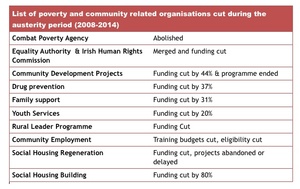
austeritycuts
The cuts have resulted in local community projects being either closed or trying to survive by laying off workers, reducing their pay or putting them on short time.

The community and voluntary sector has suffered a 31% reduction in numbers employed (a loss of 17,000 jobs) — three times the rate of reduction in general public service numbers.

If we look at the Local Community Development Programme (LCDP) for example, it experienced a dramatic reduction in funding from €84.7m in 2008 to €48m in 2014, is now closed with local projects put under the control of local authorities and is being subject to a commercial tendering process.

Regeneration plans for new social housing and community employment opportunities were developed in the late 1990s and through the 2000s for disadvantaged estates that had suffered decades of state neglect and high rates of unemployment and deprivation.

Areas included Moyross in Limerick, Ballymun, Dolphin House, St Michaels, and O Devaney Gardens in Dublin, and other estates in Cork, Sligo and Waterford.

While some were partially regenerated like Ballymun and Fatima, the collapse in the Public Private Partnerships (as developers withdrew) in 2008 and the austerity budget cuts to regeneration funding meant that many estates saw their hopes and dreams of a new future destroyed.

I worked for six years as a community regeneration worker for the children’s charity Barnardos in Dolphin House in Dublin’s inner city where I saw the devastating impact of the cuts to regeneration.

We developed a ground breaking human rights campaign that pressured Dublin City Council and the government to act on the terrible housing conditions affecting tenants there. These communities need to be given hope again.

An important question which remains to be answered by the civil service and political decision makers is why these community services and regeneration projects were disproportionately cut during austerity and why they are still not restored?

Is it because the vulnerable, disadvantaged communities and the poor simply do not matter to the Irish state and political establishment?They clearly were not sufficiently prioritised and protected in these difficult years.

Is it because they traditionally have not voted?

Is it because they are not wealthy and thus are not potential donors for political parties?

Or is it because of a wider societal discrimination that blames all these groups and areas for their problems rather than accepting that their disadvantage results from the deep ingrained inequalities in the Irish economy and society and, therefore, we all have a responsibility?

Perhaps it is because the values that drive these organisations and communities such as caring for others, solidarity, not-for-profit, co-operation, and empowerment challenges the laissez faire, free-market, private wealth accumulation ‘greed is good’ that official Ireland supports in profit chasing entrepreneurs and tax avoiding corporations?

There is no doubt that part of the reason is that austerity provided the state with an opportunity to remove community advocacy which had become a political irritant for elected politicians and the civil servants in various departments and local authorities.

The work of community development had become too effective in highlighting the need for the State to listen to, and provide greater support for, communities left out during the Celtic Tiger and then suffering under austerity and so they were cut.

It is also part of a wider trend where the Irish state has been supressing community advocacy for a number of years. For example, HSE grants to community and voluntary organisations often come with the conditionality that:

“You must not use the grant to change law or government policies, or persuade people to adopt a view on law or public policy”

What a dangerous thing to do! Try to change a law or ‘persuade’ people to ‘adopt a view’. It is a sign of our shallow democracy that such advocacy is not viewed as central to the role of community and voluntary groups. It is a hangover from a paranoid, insecure and oppressive state that required the silence of society in order to abuse and oppress.

Rather than seeing NGOs and the community and voluntary organisations as having a really strong contributing role to raising awareness of issues affecting our most vulnerable, enhancing our democracy through empowering the marginalised, and bringing about a more equal society through the creation of a locally sustainable and vibrant economy – the Irish state instead has viewed them as a threat and an annoyance, showed in the fact, that they were cut first and cut deepest, in austerity.

As a community worker I saw how good quality social housing, homework and youth clubs, community employment and enterprise, child and family support, drugs programmes, community gardai and strong community development working together with the local communities can really change people’s lives by reducing poverty, improving social inclusion and inequality.

We should learn from these positive examples.

The problem at the heart of the state’s narrow vision and analysis of community work, regeneration and the community and voluntary sector is that it fails to appreciate the huge economic and social benefits that they provide. Public spending on youth and community work, child poverty and family services, and regeneration is not a ‘cost’ i.e. lost funding.

These services provide multiples of a return on any public investment put in as they reduce other social and health costs including costs associated with school leaving, crime, hospitals, and unemployment. They also provide for a more socially cohesive and inclusive society that makes the best use of all its human resources. They can tackle the root of so many of our social issues that we currently waste so much resources on in responding from crisis to crisis and emergency firefighting.

There is an urgent need for a properly funded national regeneration programme including community and child services, new housing and local facilities to be set up to deliver regeneration for the disadvantaged.

The funding should also be restored to community development and youth projects. While the decision to commercialise and privatise the community development programme through competitive tendering should be reversed.

A new reinvigorated National Combat Poverty Agency should also be set up to support local independent community development projects. A mature, democratic, and equality orientated state and government would do no less.

You can listen and watch here to video I have made highlighting the impact on disadvantaged communities of austerity and the collapse of regeneration as part of my Seanad campaign.

Dr Rory Hearne is a policy analyst, academic & social justice campaigner. His column appears here every Wednesday. Rory is an independent candidate for the Seanad NUI Colleges Panel. He writes here in a personal capacity. Follow Rory on Twitter: @roryhearne

Rollingnews

blindboy
rory

From top: Blind Boy of The Rubber Bandits on Channel 4 News; Dr Rory hearne

Ireland’s ‘millennials’ are a generation in crisis.

But they are fighting back.

Dr Rory Hearne writes:

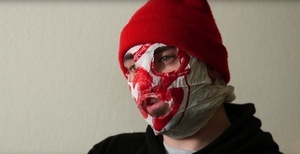
Last week Blindboy Boatclub of The Rubberbandits was on Channel 4 News talking about how the recession has stolen ‘their 20s’ from young people and that there’s “huge amounts of suicide, jumping into rivers, and emigration” and for “a lot of young Irish people, they don’t see a future.”

Blindboy is absolutely correct. Ireland is no country for young people and families.

The recession and austerity had a devastating impact on younger generations (particularly those now in their 20s and 30s – the so-called ‘Millennial’ Generation or Generation Y) and the recovery has failed to improve things.

A global debate is taking place about the plight of the Millennial Generation and the ‘intergenerational inequalities’ they face. The Guardian ran a series of articles on ‘The Trials of Generation Y’ where it described how they face “a perfect storm of debt, housing and joblessness.”

From high unemployment in Spain and Greece, and massive debt and stagnant wages in the US, to the UK where they face high house prices locking them out of home ownership and into extortionate, dismal rental arrangements .

They are the the Jilted Generation – set to be the first generation to do worse than its parents. Studies have also shown this generation to suffer from anxiety at much higher rates than previously.

The Millennial generation in Ireland have it even worse with the biggest impacts in terms of ‘generational inequality’ hitting them from the austerity related public sector recruitment embargo, lower pay rates for new public sector employees, casualisation of employment, exorbitant child care costs and an unprecedented housing crisis.

The public and civil service (e.g. guards, nurses, teachers, civil servants) have traditionally been a huge area of employment for new college graduates but it was effectively shut off to young people with the public sector recruitment moratorium introduced in 2009 by the Fianna Fail/Green government.

It was continued by the Fine Gael/Labour government until just last year when it was lifted in some areas.

graph1

The impact of this can be seen in the dramatic fall in numbers employed in the public sector from 369,000 in 2008 to 327,100 in 2015 (see graph above).

The result is a generation shut out from the public sector. We now have the situation where the average age of staff in the Civil Service is close to 50 and just 4 per cent are under 30.

To make matters worse the younger generation faces a further discrimination. New entrants to the public sector since 2011 are on a 10% lower pay scale than those employed prior to 2011 (this is on top of the 14% cuts to all public sector employees).

This issue was raised at the teacher’s conferences this week where they spoke of the inequality and unfairness of this two-tier pay scale which will result in young teachers receiving up to €300,000 less than their older colleagues over their career.

TUI General Secretary John MacGabhann explained to the Irish Times that these young teachers “cannot afford rents, are being forced – by poverty – to give up part-time jobs, to emigrate…they cannot plan, have no creditworthiness, have their personal independence compromised. Why? Because government marked them out for especially punitive treatment.”

On top of the public sector moratorium and the lower pay rates – new entrants to the public sector have also faced a growing problem of ‘casualisation’ or ‘precarious’ contract work.

This is where workers are employed on short term temporary or fixed contracts – often for six months or a year – and then either let go or the contract is extended on a further short term basis.

The campaign group Third Level Work Place Watch explains that younger researchers and teaching staff (tutors and lecturers) have no job security at all, face exploitative rates of pay and worse working conditions. This casualisation also erodes academic freedom and is a major threat to higher education.

This problem of precarious and low paid work is affecting younger workers across the economy. It is part of a ‘race to the bottom’ as employers reduce wages, hours of employment, benefits, and job security.

The most extreme form of casualisation has been experienced by those forced into unpaid internships and Jobbridge schemes which are being used by employers as cheap labour for restaurant staff and even teachers, community workers and psychologists.

I experienced this precarious work as a community worker and contract lecturer. I went from short term contract to short term contract and I felt forced to leave lecturing as it was explained to me that there was little prospect of my contract being extended ‘because of the impact of austerity cuts to the university budgets’.

It is hugely stressful working in such situations, particularly if you have significant financial responsibilities such as young children and a mortgage (both of which I have).


graph2

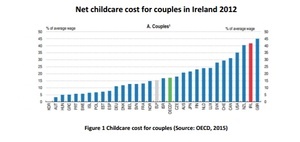
Childcare costs I can tell you for certain are a huge impact on parents. Ireland has the second highest childcare costs in the OECD for couples and the highest in the OECD for lone parents.

For others it is extremely difficult to plan your future such as getting a mortgage or even having a family while you are in such an insecure employment situation. And of course it’s much worse for those unemployed – our youth unemployment rate is still 20%.

Housing is a crisis for this generation. Whether it is being stuck in mortgage arrears, facing escalating and unaffordable rents with no long term security of tenure or an inability to purchase your own home. The harshest end of this is felt by those pushed into homelessness.

All of these issues have created a gaping hole in our generation as it has forced 250,000 (mainly young people aged in their 20s and 30s) to emigrate between 2010 and 2015.

But it doesn’t have to be like this.

These all result from political choices and, therefore, different political choices can achieve equality for all generations and all households. This means prioritising affordable housing and childcare, secure and well paid jobs, a top class public health system and a genuinely free and fair education system.

There is hope for this jilted generation from the increasing numbers of young people involved in campaigning for social justice and equality.

These can be seen in the Marriage Referendum, growing housing campaigns (e.g. Dublin Tenants Association, Housing Action Now, the Irish Housing Forum), Third Level Work Place Watch, the young workers network, young teachers, new student activists (e.g. Seanad candidate Lynn Ruane), Right2Water, mental health campaigners and the Repeal the 8th Campaign.

The courage of this new generation was most evident last weekend when the young homeless mother Erica Fleming organised a protest at the housing crisis and how it represents a failure to achieve the Republic of Equality that is outlined in the Proclamation.

[I am hoping to raise awareness of these issues by making them central to my campaign for election to the Seanad. In a short video I explain the reality for Generation rent, debt and job insecurity. You can watch it here]

Dr Rory Hearne is a policy analyst, academic & social justice campaigner. His column appears here every Wednesday. Rory is an independent candidate for the Seanad NUI Colleges Panel. He writes here in a personal capacity. Follow Rory on Twitter: @roryhearne

pa

rory

From top: Carrying wood from Sackville Street, Dublin after the 1916 Rising Dr Rory Hearne

What right do we have to commemorate when the very men and women who took part in the Rising would abhor what is going on in Ireland today?

Dr Rory Hearne writes:

The 1916 rising commemoration on Sunday will start with a reading of the Proclamation at the GPO.

I wonder what will go through the minds of the dignitaries, politicians, the thousands lining the streets and those watching on TV when they hear these lines read from the Proclamation:

“The Republic guarantees religious and civil liberty, equal rights and equal opportunities to all its citizens, and declares its resolve to pursue the happiness and prosperity of the whole nation and of all its parts, cherishing all of the children of the nation equally”

Will they think of the 138,000 children in poverty across this country? Will they think of the 8000 children who went to the Capuchin day centre last year in order to get a hot meal? Or the 3 year old girl who was fed from a soup kitchen on O Connell Street last week?

Will they think of the 1,570 children living in emergency homeless accommodation in our capital city?

Will they think of the 90,000 on housing waiting lists? Or the 46,000 people living in homes owned by vulture funds? Or the 37,000 homeowners in long-term mortgage arears?

They should. I will be. I have thought a lot about the commemorations and I am disturbed by the hypocrisy and contradictions in them.

I cannot stop thinking about the shameful disgrace of thousands of children hungry and homeless in this country while we commemorate the Rising and Proclamation of this Republic.

A Republic which was founded on the very principles of ensuring such children would be cherished equally.

How can we genuinely commemorate the Rising and Proclamation without feeling an intense sense of guilt and shame at the current housing crisis?

What right do we have to commemorate when the very men and women who fought in the Rising would abhor what is going on in Ireland today?

The right thing to have done would have been to cancel the commemorations and in their place to hold a national crisis summit on the housing and homeless emergency.

Vulture funds and landlords are evicting families as you read this and just last week it emerged that Dublin rental prices are now higher than their peak. Rents are completely unaffordable for low income earners.

For example, the average monthly rent for a house in Dublin is almost 85% of the monthly minimum wage of €1546.3 (while the average national rent is 60% of the monthly earnings for someone on a full time minimum wage income).

It is troubling to see how the history we are commemorating is repeating itself. For many involved in the rising, particularly socialists like James Connolly, the terrible housing conditions that existed in the tenements in Dublin at that time was a strong motivating factor.

The bitter irony is that 100 years on housing conditions are again a major human catastrophe in this country.

There is also an eerie parallel with today’s housing crisis and our history as a colonised country. 100 years on we are again being colonised by external forces – this time its the foreign vulture funds who are taking over our housing, land and mortgage loans. In 1916 as with today, this colonisation is being facilitated by our own political and business (property industry) establishment.

But some things are very different. We now have control over our own destinies and so there can be no excuses for not solving the housing crisis. We can’t blame a foreign empire (although Europe did have a role in forcing the bailout and austerity – but it was our own political choices to cut social housing funding).

The biggest difference between 1916 and today is that we are now one of the wealthiest countries on the planet.

Therefore there are no excuses for children being without a home or going hungry. Did you know that €45 million is being spent on the various commemoration events this year? Wouldn’t this be better spent on addressing the housing crisis?

We know the solutions to the housing crisis.

Focus Ireland outlined this week a five Point Plan that it is calling on a new government to implement including a ‘cast iron commitment to ending the family homeless crisis, setting a firm deadline to achieve this, building at least 40,000 social houses over the next five years and holding a referendum on the ‘right to a home’.

The Dublin Tenants Association has also made a very logical call for the banks to be stopped from selling mortgages to third-parties (vulture funds), for a removal of the ‘sale of property’ as grounds for the termination of a tenancy and for NAMA to stop selling housing or debt secured by housing to vulture funds and other bodies.

It’s not as if we don’t have the land and finance to build much needed housing. There is a huge amount of state owned land held by local authorities while NAMA has enough land and finance to build 50,000 affordable and social houses.

There is also 2,233 hectares of undeveloped zoned land in the wider Dublin region which could provide 102,500 new housing units but developers and speculators are sitting on it waiting for prices to rise further. An emergency tax should be introduced to force building on this.

The problem is we just do not have the political and institutional will to do what is necessary.

Vested interests of the property industry, developers, vulture funds, landlords, estate agents, banks, and financiers are ensuring that the status quo does not change and thus the housing crisis continues to worsen week by week.

It is time to raise the public pressure to counter these vested interests and demand a housing system that is primarily based on meeting people’s need for a home and not based on relying on the private market – which is the property industry and speculators – which has failed over and over to provide affordable and secure housing.

I want to commemorate 1916 and I am proud of this history. But I am ashamed of our present. We have no right to commemorate 1916 in any way – other than to use it to reflect back to us our failure to deliver the basic right to housing to citizens of this Republic.

There is a very genuine commemoration of the Easter Rising and the Proclamation taking place on Easter Sunday and it is a Protest for the Homeless. It is being organised by Erica Flemming, who, along with her daughter is homeless. She explains that she feels she has to take to the streets and she is organising the protest in order to:

“stare at power in the eye and hold it to account for the experiences of poverty that are facing my child daily. Her playground is a hotel corridor: I rarely get to provide her with a home cooked meal. As I tuck her in at night, I can’t even afford her the dignity of leaving the room. This isn’t the Republic that people died for and I feel duty bound to demand that my daughter be cherished equally in the eyes of this State”.

Erica is organising a friendly, family orientated event on Dublin’s North Earl Street on Sunday at 1pm to “highlight that our children matter and that a home is the minimum we should be affording our children on this anniversary of an event associated with such strong themes of equality and what it truely means to live in a Republic”.

We can only truly commemorate 1916 when the housing crisis is dealt with and there are no children and their family like Erica’s who are homeless or suffering poverty.

For information on the Homeless Protest on Easter Sunday see here:

Dr Rory Hearne is a policy analyst, academic & social justice campaigner. His column appears here every Wednesday. Rory is an independent candidate for the Seanad NUI Colleges Panel. He writes here in a personal capacity. Follow Rory on Twitter: @roryhearne

90412298rory

From top: The Cruise Park housing estate in Tyrellstown in West Dublin, whose developers’ Ulster Bank loan was bought in 2014 by a Goldman Sachs vulture fund; Dr Rory Hearne

Homeowners and tenants need protection from vulture funds such as those owned by government advisors, Goldman Sachs.

Dr Rory Hearne writes:

There needs to be an immediate suspension of the sale of Irish housing loans to the vulture funds and emergency legislation to protect tenants and those in mortgage arrears from eviction.

There is also a need to investigate the role of Goldman Sachs, the vulture fund involved in evicting residents of Tyrrelstown, in advising the Irish government.

Goldman Sachs is a multi-billion dollar US multinational investment fund company. It is involved in more ways than we realise in Ireland. Beltany Property Finance is the Goldman company involved in the Tyrrelstown development and it bought the loans in 2014 from Ulster Bank.

Goldman also played a key role in advising successive Irish governments on the restructuring of the banks from 2008 to 2013 (for which it was paid  €8million), and it is still contracted by the Department of Finance to advise it on the potential sale of AIB.

Surely there are potential issues of ‘conflict of interest’ and the profiting from ‘insider knowledge’ here?

Goldman could have gained intimate knowledge of the properties and assets held on the loan books by the Irish banks such as Ulster Bank. Goldman, as other vulture funds, tend to make significant profits from buying these ‘toxic’ or ‘distressed’ loans at discount prices and then selling them on when the markets rise – as is going on now in Ireland.

Questions need to be asked about why Goldman Sachs remains in such a prominent position advising the Irish government on the restructuring of the Irish banks. Especially given this clear conflict of interest where Goldman can profit from this intimate knowledge it gains of the restructuring of these very same Irish banks.

Is it because of the close relationship between Goldman Sachs and governments?

For example, Mario Draghi, President of the European Central Bank, is a former employee as was the Treasury Secretary in the US. And then there is Peter Sutherland, recently retired Chair of Goldman Sachs, who is a leading member of the political establishment in Ireland.

Haven’t we seen disastrous outcomes from this close relationship between politicians, financial institutions and property before?

Goldman Sachs was actually charged by the US Securities and Exchange Commission for its role in causing the 2008 financial crisis – directly linked to its role in the subprime housing mortgage market.

Goldman, profited from, and played a role in causing, the 2008 financial crash and the 2010 European debt crisis. Rolling Stone magazinehas called Goldman “the giant vampire squid” for its vampire like profit squeezing from economies and the devastating impact on ordinary people’s lives.

And yet it continues to hold huge influence over governments?

It begs the obvious question. Why would you ask a financial investment fund, who have consistently shown that they will always act in ways that are most profitable to them, for advice on an economic and social crisis like our banking and housing crash?

You only ask investment funds like those if you want to know how to maximise the interest from vulture funds in buying up distressed properties and assets.

And this is the heart of the explanation of the current situation in Tyrrlestown and our ever worsening housing crisis.

It is the thinking that underpinned the decisions taken when the Irish housing market and banks collapsed and the scale of the losses and mortgage arrears crisis became apparent.

Government and policy makers focused on removing the ‘problem’ of toxic housing loans from the bank’s balance sheets in order to save the banks and help them return to profitability and ‘healthy status’ as soon as possible.

This was the priority in policy decisions. The impacts on home owners and renters living in the houses and any future housing crisis, was a distant consideration.

Policymakers knew (thanks to the advice from the likes of Goldman) that the non-bank funds buying these loans (bundles of mortgages) would be mainly interested in high rates of profit and making that as quickly as possible by selling off the property as soon as the housing market would recover.

So the result was the ‘pillar’ Irish banks (and European financial system) were ‘saved’ by the taxpayer bailouts and the sale of distressed toxic loans (i.e. developer’s loans –land and thousands of houses like Tyrrlestown) to various vulture funds and subprime housing companies.

The price for this policy is now being paid by the families losing their homes in Tyrrelstown and the tens of thousands more who will face a similar situation in the coming months and years as receivers, banks and vulture funds all look to profit from a rising property market.

The other associated price for this approach is the escalation of rents and the homeless crisis which arises, in part, from the failure to introduce rent control. Rent control would have reduced the interest of vulture funds in buying up Irish distressed property and that explains the political coolness towards it.

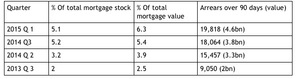
The scale of the increase in ownership of Irish housing, particularly mortgages in arrears, by non-bank vulture funds is staggering. My analysis of central bank figures shown in the table below reveals that these ‘non-bank entities’ (vulture funds) now hold 47,461 mortgage accounts.

And of these 19,818 are in arrears of more than 90 days, with 13,050 of these in arrears over 720 days. Therefore, these funds hold almost 25 per cent of all mortgage accounts in arrears of more than 720 days.

Their increasing role is shown by the fact that they have doubled their holding of the total Irish mortgage stock in just two years from just 2% of the total stock in 2013 to 5% in 2015 (6.3% in value terms).

graphThe growth in Non-bank entities (vulture funds) in holding Irish housing 2013-2015

Something can be done to change this and protect people in their homes from the vulture funds. It requires the government temporarily suspending all further sales and repossessions of housing and loan books including Irish residential property by either NAMA or the banks.

A new housing and homes agency should be immediately set up to purchase these distressed properties and work on solutions that protect the tenants and homeowners in their homes.

Furthermore, emergency legislation is needed to strengthen tenant’s rights to enable them stay in their home, and rent control is required to avoid economic evictions of tenants.

Finally, the Department of Finance and other government contracts with vampire vulture squid, Goldman Sachs, should be ended immediately.

Dr Rory Hearne is a policy analyst, academic & social justice campaigner. His column appears here every Wednesday. Rory is an independent candidate for the Seanad NUI Colleges Panel. He writes here in a personal capacity. Follow Rory on Twitter: @roryhearne

90365168
rory

From top: Begging on the Ha’penny Bridge, Dublin; Dr Rory Hearne

The rich are getting richer and the vultures are circling.

Dr Rory Hearne writes:

“The test of our progress is not whether we add more to the abundance of those who have much; it is whether we provide enough for those who have too little.”

Very true words spoken by former US president, Franklin D. Roosevelt. Unfortunately if we apply them to Ireland we can see that we are certainly making plenty of ‘progress’ in adding to the abundance of ‘those who have much’, according to a report released last week by property agent Knight Frank.

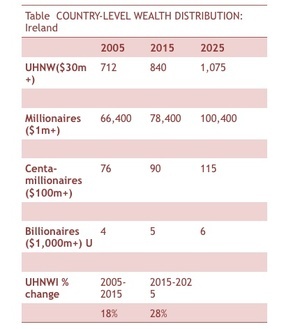
Their Wealth Report 2016 showed that the number of ultra-wealthy individuals in Ireland increased by 18% between 2005 and 2015, and that number is set to increase by 28% over the coming decade. This follows on from the recent Sunday Independent Rich List which showed that the top 300 wealthiest Irish people doubled their wealth since 2010.

This increase in wealth at the top of society while we have growing numbers of homelessness and child poverty at the bottom is morally wrong and socially unjust. It is shameful and unethical.

Look at the stark contrast between this rising wealth for those at the top of Irish society and the reduction in wealth and income for those in the middle and at the bottom.

For example, in terms of deprivation, in the same period of time as covered by this increase in wealth, the number of children aged 0-6 suffering from deprivation in Ireland doubled from 55,000 in 2007 to 105,000 in 2014.

How is this right? How is it allowed to continue?

These ‘ultra high net worth’ (UNHW) individuals in Knight Frank’s Wealth Report 2016 are individuals who have a net worth of at least US$30 million (after accounting for shares in public and private companies, residential and passion investments such as art, planes and real estate). That is a massive holding of wealth.

1

The Wealth Report (you can read it here) also finds that the number of millionaires in Ireland is projected to increase from 66,000 in 2005 to reach 100,400 by 2025 (see Table above).

The Knight Frank Wealth Report also needs to be looked at in the context of our worsening housing crisis.

The Report highlights that property (residential housing and commercial real estate property) is a key aspect of wealth accumulation by the wealthy. The report explains how “super-normal returns” from residential property “helps underpin the net worth of the ultra-wealthy”.

Knight Frank, of course, benefit from this themselves as they are a global ‘property agent’ and property advisor, handling sales of very large properties. Clearly, promoting the role of property in wealth accumulation for UHNW individuals is an important aspect of their business model.

Their Report shows that housing property (primary residence and second homes) accounts for a quarter of UHNW’s investable wealth, while commercial property investments make up 11%. Thus, total property investment makes up almost 40% of the wealth of the UHNWs while financial investments (equities, bonds, etc) makes up a smaller proportion (28%).

And the importance of property as an asset has increased in recent years. The reason for the increasing importance of purchasing property was its role as an ‘investment to sell in the future’ and a ‘safe haven for funds’.

This is in contrast to how most of us see housing as a home rather than an investment asset.

The investment in property by the wealthy is playing a role in recent property price increases in ‘prime’ markets (like Dublin). The report highlights that “it has been the weight of money from wealthy investors looking to secure assets in leading world economic hubs that has propelled markets to record levels”.

I have shown here before the role of global wealth funds in worsening the housing affordability crisis in Ireland by driving up rents through the sale of property and land by NAMA to vulture funds.

So the vulture and wealth funds, the wealthy and banks increase their wealth by dispossessing the poorest of their homes and extracting ‘super profit’s from speculative sales of land and property, along with what they get from rental income.

This wealth isn’t ‘created’ from thin air – it is being paid for by the Irish taxpayer through the bank bailouts, austerity and NAMA, mortgage distress, homelessness and escalating rents and house prices.

The result of this is most visible in our housing crisis –from the 37,000 still in mortgage arrears to the 1,570 children and their families who are now homeless in Dublin.

2

Source: Department of Environment

It is interesting to read in the Report that even the wealthy are realising that the growing concentration of wealth, particularly within the advanced economies, is a major problem.

There is a specific Chapter in the Report entitled ‘Wealth Inequality takes Centre Stage’ which highlights the ‘growing sense of disenfranchisement” that “is changing the political landscape globally”. They explain:

“wealth inequality has continued to climb the political agenda and is now one of the biggest issues facing politicians as they try to address those who feel disenfranchised”.

There is an increasing desire from ordinary people to see a stop to rising inequalities and for policies that will make society more fair.

One proposal that could make a fairer society is a wealth tax. Interestingly we had a wealth tax before in Ireland – it was introduced by a Fine Gael Labour government in 1975.

It was levied at 1 per cent of the value of assets in excess of £100,000, with family homes, bloodstock, livestock and pension rights exempt. But after the 1977 election Fianna Fáil abolished it.

It is time to look again at the merits of a wealth tax. A 1% wealth tax that would apply only to the top 1% of households (and would exclude homes, farm land and pension savings) in Ireland could raise up to €500 million.

That is a very large amount of money (but insignificant to the ultra wealthy) that could build housing for the homeless, fund our health service and provide school meals to address child poverty. Isn’t it time for a wealth tax?

Dr Rory Hearne is a policy analyst, academic & social justice campaigner. His column appears here every Wednesday. Rory is an independent candidate for the Seanad NUI Colleges Panel. He writes here in a personal capacity. Follow Rory on Twitter: @roryhearne


9041036490410379 90410435 9041045890410369rory

Celebrating their General Election victories at the weekend, from left: From top: Mary Lou McDonald and Sinn Fein supporters: Paul Murphy and AAA supporters; Socialist Party’s Ruth Coppinger; Catherine Martin and Eamon Ryan of the Greens; Róisín Shorthall with Soc Dem supporters; Dr Rory Hearne

Is a left-wing government possible?

No wait.

Come back.

Dr Rory Hearne writes:

So the election dust is settling a little. So what did people really vote for and what should the Left parties and Independents do about government?

Clearly the people voted to reject the former government of Enda Kenny and, particularly, the Labour Party. The scale of that rejection is a political earthquake even though lots of commentators are trying to downplay this.

The demand for change was the rejection of the ‘recovery’ narrative that promoted an economic recovery and ignored the housing and health crises. It was also a rejection of the promises of USC cuts and instead people wanted investment in public services.

The government, as I have been arguing on Broadsheet and elsewhere for a number of years, absolutely failed to give sufficient priority to the social costs of austerity and the pain that so many people are still suffering.

It was, above all, a rejection of politicians who failed to fulfil the electoral promises and commitments they made. People were angry at the political choices that failed to protect the most vulnerable – children, lone parents, the disabled, the sick, disadvantaged communities – both in cities and rural areas.

So what now?

The Left parties – and I include the broad spectrum in this (Sinn Féin, the AAA-PBP, Social Democrats, Greens and Left Independents) should get together and develop a coherent Programme for Government that they should propose to the Dáil when it meets on March 10.

Combined, they are now a significant block of almost 45 TDs. They could have a rotating Taoiseach with each group having a six-month term. Isn’t it time to shake up our democracy and government?

Their Programme for Government should be called, A Plan for a Fair and Equal Ireland – A Plan for Society’s Recovery – and include the following:

Implementing emergency measures to solve the homelessness crisis

Setting up a Homes and Housing Agency to start building social and affordable housing (NAMA’s land and funding be integrated) on a large scale

The setting up of an Irish National Health Service – providing universal public health for all citizens (from primary care to hospitals, mental health and community services)

Abolishing Irish water, water charges and initiating a referendum to enshrine water as a public good

Abolishing the property charge and replacing it with a wealth tax aimed at those with a net wealth over €1million

Creating a Combat Poverty and Inequality Agency that develops a plan to eliminate child poverty within 5 years

Commit to holding a referendum to Repeal the 8th Amendment

Implement a referendum to enable Citizen Initiated Referendums

Implement a referendum to insert economic, social and cultural human rights (right to housing, health) in the Constitution

Reform the Seanad to give voting to all citizens in its elections

Set up a new Infrastructure Plan based on a significant increase in investment in public infrastructure – child care, elderly care, transport, broadband, green technology, housing

Plan to introduce a living wage and strengthen worker’s collective bargaining rights

Restore greater powers to local government

I don’t think there is anything the broad left parties would disagree with here. So why don’t they come together and put this forward as an alternative Programme for Government and seek the backing from TDs in Fianna Fáil and Fine Gael.

Labour could decide whether they are going to go back to their social justice roots or continue the path of austerity.

This would show that the Left is serious about government and that it has a clear policy platform. It would also show whether Fianna Fáil is serious or not about a fair Ireland.

Fianna Fáil understood the mood of the people and explicitly made the case for investing in public services over tax cuts and contrasted themselves with the government’s approach.

They presented a ‘centre Left’ campaign during the election and stole the policy ‘clothes’ of the Left. So where do they stand? Will they go back to their right-wing and corrupt policies of the Celtic Tiger era or take a new direction?

A Programme For A Fair and Equal Ireland, presented publicly by the Left parties, would be a good opportunity to explain to the people of Ireland what exactly the Left stands for and how it concretely proposes to achieve a fair, equal and sustainable Ireland.

It would show that the Left is not just divided and torn apart, incapable of mounting a serious challenge and taking power.

This would also really represent the desire for real change expressed by the people in this election. This democratic will should be the main focus in the formation of a new government rather than a narrow discussion around personalities and party interests.

People have voted for society to be given as much priority as the economy. They have voted for a fair and equal Ireland which has high quality public services. This represents a significant shift in the political value base of voters.

There is an onus on this block of broad Left TDs to come together and put forward a coherent policy alternative that could achieve an Ireland of social justice and equality.

They should not repeat the mistakes of the Labour Party and compromise on their core policies. They should only enter government if their mandate and policies are fulfilled.

But they do need to step up now and offer a clear alternative direction for a new government.

Dr Rory Hearne is a Senior Policy Analyst with TASC, the Think-Tank for Action on Social Change. His column appears here every Wednesday. Rory is an independent candidate for the Seanad NUI Colleges Panel. Follow him on Twitter: @roryhearne

Rollingnews

richlist

rory

From top: The Sunday Independent Rich List; Dr Rory Hearne

Rejoice.

The rich have recovered.

Dr Rory Hearne writes:

We should be honest about the state of this place and change the name of our country from the Republic of Ireland to the Republic of Inequality.

Two issues that emerged in the last week showed the reality of the recovery and the inequality at the heart of it.

Firstly we found out that more families became homeless in Dublin in January than any previous month on record. 134 families, including 269 children became homeless bringing the number of homeless children in Dublin to 1,570.

Secondly, the Sunday Independent Rich List showed that the top 300 wealthiest people doubled their wealth since 2010. These 300 people alone have €87.7bn in wealth. That is a fifth of all the wealth in the country.

This shows why, for most people, the election choice between stability and chaos – keeping the recovery going or ‘going backwards’ are meaningless slogans that ignore the reality that the economic recovery has been deeply unequal.

Rising inequality in Ireland has not been given sufficient attention despite the growing global evidence that inequality is a major concern.

Another fact about wealth distribution: half of all the people in Ireland have less than 5% of the wealth in the country while the top 20% have 70% of the net wealth.

Growing income and wealth inequalities between the top of society (the 1%) and stagnating or dis-improving incomes for the rest (or the 99%) has become a major global issue. Rising inequality threatens the global economy and social cohesion.

Discussions of the Irish economy during the election should have given greater treatment to the issue of inequality. Taking indicators of inequality such as deprivation and poverty we score very poorly.

As I have highlighted here before, the number of children aged 0-6 (the most vulnerable age) suffering from deprivation in Ireland, for example, doubled from 55,000 in 2007 to 105,000 in 2014. Ireland now has the third highest deprivation rate for children aged 0-6 in the EU15 – at 25%.

This is over 8 times Norway’s level. This combined with our youth unemployment rate of 19% and 35,000 young Irish emigrating last year shows a problem of ‘intergenerational inequality’.

Another aspect is gender inequality where women are paid over 14 per cent less than men and represent 60 per cent of all low paid workers.

Then there is inequality across the country where at risk of poverty rates in the Border, Midland and Western areas are over five percentage points (at 20.5%) higher than the Southern and Eastern Region.

Inequality is clearly the human rights and economic issue of our time. It was also one of the key issues when the Irish Republic was proclaimed 100 years ago with the aspiration of guaranteeing:

“equal rights and equal opportunities to all its citizens, and…cherishing all of the children of the nation equally…”

Inequality really matters and the failure to take it seriously and take initiatives to address it, in part explains why the government’s message of ‘keep the recovery going’ has not resonated with voters.

Consistent opinion polls are showing that a majority of the public are in favour of policies that would address inequality such as greater public investment instead of tax cuts and for increasing taxes on higher incomes and wealth.

Ireland is at a defining point. The current level of economic inequality in Ireland has not happened by accident or as a force of nature – it has resulted from the type of economic policies we have pursued – and because of the political choices about who had to bear the burden of austerity and debt –and at European level regarding the response to the financial crisis.

We face a choice as to whether we want to continue along this path of an unsustainable and unequal economy.

Our economy is becoming increasingly ‘free-market’ or ‘lassiez-faire’ oriented where key aspects of our human needs and rights such as health, housing, education, childcare, water etc is marked by a social apartheid between underfunded public services and the private, ‘for-profit’ commercial, services.

The majority are left with the challenges of public services while the wealthy escape to their privilege of private health care and education. This ‘neoliberal’ economics has seen Irish economic growth marked by persistent boom and bust patterns and a marked rise in inequality and deprivation.

But a different economic and social path is possible – a more equitable and sustainable economic path. And it is one based on economic equality.

Recent research by Wilkinson and Pickett (authors of The Spirit Level: Why More Equal Societies do Better) has shown again that more equal countries do better in terms of their social and economic indicators, particularly in having less social problems and better weathering economic storms.

They highlight that some wealthy societies such as the Nordics (Denmark, Sweden, Norway) are able to reduce inequalities due to their “societal commitment to greater equality.”

That is something we should aspire to.

Despite what we are told there are always alternative policy choices available and our current scale of inequality is neither inevitable nor is it sustainable.

The government is asking you to vote for their recovery on Friday. The reality of that recovery is laid bare by the fact that on that very Election day 13 Families face eviction from a Hostel in Mountjoy St in Dublin. That is 13 Families and their children, all with different stories, all caught in a trap of homelessness, being dumped on to the streets.

Is that the recovery we want? Is that the Republic of Inequality we want?

If it is not, then on Friday – vote in hope for a more equal Ireland.

Not in fear of chaos. The housing and health crisis are chaos enough.

We have been obedient, subservient, silenced, foolish, gullible, naïve, abused, lied to, corrupted, shamed and suffered for long enough.

It’s time for change.

Dr Rory Hearne is a Senior Policy Analyst with TASC, the Think-Tank for Action on Social Change. His column appears here every Wednesday. Rory is an independent candidate for the Seanad NUI Colleges Panel. Follow him on Twitter: @roryhearne