

 Angry Punter writes:
The greyhound and horse racing industry are subsidised with €30m a year while respite has been cut by €25m..up yours Hector.
Report into Aspects Of The irish Horse Racing Industry (PDF)



Angry Punter writes:
The greyhound and horse racing industry are subsidised with €30m a year while respite has been cut by €25m..up yours Hector.
Report into Aspects Of The irish Horse Racing Industry (PDF)
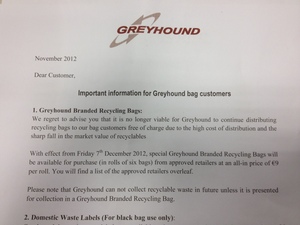 Louise F writes:
Greyhound can’t afford to offer free recycling pick up any more, so they start charging a ridiculous amount for bags! Do you know any other bin collectors who’d take my money instead?
 Oh, wait now…
WASTE COMPANY Greyhound has been ordered to remove almost 3,000 tonnes of its waste that was being illegally stored on a farm in Co Kildare.
The company, which took over Dublin City Council’s domestic waste collection service last January, had been using the farm near Nurney to stockpile accumulated waste.
The firm’s waste had been processed and bailed before storage. It was left sitting on hard stands outdoors on the farm, which was not licensed or permitted for the storage of waste, according to Kildare County Council.
Greyhound ordered to take 3,000 tonnes of waste off farm (Irish Times)
 In December 2009, Iarnród Éireann chief executive Dick Fearn told an Oireachtas Transport Committee that, two years previously, Greyhound won the cleaning and waste removal contract for the railway.
Mr Fearn told the committee: “We had some serious concerns with Greyhound Waste. Over time, we believed the services for which we were being charged may not have been provided comprehensively. We challenged the company in great detail. As any good management team should, we went through what had been invoiced and provided very carefully. In due course, we agreed with Greyhound Waste that it owed us money back. Money was repaid from Greyhound Waste. We informed the company we had no alternative but to re-tender the contract. We allowed Greyhound Waste to tender again. It had paid money back and straightened up the account. However, the next time around the company did not win the contract and at present Greyhound Waste does not supply services to us.”
Shane Ross, then a senator, asked Mr Fearn how much Grehound paid back Iarnród Éireann.
Ross: “Was the settlement a seven figure sum? Was it more than €1 million?”
Fearn: “No”
Ross:“How much was it?”
Fearn: “I do not have the figures in front of me.”
Ross: “Was it not a large sum?”
Fearn: “It was a large sum.”
Ross: “Surely, it is the type of figure Mr. Fearn ought to remember.”
Fearn: “I do not have it and I am not going to guess it.”
Chairman (Frank Fahey): “The matter the Senator has raised is a cause of concern. A company found to have acted in the way Mr. Fearn described was brought back in to tender again. That is most unusual.”
Fearn: “No. I do not think that is correct. If we found something inappropriate and if there were some breach or if we had to report a matter to the Garda, then there would be no question of the company being asked to tender again. We found contractual matters which were wrong. Basically, the money charged did not tally with the actual work done.”
Ross: “That is quite serious.”
Fearn: “It is serious but is it not good that we identified that and did something about it? If we had sat back as a management team, we would have blindly carried on paying and have done nothing about it. That was the opposite of what we did.”
Ross: “Were Iarnród Éireann getting bogus invoices?”
Fearn: “I cannot use the word “bogus” but through good management we identified discrepancies between the amount invoiced and the actual work done.”
Ross: “Was it fraud?”
Fearn: “No, it was not fraud. We had no evidence to believe that someone was deliberately doing it. Sometimes in business, one will find that if one has a good process for checking invoices against work done, one might well find errors. Sometimes they might be quite serious errors. One cannot immediately, however, jump to the conclusion that someone is doing it in a fraudulent way.”
Thomas Broughan (Labour TD): “On a point of information, the company in question has tenders for household waste collection with Fingal County Council and Dublin City Council and there is grave dissatisfaction with it. Is Mr. Fearn saying collections were not made in some stations and areas or, as Senator Ross fears, there was some sort of fraud taking place?”
Fearn: “No. What I am saying is that there were discrepancies relating to the amount of material picked up at locations, whether pick-ups were done routinely and so on. We believed that in some of the invoicing there were inaccuracies and errors. We believed, therefore, money needed to be refunded to Iarnród Éireann. We did that diligently. We sat down with the management of Greyhound Waste and, in due course, money was refunded to Iarnród Éireann. We did not have evidence of fraud and, therefore, did not go to the Gardai.”
In December 2010, Greyhound registered its company in the Isle of Man, meaning it does not have to publish its accounts. Chief executive Michael Buckley defended the move, saying: “The way it’s been portrayed, that we’re trying to hide behind a veil of secrecy, we don’t accept. Loads of group companies in Ireland do this, we’re a private business and we’re fully entitled to do this.”
In January 2011, Greyhound was forced to pay €9,000 in fines and costs to the Environmental Protection Agency for breaches of its licence to run a waste facility in Clondalkin, Dublin.
In 2011 Dublin City Council decided to sell it’s loss-making waste collection service. In April it hired Ernst & Young and paid the group €250,000 to recommend a firm.
The accounting firm chose Greyhound and the sale was made in December 2011. This was despite 50 out of 52 Dublin city councillors voting against Greyhound. City Manager John Tierney invoked a veto introduced by former environment minister Martin Cullen to overrule the vote. Details of the sale have been kept confidential.
On January 16, 2012, Greyhound took over the bin collection service from Dublin City Council. It’s 140,000 customers had to pay a €100 annual standing charge, a €6 charge per lift for black/grey bins and €2 per lift for each brown bin, with an increase in lift fees expected in July. The takeover sparked massive criticism over the firm’s demand that the standing charge be paid upfront in full. There was also criticism over missed collections. Greyhound also announced it would provide a free service to waiver customers until December 31, 2012. But in 2013, waiver customers will have to pay. In return for collecting the 32,000 waiver customers’ rubbish, Dublin City Council will pay Greyhound €4.2million this year.
Yesterday, in The Sunday Business Post, it was revealed that just four months after acquiring the service Greyhound has sold its interest in Dublin’s commercial waste collection business to it’s rival Panda – and with it a customer list containing details of all 4,820 businesses the city council used to deal with. Greyhound retain the residential list. For now.
What’s that funny smell?

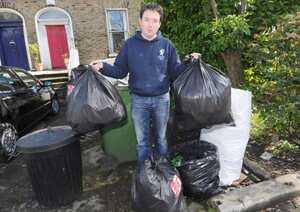

The power of Twitter! After yesterday’s tweet, Greyhound’s Dublin city region manager rang this morning. Discussed issue, rubbish now gone!
— Ronan Lyons (@ronanlyons) April 11, 2012
Trickle down economics.
It really works.
Yesterday: Garbage Provider Latest
(Laura Hutton/Photocall Ireland)
Last rubbish collected pre-Christmas. Greyhound bin-man told me just there: “Management don’t care. Move to another provider.”
— Ronan Lyons (@ronanlyons) April 10, 2012
 Arnott Street, Dublin.
Meanwhile, from Wednesday’s Dail sitting.
How did Greyhound Waste get this contract?
httpv://www.youtube.com/watch?v=HkVzhdQNTbY&feature=player_embedded


 Greyhound collection teams in Dublin this morning.
Private company Greyhound Waste is collecting all bins in Dublin city regardless of whether customers are registered for upfront payments.

 Anglo’s auditors.
A secretive waste firm fined €1.3m for overcharging Iarnrod Eireann.
And Dublin City Councillors.
What could possibly go wrong?
For some unknown reason, the former Anglo auditors were employed by the council to choose a new waste firm for its juicy waste contract. For some even less obvious reason E&Y were given an outrageous €250,000 for coming up with the name of Greyhound.
It is far from clear why the council could not pick the waste operators themselves. They have a waste department, presumably with a more specialist knowledge than Ernst & Young. Instead, they lashed out €250,000 of taxpayer’s money to Ernst & Young, the villains of the Anglo fiasco.
What more, in the name of God, does a company have to do to find itself struck off the State’s list of favourites?
If Ernst & Young cannot be blacklisted for their Anglo howler, they should surely have been given the cold shoulder for State or local government work for several years? If they had waved the red flag on Anglo we might never have been left in our financial pickle. They didn’t. Every year for eight years they missed their chance to rumble Anglo.
So the council’s award of a contract to Ernst & Young, and then to Greyhound, demands public explanation. The big question is: how much did Ernst & Young or Dublin City Council know about Greyhound?
Not much. Or so it seems.
Earlier: Oh, Wheely
