Tag Archives: Ian Bailey

Screen Shot 2014-11-04 at 11.17.15

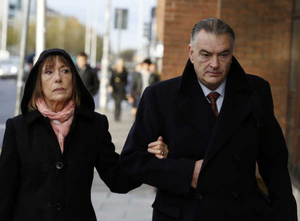
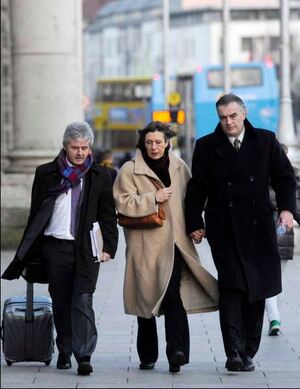
Ian Bailey and partner Jules Thomas, arriving at the Four Courts for his civil action against the State this morning. Mr Bailey is claiming that gardaí tried to frame him for the unsolved murder of Sophie Toscan du Plantier in Toormore, Co. Cork in 1996

Further to reports this morning, and at the weekend, that Ian Bailey’s high court action against the State, for damages, could last until Christmas.

It’s been reported that evidence from up to 80 witnesses will be heard.

Briton accused of film-maker’s murder puts Irish police in dock (Ed Vulliamy, The Observer)

Action by journalist Ian Bailey could run to Christmas (Barry Roche, Irish Times)

Sasko Lazarov/Photocall Ireland


buttimerbailey

[Ian Bailey, left, pictured with his solicitor Frank Buttimer leaving the Four Courts after he won a two-year legal battle against his extradition to France over the killing of Sophie Toscan du Plantier in west Cork 15 years ago in January 2012]

This morning, the Irish Examiner reports that French police will travel to Ireland next month to investigate the Sophie Toscan du Plantier case, under the Mutual Assistance Act 2008, and that Ms du Plantier’s parents Marguerite and Georges Bouniol are planning to hold a press conference in Cork on May 17.

Journalist Catherine Shanahan reports Mr Buttimer saying:

“How dare they think that they can come to this country and continue to investigate Mr Bailey, having already unlawfully tried to remove him from this country on foot of a European arrest warrant which the Supreme Court held to be unlawful; and in circumstances where it’s quite clear that the only so-called ‘evidence’ which created the warrant in the first place is the evidence which the government is now reviewing by appointing a commission of inquiry into allegations of police corruption.”

“How dare they continue to pursue a man who has not only not been charged with anything but, as far back as 13 years ago, our own director of public prosecutions produced documents that demolished the case against Ian Bailey.”

French probe into Ian Bailey a charade, says Buttimer (Irish Examiner)

Mark Stedman/Photocall Ireland

ianbutt

[Jules Thomas and Ian Bailey, with their solicitor Frank Buttimer, outside the Four Courts in 2012 – after Mr Bailey won a two-year legal battle against his extradition to France over the 1996 killing of Sophie Toscan du Plantier]

Yesterday, the Government announced the terms of reference for Supreme Court Judge Nial Fennelly’s Commission of Investigation.

The investigation will look at the recording of calls, other than 999 calls, to and from Garda stations between January 1, 1980 and November 27, 2013; the Garda investigation into the death of Sophie Toscan du Plantier and the sequence of events leading up to the stepping down of former Garda Commissioner Martin Callinan last month.

Under the terms of reference, Judge Fennelly will also establish whether any of the recorded material has been destroyed and establish “any instances during the relevant period where the Office of the Director of Public Prosecutions made use of the data and information produced by the said telephone recording systems for any purpose”.

Further to this, Ian Bailey’s solicitor Frank Buttimer has told the Irish Times today that he believes the role of the DPP, the Department of Justice and the Attorney General in the Sophie Toscan du Plantier case should be included in the terms of reference.

Mr Buttimer maintains the DPP was aware of concerns surrounding the case and the handling of witnesses – Marie Farrell and Martin Graham – back in the late 1990s, while he said the DPP has also been aware of three senior gardaí meeting with the State solicitor for West Cork, Malachy Boohig, allegedly trying to secure a decision to prosecute Mr Bailey.

We want to know why were these sleeping dogs let lie by the DPP office, the Department of Justice and why did the DPP/Department of Justice knowing all this, allowed the French state come here to seek to remove Mr Bailey from the jurisdiction in what we believe was an unlawful action.”

Bailey solicitor calls for DPP’s office to be included in Garda inquiry (Barry Roche, Irish Times)

Full terms of reference here

mf2

IanBailey[From top: Marie Farrell and Ian Bailey]

Yesterday, John Burke discussed a statement that Marie Farrell gave to gardaí in 2006 with Colm Ó Mongáin on RTÉ’s This Week. In the statement Ms Farrell alleges that she was put under “intense pressure” by gardaí to implicate Ian Bailey for the 1996 death of Sophie Toscan du Plantier.

Mr Bailey was arrested twice in relation to the murder investigation – in February 1997 and January 1998 – and released without charge on both occasions.

He’s now suing the State alleging wrongful arrest.

John Burke: “Marie Farrell was a local shopkeeper in the village of Schull in West Cork around the time Ms Du Plantier was killed at her holiday home nearby. Ms Farrell came to Garda attention shortly after the French woman’s murder when she rang Bandon Garda Station anonymously and said that she saw a man late at night on a road near the murder scene. She didn’t give her name as on the night in question, she claims to have been with a man who was not her husband and she was concerned her husband would find out. Now gardaí subsequently tracked her down and it was from this point onwards that one guard in particular began to ring her constantly about the case, she says. She’s claimed that she came under pressure from gardaí early on in the investigation, to wrongly identify the man that she had seen on the road that night as Ian Bailey, an Englishman who was living locally.”

Colm Ó Mongáin: “So, from the beginning, they were lots of phone calls. What level of detail does she give in her version of these conversations?”

Burke: “Well in this statement, Marie Farrell claims that during January and February of 1997, she was coming under intense pressure to name Ian Bailey in a statement, as the man she saw near the murder scene. One garda, she says, was ringing daily, sometimes several times a day, to discuss a possible statement. She said that the tone of the calls were not nasty at this time but they were pleading. And she said that the Garda claimed it would take a lot of pressure off him to have this statement about Ian Bailey. She was also being regularly asked whether she had said anything to her husband and she said she had not. Now, she said this garda was very concerned that other gardaí could be suspicious about him making so many calls to her home and to her shop. And she said that he asked her to go to two public telephones – one opposite the Bunratty Pub and one in the east end car park in Schull, and it was on these lines that they discussed the case initially. And then later that month, amid what she called constant pressure, she signed a statement in which she alleged to have recognised Ian Bailey as the man she saw on that night, on the road.”

Ó Mongáin: “Now according to this statement, she also claims to have been given the use of a special phone for the purposes of conducting these discussions with gardaí but not to go mad on it?”

Burke: “Yes, that’s right. Marie Farrell said, in this statement, that this garda gave her a mobile phone. She said he called it a State phone and she recounted the number of that phone in her statement and this number would appear to tally with the numbers of a normal, Garda issue mobile phone. She said he gave her the phone so that if anyone checked outgoing calls, it would look like calls were being made to a Garda rather than to her. And she said that this garda was, to quote her statement, always worried about phonecalls being checked to the extent that even when the Garda in question rang her, on the mobile phone that he gave her, he would cut the calls short and ask her to continue the calls via a public phonebox. She said that she had the use of this Garda mobile phone for around nine months and that she never paid any bills on it. She said he was constantly ringing her, looking for additional statements, relating to what she described as, to quote directly again, fictitious events involving Ian Bailey.”

Ó Mongáin: “Another key witness in this case is Martin Graham. Now Marie Farrell claims to have been rung by a garda who is deeply worried about a negative media report relating to this Martin Graham?”

Burke: “Yes, that’s right. She said that she was out at a family event one Saturday in May 1997 when a garda, who she had been dealing with, rang her and she said the garda was crying and she said that, to quote again directly, that they were “in the shit”. She said that this was a reference to a tabloid newspaper story which he believed was about to be published, relating to allegations that had been made by Martin Graham, who claimed that he was offered cash and drugs in order to obtain information about Ian Bailey and the garda pleaded with her to leave his name out of it if she ended up talking to the media or anyone about this.”

Ó Mongáin: “But that tabloid newspaper story was ultimately never published. What was the issue? Was the issue discussed any further in telephone calls, the issue of this potential story?”

Burke: “It certainly was, she said that the garda rang her sometime later during the summer of 1997 and claimed that gardaí in Dublin had somehow managed to stop this story being published. She said that the garda also told her that gardaí had put pressure on Martin Graham and he was fairly confident that Martin Graham had now gone to England and that he would not be coming back in a hurry. She made this statement in 2006 and her timeline of when this occurred would seem to fit with the same account given by Martin Graham.”

Ó Mongáin: “There’s also an indication that these calls of regular or even constant surveillance being mounted on herself and Ian Bailey?”

Burke: “Yes. Now she said that any time she met Ian Bailey, either this garda or others would ring her almost immediately afterwards to look for a blow-by-blow account of what was said. Interestingly she said that this also occurred after she met with gardaí sent especially down from Dublin to review the handling of the case, on which occasion she said this, or another garda, would ring her immediately to get a debriefing of what the other gardaí in Dublin wanted to know.”

Ó Mongáin: “So from around late December 1996, and certainly, into early 1997, Marie Farrell says she’s receiving constant phonecalls from gardaí in which she’s knowingly asked to give false evidence against Ian Bailey. We know that some calls to and from garda stations were being taped and they’re likely to play a central role in whatever Commission of Inquiry the Government puts into place. Do we know whether these calls were to Bandon?”

Burke: “Well Marie Farrell does make reference to calling Bandon in her statements. Of course we don’t know at this stage what calls were recorded and what particular recordings exist, we know that around three dozen recordings between Marie Farrell and gardaí have been found and they have been transcribed, it’s also likely that many more are yet to emerge.”

Gardaí wouldn’t comment on the claims to RTÉ.

Previously: Marie Farrell: Why I Lied About Ian Bailey (Transcript)

Witness says garda pleaded with her to implicate Ian Bailey (RTÉ)

This Week (RTÉ)

Pics: RTÉ

buttimer4
[Frank Buttimer, the solicitor for Ian Bailey and his partner Jules Thomas in their civil action against the State, at the High Court this morning]

In the High Court today, Martin Giblin, SC, for Ian Bailey and Jule Thomas, told the court that there had been “an extraordinary level of communication between the gardaí and the media of which we were unaware”.

“It is in the statement of claim that the media was used against the plaintiffs. The level of contact is beyond belief, we have a list involving hundreds of communications with journalists and we weren’t aware the communication was of that nature. It seems the operation to retrieve that material is ongoing.”

Further to this, Mr Buttimer spoke to Mary Wilson on RTÉ’s Drivetime this evening about the phone call conversations that were recorded at Bandon Garda Station in relation to the investigation into the 1996 murder of Sophie Toscan du Plantier, for which Ian Bailey was arrested twice and released without charge on both occasions.

Specifically, they discussed the high level of contact between gardaí and journalists. They later talked about Mr Bailey’s legal team’s efforts to obtain the names of three senior gardaí pertaining to the investigation.

Mary Wilson: “But isn’t that just what you’d expect to happen at a time, this was a hugely high-profile murder that took place in December of 1996. Journalists, not just from Ireland but from France as well, had come to West Cork, they were pursuing the case. So you would, in the course of events, you’d expect a lot of contact?”

Frank Buttimer: “You would of course, absolutely, that applies to any criminal event or of any event of general interest to the media, the media has to make its contacts to put out the news, there’s no issue about that.”

Wilson: “So what makes this different?”

Buttimer: “Well we allege, in our proceedings, that there was a strategic interest on the part of An Garda Síochána in utilising the media and there are two specific purposes which we maintain in our pleadings that they had in mind when they were using the media. Purpose No.1 was an evidential matter and I’m under some constraint here in relation to the directions to the High Court, so I’ll be very, very careful about that. But the second, and it’s quite an obvious one, which we have alleged, is that the fact that Mr Bailey’s arrest and indeed matters leading up to his arrest were strategically leaked to the media for the purpose of portraying Mr Bailey as the likely party responsible in relation to this matter, to create an image in the minds of the public that this was the person who must have committed this heinous crime so as that there would be an image of him in that respect, which we say strategically was used by An Garda Síochána for purposes which we would say were improper.”

Wilson: “So the journalists were used by gardaí to spin a particular line? Is that what you’re saying?”

Buttimer: “We have said it, it’s in our public pleadings, we have said it, yes.”

Wilson: “Now something else you asked for today as well, was access to information involving the identity of three senior gardaí named in a document, I think, before the Supreme Court?”

Buttimer: “Yeah, this has been in the public domain again, for some period of time. We received in an unsolicited fashion, from the Department of Justice, in the appeal against the extradition, certain material which we had not known existed. In that material are certain memoranda prepared by the Office of the DPP, and the local State solicitor in West Cork, tending to show, what we would allege, and which is stated in the memoranda, to be improper approaches by senior members of An Garda Síochána, whose purpose was to influence a decision on the part of the DPP. We have sought the identities of those senior members of An Garda Síóchána by way of a discovery application to the State. The defendants in the proceedings have maintained that it’s not a matter for them because the material in fact is the property of, or is in the possession of the DPP’s office. We have confirmed to the court today that we have applied to the DPP’s office to receive redacted memoranda in relation to that matter so that we can identify those parties formally so that we can see whether this whole information that we’re looking for fits into the strategy which we believe was applied to generate the, what we would call, false image, false intention, proper intention to prosecute and matters of that nature. We expect or we would hope that the DPP will respond to our request in the relatively near future in that regard.”

Listen back in full here

Level of contact between gardaí and media in Toscan du Plantier case ‘beyond belief’ (RTÉ)

Sam Boal/Photocall Ireland

julesbaileybuttimer
[Jules Thomas, Ian Bailey and their solicitor Frank Buttimer outside the Four Courts in March 2012 after he won a two-year legal battle against his extradition to France over the killing of Sophie Toscan du Plantier in 1996.]

Ian Bailey and Jules Thomas’ civil action against the State is up for mention in the High Court this morning.

It comes as John Burke of RTÉ last night reported that 133 separate tape recordings from Bandon Garda Station have emerged of conversations between gardaí, witnesses and journalists relating to the Sophie Toscan du Plantier murder case.

Mr Burke said they were found last autumn following a discovery order made by Mr Bailey and Ms Thomas’ lawyers.

Mr Burke reported that 36 involve conversations between [fake witness] Marie Farrell and gardaí; 18 involve conversations with [informant] Martin Graham and gardaí; 42 involve conversations between journalists and gardaí; 37 involve conversations between gardaí and other members of the force, including senior garda officers; while at least one is a recorded conference call between local gardaí and senior gardaí in Dublin.

133 conversations in du Plantier case recorded (RTE)

UPDATE, from the High Court:

buttbail

[Solicitor Frank Buttimer, Jules Thomas and Ian Bailey outside the Four Courts in 2012]

Frank Buttimer, the solicitor representing Ian Bailey and his partner Jules Thomas in their civil action against the State, spoke to Cathal MacCoille this morning on Morning Ireland in relation to his clients.

His interview this morning came ahead of today’s Cabinet discussion about the terms of reference of the commission of investigation into the recording of incoming and outgoing Garda station phonecalls over the last three decades, and a motion of no confidence against Justice Minister Alan Shatter – which will be debated in the Dáil tonight and tomorrow night.

Cathal MacCoille: “Could you just summarise for us, first of all, what you are alleging in this case?”

Frank Buttimer: “Very simply, Cathal, we’re alleging that there was a conspiracy to secure the improper prosecution of Ian Bailey based upon improper Garda practices in terms of evidence gathering and all that flows from that…[inaudible]

MacCoille: “And is, up to this stage, is the State denying everything?”

Buttimer: “Absolutely, we’re being required to prove everything. And that’s what we’re hoping to do Cathal.”

MacCoille: “When did you become aware of the existence of, or the possibility of the existence of recorded phone conversations?”

Buttimer: “Formally, last year, in the course of discovery proceedings which we took to secure, which we’re entitled to do, it’s common in any civil proceedings, we made a discovery application to the court and that process, I suppose, crystalised in May of last year. There were further sort of clarifications of the order that we got in May of last year in July. Then we got further delivery of material in terms of discovery of matters late last year. So it’s been a process which has been ongoing for some time. Now, however, I must say Cathal, this couldn’t be any secret at this point in time, the 2001 critique that was done by the then DPP [Director of Public Prosecutions] revealed to us that we saw in 2011, in the extradition proceedings, it revealed, which we already knew anyway, allegedly highly questionable practices which were commented upon by the Supreme Court in trenchant terms, during their dealings with the extradition appeal.”

MacCoille: “But the phonecalls, when you said you ‘formally became aware of them’ last year, informally?”

Buttimer: “I’d rather not get into the detail of the case, Cathal, because I suppose assuming that it is the case that’s exercising everybody’s concern, it is a matter that is pending before the court, you know, in fairness as well.”

MacCoille: “Well you have received documents under discovery, is the process of discovery, from the State by you, is it complete?”

Buttimer: “No, the discovery process is ongoing and I suppose it’s public knowledge again that we have to go back into the High Court to have the court adjudicate upon a claim that the State is making, with regard to the issue of privilege. In other words, where there are materials that are possessed by one side to the case, to the case, that side can claim privilege for all manner of reasons and the State is claiming privilege in relation to certain significant materials. The reason, essentially, why the State is claiming privilege is, is that it is in the public interest that these materials which they don’t want us to see should not be given over to us. We maintain, and reply to that, that privilege is defeated by fraud in effect or by malpractice and we will be strongly arguing for the High Court that the State has no leg to stand on in relation to such an assertion. In other words, that the public interest, the interest of the State should be served by not revealing what we consider to be these highly questionable practices.”

MacCoille: “Just to be clear about this. You received material from, as I understand it, from the State about 11 days ago, which related to phonecalls or transcripts of phonecalls?”

Buttimer: “Again, I won’t comment on specifics, all I can confirm is that the discovery process is ongoing, I must say Cathal, I’m reading about my own case as much in the media as I am dealing with it myself.”

MacCoille: “Just to be clear about this though: You received material 11 days ago, and are you telling us that the State is seeking to, they’ve given you the material, but they want the court to hold that as privilege, in other words that it can’t be used and can’t be disclosed?”

Buttimer: “No, to be fair, we have received a certain amount of material, the argument has yet to occur about whether we should receive material over which the State is claiming privilege, that is Judge [John] Hedigan, that argument has to be determined by the High Court judge who is managing this case that application is pretty much pending at this point in time, we’re just doing some paperwork on it.”

MacCoille: “Yeah, so, ok, can we assume that material related to phonecalls which you have been given, that’s, the State isn’t going to claim privilege over that and that we will hear about it?”

Buttimer: “Again, I would rather just to maintain my position on that at the moment, Cathal, because it touches upon matters that are between myself and the office of the State solicitor presently.”

MacCoille: “All right. So, OK, is the position, of material that you have, whatever it is you don’t want to go into details. But the material that you have, the State is not claiming privilege over that material, that you have already? The State is, or maybe, claiming privilege over other material which you haven’t yet got?

Buttimer: “Correct.”

MacCoille: “So how long is this going to take before it comes to court?”

Buttimer: “Well, you know, when you’re dealing with the State and maybe my own situation as well, it’s taken a while but, you know, you must remember the proceedings, by the way, Colm, have been in being since 2006 or 2007. We had the interruption people I’m sure are aware in the meantime of the attempt by the State, well the French state actually to remove Mr Bailey from the jurisdiction and all sorts of other activities in the meantime. So it’s been a, it’s been a  great battle.”

MacCoille: “And it’s ongoing. Just to return to the phonecalls. I know you don’t want to go into details but you said you became aware of these formally last year and they were referred to rather obliquely, I think in the High Court but on relation to the phones material, are you satisfied, you’ve got what’s there?”

Buttimer: “Well I have what I have, is as much as I can tell you?”

MacCoille: “Well are you satisfied with what you have? That the discovery in relation to the phones issue that you raised a year ago, that you’ve got what you wanted to get?”

Buttimer: “You’re asking me if I’m satisfied with what I have. I firmly believe, and my client is alleging this, that is a gross conspiracy, in conspiratorial matters, there are many, many things I’m sure that went on that I would love to access and I’m going to keep on trying.”

MacCoille: “All right, Frank Buttimer, solicitor for Ian Bailey and Jules Thomas, thank you very much for talking to us.”

Listen back here

Laura Hutton/Photocall Ireland

00126344GrahamMirror

[From top: Ian Bailey and Jules Thomas in 2012; Martin Graham, an acquaintance of Ian Bailey. Lawyers for Mr Bailey have claimed gardaí gave drugs to Mr Graham in order to secure evidence against Mr Bailey. The claim has been denied by gardaí.]

John Mooney, of The Sunday Times, spoke with Colm Ó Mongáin on RTÉ’s This Week yesterday to discuss the secret recordings of conversations pertaining to Ian Bailey in Bandon Garda Station.

It followed his story in yesterday’s Sunday Times that eight conversations were recorded between May 20, 1997 and June 4, 1997, which suggest that gardaí did give  money and drugs to Martin Graham to secure incriminating evidence against Ian Bailey.

Mr Mooney wrote that the recordings at the station “appear to corroborate claims made by Ian Bailey that detectives tried to frame him for the murder of Sophie Toscan du Plantier in December 1996”.

John Mooney: “The overall practice of recording conversations at garda stations really isn’t the main issue here. The main problem that Government face is that they have a series of recordings which suggest and appear to corroborate claims by Ian Bailey, who is in the middle of a landmark civil action against the State, that he was being framed for murder which he didn’t commit. And that the announcement of a judicial inquiry into the widespread recording of calls to stations is maybe something that was organised as a detraction from the main issue. For the simple reason is that in November 2011, lawyers for Ian Bailey were given documents from within the Justice…specifically the DPP which stated that he believed there was no evidence against Ian Bailey. That document was released via the Department of Justice to Ian Bailey and not through the normal channels and that in itself raises its own significant questions. But the, I suppose, the prime one being is that Alan Shatter knew about these allegations going back to 2011 and that the State has, despite all of this, continued to fight this case and defend it.”

Colm Ó Mongáin: “So, as you mentioned, back as far as 2012 and the DPP’s report was furnished to the Bailey legal team when he was fighting extradition proceedings, one would think that the mere mention of Sophie Toscan du Plantier within the Department of Justice would sound serious alarm bells?”

Mooney: “Well, I suppose it’s incomprehensible to think anything else. I mean, we, today, in today’s paper we published more information about letters. The Department of Justice were being notified in February 2008, that there was more issues concerning these matters. I think there’s a very, very clever game being played here. I think that it’s quite clear that this issue is all connected to the case, the civil action concerning Ian Bailey and Jules Thomas and that various people in various arms of the State knew there was a problem going back for years. Like the DPP’s report, which outlined that there was allegations that drugs were being given to people to make, I suppose to get confessions off Ian Bailey and there was preferential treatment being given to Marie Farrell, people like that…”

Ó Mongáin: “Well while those things were said, in the report and the Supreme Court, now that they said that those claims were never tested in court as such but were matters for serious concern.”

Mooney: “Absolutely and I was at some of those Supreme Court hearings and certainly the body language of the judges involved left it very clear that, I think one of the judges described this as matters of absolute exceptional public importance. So this has been known about and the fact that these tapes turned up a number of weeks ago, I think it’s important to suggest that these tapes were in the process of being transcribed so every couple of weeks something new was coming out. Garda headquarters were becoming aware of another issue and that this was being fed up the line, so to speak, into the DPP’s office, the Attorney General and the Department of Justice.”

Ó Mongáin: “And do we have knowledge as to then what the protocols were within the Department of Justice, at what level this gets parked and when further information gets kicked up to the highest levels.”

Mooney: “My understanding of this is that this really became a serious and significant issue in the Department of Justice around February 28. There were more correspondence between Martin Callinan and the Department of Justice on March 10. Whatever happened at that point, the following day Martin Callinan was asked to attend a meeting with the Attorney General and people from the Chief State Solicitor’s office and also the Department of Justice itself. And there were significant concerns being expressed at that point. Because the issues here are very, very complex. For example, if gardaí gave drugs to an individual to get incriminating evidence, where did he get the drugs from? I know that is a major, major, major issue now for Garda headquarters.
For example, if those drugs were seized off someone, what happened to the case of the person from whom they were seized from? Who knew what about Marie Farrell? Who was asking Marie Farrell to engage in certain activities or was she coerced as she alleges on that? So there’s lots of different issues emanating out of these tapes. And specifically, the State knew and indeed Enda Kenny knew and I would assume the Department of Justice all knew that this evidence was now being passed over to Ian Bailey’s legal team. Therefore it would be just a matter of time before this would enter the public domain.”

RTÉ This Week

Previously: Hash For Questions?

“Gardaí Don’t Lose Records In Murder Cases”

Pic: Irish Mirror

00126360 [Ian Bailey who has won a two-year case against his extradition to France over the killing of Sophie Toscan du Plantier]

Sophie Toscan du Plantier, 39, was found beaten to death outside her holiday home in Schull, west Cork, two days before Christmas in 1996.

The investigation into the murder has long been been the subject of controversy with recent claims that Ian Bailey and his partner Jules Thomas were under Garda surveillance up until 2012, with sightings of the couple logged onto the garda Pulse system.

The Sunday Times reported that the logs continued up to a week before the Supreme Court ruled against his extradition in March, 2012.

Another controversy surrounds the allegations made by Mr Bailey’s lawyers about the two investigating [now retired] gardaí who dealt with an acquaintance of Mr Bailey called Martin Graham.

Mr Bailey’s lawyers have alleged that retired Detective Gardaí Tom Fitzgerald and Liam Leahy offered Mr Graham drugs to secure evidence against Mr Bailey.

Both gardaí have denied the claims and no charges have ever been brought against them.

On Sunday, RTÉ reporter John Burke spoke to Colm Ó Mongain of This Week about two statements he obtained from 1997, made by the two gardaí. The statements were made after an allegation that gardaí gave Mr Graham drugs in return for help with the murder investigation emerged.

The allegations that Martin Graham was offered drugs was also discussed in a 2001 report by the Director of Public Prosecutions which was subsequently referred to in the Dáil in July by Independent TD Clare Daly, who said: ‘Gardaí gave hash, cash and cigarettes to a drug taker with criminal convictions in order to obtain incriminating evidence against Ian Bailey.’

RTÉ reported that the DPP’s report, referred to by Clare Daly, was admitted to a Supreme Court appeal.

Mr Justice Murray said the report was dramatic and shocking but that any examination of the report would require evidence and, especially, evidence from anyone adversely affected by it, who wanted to rebut it. Counsel for the State said gardaí would object to its contents.

John Burke: “Martin Graham was an Englishman who ended up living in West Cork by the late 1990s. He lived in rented accommodation in Skibbereen. Ian Bailey was arrested in February, 1997, as part of the Sophie Toscan du Plantier murder inquiry and, after his release, he stayed for a few days in the same rented accommodation as Mr Graham, before returning to his home in Schull. Gardaí later interviewed the occupants of the rented house, including Martin Graham and, arising from this inquiry, detectives Jim Fitzgerald and Liam Leahy, whether individually or collectively, met Mr Graham around 15 times over the following four months.”

Colm O’Mongain: “And why did they meet him? What was the purpose of those meetings?”

Burke: “Well, according to his statement by Detective Garda Fitzgerald, dated June 24, 1997, Martin Graham voluntarily offered to orchestrate further meetings with Ian Bailey and to report back on what Mr Bailey might say about the murder of Sophie Toscan du Plantier and this involved making trips to Mr Bailey’s home in Schull. It also involved going to festivals and socialising with Ian Bailey. And, if there was a particular event that he thought Mr Bailey might be attending, the ultimate purpose was to get close to Mr Bailey and to engage with him about the murder.”

Ó Mongain: “Now, as mentioned at the outset, it was later claimed that Mr Graham was offered drugs – both gardaí deny this. And neither they, nor any other garda, has faced charges relating to such a claim.”

Burke: “Yes, that’s correct.

Ó Mongain: “So the second of Detective Garda Jim Fitzgerald’s statements deal with his use of the word ‘stuff’ to describe items he’d given to Martin Graham and the word ‘something’ contained in a tobacco pouch. These, the use of these words occurs during taped conversations they had with Martin Graham.”

Burke: “That’s right. Detective Fitzgerald makes a statement to clarify these matters for the garda authorities. In this second statement, he refers to two conversations he had with Martin Graham. In one, he says ‘the stuff’, he makes reference to giving Martin Graham various items of clothing. The ‘something’ Detective Fitzgerald says he refers to, as being in the tobacco pouch given to Martin Graham by him is, according to the statement, 20 pounds in cash which he says another garda saw him put in the pouch on the way to meeting Mr Graham. The statement also gives details of another conversation with Mr Graham in which he used the word “stuff” when asking Mr Graham how drugs were distributed in the West Cork area. Garda Fitzgerald also deals with his use of the term ‘old smokes’ in this second statement. Again, he says, this means different things and different contexts, when talking about the West Cork drug scene with Mr Graham he says ‘old smokes’ mean cannabis. The term ‘old smokes’ is also used to describe loose tobacco, given to Mr Graham, according to the statement.”

Ó Mongain: “And, of course, Gardas Leahy and Fitzgerald both deny that either of these meant that drugs had been given to Mr Graham as we said at the outset. No garda has ever been charged in connection with such allegations. Now, leaving that issue aside, both gardaí go in to some detail in their statements regarding sums of money which were given to Mr Graham.”

Burke: “Yes, Detective Garda Fitzgerald says in one statement that between February and April of 1997, they had given Mr Graham, what he described as small monetary expenses as requested by him in the event of he socialising with Mr Bailey. Detective Fitzgerald recounted how he had met Mr Graham on the 11th of May. Mr Graham had said he would be attending the Fiddlers’ Fair in Baltimore over the following week and he would be meeting Ian Bailey there. Martin Graham asked him for money to cover his expenses, if he met Mr Bailey and the detective gave him the money. Mr Fitzgerald said he had also given Martin Graham cigarettes and tobacco and he said he was aware and was present when Detective Garda Leahy gave Mr Graham clothes.”

Ó Mongain: “That was then Detective Fitzgerald’s statement on monies given to Mr Graham. What were Detective Garda Leahy’s recollections?”

Burke: “Garda Leahy remarked that on the 30th of March, 1997, there was another festival in Kilcrohane and it was felt that Ian Bailey would be at this event. Of this, Detective Garda Leahy said:

‘Graham agreed that he would go there. It was a two-fold purpose: one to enjoy himself and, secondly, he may meet Bailey. I dropped him to Kilcrohane and, as he had very little funds, I gave him 30 pounds to tide him over. I previously gave him money to compensate him for his time and efforts.’

Ó Mongain: “Other than giving Martin Graham money to socialise with Mr Bailey, what other items did Detective Gardaí Fitzgerald and Leahy say they provided to him?”

Burke: “In a handwritten statement on October the 20th, 1997, Detective Garda Liam Leahy said he bought clothes for Martin Graham at Kevin Bohan’s General Drapery Store in Bandon – two shirts, one jeans, one sweatshirt, one pair of socks, to the value of IR£64.95. He explained in the statement that he felt bad for Mr Graham as he thought he had only one set of clothing. Now that’s perhaps an unusual level of detail to include in a Garda statement but Liam Leahy said that the waist of the jeans that he bought for Martin Graham was too wide and so he personally went back to the drapery store and changed them for a smaller pair. Detective Garda Leahy said he got a receipt for the clothes which he bought for Mr Graham. He said he submitted this receipt to his superior and was fully reimbursed.”

Ó Mongain: “Now what other level of interaction did Mr Graham have as part of providing assistance to the investigation?”

Burke: “The two detectives also took Mr Graham on a tour of the scene where the murder took place, at Martin Graham’s request. He wanted to be familiar with the area if he ended up speaking to Mr Bailey about the murder.”

Ó Mongain: “So, four months after first interacting with Martin Graham, both detectives were giving formal statements regarding this engagement. Why was this?”

Burke: “Well, in or around May of that year, Detective Garda Fitzgerald said that he learned that an allegation had been made, that gardaí gave drugs to Martin Graham, in return for assistance in the murder probe. In terms of why these statements were made, we know that at least two of the statements, which both the detective gardaí made between June and October 1997, were in direct response to queries from their superior officers, in relation to how they interacted with Martin Graham.”

Ó Mongain: “Ian Bailey is taking legal action against the State and part of that claim involves an allegation that Detectives Fitzgerald and Leahy offered drugs and cash to Mr Graham, among other claims of alleged garda misconduct. Gardaí have denied these claims. You’ve contacted both retired gardaí, seeking comment on the content of their original statements.”

Burke: “Yes, I contacted both Mr Leahy and Mr Fitzgerald. They said they had no comment to make on any aspect of the allegations. Mr Graham is believed to be no longer living in Ireland and was last known to have lived in Cornwall around 2006. He could not be contacted for comment.”

Listen here

Bailey(Solicitor Frank Buttimer, Jules Thomas and Ian Bailey outside the Four Courts last year)

Frank Buttimer said he found it surprising that a file from the murder investigation identifying Mr Bailey as a suspect in the death of the French film producer cannot be found. The 39-year-old mother of one was killed at her holiday home at Toormore near Schull in west Cork, in December 1996.
“It is a cause for concern because we don’t know what it contains and we believe we are entitled to access the information for Mr Bailey’s action for damages for wrongful arrest by the State,” Mr Buttimer told The Irish Times. “As a general point, gardaí don’t lose records in murder cases or other such serious crimes – files in such cases just don’t get lost, especially in a case where the file remains open.”

Bailey solicitor concerned over missing file in Toscan du Plantier murder case (Barry Roche, Irish Times)

Previously: Marie Farrell: Why I Lied About Ian Bailey (Transcript)