
Tag Archives: Local elections

Fianna Fáil leader Micheál Martin

Dr Adrian Kavanagh is a lecturer in the Maynooth University Department of Geography.

On his excellent blog, he regularly shares his research on political parties and the geography of elections.

This morning, he’s written about the fact there are now 273 (32.3%) officially selected or declared female candidates out of 844 selected or declared local election candidates – with Fianna Fáil currently having the fewest female local election candidates.

In relation to parties, he’s found the following parties have declared the following numbers of female candidates so far…

Fine Gael: 49 (27.5%)

Fianna Fáil: 47 (18.7%)

Sinn Féin: 49 (38.9%)

Labour: 29 (42.6%)

People Before Profit: 25 (54.3%)

Social Democrats: 25 (56.8%)

Green Party: 18 (47.8%)

Solidarity: 9 (52.9%)

Workers’ Party: 4 (44.4%)

Renua: 1

Non-party/Independent: 15 (23.8%)

Read in full here: Female candidates contesting the 2019 Local Elections (Adrian Kavanagh)

Related: Fianna Fail falling short on female candidates for local elections in May (Stephen O’Brien, The Sunday Times)

Rollingnews

DP

[Direct provision accommodation centre for asylum seekers in Lissywoolen, Athlone, Co. Westmeath]

There are approximately 4,360 asylum seekers living in direct provisions centres across Ireland. The adults among them are allowed to vote in the local elections.

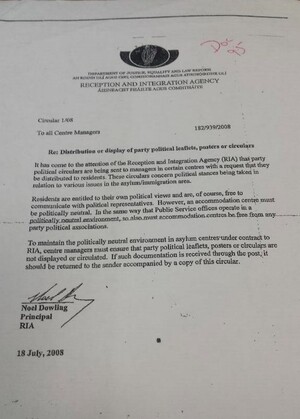
However, election candidates are not allowed to canvass at the centres.

On this matter, Joan O’Connell writes on her blog:

“If politics is conceived as a zero-sum competition for power, then this step by a state agency can be regarded as the yet another exercise of power over an already almost totally disempowered group in Irish society. The near-total exclusion of asylum seekers from participating in the society where they live is highly questionable.
“By denying election candidates the opportunity to canvass the views of certain constituents, this “policy” impedes the opportunity for candidates to hear the views of asylum seekers and others – to hear their minds and voices. In turn, the “policy” hampers the ability of voters in direct provision centres to be fully informed about their rights and obligations, and to contribute to and influence the local politics – which by law they are entitled to do. If voices are silenced and bodies remain invisible, what does this mean for the ideas and leadership which shape Irish society?”

Joan O’Connell’s blog post, An interference with democratic process: The right to vote in Ireland, in full here

Update:

letter

UCD law lecturer Dr Liam Thornton writes:

“Asylum seekers not even entitled to receive leaflets from political parties…”