


Tag Archives: Media

Mercille

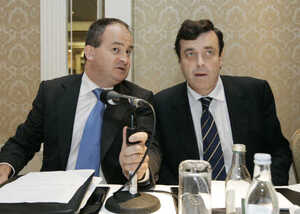
90200319(Dr Julien Mercille, top, and Marc Coleman above with Brian Lenihan at a Confidence In Media conference, 2010)

You may recall UCD lecturer Dr Julien Mercille’s analysis of how the Irish media handled the housing bubble.

Among those Dr Mercille singled out for specific attention was Marc Coleman as he was economics editor of the Irish Times during the latter part of the boom

Mr Coleman responded on twitter that he had warned of an impending crisis and evidence of this was available if we had “bothered to check” the archives. He sent on this correspondence (a letter to the editor the Sunday Tribune in 2010), in which he defends his record as a commentator and analyst during the housing bubble.

Dr Mercille writes:

In April, Broadsheet.ie published articles about some work I have been doing on the media’s coverage of the housing bubble in Ireland, here and here. My point was that the Irish media supported the hype about the housing market and contributed to inflating the bubble that collapsed a few years ago, leading the country into a deep economic crisis.

One media commentator, Marc Coleman, formerly Economics editor at the Irish Times and now running his own radio show on Newstalk, wasn’t so happy about it, and responded to Broadsheet.ie (see above)

I decided to examine Coleman’s record on the housing bubble in more detail, and so I took a look at all the newspaper articles on the property market he has written since 2004 as well as his two books, The Best Is Yet To Come (2007) and Back from the Brink (2009).

Perhaps the clearest examples of how wrong he has been come from the following pieces. In September 2007, he attacked those who warned of a housing collapse like David McWilliams as ‘careless talkers’ who make meaningless ‘simplifications and generalisations’ and threaten to ‘run down our economy’.

Coleman claimed that ‘Far from an economic storm—or a property shock—Ireland’s economy is set to rock and roll into the century’. He thought the economy was so strong that he wrote that ‘Ireland enters the 21st Century in a position of awesome power’, which ‘promises a future more flourishing than ever before; a future that will turn economic prosperity from a statistical fact to a reality’.

Apparently, the country was doing so well that worldwide, ‘hundreds of millions of people are one the move, looking for a country like Ireland to make their home’. After all, ‘Far from collapsing, our economy and property prices will do more than hold up’. Supposedly, all we needed to do to protect ourselves against a crisis was not to talk about it, because ‘unless we talk ourselves into one, an economic storm is not going to happen.’ All we had to do is proceed as if there was no problem at all: ‘If we keep our eyes fixed forward and our heads cool, then the best is yet to come’.

Also, in March 2007, just as the housing bubble reached its peak, he wrote confidently that ‘Nothing exciting is in prospect for the market over the next two or three years, but nothing dangerous is in prospect either’. Later that month, he wrote that ‘some commentators on the property market… are predicting the downfall of the market, the collapse of the economy and the sky falling on our heads’. He said that those people were ‘talking nonsense’, and ‘dangerous nonsense at that’. He continued: ‘Doom merchants and indulgent parents are bad for the market’. He didn’t like those ‘irrational predictions of doom’ because he said ‘the market is correcting, not collapsing’ and in any case we shouldn’t worry because there is only a ‘modest amount of overvaluation in the market’ and ‘the safety nets for house price levels in 2008 are effectively already in place’.

But those are not his only contributions. He wrote a number of articles over the years that reinforced the notion that house prices were set to climb higher or, at worst, would gently stabilise in a ‘soft landing’. For example, he penned articles entitled ‘Housing Demand Set To Stay Strong’ (Irish Times, 28 September 2005), ‘Risk From Collapse in House Prices “Has Receded”’ (Irish Times, 2 November 2005) and ‘House Prices “Set for Soft Landing”’ (Irish Times, 22 November 2005). In another article, entitled ‘“Ryanair” effect adds to confidence in housing market’, he wrote that ‘The Irish housing market will experience another strong year, due in part to Ryanair making Ireland a more accessible place to work, according to Irish Intercontinental Bank (IIB) chief economist Austin Hughes’ (Irish Times, 25 January 2006). He presented another entertaining thesis in an article entitled ‘Legalisation of Contraception a “Major Factor” in House Price Rise’, reporting on a study entitled ‘Condoms and House Prices’ by Alan Ahearne of NUI Galway and Robert Martin of the US Federal Reserve Board (Irish Times, 1 May 2006). Another piece, entitled ‘Economists Forecast 15 More Years of Strong Growth’ (Irish Times, 23 March 2006), stated that ‘As a result of population growth, the number of houses is expected to continue growing by around 65,000 units a year until at least 2020’.

Later, he wrote an article entitled ‘Housing Market Set for “Soft Landing”’ (Irish Times, 28 February 2007) and stated reassuringly that ‘Negative equity is here—but only for a tiny percentage of the market’ (Irish Times, 14 June 2007). One could say that some of those articles were merely news stories and that Coleman was only reporting the opinion of others, but that confirms my point: he chose to report the views of those property ‘experts’ who were cheerleaders for the market, but ignored those who warned that it was in bubble territory, such as Morgan Kelly, David McWilliams, or The Economist magazine.

In January 2006, in the Irish Times’ Property section, Coleman advised his readers on how to buy property overseas. The article started thus: ‘Thinking of investing abroad? Don’t just check out the bars and the beach—research the economy of the country you’re buying in if you want it to be a good long-term prospect. Economics Editor Marc Coleman shows you how’. For example, he wrote that ‘The absence of serious political discord in a country is a necessary if insufficient condition to making a sound investment, in that it helps underpin confidence in the property market’.

In August 2006, he wrote the introduction to a Daft.ie report on the property market. In it, he claimed that the housing market’s ‘price resurgence is “fundamental” in nature’ and thus that it was ‘unlikely’ that ‘a downturn in the market [was] going to happen’.

In January 2008, Coleman encouraged his readers to buy property, writing that ‘provided you are not paying 2007 prices, 2008 could be an excellent year in which to buy’. Some might have wondered whether ‘you should wait until 2009 before buying a house?’ But Coleman said assertively that ‘that idea is nonsense’—as such, ‘many will this year have perfectly good reasons to buy houses in 2008 and—provided they pay 2006 prices—they should go ahead in confidence’. He believed that the property market would ‘bear out my prediction of a quick correction in 2008 followed by resumed growth’.

In March 2008, he wrote another piece entitled ‘Property: bottoming out—so it’s time to spend’. He minimised any worries about the market: ‘Less about a boom and bust, Ireland’s current economic story is more like a property bulge passing through the gullet of our economy’. He thought that by early 2009, ‘at the very latest, house price growth should turn very modestly positive’.

In October 2008, he attacked those who suffer from ‘illiterate panic-mongering’ and talk down the property market and who ‘with no quantitative discipline to back their statements, tell us that house prices are going to fall by another 40 per cent’—well, they’ve actually fallen by about 45% since then.

His optimism was displayed again in a January 2010 article entitled ‘All Signs Indicate We Are Turning the Corner on to Recovery’ (Sunday Independent, 10 January 2010) and in another one entitled ‘It’s Not “Hype”, the Worst Really Is Over’ (Sunday Independent, 7 February 2010) in which he wrote that ‘The armageddon brigade may argue otherwise, but the evidence suggests we are on the slow road to recovery’ and that ‘the signs of recovery are everywhere’.

A few of Coleman’s articles may appear to have warned against a housing crash, such as one entitled ‘Economy Vulnerable to Housing Crash’ (Irish Times, 4 March 2006), but in fact when one reads them, they turn out to have been reassuring about such an event, stating that ‘The good news is that, although possible, a crash is not yet probable’.

Coleman tried to defend his record in an article in the Sunday Independent in 2010, in which he gave examples of articles written by himself that purport to demonstrate that he had, in fact, warned us all about the impending collapse of the economy. However, none of his examples prove anything of the sort. All one can find are a few sentences saying that growth may not be sustainable, that credit is growing too fast, that the construction sector is a very large part of the economy, that the financial sector could be better regulated, etc. For instance, he says that ‘On March 31st 2006 in a piece that began “Stop the economy I want to get off” I warned that financial regulation had broken down’. The piece says that the economy is overheating, but doesn’t warn about a housing bubble.

Coleman also wrote a book entitled The Best Is Yet To Come, published in November 2007. It makes a number of economic assumptions that are simply wrong or irrelevant, such as arguing that a country’s climate and a coastal location help its economic performance: ‘Situated on the temperate if rainy north-west fringe of Europe, Ireland has one of the world’s most fortunate locations’ (pp.11-12). Another one is the book’s main argument, that population growth will stimulate economic growth in Ireland. As Colm McCarthy and Dan O’Brien have noted in their reviews of the book, that doesn’t make any sense, as on that count sub-Saharan Africa, India and other poor countries should be rich. To grow an economy, you need the right policies.

The book presents a very optimistic picture of the Irish economy. Coleman finished writing it in early October 2007, and by that time, signs of an economic slowdown were apparent. For example, he wrote that ‘At the time of writing, latest forecasts from the ESRI indicate that the so-called Celtic Tiger would expire in 2008’ and that housing construction would decrease.

But Coleman saw that as a mere ‘pause for breath’ on the part of the economy. In other words: ‘Ireland’s economic miracle is far from over. As anxiety mounts about the end of Ireland’s boom, The Best is Yet to Come argues that Ireland is not experiencing the beginning of the end, but rather the end of the beginning’, as stated on the book’s back cover.

There’s one line of defence that Coleman may use, and it goes something like this: ‘My predictions were conditional on the government doing this and that, and it didn’t do it, so I can’t be proven wrong’.

For example, in many of his articles and in his 2009 book, entitled Back from the Brink: Ireland’s Road to Recovery, he kept predicting that house prices wouldn’t fall too much or would stabilise soon, only to be constantly proven wrong by further falls in house prices.

But he then says that his predictions were conditional on the government cutting stamp duty or enacting some reforms. He even said that his predictions would materialise provided ‘the kamikaze commentators stop killing confidence’ (p.75). But that line of defence is worthless.

Anybody can predict anything and then blame the government or anybody else for not having done this or that, or not enough of this or that, or having done this or that, but not at the right time, or having done this or that, but not well enough, etc.

Julien Mercille is lecturer at UCD, and author of the forthcoming book, The Media and the Irish Economic Crisis: A Political Economy (Routledge).

Previously: For Those Who Shouted Stop He Salutes You 

I Never Promised You A Rose Garden

(Mark Stedman/Photocall Ireland)

Update:
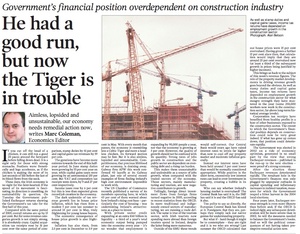
it Marc Coleman has defended his record on twitter, challenged Dr Mercille to a debate  and has asked us to reprint this article from the Irish Times of July 6, 2006, which we are happy to do. Larger version here.

Juliendavid_on_primetime_2003KellyFor the rest of YOU.

No Mercille!

You might recall last week’s post concerning Dr Julien Mercille (top), of University College Dublin and his report into the Irish media and the property bubble.

His academic paper claims that organisations such as the Irish Times, The Independent group and RTE helped stoke, sustain – and ultimately fail to warn people about the dangers of – the bubble.

Having now read  the report.

It wasn’t all bad news..

Dr Mercille (who has given us permission to quote from his findings), writes:

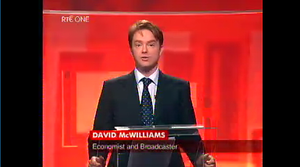
“In Ireland, economist David McWilliams (centre) warned unambiguously about the unsustainability of the boom as early as January 1998, when he wrote that ‘fundamentals count for nothing if your house is built on a bubble’ and pointed to the fact that mortgage lending in Ireland ‘has been growing at 15 per cent per annum for the past four years. This cash has been funnelled with the help of significant fiscal incentives, into bricks and mortar, pushing, as we all know, prices through the roof. On top of this, general credit in the economy is up more than 20 per cent in 1997 alone. A quick glance at property prices suggests that we are definitely entering asset-price bubble territory’. Until the crash, McWilliams has been one of the few analysts in Ireland to warn publicly and explicitly about the growing housing bubble and its eventual collapse. Another Irish analyst to have done so is Morgan Kelly (above). He looked at nearly 40 property booms and busts in OECD economies since 1970 and showed that there is a strong relationship between the size of the boom and ensuing bust: typically, ‘real house prices give up 70 per cent of what they gained in a boom during the bust that follows.”

“Kelly observed that, between 2000 and 2006,house prices in Ireland had doubled relative to rents, while the price-to-income ratio had also significantly outpaced its historical level. This showed that Irish property prices were no longer sustained by fundamentals such as rising employment, immigration or rising income. He predicted a fall in real house prices of ‘40 to 60 per cent over a period of 8 to 9 years’, which seems relatively accurate as of this writing.”

But.

The prevailing mood was such that:

“Marc Coleman, the Irish Times economics editor, wrote as late as September 2007 that: ‘Far from an economic storm – or a property shock – Ireland’s economy is set to rock and roll into the century’. In fact, ‘Ireland enters the 21st Century in a position of awesome power’.

[Of Brendan O’Connor’s June, 2007 Sunday Independent column: ‘The Smart, Ballsy Guys Are Buying Up Property Right Now’] “(The article was) urging Ireland’s readers to buy property, saying himself: ‘Tell you what, I think I know what I’d be doing if I had money, and if I wasn’t already massively over-exposed to the property market by virtue of owning a reasonable home. I’d be buying property. In fact, I might do it anyway…anyone who is out there in the jungle will tell you that it is a buyer’s market big time’

Dr Mercille gives four reasons why the media may have sought to downplay the bubble and its dangers.

1) The news organisations have multiple links with political and corporate establishment, of which they are part, thus sharing similar interests and viewpoints.

2) Just ‘like elite circles’, they hold a ‘neo-liberal ideology’, dominant during the boom years.

3) They feel pressures from advertisers, in particular, real estate companies.

4) They rely heavily on ‘experts’ from ‘elite institutions’ in reporting events.

He writes

Irish news organisations are large private or government-owned institutions, and as such are themselves part of the corporate and political establishment…”

“…The overall point is that news content reflects economic and political elites’ interests and views. The Irish media can be seen as neoliberalised, in line with Ireland’s political economy. Over the last several decades, mergers have reduced the number of smaller, independent regional news organisations and increased the concentration of ownership, while the liberalisation of the industry has allowed a number of foreign companies to take stakes in the Irish media. It has been argued that increased commercialisation has contributed to a shift away from investigative journalism and toward a ‘tabloidisation’ of the news.”

Dr Mercille says because the property boom helped key sectors of the Irish corporate and political establishment, “it was never seriously challenged”.

“Government-owned media are by definition controlled by the government to a greater or lesser extent, through funding and appointments of principal officers. In theory, state-owned media could be more representative of popular concerns than private media since they are part of the democratic structure of government. However, this only goes so far as the government is democratic and, in Ireland as elsewhere, national politics are largely dominated by a few parties representing various factions of the establishment.” 

“In 2008, PricewaterhouseCoopers conducted a detailed study offering a comprehensive look at the ownership, size and concentration of the media in Ireland that illustrates the above statements. Independent News & Media (INM) is arguably the dominant media conglomerate and is listed on the Irish and London stock exchanges. During the housing bubble years, it generated annual revenues of €1.67 billion (2007 data), owned 200 newspapers and magazines, 130 radio stations and 100 online sites in Ireland, the UK, South Africa, India, Australia and New Zealand. In Ireland, it owns seven national and 17 local newspapers and 27 websites. Some of those are leading titles, such as the Irish Independent, Sunday Independent, Sunday World and Irish Daily Star.

“Its main bankers are Bank of Ireland, AIB and Ulster Bank Ireland, which were all deeply involved in the housing bubble. Its board members and directors are establishment figures, including the financial sector. For example, board members have included Brian Hillery, a Director of the Central Bank of Ireland and former Fianna Fail member of parliament, Dermot Gleeson, the chairman of AIB during the housing bubble years, and B.E. Summers, a director of AIB.”

“The Irish media even acquired a direct financial interest in the sustenance of the real estate bubble by acquiring property websites. For example, in 2006, INM bought PropertyNews.com (along with the PropertyNews monthly newspaper), the ‘largest internet property site on the island of Ireland’ listing ‘nearly 20,000 properties for sale’. In 2006, the Irish Times, Ireland’s newspaper of record, also bought the property website MyHome.ie for €50 million, along with the website newaddress.ie which aims to make it easier for home owners to move residences. The Irish Times’ board has also been replete with individuals linked to the corporate and political establishment. For example, during the bubble years, the board included David Went, CEO of Irish Life & Permanent, an Irish bank deeply involved in the housing boom.”

“RTÉ is Ireland’s state-owned media organisation and dominates the television sector. It is funded through advertising revenues, indicating an important commercial dimension, and also by the government through license fees collected from the public. The government appoints RTÉ’s board, giving it additional influence on the organisation.”

During the boom years, RTÉ had as chairman Patrick J. Wright, who was at the same time a director of Anglo Irish Bank, which epitomised more than any other bank the excesses of the Celtic Tiger and property lending. In 2006, Mary Finan took over as chair, with a resume including positions such as director of the ICS Building Society, a Bank of Ireland subsidiary mortgage lender that offered 100 per cent mortgages from 2005 onwards and was eventually covered by the 2008 government guarantee.”

In relation to advertising, Dr Mercille writes:

“The Irish media received a large amount of funding from property advertising during the housing boom (and, as seen above, they even became owners of property websites). Most newspapers published weekly supplements for commercial and residential property, ‘glamorizing the whole sector’, while ‘Glowing editorial pieces about a new housing estate were often miraculously accompanied by a large advertisement plugging the same estate’, in the words of Shane Ross, former Sunday Independent business editor.

“Ross also shows the power of advertisers’ in influencing news content when he states that: ‘Unfavorable coverage of developers and auctioneers in other parts of the newspapers was regularly met by implied threats from property interests that advertising could go elsewhere’.

“Moreover, a journalist working for the Irish media stated that journalists ‘were leaned on by their organisations not to talk down the banks [and the] property market because those organisations have a heavy reliance on property advertising’. As Irish Times columnist Fintan O’Toole remarked: ‘There is no question that almost all of the Irish media for the last 10–15 years has had a crucial economic stake in a rising property market. Because property advertising is very lucrative and is a very important part of what makes the Irish media tick’.

Continue reading →

Screen-Shot-2012-10-08-at-17.06.56Julien
MediaSome empirical evidence.

An investigation into the Irish media’s role in Ireland’s housing bubble by Canadian academic Dr Julien Mercille, above, of University College Dublin is out.

A synopsis of the article has been published on Social Europe Journal, in which Dr Mercille writes:

“It is not too difficult to identify a housing bubble in the making, based on simple indicators such as the P/E (price/earnings) ratio and the price-to-income ratio. This is what a few analysts did, such as The Economist magazine, which stated in 2002 that Ireland’s real estate market had been ‘displaying bubble-like symptoms in recent years’ and estimated that it was then overvalued by 42 per cent.  However, the Irish media were almost without exception cheerleaders for the booming property market, only dampening their enthusiasm months after prices had started to decline in late 2007 and 2008.”

“One way to illustrate this claim is simply to count the number of references in the press to the notion of a ‘bubble’ in the housing market before and after the crash. The figure [below] shows this for the Irish Times, Ireland’s newspaper of record. It can be seen that before 2008-2009, there were comparatively few articles that even mentioned that the market might be in bubble territory. On average, the newspaper had 5.5 times more articles on the bubble per year in 2008–2011 than in 1996–2007. For the newspapers Irish Independent and Sunday Independent, which boast a high readership, it was even worse: they had on average 12.5 times more articles mentioning the bubble in 2008–2011 than in 1999–2007. And that doesn’t mean that such articles published before the crash warned of a bubble—very, very few did, and many only talked about it to attempt to reassure readers that in fact, it didn’t exist.”


ITchart

“Some Irish Times articles’ titles give an idea of media coverage,” Dr Mercille adds:

Bricks and Mortar Unlikely to Lose Their Value’ (11 December 2002),
Prices to Rise as Equilibrium is Miles Away’ (18 March 2004),
House Prices “Set for Soft Landing”‘ (22 November 2005),
Property Market Unlikely to Collapse, Says Danske Chief’ (2 February 2006)
And
House Prices Rising at Triple Last Year’s Rate’ (29 June 2006).”

He continues:

“Another way to look at the performance of the Irish media before the crisis is to consider that between 2000 and 2007, the Irish Times published over 40,000 articles on economic topics – but only 78 were about the real estate bubble, or 0.2 per cent of the total. In other words, any article that might have been critical about the housing market was effectively lost in a sea of uncritical reporting. That’s a very poor record for one of the most important economic events in Ireland over the last decades.”

“Television displayed the same behaviour as the print press. During the boom, the state broadcaster, RTÉ, fed the national obsession with property by airing shows like House Hunters in the SunShowhouseAbout the House and I’m an Adult, Get Me Out of Here. In particular, Prime Time, a leading current affairs programme, remained essentially silent on the dangers inherent in the rapid growth of the property market.

“Between 2000 and 2007, it presented over 700 shows, but only 10, or about 1 per cent of the total, talked about the housing boom. Worse, the majority of these had guests arguing that there wasn’t any bubble. This is not surprising, as most of them were either affiliated with the property and financial industries or politicians from Ireland’s establishment parties (Fianna Fail, Fine Gael and Labour), which all had direct or indirect political or economic interests in sustaining the fiction that the Irish economy was booming, and would not stop booming. They were quickly brought back to their senses, but alas, too late.”

The full academic journal is available to purchase – at a knock-down-price! – here.

The Role Of The Media In Propping Up Ireland’s Housing Bubble (Dr Julien Mercille, Social Europe Journal)

Previously: A Reason We’re In This Mess

Irish Times defends property boom coverage (RTE, May 5, 2011)

Pic: UCD

H/T: Rob Kitchin

RTE 1’s Inside Nationwide on Monday traced Irish Nationwide’s meteoric rise in profits from IR£12,000 in 1975 to €391million in 2007.

Richard Curran (above) and Tom Lyons (2nd pic) reported how Ernst and Young and solicitors McCann Fitzgerald were hired to carry out an investigation into the building society, following Michael Fingleton’s resignation in April 2009.

Mr Lyons and Mr Curran reported how the information contained in the subsequent report is so sensitive, successive governments have refused to publish it.

The report catalogues dire lending practices, disastrous risk management records and a virtually non-existent practice of keeping a coherent trail of documentation or records. And Mr Fingleton didn’t use a computer.

The documentary also briefly mentioned how Mr Fingleton courted the Press in the mid-1970s, with Paul Drury, from the Irish Daily Mail, recounting how he first met Fingers at one of his Christmas parties.

Later, Mr Curran says:

“Back then Michael Fingleton often made himself available to journalists. They came to his parties. He was available for quotes and comment. And, on top of that, he was happy to advance them money to buy their first homes. Irish Nationwide began building a profitable business providing savings accounts and mortgages and Michael Fingleton became the go-to man of the financial industry. His journalist contacts knew they could give him a call when doing a piece on banking.”


The documentary also heard from Olivia Greene, who was employed at INBS, but didn’t  mention that Ms Greene told a  2011 employment tribunal that, when it came to lending, there were certain criteria for the general public and a different set of criteria for people in certain social circles – including members of the government, media and close friends.

So why didn’t the documentary examine the role of a mortgaged-up media in Irish Nationwide’s rise?

Minister for Communications Pat Rabbitte has attacked media coverage of politics, criticising it for “all-pervasive negativity” and for refusing to “give a damn” about the consequences of its reporting.
In an interview with The Irish Times he suggested that relentless denigration of politics had adverse effects on society.

“You are dealing with a very cranky media who advocate tough decision-making and when they get tough decisions they start piddling around at the edges trying to unravel it.

“There is an all-pervasive negativity in the media that is not helping the mood of a people that is in distress and difficulty. I don’t think the media give a damn about where this is going to bring politics. It is worthy of some thought of where the constant denigration of politics is going to bring us,” he said.

Oh, be nice.

Rabbitte accuses media of damaging democracy by ‘denigrating’ politics (Harry McGee, Irish Times)

(Sam Boal/Photocall Ireland)

Irish Times women, 1970s: from left; Maeve Donelan; Nell McCafferty; Mary Maher; Geraldine Kennedy; Renagh Holohan; Gabrielle Williams; Christina Murphy; Mary Cummins and Caroline Walsh.

Of course, The Irish Times would never knowingly objectify women just for larks. That doesn’t make it any less unnerving to me that at evening news conferences, a typical ratio of men to women is 15 to one. When there are two women present, I count it as a good day for the sisters.
I have no idea how to fix a situation that has its origins in the fact that global wealth is the domain of white men. All I can do is consume the few examples of women-controlled media that do exist – strictly non-commercial projects, such as the Women’s Views on News site or the Antiroom podcasts.
The sheer relief that comes with listening to the latter and knowing that its panel discussions were at no time mediated by a man is quite unique. But it’s bittersweet too. Women are not a special interest group. We are not a minority. And yet in terms of media power, we are such small fry, buried beneath a cascade of fried eggs.
As for the blossoming No More Page 3 campaign, I wish them luck in trying to change attitudes to nudity in the news, though doubtlessly “the market” will continue to dictate that breast is best. Nipple counts, like hypocrisy levels, will remain perkily high. It’s not fair, but it is a game.


Media content Needs A Sex change (Laura Slattery, Irish Times)

Previously: How Women Came First (Mary Maher, Irish Times archive)

The strident claims that privacy legislation would curtail vigorous investigative journalism in holding the powerful to account are laughable. Laughable not just because privacy legislation would have no relevance to holding the powerful to account, but because there is almost no journalism here that seeks to hold the powerful to account and, in truth, there never has been.


Ah.

Media Continues To Fail To Hold Powerful To Account (Vincent Browne, Irish Times)


http://www.youtube.com/watch?v=6QoEEGySGm4#!

No, really.

Dutch private startup company Mars One is planning a human colony on Mars by 2023, ten years ahead of NASA. The $6billion project will be financed by turning it into ‘the biggest media event ever’. Auditions for the four Martian colonists begin this year.
The company sez:

Mars One will establish the first human settlement on Mars in 2023. A habitable settlement will be waiting for the settlers when they land. The settlement will support them while they live and work on Mars the rest of their lives. Every two years after 2023 an additional crew will arrive, such that there is a real living, growing community on Mars. Mars One has created a technical plan for this mission that is as simple as possible. For every component of the mission we have identified at least one potential supplier. Mars One invites you to join us in this next giant leap for mankind!

Naturally, Big Brother creator Paul Römer is a sponsor, and Nobel Prize winning physicist Professor Gerard ‘t Hooft (who features in the promo video above) seems enthusiastic too.

dailywh.at

From the media room at the Fine Gael Ard Fheis in the National Convention Centre, Dublin.

Before this happened:


(Laura Hutton/Photocall Ireland) (Mary Minihan)

httpv://www.youtube.com/watch?v=ct6L8dFcfW8

From Anonymous:

No more shall the media pick and choose what the people hear as news. No more shall we allow you to report on Whitney Hudson (sic) when Syrian rebels push towards a civil war. No more shall we allow you to report on [basketball player] Jeremy Lin when the tension in the Middle East is mounting. No more shall we allow you to report on the Kardashians’s marital problems, Beyoncé’s baby drama, or Charlie Sheen’s drug problems when countries around the world are facing devastating financial bankruptcy. These Entertainment time-wasters have proven to be no more than a distraction to the people, as important news and headlines never get the justice they deserve. We are Anonymous and we are here to say, you can no longer choose what is front-page material.

Squee.

#OpOccupyTheMedia: ‘Anonymous’ Tells Media ‘You Should Have Expected Us’ (Occupy America)

Meanwhile: WikiLeaks Publishes Stratfor Emails Linked To Anonymous Attack (Guardian)

Thanks Portobello Geek