St Ciarán of Saigir
Ireland.
Land of saintly termination.
The roots of lay and clerical anti-abortionism in Ireland would appear to be a modern phenomenon as medieval sources indicate a country in which abortion could be seen as a less severe offence by clerics, for example, than bearing an unwanted child or committing ‘fornication’.
In the middle ages women commonly underwent abortions in Ireland and the fact that they did so is reflected in numerous sources. Enshrined in the medieval Irish legal code is that fact that a wife could be divorced if she had procured an abortion for herself. This prohibition is part of a long list of grounds for divorce which included infanticide, flagrant infidelity, infertility, and bad management.
Thus the circumstances in which a man could divorce his wife were obviously quite severe but even still the wife was allowed to receive her marriage-portion back (even after an abortion).
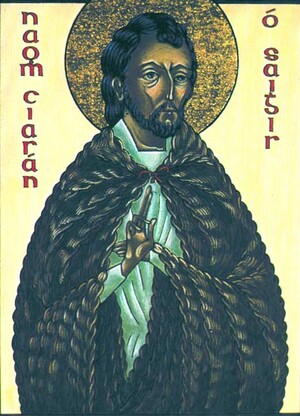
Ireland has four saints who are recorded as openly and miraculously carrying out abortions, Ciarán of Saigir, Áed mac Bricc, Cainneach of Aghaboe and Brigid of Kildare.The life of Saint Ciarán (c. 6th century) told the story of a young virgin, Bruinech, kidnapped by King Dimma who raped her, and she became pregnant. Bruinech appealed to Saint Ciarán, who miraculously aborted the foetus. Later, versions of this Life told of Ciarán making the foetus disappear rather than aborting it. Áed blessed a nun who was pregnant and the foetus disappeared, similarly with Cainneach. Brigid was the only female saint to carry out abortions. She is also the premier female saint of medieval Ireland.
The Penitential of Finnian written c. 591 CE lists the punishment for women who abort
- If a woman by her magic destroys the child she has conceived of somebody, she shall do penance for half a year with an allowance of bread and water, and abstain for two years from wine and meat and fast for the six forty-day periods with bread and water.
It is worth noting here that the penance is quite a lenient one and was much less for example than the time assigned to penance for childbirth which demanded six years fasting on bread and water. These sanctions appear to indicate a society where women were certainly acquainted with reproductive choices, exerted agency in choosing to abort and in which the penalties for doing so were quite minor.
Knowledge of abortifacients must have been passed down through the (female) generations and were thus greatly feared by the (male) Establishment because “they subversively aimed the devious weapon of spells and potions at the patrilineal kin group, the community, and all orderly, congenial gender relations.” Thus the killing of the foetus was not so much the issue at stake rather it was the power of the women who chose to do so (and had the means to do it) that was feared as it lay outside male knowledge. Making the link between a woman’s reproductive freedoms and witchcraft ranks as a severe challenge to female reproductive agency.
Abortion in Medieval Ireland (Dr Gillian Kenny)
With kind permission.
Thanks Ciara