Tag Archives: Mother and Baby Home Report

Yesterday.

In a response to the Final Report of the Mother and Baby Home Commission of Investigation…

…Children’s Minister Roderic O’Gorman launched a consultation process seeking submissions on what should be included in a Restorative Recognition Scheme, as ‘reparation for the wrongs that occurred’ in the homes.

To help with this, Minister O’Gorman has employed the services of Oak Consulting, a Wexford based group specialising in conflict resolution.

Bebe writes:

‘To me, it’s another delaying tactic, outsourcing what the Government themselves should do, with the opportunity for them to look perplexed when it goes pear-shaped. They haven’t a notion of adopting the recommendations – i.e. they will continue to deny as many women and children redress as they possibly can.’

Anyone?

Yesterday: Mother and Baby Home Report Update


Last night.

Tuam Campaigner Breeda Murphy is joined by English lawyer Frank Brehany (top left), who movingly tells how he fulfilled a promise to his late father Frank Snr. (top right), a Tuam adoptee.

Eunan Duffy was unable to join us but will return next week.

This is the tenth in a series of shows with Breeda and Eunan looking at all aspects of the Mother and Baby Home Report. They can be viewed here.

Minister for Children Roderic O’Gorman in the Dáil yesterday

This morning.

Ahead of a vote in the Dáil later on a Social Democrat motion to extend the Mother and Baby Home Commission of Investigation by 12 months…

…an open letter to TDs from Tuam campaigner Breed Murphy:

They told us they couldn’t find anything; that there is no trace of the mother. Imagine reaching your eighty-eighth year and not knowing who you are? Or when your grandchild looks into your eyes and says “Grandad tell me about your mammy” as they often do when they experience unconditional love and presume that Grandad’s experience was just like theirs.

Imagine that is your child asking your father to recall what he cannot.

Our State has done that to our people. Time and again we have failed survivors of Ireland’s institutions. It is the eleventh hour and you can change that. Power is invested in you, each one of you because you too are social justice advocates just like me.

Over six years ago I began working full time, on a voluntary basis as a post-graduate student with experience of three different disciplines, on the issues related to Mother and Baby Homes. I attended the very first meeting in Galway in 2015 where I met with survivors; shy, reserved yet resilient people they came together to begin the process of discovery. A process that is ongoing.

I had met people just like them on the streets of Camden and Cricklewood where I conducted research for my thesis on the ‘Forgotten Irish’ in 2009. I found, to my dismay, Ireland had neglected them not just in their now latter years but in their childhood where in the Institutions they were housed, survival of the fittest against many odds where abuse and neglect as discovered in the Ryan report was “systemic, endemic, arbitrary, excessive, chronic and pervasive.

The most recent publication of our dark chapter in the Commission’s report dilutes survivor testimonies to the point where they are not recognised as the truth-teller, the witness, the whistle-blower. We are told the institutions provided a ‘refuge’ which translates as a place of safety or shelter. Testimonies from survivors tell us otherwise.

The Commission found that there was very little evidence that children were forcibly taken from their mothers and while it accepts mothers did not have any other option it says is not the same as ‘forced adoption’.

One has to ask the question how much evidence is enough?

Surely if one or ten or a hundred say they were not allowed care for their own child, it is enough. One translates to two lives ruined and an aftermath of intergenerational trauma to a wider circle.

Again, in relation to adoption the Commission reports women who claimed their consent was not full, free or informed are reminded that it may not be their view at the time of the adoption. Because the Commission is looking for hard evidence but admits evidence is thin on the ground.

Like the story of Jackie Foley who was forced to sign a fictitious name when aged 15 on the adoption of her baby. Or the case of Tressa Reeves and her son Patrick Farrell who settled their case in 2018 against the State some fifty seven years after his illegal adoption. Evidence is there – sometimes staring in the face. Then to cap it all, those same survivors are told their evidence is contaminated.

I honestly do not have words for this injustice though it is a continuum through decades, nothing historic about it. You have the opportunity to change the narrative in favour of survivors.

It takes courage and conviction but not nearly as much courage as it has taken for survivors to trust the system, step up to the mark and pour out their innermost fast held secrets because they, like me, felt you would believe them.

Please on behalf of the many people who were trafficked as early as 1926 in the case of the Tuam Mother and Baby Home, from one institution to another; some spending formative years in two, three institutions or boarded out or picked by an American couple, please remember them in these dying days of the Commission.

Because they are not alone in Tuam, or Dunboyne or Roscrea or Kilrush or Newtowncunningham – they are scattered far and wide, throughout the globe and the length and breadth of our country, in your parish and mine.

They deserve equal recognition for what they endured and an answer as to how a report that places them central to the process lulling them to a false sense of security only denies them again.

On Tuesday, we spoke for some twenty minutes on a podcast with Deputy Jennifer Whitmore who put forward the motion. We are grateful to her and those of you who stood in the Dail to advocate today and on other occasions in both houses. Because as ever, when we do not acknowledge past failings we are bound to repeat them. We are doing so today.

Please do not let this be your legacy, that you stood on the wrong side in history. Lest that day comes when your grandchild sits on your lap and says “Gran(dad or ma), tell me what you did in Dáil Eireann”. Let your response be “there was a time when we treated women and little children badly and I stood up for them”.

Stand with us, for truth, for justice, for recognition and most of all for accountability.

Kind Regards,

Breeda Murphy

Activist on Mother and Baby Homes.

Yesterday: Time Is Not On Our Side

Minister for Children Roderic O’Gorman in the Dáil this morning

This afternoon.

The Government has been accused of speaking out of both sides of its mouth on the issue of extending the Commission of Investigation into Mother and Baby Homes.

Social Democrats TD Holly Cairns said:

“Earlier today, the Government committed to not blocking the Social Democrats’ motion to extend the Commission of Investigation. However, when challenged by my colleague Gary Gannon TD to give effect to this by allocating time in the Dáil, they voted that proposal down.

“This shows that the Government is attempting to look both ways on the issue. To avert a rebellion of Government TDs and to give the appearance of wanting to do the right thing, they avoided having to vote down the Social Democrats’ motion to extend the Commission.

“It is a disgraceful attempt to effectively hoodwink the Dáil. The Social Democrats have legislation ready to go and the Government simply must allow time for the motion to be brought into effect.“

Earlier…

Last night.

Social Democrat TD Jennifer Whitmore (at Leinster House yesterday, top) joined adoptee and activist Eunan Duffy and Tuam campaigner Breeda Murphy to discuss her party’s bill to extend the Mother and Baby Home Commission of Investigation by 12 months.

The commission is due to be dissolved this Sunday amid rancour over the treatment of witnesses’ testimonies.

The bill is being debated in the Dáil today (watch live here) and will be voted on Tomorrow. The government has said there will be no free vote.

Meanwhile…

This morning.

A letter from the Irish Council for Civil Liberties (ICCL ) and Amnesty International Ireland calling on TDs to  extend the term of the Commission of Investigation into Mother and Baby Homes.

ICCL

Minister for Children Roderic O’Gorman has said he is “not accepting” the statement by the Commission of Investigation into Mother and Baby Home that they do not believe deleted audio testimonies from survivors are retrievable.

This morning.

Further to the decision to delete audio recordings of witnesses who gave evidence to the Mother and Baby Homes inquiry…

…the recordings were made when former residents were invited to tell their personal stories to the inquiry. Its final report said people were informed before they gave evidence that the recordings would be destroyed. But some witnesses dispute that and the Data Protection Commissioner has questioned the legal basis for the deletion.

Speaking on RTÉ’s Today with Philip Boucher Hayes, Minister O’Gorman said:

“It responded to me on Tuesday saying they believe the audio files weren’t retrievable. I’m not accepting it. We all know how difficult it is to permanently destroy electronic information.

“So I’m going to be continuing to engage with the commission on that to see if there is any technical solution available to the retrieval of those files.”

Minister ‘not accepting’ commission statement on deleted testimonies (RTÉ)

Meanwhile….

This afternoon.

Social Democrats TD Jennifer Whitmore will next week introduce a Dáil motion to extend the timeframe of the Mother and Baby Homes Commission by one year. The commission is scheduled to be dissolved on February 28.

Deputy Whitmore, Soc Dem spokesperson for Children, said:

“We in the Social Democrats have a real concern that there is no legal basis for what the Commission has done here. We have written to the Office of the Data Protection Commission seeking an investigation into the circumstances surrounding this and the legality of such destruction under Article 6 and 9 of the GDPR legislation.

“Pending all the questioning and potential investigations into this act, we are calling for an extension to the Mother and Baby Homes Commission. There are concerns that if it does wind down, investigations cannot be fully carried out and questions will remain unanswered as a result.

“Our Dáil motion is a call to buy more time for survivors in their search for truth and justice.”

Minister ‘not accepting’ commission statement on deleted testimonies (RTÉ)

RollingNews

Last night.

Tuam campaigner Breeda Murphy and adoptee and activist Eunan Duffy discuss the refusal by Justice Yvonne Murphy (top) to take questions from TDs and Senators about her controversial report into Mother and Baby Homes.

Judge Murphy had asked for an alternative date for her appearance before a joint Oireachtas Committee on Children, but has now indicated that she will not attend.

The commission of investigation is to be dissolved on February 28.

This is the eighth episode in a series of shows with Eunan and Breeda dealing with Mother and Baby Homes across the island of Ireland and the issues facing birth mothers and adoptees. All are available on our YouTube channel.

Meanwhile…

Mother-and-baby homes were shrouded in secrecy and some witnesses who gave evidence to the inquiry were traumatised individuals who had never spoken to anyone about being in the institutions.

The confidential committee hearings were set up to allow survivors to describe their personal experiences in a non-confrontational way.

Anonymity was assured and their accounts and allegations were to be listened to without challenge.

Privacy was a concern for many witnesses and, given several said their pregnancies were a result of rape for which no-one was convicted, their testimonies were legally sensitive.

The Data Protection Commission said: “We have written to the commission with a number of questions around the deletion, and the legal basis for the deletion, of these records.

“We are awaiting their response.”

When asked about the deleted recordings, the inquiry told BBC News NI it had explained the matter in its final report.

“Witnesses were asked for permission to record their evidence on the clear understanding that the recordings would be used only as an aide memoire for the researcher when compiling the report and would then be destroyed,” the report stated.

Mother-and-baby homes: Questions raised over recordings being deleted (BBC)

From top: Jennifer Whitmore TD and Taniaste Leo Varadkar

This afternoon.

The Dáil at the Convention Centre, Dublin.

Social Democrat TD Jennifer Whitmore raised the destruction of testimonies given by survivors to the Mother and Baby Commission of Investigation. Witness testimony was quickly erased without detailed transcripts being made.

Deputy Whitmore said:

“Tánaiste, 550 survivors gave their testimony as part of the mother and baby homes commission. Those recordings were never fully transcribed ad they have since been destroyed. This is despite assurances from the minister in October that survivors would be able to access their own story.

“And also a clause in the 2004 Commission of Investigation Act that the commission is required to retain all evidence it receives.

“It’s been reported that the DPC [Data Protection Commission] has contacted the commission regarding the destruction of these files. However the commission is due to be dissolved on the 28th of February which is only a few weeks away. I think it’s really important that we don’t fail these survivors again, Tánaiste.

So I would ask will the Government immediately extend the term of the commission to enable for a full investigation of the destruction of these files and to enable the recovery of any information.”

Tanaiste Leo Varadkar Leo Varadkar replied:

“Thanks, deputy. I only heard about that the other day and was quite surprised to hear it, quite frankly. But it is something that I known the Minister for Children is now aware of and it’ll be for him, as to whether or not it makes sense to further extend the term of the commission.

“I think it is important to say again that the Mother and Baby Home Commission is independent of government. It was established by the Oireachtas. It’s not controlled by the Government, or the creature of Government. Commissions, by their very nature, just like tribunals, are independent bodies.

“And I think perhaps one of the flaws in the process is an independent body, like a commission, can spend five years hearing evidence, examining evidence and then makes its report but then is not there to explain it.

“And you’re there, as a Government minister, left trying to explain a report that you had no role in actually drawing it up. I don’t blame the commission for that in any way but I think if we’re going to do another inquiry on another similar issue, we [inaudible] with a better way to do it.”

Previously: Mother and baby homes: Audio recordings of personal interviews have been destroyed (Irish Examiner)


From left: Social Democrat TD Holly Cairns; Tuam Mother and Baby Home burial site

Yesterday.

Dáil Éireann.

Social Democrat TD Holly Cairns asked Taoiseach Micheál Martin if he would observe the ‘legal obligation’ to hold inquests into deaths at Mother and baby Homes.

Deputy Cairns said:

“Under the Coroners Act, it is the duty of a coroner to hold an inquest when a body is found in his or her district and when a person dies in State custody or detention.

Given that the mother and baby homes commission has reported on mass disappeared infants’ and children’s remains in unmarked graves, there is a legal obligation for inquests to be carried out for each deceased individual.

We know this relates to a large number of coroners in every relevant district and would be unprecedented in the use of resources. There is a legal obligation, however. Will the Taoiseach ensure that coroners carry out their duty to ensure that survivors get justice?“

Taoiseach Micheál Martin replied:

“I will make further inquiries on this. There are clearly legal obligations but that in itself is an enormous challenge going back to the early decades of the State from the 1920s, 1930s and 1940s. The 1940s in particular saw an appallingly high infant mortality rate in mother and baby homes. The Minister for Children, Equality, Disability, Integration and Youth is developing a broad base response to the commission’s report. How to deal with this will form part of it.”

Anyone?

Yesterday: ‘Gaslighting Survivors’

RollingNews


From top: Senator Mary Alice Higgns; Senator Joe O’Reilly and  Senator Gerard Craughwell

Yesterday.

Seanad Éireann.

Senators resumed debating the conclusions drawn from the Report of the Mother and Baby Homes Commission of Investigation with many powerful contributions.

Some highlights.

Senator Lisa Chambers said:

“Questions remain to be answered by the commissioners themselves over some of the language. I do not think the Minister is in a position to answer the questions that we might have about certain phraseology used in the report. I refer to the statement that there was no evidence that children were harmed in these institutions. That is an obscene statement and one that is nothing but insulting to the survivors of those homes. Direct testimony is evidence. People recounting their direct experience is evidence. Are we looking for CCTV footage? Are we looking for photographic evidence? Who are the commissioners to decide that the evidence is not there? Were they so long in the bubble of doing this report that they became desensitised and cold to the experience of the people that lived through this experience?

“Questions must be asked about the accounts that some survivors gave that were not properly accounted for in the investigation. I refer to questions that were apparently put to survivors that were never put to them.

“We cannot simply brush over those things. There is now an onus on the Government and the State to address those questions properly. I reiterate my call that the commissioners involved in preparing this report should, take questions from survivors, the public and the media. They are not in isolation. They are publicly known now; we know who they are. They were paid well for their work. They were given ample time to complete their work. I do not think the State received from them the level of workmanship that would have been expected on that report.”

Senator Sean Kyne said:

“It is also clear that in this State, it was a man’s world. There were men who got girls and women pregnant and did not take responsibility. Of course, that does not apply to all men, as others have said, but there were those who did not take responsibility. We think of the men in the church, and it was predominantly men, although many nuns also acted in an unchristian manner within these institutions. We think also of the men in politics, and it was predominantly men, in the Dáil, Seanad and local councils. Some of those men were in charge of these institutions.”

Senator Gerard Craughwell said:

“I was in a house on the night that a girl who was working away from home rang her mother to tell her she was pregnant. The girl’s father was a stern, Victorian man and I remember the family that night being in panic about how they were going to deal with it and how they would tell the father.

“As soon as that man heard it, the first thing he said was: “Bring my daughter home and let me look after her”. Not every family disowned their child and I take grave exception to the practice of calling out families as having deserted their children.”

Senator Malcolm Byrne said

“I do not buy it that some natural mothers do not want contact with their children.

“The evidence shows that one in 20 natural mothers who were on the national adoption contact preference register did not want contact with their son or daughter, but at no stage did they want information about their health circumstances and so forth denied to their child.”

Senator Joe O’Reilly said:

“The process is just starting now and I see it as being a two-pronged approach. The first is that we are remembering and acknowledging in a very public, holistic and proper way. We are even allowing further testimony. We are doing all that. The second is that we compensate in a generous, holistic and unmiserly way that will not be difficult to access. These people experienced enough hardship as vulnerable people. It is time they were the recipients of kindness from the State.”

Senator Alice Mary Higgins said

“The report tells us that the Irish Human Rights and Equality Commission asked for any investigation to be informed by human rights law, but the Government did not opt for that approach in its mandate to the commission. This raises very serious questions. The sidelining of human rights really does show.

“When the State puts a payment on the heads of vulnerable people, as it still does with regard to direct provision and homelessness, it can be dangerous. When the State surrenders power to religious orders, as is currently planned for the national maternity hospital, it can be dangerous. I urge the Minister to work with all of us to build a state that takes responsibility for the past and for the future.”

Senator Vincent P Martin said:

“We had the Dáil Éireann republican courts from 1919 to 1924 during the struggle for independence when the people turned their backs on the British common law system. There was a judge all those years ago called James Creed Meredith.

“In a groundbreaking decision at the time, by applying Brehon law rather than common law, he ruled that the father of a child born out of wedlock ought to pay maintenance. It is a small thing. When we restored the British-style Judiciary in 1914 we reapplied the common law and we reversed that decision.

“That was the position all the way up to our lifetime and the 1980s. Then, past Members of this House – we should give them credit for it – including Mary Robinson and Nuala Fennell, were instrumental in giving recognition to such basic rights as inheritance rights and recognition for children born outside of wedlock.”

Senator Annie Hoey said:

“I refer to the insistence that the Church and the State did not force women into the mother and baby homes and that there was no forced adoption or coercion. I speak for many people when I say that those statements are incredible, almost audacious. My colleague, Senator Craughwell, put it correctly when he said that this is gaslighting survivors. In the same week that we have had the first person convicted and sentenced for coercive control, a crime for which I believe a twelve-and-a-half-year sentence was handed down, I find it extraordinary that we can recognise coercive control as a crime but not cast our eyes back into our grisly past and see the deep coercion that took place in those homes.”

Senator Garret Ahern said:

“When the Department of Health proposed turning the Sean Ross Abbey into a home for children with special needs in the 1960s, the Bishop of Killaloe rejected the proposal. His intervention resulted in a number of visits to the bishop by senior civil servants and letters from Ministers. The closure of the Sean Ross Abbey was delayed for several years until the bishop had died and his successor subsequently gave his approval. During those years, many children died.”

Transcripts via Oireachtas.ie

Thanks Breeda Murphy

Last night

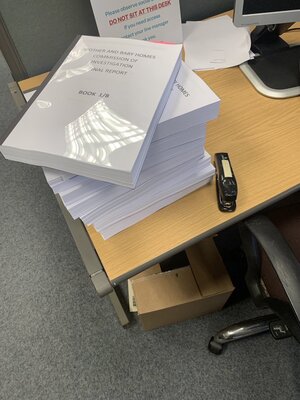
Tuam campaigner Breeda Murphy and adoptee and activist Eunan Duffy on the reaction from survivors to the publication of the weighty if insubstantial Mother and Baby Home Report (top).

This is the sixth in a series of shows with Eunan and Breeda dealing with Mother and Baby Homes across the island of Ireland and the issues facing birth mothers and adoptees. All are available here.

Pic via Joe Duffy