Tag Archives: Mother and Baby Home

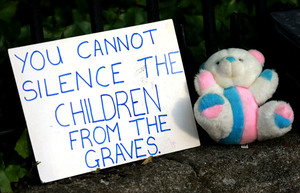
From top: Outside the former Mother and Baby home in Tuam, county Galway; Mairead Enright

This morning.

Further to the publication by 25 academics of an alternative executive summary to the Mother and Baby Homes Commission of Investigation final report…

…one of its authors, Mairead Enright writes:

‘The Commission of Investigation into Mother and Baby Homes concluded that primary responsibility for the treatment of unmarried women and girls and their children lay with their own families and with their children’s fathers. Our approach required us to reassert the primacy, in law, of State responsibility for addressing human rights abuses.

Here are just three examples of differences between the commission’s reasoning and ours.

The commission suggests that children who did not spend long in an institution are unlikely to have been abused. By contrast we recognise forced separation from a parent as a harm in itself. We also highlight the particular vulnerability of young children, who may suffer greatly even from brief periods of institutionalisation because they are completely dependent on adults and unable even to attempt escape.

The commission dismisses claims related to maltreatment in childbirth by referring to the presence of trained medical staff in the institutions. We recognise that the experience of giving birth in an institution may be inhuman and degrading where one is totally under the control of the institution’s staff, subject to regular punishment and emotional abuse and perhaps very young and separated from all other support structures.

The commission insists that “forced” adoption was not a serious issue in the institutions. We unpack its narrow use of the word “force”, taking seriously the many social and emotional pressures that made resistance to adoption almost impossible for unmarried Irish women, well into the 20th century.’

Alternative Executive Summary here.

Why mother and baby homes report findings cannot be let stand (Mairead Enright, Irish Times)

RollingNews

Last night.

Mother and baby Home activists Breeda Murphy, Eunan Duffy and Frank Brehany discuss the latest developments on the fall-out from the Mother and Baby Home report and the reaction to the discovery of burial sites in Canada.

Eunan shares the research that led to the revelations in last week’s Sunday Times (above) that the bodies of at least 27 children were donated for medical research without consent to Queen’s University Belfast including from Mother and Baby homes.

This is the 19th in a series of shows with Breeda, Eunan and Frank looking at issues surrounding the publication of the Mother and Bay Home Commission of Investigation report. They can be viewed here.

Bodies of 27 children donated to Queen’s University for medical research (Justine McCarthy, Sunday Times)

From top: A memorial at the site of a former Catholic-run residential school in Saskatchewan, Canada last week; a protest at the Mother and Baby Home Commission offices in Dublin last January; ‘Cue Frank’ podcast

This afternoon.

A new ‘Cue Frank’ podcast by Mother and Baby Home activist and lawyer Frank Brehany, whose father was a Tuam adoptee.

Frank, a founder member of SALI, discusses the Institutional Burial Bill and the Irish connection to the recent discoveries of unmarked burial sites in Canada.

Previously: “We Need To Know Who Died, We Need To Know How They Died”

RollingNews/Getty

Historian Catriona Crowe (right): The Mother and Baby Home Commission of Investigation committee in 2015, at left: Professor Mary Daly, Judge Yvonne Murphy and child law expert Dr William Duncan

This morning.

On RTE’s Today with Claire Byrne, presented by Damien O’Reilly.

Historian and former head of special projects at the National Archives of Ireland Catriona Crowe spoke about her essay in the Dublin Review which outlines how the testimony of Caroline O’Connor, Noelle Browne and Annette McKay – given to the Confidential Committee of the Commission of Investigation into Mother and Baby Homes – was misrepresented in the commission’s report.

Some 550 people’s testimony given to the Confidential Committee was excluded from the commission’s main report and did not help form the commission’s findings, one of which was that the commission did not find any evidence of forced adoptions. Ms O’Connor’s testimony explained how she was forced to give up her son for adoption.

From Ms Crowe’s interview….

Damien O’Reilly: “Just back, once again, to the discrepancies, that you discovered in your investigation and back to Caroline and to Noelle and, indeed to Annette later, who you refer to in your essay as well, explain, for example, how deep these discrepancies were?”

Catriona Crowe: “Well, in the case of Caroline O’Connor, we have what amounts to about a six-page vivid testimony which she wrote down, she gave a copy of that to the commission and she read it out during the course of her session with them. She spent just over an hour, speaking to the confidential committee. As you’ve just said, she had the brilliant inspiration to tape that herself. So I was able to listen to that tape and then identify Caroline in the confidential committee report where everything is anonymised so you don’t get the details of what institution people were in, or any allegations about individuals, fair enough. That would require them to be able to comment on it.

“So. Those six pages of vivid testimony, that hour long discussion that she had with the confidential committee is reduced to two paragraphs and three quotes. The three quotes allegedly come from her own words. One quote is accurate, one is entirely made up, it does not exist either in her own testimony or in the tape that was made. And the third is botched. She’s misquoted and it makes something very serious in her life sound grotesque in a way that it was not.

“So what does that tell us? It tells us that, yes, they made a tape, they told her they would make a tape, they said nothing about destroying the tape, by the way, after the event, which is of course what happened. Did they listen to the tape when they were coming to the point of trying to reduce this material down to a size for their confidential committee? It would seem they didn’t.

“They were taking notes. Were those notes impressionistic notes? Or were they made by a stenographer who knew shorthand? I mean we shouldn’t have to go into all of this detail. But it’s still a mystery how survivors could be so misquoted and misrepresented in the confidential committee and, primarily, so reduced. Two paragraphs from all that wonderful information.”

Later

O’Reilly: “Is the testimony, in its collective, does it take from the actual thrust of the final report when you take all of the testimonies together even if there are paragraphs here and quotes here and there. Do you think that it takes from the overall thrust and final report?”

Crowe: “Well the fact is that the commission decided itself not to include it. This is main issue here. This is the real problem. The commission, by the admission of Professor Mary Daly who appeared at a seminar in Oxford last week, did not include the 550 testimonies to the confidential committee as part of their final report and those testimonies did not inform their conclusions. That is critical here. Because some of their conclusions were that there was no evidence of physical abuse in the mother and baby homes, no evidence of forced adoption, that the church and state were not the main perpetrators…”

O’Reilly: “Yeah, it was family members…”

Crowe: “Yes, it was family members and fathers which goes against every idea of historiography we have for the 20th Century, so….”

O’Reilly: “They were complicit but probably not the main drivers. I mean where did families get these ideas in the first place. But the point I’m trying to make is the commission left out the testimony of 550 people. There were 60 others that spoke to the investigative committee which they did apparently take into account or say they did. We are now missing a huge chunk of what should have had a bearing on the conclusions and recommendations of this commission. They are not there. That is serious.”

Later

Crowe: “It’s remarkable when you compare this commission to other previous ones. That the commission’s decided not to give a press conference when the report was published, not to launch it and own it themselves as their commission’s report. And to take questions from journalists and from survivors as Sean Ryan did back in the day when he published the report on industrial schools, as Martin McAleese did [Broadsheet note: Martin McAleese took no questions following the publication of his report into the Magdalene Laundries], whatever the shortcomings of these reports, their authors owned them and came out and answered questions, legitimate questions about them. That has so far failed to happen with this commissioners and it is mysterious. One would think, after producing 3,000 pages, five years of work, they would want to come out and defend what they have written and their conclusions…”

Later

Crowe: “Many people who went to the confidential committee desperately wanted to speak to the investigative committee and were not allowed to do so. So fine, you can actually…”

O’Reilly: “How were the people that spoke to the investigative committee, how were they chosen?”

Crowe: “We don’t know. We actually don’t know.”

O’Reilly: “How many of them were there?”

Crowe: “64. I think 19 applied directly to go there [to the investigative committee]. Now I’m not an expert on this…but I did count in the report the number of survivors they mention from the different institutions…”

O’Reilly: “And was the evidence gathered from the investigative part of the commission, did that form the main body of the report? Whereas the 550 people who spoke to the confidential side of the commission, was their evidence disproportionate in the final report?”

Crowe: “It wasn’t there at all. That’s the point. The evidence from the confidential committee remains in a bubble to one side. It does not inform the conclusions.”

O’Reilly: “At all?”

Crowe: “No! We’ve been told that by a commissioner.”

Later

Crowe: “They [people working within the commission] may have been lawyers, our learned friends are, of course, very experienced people in all kinds of ways, they may be used to interviewing people and writing reports but those are legal interviews, they had no training in how to deal with people who were telling very traumatic stories to them and they certainly had no training in oral history and how to conduct those kind of interviews properly. So, yes, they were lawyers, grand, great. It didn’t meet the case. And in fact it doesn’t matter because whatever we say about the professionalism or otherwise about the people conducting the interviews, the end result is to mangle, misquote and misrepresent at least two or three of the testimonies that we know about that went to the confidential committee.

Now the miraculous outcome of all of this is that, despite the commission destroyed the original tapes, made by the confidential committee, 550 people’s tapes, the back-up tapes were discovered to be in existence…”

Later

Crowe: “As far as we know, from the tapes I’ve heard, I’ve heard two tapes now, in neither case, is the witness told that ‘these tapes are going to be destroyed‘. They’re asked if they agree to have the thing taped as an aide to accuracy for the report, I mean, I quote it in the [Dublin Review] piece for Caroline but they’re not told the tapes are going to be destroyed. That was kept a secret. Now if they can prove, they still have the back-up tapes, that a large number of people were told this, despite the fact that we have two who were not, then we’ll have to look at it again….”

Listen back in full here

Previously: The Language Of Scholarship

From top: Mother and Baby Homes Commission of Investigation in 2015, from left: Mary Daly, Yvonne Murphy and William Duncan, in 2015; Mary McAleese

“I think the Mother and Baby Commission of Investigation report is a magnificent work of scholarship, may I say. I think it’s a superb work of scholarship. It’s cool. It took 5 years. Cool though it is it replete with compassion…

…It is an extraordinarily important archive and I would like to congratulate the authors [Judge Yovonne Murphy, historian Professor Mary Daly and child law expert Dr William Duncan] who put five years of their lives into this. Let’s remember who they were.

Nobody knows more about this story, apart someone like the extraordinary heroine Catherine Corless and the women who suffered through their experiences in these institutions, there are probably few people in the world who know about this situation as these three people do and the team of people who work with them.

You have to remember this is a report that is going to have to stand the test of scholarship, scholarly analysis, of profound research. These women have important stories to tell, every one of them has their own story to tell and I agree absolutely that it’s so important those stories are given absolute respect.

But then you take all the stories and you analyse them and you research them and you try to tell an overall narrative and as the report says from the very get-go, you’re dealing with complexities that are so profound that you are probably never going to be able to satisfy the hurt, the rawness, the woundedness, the need for vindication, the need for an apology, the desire for sorrow and the lives that can never be restored to them…

I was very impressed by the scholarship of the document and some people might think because it’s, you know, a bunch of lawyers and historians, they might find that, you know, the language of scholarship sometimes can appear, you know, not so much distant but objective but I do think there was huge, huge compassion.”

Former President Mary Mcaleese on RTÉ Radio One,  January 16, 2020.

Yesterday, the Dâil heard that a new Mother and Baby Home Commission may have to be established after an admission that the report discussed above ignored hundreds of survivor accounts.

Yesterday: ‘Repudiate The Report’

Gatekeeping

Committee seeks to hear from mother-and-baby home commissioners (RTÉ)

Taoiseach says Mother and Baby Home Commission should go before Dáil, amid outrcy over comments by Prof Mary Daly (Independent.ie)

From top: The Bessborough Mother and Baby Home in Cork; A map indicating a children’s burial ground on the grounds of the former institution

This morning.

Via Irish Examiner:

In its decision, posted to participants in last month’s oral hearing on the project, the board said having regard to the fifth interim report and the final report of the Commission of Investigation into Mother and Baby Homes, and on the basis of the information submitted in the course of the application and oral hearing, it is not satisfied that the site was not previously used as and does not contain a children’s burial ground.

It said it considers that there are reasonable concerns in relation to the potential for a children’s burial ground within the site associated with the former use of the lands as a mother and baby home over the period 1922 to 1998.

Plan to build 179 apartments on Bessborough grounds rejected (Irish Examiner)

Last week: ‘Perhaps Forgetting Where They Were Buried Is A Way Of Forgetting That They Died’

Anne Kelly Silke was fostered out of Tuam Mother and Baby Home aged nine.

January 12.

Yesterday.

‘Anne was moved from one home to another, more often treated as an unpaid servant than as a family member. Her childhood was one of beatings, deprivation and loneliness. As she grew up, she experienced prejudice for being a “Home Baby” and even found it hard to find a partner locally…’

From a Would You Believe? documentary on Anne and the Tuam babies, RTÉ One.

RIP.

Friday: Mother and Baby Home Report Update

Last week: Whitmore Time

Getty

Yesterday’s Sunday Independent

“The plan is that it will go to the Cabinet that week, and following the Cabinet meeting, the Taoiseach and I will host a webinar solely for survivors at which we will discuss and bring out the major conclusions of the report for survivors. It will only be after that point that it will be available. We will hold a press conference for the general public, but we will be engaging with survivors first and telling them first.”

Minister for Children Roderic O’Gorman, December 3, 2020

“It is extremely disappointing that the leak has occurred. Survivors were given clear assurances about how the release of the report would be handled. The publication of details of the report in the media today flies in the face of this. Minister O’Gorman needs to set out how he will establish how the leak occurred.

“He also needs to set out again how he will consult with survivors and survivors’ groups and ensure that assurances made about how the report will be released will be honoured.”

Social Democrats spokesperson for Children, Jennifer Whitmore TD this morning

Good times.

Friday:  A Week of Reckoning

From top: Minister for Children, Disabilty, Equality and Integration Roderic O’Gorman TD; Mother and Baby Homes Commission of Investigation members at the commission’s launch in 2015, from left: Professor Mary Daly, Judge Yvonne Murphy, Dr William Duncan.

This morning/afternoon.

Some details surrounding the publication next week of the long-awaited report by Mother and Baby Homes Commission of Investigation have been released.

Via Tuam Mother and Baby Home Alliance:

Minister for Children, Disabilty, Equality and Integration Roderic O’Gorman has advised this morning that he will be bringing a Memorandum to Cabinet on Tuesday the 12th January as he intends to seek approval for the publication of the Final Report of the Commission of Investigation (Mother and Baby Homes and certain related matters) and the Commission’s Sixth Interim report.

On the same day, he will also bring a separate Memorandum seeking approval to proceed with the Certain Historic Burials (Authorised Interventions) Bill, which will allow for exhumation and dignified reburial of the remains interred at the site at Tuam. Pending Cabinet approval, the Bill will then proceed to pre-legislative scrutiny in the Oireachtas.

After the Cabinet meeting, An Taoiseach and Minister will host an online presentation for former residents and those directly affected  to outline some of the key findings from the Report, along with details of the initial Government response.  The Minister has provided details of how we can access the online webinar.  The webinar is not open to the media who will be afforded a separate briefing after the webinar has concluded.

Meanwhile…

Last night.

Breeda Murphy, of Tuam Mother and Baby Home Alliance, and Mother and Baby Home adoptee and activist Eunan Duffy on what they hope and expect from the report.

RollingNews, Chris Bellew /Fennell Photography

Over the weekend.

The Two Norries podcast met traveller Catherine Coffey O’Brien.

Catherine spent a large part of her childhood in an industrial school and then in Cork’s Bessborough mother and baby home as a pregnant 16 year old. She has called for Bessborough – earmarked for a housing development – to be preserved and appropriately maintained as a memorial site.

Catherine (@1.07) explains why she believes medical histories should be provided to all adoptees but the identity of birth mothers must remain confidential.

The report of the Commission of Investigation into Mother and Baby Homes will be published next week.

Previously: Unto Us A Child Is Born

The Two Norries