
 David Scott tweetz:
Nice to see the posh folks of Rathmichael have named their houses on Google Maps. Check one of them.



David Scott tweetz:
Nice to see the posh folks of Rathmichael have named their houses on Google Maps. Check one of them.
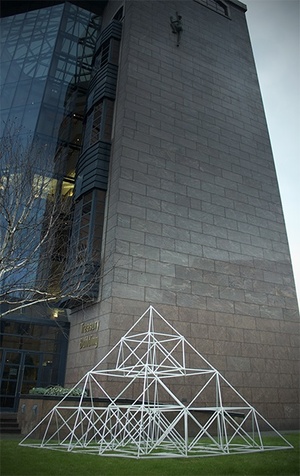 This afternoon.
Dave Madigan and Meadhbh O’Connor write
We are two visual artists working on a joint project entitled ‘Power Structures’, which involves the photographing of a temporary sculpture in different loci of power. We are interested in aspects of power in its many manifestations.We have constructed a modular Sierpinski pyramid as a symbol of a hierarchical structure, i.e. many components on the lower layer, proportionally fewer on the layer above and so on rising to a single apex.
We have been photographing it with various recognisable institutions or agencies of power and influence, be they political, financial, religious, infrastructural or social. It is our intention to elicit in our audience a questioning of the nature, distribution and formation of power in society. We took this at 4pm outside Nama’s headquarters in Treasury Building, Dublin.
 More information on the project here.


TWO OF the State’s most ambitious developers, Johnny Ronan and Richard Barrett, will see the end of their globe-spanning company, Treasury Holdings, next week after conceding defeat in litigation taken by one of its banks.
Liquidators are expected to be appointed on Tuesday to the insolvent property business by the High Court after the company said it was no longer resisting an application by KBC Bank to have the company wound up over a debt of about €55 million. The rejection of a last-minute offer by US bank Morgan Stanley to buy the company’s debts from the State’s National Asset Management Agency (Nama), which supported KBC’s action, has led to the imminent failure of the group, sources close to the company said.
One of Nama’s top 10 debtors, Treasury has total debts of €2.7 billion, including more than €1 billion with the State loans agency.
(Laura Hutton/ Photocall Ireland)




On April 1, 2012, the Sunday Independent published an article stating UK equity firm Forum Partners had hired former Nama executive and portfolio manager Enda Farrell “to scour the Irish market for distressed debt deals”.
On August 5, John Mooney, of the Sunday Times, reported that Farrell and his wife Alice Kramer had purchased a five-bedroom house in Sundaywell, Lucan, Dublin for €410,000 in December 2011 from the agency’s portfolio without the board of Nama knowing about the sale.
The property was never advertised.
The article stated Farrell bought the home after he made an unsolicited approach in August 2011 to the previous owner Thomas Dowd, a former business associate of Derek Quinlan.
It said Farrell didn’t tell Dowd about his position in Nama. Dowd had bought the house for €1.4million in 2004.
Mr Mooney wrote: “Dowd is believed to have provided Nama with Farrell’s name and address before the sale, but the agency’s compliance and supervisory departments appear not to have noticed the connection.”
He added an investigation by the newspaper prompted officials in Nama to carry out an internal inquiry.
On August 6, 2011, it was reported that Farrell felt he acted in good faith.
The Irish Daily Mail quoted him as saying: ‘In July 2011, at a time when my wife and I had decided to purchase our first home but before we had identified a specific property, I discussed the possibility of acquiring a Nama property as my home with the agency’s head of compliance.
‘I received Nama compliance training during which I was told I could purchase residential property as a principal residence. I sought and received informal clearance from the compliance unit to purchase a property as a primary residence.
‘I did not inform Nama of this specific purchase which closed in the weeks leading up to my departure from the agency. I believe I acted with probity at all times.”
On the same day, RTE reported a Nama spokesperson saying they had: “no record of clearance for a transaction in which a former employee bought a NAMA property”.
On August 12, The Sunday Times reported comments from Farrell’s solicitor Robert Dore that Farrell believed some of his co-workers at Nama knew about his property deal.
Yesterday it was reported that Nama had obtained High Court orders last week to issue legal proceedings against Farrell “over the alleged removal of confidential information from the agency.”
The orders demanded Farrell and his wife to hand over all the confidential documentation they had on Nama.
Last week’s proceedings were held in camera. But yesterday, at Nama’s request, the order to keep them private was lifted.
RTE reported: “Lawyers for NAMA told the court that information was taken in a premeditated way over a number of months. The court was told the confidential information taken relates to loans and properties with a combined value of many billions of euro.”
In a statement, Nama said it became aware of the purchase on August 2.
Today, in a report from yesterday’s high court proceedings, the Irish Times reports that Enda Farrell’s wife works in compliance for Ernst & Young..
It also reports that the court heard Farrell sent up to 30 emails containing “highly confidential and commercially sensitive information” from Nama to his wife.
The court heard Nama uncovered this after Deloitte conducted an audit – on foot of learning about the sale. The court heard an internal inquiry is now taking place in Ernst & Young.
Last March, the Irish Independent reported Ernst & Young had earned €8.4million from its work with Nama since its inception.
Deloitte, which is Nama’s internal auditors, had earned €4.8million.

And much more besides.
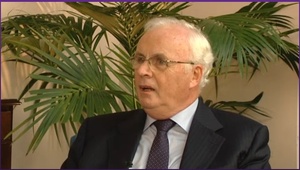
Yesterday NAMA chairman Frank Daly (above) spoke to Vincent Browne (top) on foot of the release of NAMA’s 2011 annual report in which NAMA said it made a profit of €247million for 2011.
Vincent Browne: “Properties originally valued at €74billion were transferred to NAMA and NAMA paid €31.8billion for those loans and assets. What are they worth now?”
Frank Daly: “What they’re worth now, on our books, is probably about €27-€28billion. That takes account of properties that we have sold obviously in the past two and a half years. Put it also takes account of impairment charge provisioning that we have done over the last two years. We’ve done the impairment charge simply because property prices have continued to deteriorate and it’s only correct that we should actually make provision for that. Our approach to that has been quite conservative, quite prudent because we want to be as objective as we can about the figures that are in our accounts. And, you know we operate under IFRS and those accounts are audited. The impairment provision is rigorously evaluated by ourselves, by our own auditors and by our external auditors.”
Browne: “So there’s a loss of about €4 billion. At least. According to your figures.”
Daly: “On the books there is a loss of about €4billion.”
….later
Browne: “We were told that when NAMA was set up that developers would be pursued for every last penny. That we’d get back the €70 billion that we owed or as close to it as possible – not just the €31.4 billion or whatever or €31.8billion that NAMA paid for the properties but the whole lot. Now we hear that ‘No, no, NAMA isn’t bothered about going after every last penny. It merely wants to cover the funds that it paid for these properties. And let the banks, which are largely owned by the people of Ireland, let them suffer the losses.”
Daly: “No, NAMA is realistic, right? We have never said that we would not pursue everything and we still say that to the greatest extent that we can, that we will pursue every penny. But we’re also realistic enough to know that at the end of the day, you know, we pay 31.8 billion for those loans on the basis that that’s the value of the assets backing them up, the securities backing them up. So that’s the sort of bottom line figure. That’s the one we are very definite we’ll collect and is realistic to collect.”
Browne: “You mean that you’re hoping to collect.”
Daly: “Well it’s more than hope.”
Browne: “As of now you’re saying there’s a deficit of about €4 billion?”
Daly: “This is based on analysis, this is based on our strategic planning. This is based on the very rigorous granular evaluation of our portfolio that I just talked about. Will we get more than the €31.8billion? Will we pursue the whole €74? It’s our intention to pursue as much as we can but I mean it would be disingenuous for me to sit here and say to you, or say to anybody, that we’re going to get back the €74 figure, we’re not.”
Browne: “Frank, you’ve given the impression to several of the developers who lost a fortune on these things that you’re really only looking for the amount that NAMA paid.”
Daly: “No, no, sorry.”
Browne: “I got that impression.”
Daly: “No, if you were in here at meetings with developers…”
Browne: “I’d love to. Are you inviting us in, wha’?”
Daly: “I’m not inviting third parties yet. We don’t need a referee right now. They would tell you that all our focus is still on getting as much as we possibly can. But I have to be realistic. NAMA has to be realistic, you know. If the €74 billion were recoverable, you know, there wouldn’t really be a need for NAMA in the first place. You could have just left the whole thing out there with the banks and eventually it would come back. We’re realistic, but rigorous. We’ll chase what we possibly can.”
Browne: “How many of the developers, in respect of the people you’ve been dealing with. How many have you forced to redress property transfers? In other words a lot of them have transferred property to their spouses..And how many of them have you gone after and insisted properties be transferred back?”
Daly: “It’s one of the main focuses of every, of discussion of every business plan of every debtor, you know? What did you transfer in the last five years, seven years, eight years? Was it transferred with a view to taking it away from NAMA? And, if so, bring it back, right. We have brought back between, actual returns of property and charges we have got over property, something like half a billion to date. And I expect that there is a bit more to come there yet. And that’s from a variety of developers because we won’t do business with them. We won’t do business with them unless they bring back assets they transferred.”
Browne: “But you’re doing business with a lot of developers and you’re paying them a lot of money – in some instances up to €200,000 a year, you’re promising them bonuses, there’s a chance they might get their properties back – this isn’t what we were told would happen.”
Daly: “Well, first of all, we’re not, we’re paying three people or indeed, we’re allowing three people out of the overheads of their businesses to take salaries of €200,000 a year. In each of those cases, those individuals are managing now for NAMA, for the taxpayer portfolios worth a billion, a billion and a half, two billion.”
Browne: “Why should we be paying someone €200,000 – people who contributed to the wrecking of the economy. What are we doing paying them €200,000 a year?”
Daly: “It’s a very valid question. And I, and my colleagues in NAMA, would ask ourselves the same question. But, you know, at the end of the day, we’re a commercial organisation. We have to get the best financial return we can for the taxpayer. And we, everyday, have to ask ourselves what decision do we make that actually does that, that gets that. And in the case of these developers who are managing their businesses, who know their business, grew up with the business, made some spectacular mistakes along the way. But if we take the view that they are in the best place to work it out to the benefit of the taxpayer and if we take the view that they will cooperate with us then we allow them to take a salary. I don’t think anybody likes it, you don’t like it, I don’t think the public likes it, I don’t particularly like it but it’s a practical, commercial decision.”
Browne: “Somebody has said that NAMA has become the train driver of the greatest gravy train ever in terms of the fees you’re paying accountants, many of them whom were accountants and auditors of the banks. The fees you’re paying solicitor firms, many of which were also advising many of the developers and some of the banks. The fees you’re paying barristers, estate agents and all of that. What do you say to that?”
Daly: “I say two things. First of all we pay fees because we have to pay fees. We need legal advice, we need accounting advice, we need taxation advice. The alternative is that we create a massive quango in NAMA by employing loads of people in those disciplines. And in a lot of those areas, we only need those skills on a temporary basis. So certainly while last year and the year before, as we were bringing the loans across and doing legal due diligence, we would have paid out a lot in fees for legal and accountancy services. That is in some way non-recurring costs and some of it will not be there in the future. As to who we employ, you know, we go through a public procurement exercise, we get the best competitive rates we can. At the end of the day though we need the best advice we can get.”
Daly later admitted the average pay for 214 NAMA staff members is €103,000.
Previously: So You Saw Harry Crosbie On The Saturday Night Show, Right?
Suspicion Lingers Over The True Financial Condition Of Nama (NamaWineLake)
 The unfinished Gleann Riada estate, Longford, where an apartment block is being demolished by Nama,
It wasn’t meant to be this way
A flood of other [planning] applications were made between 2000 and 2005, most of which were applied for in the name of Flancare Clonmel Distribution Ltd. They included a four-storey 110 bedroom hotel with leisure centre and swimming pool (approved), drive-through restaurant (approved), car showrooms (approved), 11 industrial units (approved), crèche (approved), service station (approved) neighbourhood centre with six retail units (refused) and a 15,000 m2 gross anchor unit retail space with adjoining shops (refused).
And
One of the major issues with Gleann Riada is its location on marshy land, that was historically a flood plain.
Demolishing More Than A Building – The Gleann Riada Folly (Longford News)

It has taken over 30 days of hearings, the court room has been packed to the gunnels with nearly 40 solicitors and barristers, the saga encompassed Bono from U2, Tony Blair, princes, yachts and of course Derek Quinlan “sitting around on his fat arse”, and today we get one ruling on one small – but highly significant for NAMA – aspect of the Paddy McKillen (above) versus the Barclay brothers case in London’s High Court.
Earlier this year, a British High Court judge gave an interim ruling which supported Paddy’s claim on a peripheral point in the case. That ruling was appealed to the British Appeal Court. The point at issue was whether or not NAMA had the right to sell the loans in the way that it did. Paddy said it hadn’t. NAMA said it had.
Paddy has lost.
More Here: Victory For NAMA In Epic London Court Battle (Nama Wine Lake)
Previously: The Relationship Between Paddy McKillen., Alan Dukes And Mike Aynsley

 This morning Sean Quinn, his son Sean (top) and his nephew Peter Quinn were found guilty of trying to put some of Quinn Group’s international property assets out of the reach of Anglo Irish Bank.
On foot of this IBRC (formerly Anglo) CEO Mike Aynsley (above centre) said: “Bringing this contempt motion was a valid and necessary step for IBRC to take. “The proven planned, covert and illicit actions taken by the Quinns and connected parties have resulted in millions of Euros being lost or put at risk. IBRC will continue to seek to remedy this and recover as much of the remaining assets as possible on behalf of the Irish taxpayer.”
Separately last Saturday the Irish Independent reported: “The Comptroller and Auditor General (C&AG), questioned the value of NAMA trawling for hidden developer assets, even where debtors were not co-operating with the agency.…Some hidden wealth was discovered, but the assets ‘were insignificant in value and not all would result in a benefit to NAMA’, according to the C&AG report. Questions over the value of the pilot scheme have left a major question mark over NAMA’s intention of carrying out detailed searches into the wealth of all of its borrowers.”
Nicola Tallant, in the Sunday World last, reported how auctioneer Arthur French owes €50million to IBRC following a series of loans from Michael Fingleton’s Irish Nationwide Building Society and property and land purchases in Dublin, Kildare, Galway and Two Mile Borris in Tipperary.
It stated 10 properties French bought are now in NAMA.
 But, the article, continued: “The millionaire auctioneer has allegedly cashed in around €10million of successful property developments in the last three years but has failed to pay any of what he owes to the State.”
Adding: “(French) was shocked when we contacted him about his NAMA loans, saying ‘Why are you running a story on it? You don’t run a story on everyone who is in NAMA.’ French then refused to comment on why he has not paid any money back on the loans, despite reports that he has sold off assets in the region of €10million over the past three years.
(Sam Boal/Photocall Ireland)
 From left: Mike Murphy and Pat Doherty (of Harcourt developments) with Bertie Ahern and a model of the Park West complex in West Dublin, in 1999.
Yesterday it was reported in the Irish Times how Fine Gael and Labour did not declare a single political donation from last year, based on new figures from the Standards in Public Office Commission.
Parties do not have need to reveal political handouts unless the sum surpasses a threshold of €5,078.95.
Last year the combined total spent by the Coalition on the general election amounted to around €2million.
This means almost 400 payments from unknown donors could have been made to the Government parties last year.
Or there were a lot of successful table quizzes.
In today’s Irish Examiner,
Interestingly he tells how indebted Pat Doherty-owned Harcourt Developments, which has cut a debt deal with Nama,
Harcourt made €220,000 in political donations during the boom, including €129,000 to Fianna Fáil, and €49,900 to the PDs.
The firm had been prolific funders of Fianna Fáil during its time in power. The company had donated lesser sums to Fine Gael while in opposition. Its most recent returns recorded a single political donation of 1,500 United Arab Emirates dirham (€330) to Fine Gael.
Maybe it was this decision or the sheer weirdness of a company presumably dealing with a large amount of public debt (Nama files are secret) still donating to political parties that made Mike Murphy quit the board of Harcourt (after 10 years as director) a month after the election.
We literally may never know.
Political Donations Under The Radar (Conor Ryan, Irish Examiner)
(Aidan Crawley/Photocall Ireland)
 Nama chairman Frank Daly (left) and chief executive Brendan McDonagh.
The National Asset Management Agency overpaid for the loans it acquired from five Irish banks and will struggle to recover the €32 billion it paid to the lenders and its costs, the Comptroller and Auditor General has said. The latest report from the State’s budgetary watchdog said that even after writing down loans by 57 per cent on their original value, the price paid by the agency represents “State aid” of more than a fifth of this to the banks, or a subsidy of €6 billion.
Comptroller Says Nama Overpaid For Bank Loans (Simon Carswell, Irish Times)
(Laura Hutton/Photocall Ireland)