Tag Archives: Paul Murphy

Screen Shot 2016-04-28 at 15.33.18

Anti-Austerity Alliance TD Paul Murphy

The Irish Times reports:

Legal aid has been assigned to Anti-Austerity Alliance TD Paul Murphy in relation to his trial on charges of falsely imprisoning Tánaiste Joan Burton during a water charges protest almost 18 months ago.

A trial date has not yet been fixed for Mr Murphy (32), with an address at The Copse, Woodpark, Ballinteer.

…A solicitor acting for Mr Murphy on Thursday said he was making an application for legal aid and handed in a statement of means. He said the State was on notice and had no objection. He said the case could last four to six weeks.

Judge Melanie Greally said based on the average weekly income in the documentation she would assign legal aid. The figures in the documentation were not disclosed in open court.

FIGHT!

TD Paul Murphy assigned legal aid for Jobstown protest trial (Irish Times)

Leah Farrell/Rollingnews

jobstown1CWMbgT9WUAAquaL

This afternoon.

The Crimonal  Courts of Justice, Parkgate Street, Dublin.

Anti-Austerity Alliance TD Paul Murphy and two AAA councillors have been sent forward for trial by a jury at the Circuit Criminal Court, accused of false imprisonment of Tánaiste Joan Burton during a protest against water charges in Jobstown in Tallaght just over a year ago.

State solicitor Rachel Joyce said the DPP directed “trial on indictment” meaning the case will go before a judge and jury in the circuit court which can impose lengthier sentences.

Solicitor Michael Finucane, applying for legal aid, told the court that one of his clients who is charged with false imprisonment could “get life potentially”.

..they will face their next hearing on January 22.

Paul Murphy, councillors sent forward for jury trial (RTÉ)

Pics via Dave Murphy and  Dave Gorman

90398697903986929039869090398689

This afternoon.

Outside The Criminal Courts of Justice.

A demonstration in support of Socialist TD Paul Murphy and up to 27 anti- water charge protesters as they face charges of falsely imprisoning the Tanaiste Joan Burton TD and one of her advisers during a water charge protest in Dublin last November.

32 Charged Over Dublin Water Protests (RTÉ)

(Mark Stedman/RollingNews.ie)

CO8Y2QnWEAALqFN

CO8bn1VWcAAgxpr

Anti Austerity Alliance TD Paul Murphy – and other Jobstown protesters who have been served with summonses last night and this morning – hold a press conference at the West Side Boxing Club in Tallaght, Dublin.

They will hold a protest outside the Central Bank in Dublin on Saturday at 1pm before marching to the Criminal Courts of Justice on Parkgate Street, next to Phoenix Park.

Previously: Are You Being Served?

Pics: Paul Murphy

Screen Shot 2015-08-14 at 12.52.16 Screen Shot 2015-08-14 at 12.52.39

Socialist TD Paul Murphy and Irish Water protesters, including Ken and Carole Purcell, centre, addressing the media at a press conference in Brookfield Community Centre Tallaght this morning

Further to RTÉ Crime Correspondent Paul Reynolds’ report on Wednesday’s Nine News that the DPP Claire Loftus has directed more than 20 people who took part in the Jobstown protest last November are to be charged, some of those involved held a press conference this morning.

In the Irish Times, Mary Minihan reports:

Protesters who took part in the incident in Jobstown, Dublin last November when Tánaiste Joan Burton was trapped in her car have warned Government Ministers they can expect worse treatment….“It’s not a personal hatred of Joan Burton. I don’t know the woman. Nobody here knows the woman. But it’s a hatred of what she represents politically which is a complete sell-out of people and then really laying the boot into working class communities,” Mr [Paul] Murphy said.

Meanwhile, RTÉ reports:

“Carole Purcell and her husband Ken said they found out about the possible charges when they read it in the newspaper on Thursday, after it was reported by RTÉ the previous evening…Ken Purcell said he hoped gardaÍ would contact their solicitor so that they would know where they stood.”

Water protesters warn Government of ‘a hell of a lot worse’ (Irish Times)

Jobstown residents express fear over possible protest charges (RTÉ)

Pic: Sam Boal/Rollingnews.ie

Earlier: Iffy Leaks

90375912Lynch

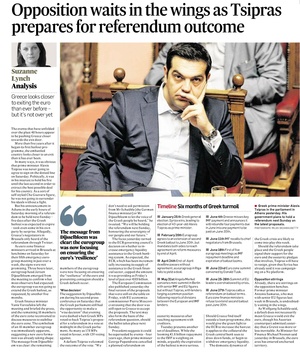
Paul Murphy (top) and the opinion piece by Suzanne Lynch in yesterday’s Irish Times

This morning, Anti-Austerity Alliance TD Paul Murphy and Suzanne Lynch, Irish Times’ European Correspondent, spoke to Seán O’Rourke on RTÉ Radio One’s T0day with Seán O’Rourke ahead of Sunday’s bailout referendum in Greece on Sunday.

What began as a chat about Greece turned into a discussion about pro-EU bias in the media.

Seán O’Rourke: “I see, I quote, in the Daily Telegraph today, from the Greek finance minister Mr Varoufakis effectively threatening to sue the EU institutions and to seek a court injunction to block any effort to expel it from the euro and they’re talking about taking advice and considering an injunction at the European Court for Justice if any such move is made because it’s just not provided for in any of the European treaties.”

Suzanne Lynch: “It’s possible, they haven’t confirmed that yet, here in Brussels, about that report but I mean there’s a lot of legal [inaudible] about a lot of aspects about what’s happened over the last week, not least whether the referendum in Greece is even legally possible because you’re not supposed to have referendums on fiscal measures.
So there’s legal questions everywhere you turn here on this issue and then one of your correspondent or your contributor there was making the point that the ECB is kind of acting, I suppose the implication, without, you know, beyond its mandate by effectively forcing the Greek government to impose capital controls. A lot of people in the ECB would say that already the ECB has being going past its mandate by keeping the banks going for this long with emergency funding. So, you know, no matter what way you look at this, really the argument is there on every angle I think on this saga.”

O’Rourke: “What’s your take on that speech made yesterday by the President of the European Commission Jean Claude Juncker – effectively using language that could be considered to be quite emotive and maybe not the most wisely judged of languages as well. ”

Lynch: “Yeah, that goes without saying, that his reference to suicide was badly judged. One can only think he wasn’t speaking his first language, that he meant something else but yeah, absolutely, I mean people are saying here that while he was trying to rally the Greek public, he may have actually achieved the opposite in this speech. But it was very wide-ranging.
He spoke for nearly a half an hour, he touched on everything from when Greece first joined the European Union in 1981, he talked about how personally he’d been involved in the association. He talked a lot about solidarity and how, you know, this isn’t about protecting one country against 18 others and he said a number of times about the other Eurozone countries, that you have to think of those countries.
And, again, he mentioned Ireland, he mentioned other bailed-out countries but I think he was implying these other poorer, east European countries in the European Union and the Euro, countries like Bulgaria, Slovakia, there’s huge opposition to any further concessions to Greece from those kind of countries. Their GDP is much lower than Greece. Their pensions are much less generous than the Greek pensions and that’s the reality so, you know, it’s very hard to sell this idea of further concessions to Greece. There are a lot of those poorer east European countries in particular.”

O’Rourke: “What do you say to that point, Paul Murphy?”

Paul Murphy: “Well I say first of all, about the Jean Claude Juncker speech, that it was peppered with falsehoods. The idea that the Greek side walked out of the negotiations is false. He claimed that the …”

Lynch: “Well I don’t think that’s the case, Paul, they did, they broke off negotiations on Friday. That’s exactly what happened.”

Murphy: “Well that’s…no it’s not what happened. You’re taking the line…”

Lynch: “What happened?”

Murphy: “…from the so-called creditors.”

Lynch: “No I’m not taking the line, I’m telling, I’m pointing out the fact there’s been constant spin from the Greek side on this aswell. So you think they didn’t walk out from the negotiations on Friday?”

Murphy: “Correct. Varoufakis was asked to leave at a certain stage so the Euro group could continue without him which is an unprecedented measure.”

Lynch: “That’s Saturday, that wasn’t Friday, that’s Saturday. You’re confusing, the Friday I’m talking about, in the negotiations.”

Murphy: “OK, I think the role of the media in this, to be honest, I think Suzanne Lynch’s articles have been consistently biased and taking the side of the so-called creditors, the Troika. In a recent article, she referred to Tspirias as a ‘self-styled Che Guevara figure’ – that’s not unbiased journalism. It’s taking the line of the establishment and repeating the propaganda here. Juncker claims …”

O’Rourke: “Before you go any further, I want Suzanne Lynch to come back on that, if she wishes. Suzanne?”

Lynch: “I think I’ll just leave that actually, Seán.”

Murphy: “But I just think the behaviour there of..”

Lynch: “Well I’ll say on thing: that was an analysis piece that I wrote. In the irish Times there’s a strong division between news and analysis and I’m not going to get into a sense of my work with Paul Murphy on radio. I would like him to get back to the factual issues. The Greek negotiators did break off negotiations on Friday, that’s exactly what happened.”

Murphy: “No that’s not accurate. So, on a factual issue, Mr Juncker caiamed that the reposal of the institutions does not include any cuts on pensions , that is completely inaccurate. Even the correspondent for the Financial Times tweeted, sorry this is not true, creditors bailout includes phasing out a solidarity grant , this is a pension cut regardless of what Juncker says. He claimed that the measures that the Commission is putting forward are socially just and not accurate, they’re abolishing heat oil subsidies, they’re enabling people who are less than €1,500 to have money taken directly from their wages. They’re heaping more tax on ordinary people, through payment on VAT. on basic goods, etc, and so there’s a massive spin going on about this, right? And the line is, the Greeks broke off negotiations, they’re unreasonable, they’re not capable, they’re unprofessional, etc, etc, etc. What they’re ignoring here is the question of democracy. What everyone fears is democracy…”

O’Rourke: “Going back to the point , you’ve dealt with that now, Juncker’s speech at some length but what about the point Suzanne Lynch has made and, by the way, sorry, I don’t think it’s right for you to accuse somebody of bias. I think Suzanne Lynch is a professional, honest journalist, reporting things that she sees and, by the way, to describe a man as a self-styled Che Guevara is a compliment.”

Murphy: “No it’s an insult, it’s a ridiculously insulting comment…I’m not questioning her integrity as a journalist.”

Talk over each other

O’Rourke: “Romania, the Czech Republic, or Latvia or Lithuania, these people are in countries that have a far lower GDP and income per head of population then the people in Greece. They’re not in favour. I mean where does democracy apply to them?”

Murphy: “No, but nobody, working people across Europe should not be paying for this crisis. The crisis should be paid by the banks in Europe, the bondholders in Europe, which are responsible for the crisis.”

Lynch: “But they are paying for the crisis, they have leant them billions of euro and that’s the problem.”

Murphy: “No, no they’re not. Suzanne, if you’re going to be accurate, you’ll know that 90% of the money that went to Greece from the Troika did not go to the Greek economy ,it went back out, it went on to the balance sheet of the Greek people and they’ll pay for it now, forever, unless they reject this deal and it went back out to bail out the banks. That’s what ‘s happening here, just like what happened in Ireland and I think people across Europe can hopefully see this. This is not a question of the people of Greece agains the people from elsewhere in Europe, it’s a question of ordinary people, the 99% across Europe versus the 1% represented by the Junckers and the Merkels and the Hollandes and the rest of them.”

Silence.

O’Rourke: “Suzanne?”

Lynch: “I just want to get back to the facts actually not engage in any of this kind of more ridiculous discussion with Paul Murphy there. The fact is that the two deadlines today, the IMF repayment of €1.6 million, it looks like Greece will not pay that repayment but, more importantly, the second bailout expires. I think this is probably more significant because this could give the trigger for the ECB to react further and to withdraw the emergency funding and essentially let the Greek banks go.

So what we might see today, and what I’m reporting today, is there’s definitely a sense that there’s a diplomatic incentive to get a deal agreed by the end of today. But what does seem likely is that , in any event, the second bailout that expires today, it’s very late now to get that extended. Enda Kenny said that as well this morning because, technically, it has to a lot of parliaments. Five other parliaments, including the German parliament. So that looks unlikelt. I mean the only possibility is that maybe Greece would apply for a third bailout because they, legally, again can request that.

So, I mean, there is this conundrum and this, somebody called it a parody of a referendum, in that Tsipirias called a referendum for next Sunday on something that will not exist anymore because that bailout expires today. And also, I think it’s showing again very bad political judgement by Alexis Tsipirias, he’s actually putting this to the people when they will have been faced without about five days of bank closures and capital controls so, of course, that’s going to galvanise more people, maybe to vote Yes and say, ‘hang on we’re not sure about this route, we better get back to the negotiating table’.”

Listen back in full here (starts at 16 mins)

Related: Analysis: Tsipras’s gamble backfires as Greece nears exit

(Photocall Ireland)

90375946

Socialist Party TDs Ruth Coppinger and Paul Murphy outside Irish Water HQ in May

Irish Water has claimed 70% of households (1.32 million people) have registered with them.

However…

Paul Murphy TD writes:

What they’re not telling you is two key things:

1. They have refused to give the payment figures after we asked for them six different ways (Enda Kenny, Irish Water briefing, Richard Bruton, Alan Kelly, FOI request, FOI appeal). Yet now they’re happy to give out their registration figures, in advance of the registration deadline. What about the “commercial sensitivity” that they cited as an excuse not to give the payment figures? Clearly the payment levels are a lot lower than 70%

2. On 19 March, they claimed that 1.23 million people have signed up. So three months have passed, how many ads have played on RTE and elsewhere suggesting you’ll get free money if you sign up? Yet only an extra 90,000 have signed up. How much have they spent on propaganda for each of those 90,000 – €100 each maybe for the ads?

We’re winning, they’re scared. Don’t buy the propaganda – spread the truth and mass non-payment will sink Irish Water.

FIGHT!

Paul Murphy (Facebook)

Murphy claims ‘big victory’ for anti-water campaign imminent (BreakingNews.ie)


Screen Shot 2015-05-14 at 10.24.44Screen Shot 2015-05-14 at 10.25.07

In the Dáil yesterday, during Leaders’ Questions, Independent TD Paul Murphy asked Taoiseach Enda Kenny how many Irish Water bills have been paid so far.

He suggested that the rate of non-payment was higher than the Government expected.

Mr Kenny told Mr Murphy to get the information from Irish Water.

He added he wasn’t going “to spoonfeed” Mr Murphy, before saying: “I advise [Mr Murphy] to toddle along to the audio-visual room at 4pm where Irish Water will give him the answers to any questions he wishes to ask.”

Socialist Party TD Ruth Coppinger asked: “What is the point of Leaders’ Questions then?”.

Mr Kenny replied, “To tell you where to go.”

Several deputies asked Mr Kenny to withdraw the comment.

He didn’t and the Dáil sitting was suspended.

Paul Murphy: “Irish Water has issued almost 1 million bills, 592,000 of which have passed their pay-by dates. How many water bills have been paid? What is the rate of payment and non-payment? I suspect there is much more non-payment than the Government hoped. Otherwise, the Taoiseach would be shouting from the roof-tops that people were accepting the charges and we would not be faced with the bogeyman of legislation that is always just around the corner but never arrives.

On 3 February, the Taoiseach told the Dáil that the legislation would be ready in the next couple of weeks. More than a couple of weeks later, on 25 March, he told the Dáil it would be introduced in a few weeks’ time. A few weeks have passed, and yesterday, he told the Dáil it would be enacted before the House rises in July. At this rate, Godot himself may ramble by before any legislation comes before the House. Is the delay deliberate? Is it part of a dishonest plan designed to scare people and cynically timed to happen at the same time as the bills are dropping into letter-boxes? Is it intended to created the impression that it will enable Irish Water to reach into people’s wages, benefits or pensions and deduct water charges, ably assisted by sections of the media?”

“The impression is untrue. It is clear the Irish Water cannot and will not be given any such power. According to the Law Reform Commission report, Irish Water is a company; it is not the Revenue Commissioners. It would have to go to court to seek attachment orders. We have been here before. In the 1990s, people were taken to court for non-payment of water charges and were threatened with disconnection. There were protests at the courts, which were clogged with non-payers. It proved seriously politically embarrassing for the then Government, which did not break mass non-payment, and the water charges were abolished. Court action cannot break mass non-payment now either. The Courts Service has said it would not be able to deal with the excessive burden. Perhaps this is the explanation for the haste with which Denis O’Brien got down to the courts before they clog up with water charges protesters. It would be political suicide to pursue court cases before a general election. The situation remains exactly as before, with no penalties for non-payment until July 2016, after the general election. Mass non-payment can sink the water charges. What are the figures? How many people have paid and how many have not? What are the rates?”

Enda Kenny: “The Deputy’s speech is no different from the ones he has made before. He knows as well as I do that if he wants this detailed information, Irish Water will supply it to him. The Deputy said that in the 1990s people were threatened with disconnection. The Government has listened very carefully to the genuine concerns of people all over the country and has legislated for the fact that there will be no cut-off of water supply. As I said the other day, the Government is moving to a much broader, more comprehensive and fairer system of dealing with civil debt, arising from the work done by the Law Reform Commission several years ago, in which people will not be sent to jail and the Victorian era will be said goodbye to in that regard. The charge is now €1.50 per week for a single person and €3 a week for a household of two or more persons.”

Peadar Tóibín: “For now. That is the introductory charge.”

Finian McGrath: “What about the property tax?”

Kenny: “Those who register will be entitled to a support of €100 assistance towards that from the Department of Social Protection. For this modest contribution, people will receive a high-quality water supply which one would expect in a country as developed and developing as ours in 2015. We cannot go on with a system where thousands of people have had boil water notices for years, a grossly inferior wastewater and sewage treatment systems in so many towns and where 50% of the water supply, for which people have contributed over the years, leaks away into the ground. That is why it is necessary Irish Water is a separate entity, to be able to borrow on the markets to invest to fix those leaks and to provide water and sewerage systems right across the country that will bring us to the point of competency in service and standard that we should have been at for so many years.”

“If one looks at the record, we have had an investment of €300 million over the years which is 50% of what we should have been able to invest. We cannot do that, given the scale of the finances of the country. That is why it is necessary that Irish water be established. It is also finding out through its metering programme the scale of loss of water over the past 50 years which was scandalous. The opportunity now presents itself to bring our country’s water and wastewater systems, as well as its sewage treatment plants to the highest international standards. I am sure Irish Water will be happy to supply the Deputy with the details of bills that have been issued and paid.”

Murphy: “I asked a very simple question.”

Simon Harris: “The Deputy asked the wrong question.”

Murphy: “It was about the rate of payment. The Taoiseach’s answer is to go and ask Irish Water as if it has nothing to do with the Government. The Taoiseach was not shy in boasting about puffed-up and bloated Irish Water registration figures where the same people were responsible for them.”

McGrath: “Remember that carefully.”

Murphy: “It is a bit like “Blue Peter”. Earlier, we prepared in advance and asked Irish Water what the levels of payment were. It said it would not give us those figures as it regards the levels of payment and the number of people who have paid now to be statistically insignificant. That means 500,000 bills and 500,000 people are somehow statistically insignificant. Opinion polls are done with a sample of only 1,000 people.”

McGrath: “More porkies.”

Murphy: “Does the Taoiseach not know what the rate of payments is? Has Irish Water not informed him? Will he find that information and give it to the House? Will the Taoiseach confirm that the legislation will require court cases? Will he allay the scaremongering in which he has been deliberately engaged, suggesting that Irish Water will be able to take them? We have had court cases before about disconnections. The Taoiseach was a Deputy then, supporting the Government parties when people were dragged to court. This was met with protests and the then Government could not break non-payment. The same will happen here. People will have enough reasons after seven years of non-payment.”

An Ceann Comhairle Seán Barrett: “Has the Deputy got a question?”

Murphy: “Will the Taoiseach give us the figures? Will he confirm that he is talking about court cases rather than direct deductions, in other words, that Irish Water will not be able to directly deduct? Is he seriously considering any court cases in advance of the general election? If so, does he have clear prospects lined up?”

Harris: “Deputy Paul Murphy is obsessed by this.”

Kenny: “I know Deputy Paul Murphy is elected by the people and good luck to him. Sometimes, however, he feels he is Julius Caesar and that he can dictate whatever he wants to do himself. I am not going to spoonfeed Deputy Paul Murphy.”

Martin: “In fairness, Julius Caesar was a bit more sophisticated than that.”

Timmy Dooley: “Et tu, Blueshirt?”

Kenny: “I advise him to toddle along to the audio-visual room at 4pm today where Irish Water will give him the answers to any questions he wishes to ask.”

Murphy: “When we asked Irish Water, it said it would not give us the information.”

Paul Kehoe: “He can have a protest outside the audio-visual room.”

Kenny: “That is open to every Deputy, including Deputy Paul Murphy. He can go and ask Irish Water instead of expecting me to spoonfeed him. With respect to the legislation, the Government expects to have legislated for this before the end of this session. The matter will be discussed here and in the committee rooms as one would expect. No doubt, Deputy Paul Murphy will be fully entitled to contribute with his constructive suggestions to that debate. I look forward to hearing him and his understanding of how important it is that we have a proper water supply for people and for business, as well as proper wastewater treatment plants across the country. He should go along at four o’clock and participate in the democratic presentation that will be there for him. When the Bill comes into the House, I look forward to his constructive suggestions.”

Ruth Coppinger: “What is the point of Leaders’ Question then?”

Kenny: “To tell you where to go.”

Interruptions

Róisín Shortall: “Will the Taoiseach repeat what he just said?”

A Deputy: “He should withdraw that.”

Shortall: “Will the Taoiseach repeat what he just said? A Cheann Comhairle, on a point of order. The Taoiseach has brought the House into disrepute with that comment. I ask that he withdraw it.”

Kenny: “What comment?”

Shortall: “Every Member of this House has a mandate and a right to be treated with respect.”

Martin: “It is bringing the House into disrepute. The Taoiseach said the purpose of Leaders’ Questions was to tell the Deputy where to go. He should withdraw it.”

Kenny: “Yes, I said the Deputy can go to the audio-visual room at 4 o’clock to hear Irish Water.”

Interruptions.

Shortall: “That is not what the Taoiseach said.”

An Ceann Comhairle: “Will you resume your seat Deputy? You are out of order.”

Martin: “Julius Caesar had many rights.”

Shortall: “A Cheann Comhairle, you have a responsibility to…”

An Ceann Comhairle: “Will you resume your seat Deputy? You are out of order. It was Deputy Paul Murphy’s question.”

Shortall: “…to protect the rights of Members of this House. The Taoiseach should not have made that comment to the Deputy.”

Interruptions.

An Ceann Comhairle: “Will you resume your seat Deputy? You are heading for more trouble now. Are you looking to get thrown out again?”

Martin: “The Taoiseach should withdraw his comment.”

Interruptions.

Coppinger: “A Cheann Comhairle, you have been quick enough in the past to berate us for making comments and asking us to withdraw them.”

An Ceann Comhairle: “Resume your seat.”

Coppinger: “Could the Taoiseach repeat the comment and withdraw it?”

Dáil sitting suspended.

Transcript via Oireachtas.ie

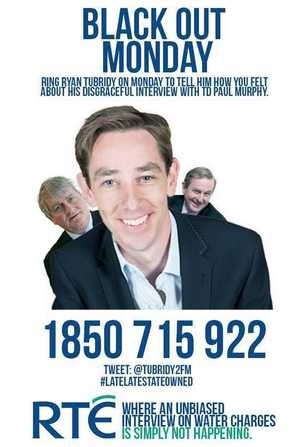
Screen Shot 2015-02-22 at 20.31.05Ryan Tubridy and Anti-Austerity Alliance TD Paul Murphy on the Late Late Show on Friday.

Nobody expects the Spanish Inquisition.

You may have caught Paul Murphy’s appearance on the Late Late Show on Friday night?

Whether you think Mr Murphy a silly Marxist loon or hi-viz Robespierre  it was (in complete fairness) an unusually hostile, poorly researched and unpleasant piece of political chat show-ing.

But don’t take our word for it.

Grab a tay/soft cushion.

Ryan Tubridy: “My next guest is a man of numbers. He spent three years as a member of the European Parliament, he’s been a member of Dáil Éireann for just four months but in his campaigning history, he’s been arrested five times. Would you welcome please, Paul Murphy, TD.”

Paul Murphy enters

Tubridy: “They’re interesting numbers, aren’t they? When they all add up. But you’re welcome to the program, thanks for joining us.”

Paul Murphy: “Thank you.”

Tubridy: “Before we get into the politics, let’s talk about the personal, because we see a lot of you in the political environment but not in the personal. So, let’s get a little bit of your own background. You’re from what part of Dublin?”

Murphy: “I’m from Goatstown.”

Tubridy: “Yeah. And tell me a little bit about the house you grew up in.”

Murphy: “Yeah, normal enough, middle-class upbringing. One brother. One sister. Did well in school. Went to UCD. Did law in UCD.”

Tubridy: “You did more than law, you came first in your class.”

Murphy: “I did.”

Tubridy: “Which is rather impressive. Was it a political house?”

Murphy: “No, not particularly I’d say. There were political discussions in the sense that, like a lot of families, people have opinions and argue about things, be it politics or culture, or whatever. And so there would have been discussion in my house but not…certainly not linked to any one political party and not a socialist house in particular.”

Tubridy: “Cause you were quite young when your father passed away, isn’t that right? How old were you?”

Murphy: “Eleven.”

Tubridy: “Eleven. And that would have had an impact on you, no doubt?”

Murphy: “Yeah, yeah of course.”

Tubridy: “In what sense?”

Murphy: “Well, you know, I suppose it was hard for my mother, for any mother, any parent, mother or father bringing up their kids on their own. That’s, you know, a difficult situation for someone. And when I think, you know, that creates an environment in a house whereby you’ve one parent one parent and you understand that there’s a pressure on one parent alone. But…yeah.”

Tubridy: “That was that, that’s the world that you lived in. There was talk, you know, reading about you, there was talk of Fine Gael in your family. Is that the case? Is there…”

Murphy: “Not in my immediate family. I mean, it’s like people will say, your family is Fianna Fáil, I mean my…”

Tubridy: “But I’m not a Socialist TD, you know?”

Murphy: “Sure, sure.”

Tubridy: “I suppose that’s the…”

Murphy: “Yeah, but some of my, in the sense that like it doesn’t say anything about your politics but I think some of my dad’s brothers would be Fine Gael, maybe one or two of them. I don’t think it’s some big Fine Gael family. And I was never aware of that actually, prior to becoming an MEP, you know, some people saying, ‘oh, it turns out you’re a Fine Gaeler’ and I’ve betrayed by Blueshirt roots apparently.”

Tubridy: “Of course, of which, of course you don’t… as far as you’re concerned. So what drew you towards socialism and the Socialist Party because, as you say, you were in law in UCD and then you obviously got your interest piqued politically by something, somewhere along the way.”

Murphy: “Yeah, like a fair number of people, I would have become political quite young, as a teenager. In particular when I was 15, 16, what would have been happening around the world? You had big protests against the IMF, against the WTO, against the World Bank, kind of anti-globalisation, anti-capitalist protests and that would have shaked, shaped my political outlook. And like, at the time, what they were about were like, unfair trade practices, it was about unjust debt, it was about austerity in places like Latin America. Some of the things that have now come to Europe then were kind of very present in Latin America and would have been a radicalising factor and then reading things and beginning to describe myself as a Socialist.”

Tubridy: “You felt that this was where your dreams and ideologies lay?”

Murphy: “Yeah, in a sense I felt that, yeah, if I could do things to make this country, this society, our continent, our world a better place, a less unjust place, a place where you don’t have so much poverty, where you don’t have war, where you don’t have just the misery that people, you know what I mean, forget about this country for even one moment, and think about the 2 billion people in the world who survive on less that $2 a day. So they’re the kind of things that drove me to say, ‘let’s try and change this’.”

Tubridy: “So, what age are you?”

Murphy: “31”

Tubridy: “31, because that puts it into a context, in terms of when that was happening and what age you were at the time. You went on, of course then, to work with Joe Higgins probably up until recently the most famous, if not the only Socialist TD in Ireland for a long time.”

Murphy: “Bertie Ahern apparently was a socialist as well.”

Tubridy: “So they so, or so he said. And then you ended up in Europe.”

Murphy: “Yep.”

Tubridy: “With him (Higgins). Tell us a bit about that.”

Murphy: “Yeah, so we, we didn’t go into the European election campaign in 2009, thinking we were going to win. And we won because the crisis had hit, people were being radicalised, moving to the left, and so we won. That was the first MEP seat we had. And so I moved over to Brussels and, whenever Joe [Higgins] got elected to work on setting up our European office, in the European Parliament, to do all of that. And then, in 2011, when Joe was elected back into the Dáil, I took over as MEP.”

Tubridy: “You were co-opted as an MEP. Ok.”

Murphy: “And so that was, I mean that was some experience. Again, a difficult experience, in the sense that, I mean, all of us sudden, you’re in the parliament, you know, debating with all these people who are, you know, establishment figures, etc. But it was a very good time to be an MEP and a very good time as a socialist to have an MEP because there were massive crisis of capitalism within Europe and like massive austerity being waged in Ireland, Greece and Portugal and so, one of the main things we tried to do was say, ‘Ok, let’s have solidarity of working people, right across Europe’. The idea of fighting for a different type of Europe, a Europe not built for the 1%, for the bankers, for the bondholders but for the 99%.”

Tubridy: “So you came out of the European project if you like, you ran for the general election, you didn’t get elected that time. No, sorry, excuse me, sorry you ran for the Europe… and didn’t get elected that time and then, of course, when Brian Hayes [former Fine Gael TD, now MEP] Fine Gael became an MEP, you took the by-election seat. Did you want to be a TD? Did you dream of being a TD? Did you want to walk the corridors of Leinster House all your…”

Murphy: “Never, I still don’t dream of that.”

Tubridy: “So what are you doing there then?”

Murphy: “Well, because I’m a Socialist activist.”

Tubridy: “Right.”

Murphy: “Right. And I think we can fight for fundamental change in society.”

Tubridy: “Right.”

Murphy: “And it’s so happened, events have happened in my life like, going over to work with Joe and then taking over from Joe, because it made sense at that time. And then the by-election happened. Events have happened that have propelled me as a Socialist activist into playing a particular type of role at this stage.”

Tubridy: “Ok.”

Murphy: “Which is being in the Dáil. But it’s not like, I’ve never had any ambition to be a TD or MEP or anything like that but I think, can I play a role in assisting, like the water charges struggle, concretely now in being a TD? Is it a good platform to assist struggles with people? It is. And I think that’s how we can use it.”

Tubridy: “And part of the reason you’re here tonight is you gave, you’ve made quite a name for yourself as part of a very different type of protesting that’s been happening in recent months. We’ll talk about the, obviously, the Joan Burton protest which, of course, became such a talking point in this country. Let’s take a little reminder of that protest and we’ll have a chat about it in a second.’

A clip from RTÉ reporter Sandra Hurley’s report on the Jobstown protest is played. In it, Paul Murphy is seen and heard speaking to the protesters via a bullhorn. From the clip:

Sandra Hurley: “A tense stand-off in Jobstown today as the angry mood against water charges spilled over. The Tánaiste was attending a Higher Education ceremony but, when she left, her car was hemmed in by around 100 protesters. Dozens of garda reinforcements arrived, along with the Garda helicopter and the Public Order Unit. This escalated the tension.”

Paul Murphy: “If they withdraw the Public Order Unit, do we agree to let her go?“

Crowd shouts back ‘yeah’.

Hurley: “Then the unit agreed to step aside in return for protesters agreeing to slowly march in front of the car to let her out. After two and a half hours, some confusion as gardai surrounded the Tánaiste and physically transferred her to another car with some protesters giving chase.”

Tubridy: “Was that a mistake? To do what happened to the Tánaiste that day?”

Murphy: “I don’t think it was a mistake, for me, as a public representative, elected on the basis of opposing water charges, to join in on that protest. That was effectively spontaneously organised by residents the night before and then grew. If I was organising that protest, or if the triple A [Anti-Austerity Alliance] was organising that protest, it would have been a different sort of protest. I mean there’s no question, it was a messy protest. It’s not your ideal situation of how a…”

Tubridy: “Was it ugly?”

Murphy: “I’d say it was messy and I’d say, I mean…”

Tubridy: “Would you say it was ugly?”

Murphy: “Well, I didn’t…I wouldn’t use the word ugly.”

Tubridy: “Would you not?”

Murphy: “I think, afterwards, which was then conflated by Independent newspapers, in particular, afterwards there were ugly scenes. I mean there was a picture that was used again and again of…”

Tubridy: “Can we just talk about that [Jobstown protest]. Don’t mind other newspapers because I’m just gonna deal with what I just saw, and what everyone at home just saw, which was, you know, the Tánaiste, the deputy Prime Minister of the country, trapped in a car for two hours, against her will. Is that acceptable?”

Murphy: “She wasn’t trapped in her car. She was able to leave.”

Tubridy: “She wasn’t going anywhere fast, Paul?”

Murphy: “No, but she left, I mean she moved from one car to the other, right? But the point is…”

Tubridy: “Did I just not, did I just not see you with the bullhorn saying, ‘shall we release her or not?’ If you say such a thing, that suggests that she needs to be released from somewhere, therefore she was not in a voluntary position to move.”

Murphy: “Just this quote and this clip has been used again and again and again, right.”

Tubridy: “Was it made up?”

Murphy: “No but the context of it has been explained again and again and again. And I don’t really believe you don’t know the context because I have explained it so many times. And this is a conscious attempt by the media to demonise anti-water charges so the context…”

Tubridy: “A lot of our viewers may not have seen you on anything, as much as you’d love…”

Murphy: “But you chose to use the clip?”

Tubridy: “We did choose to use the clip.”

Murphy: “But the context, that I’ve explained multiple times, is that the gardaí had explicitly asked me, and if this ever goes to trial, we can find the guard responsible, had asked me to put that question to the crowd. The gardaí  wanted to de-escalate the situation and they chose to talk to me.”

Tubridy: “Ok.”

Murphy: “As a public representative and so that’s what I did.”

Tubridy: “Do we need to get into semantics of, about the choice of words, ‘do we want to release that Tánaiste from this?’. Is that…am I missing something here?”

Murphy: “But it’s you that has introduced this particular quote?”

Tubridy: “You said it Paul.”

Murphy: “Sure but I’m explaining that I said..”

Talk over each other

Tubridy: “Are you saying the guards put, forced words into your mouth? That you didn’t want to say that?”

Murphy: “No, the guards asked me to communicate that message to the protesters. I wasn’t fully in charge of everything that was happening at the protest. And I was trying to play a role in having a disciplined protest and to bring the protest to an end at a certain stage. That’s what I was doing and that’s what the clip actually demonstrates.”

Tubridy: “Let’s not get lost on that. Do you think, quickly again, I’m really curious, as a public representative, do you think it’s appropriate that the Tánaiste, who I think it’s fair to say, most parties who would look at that would say, felt intimidated? Regardless of your politics, that it was not a pleasant situation for anyone to be in for two hours. Do you think that that was a mistake?”

Murphy: “No. I’ve said that it’s not a mistake. But I tell you..”

Tubridy: “If it happened tomorrow would you..”

Murphy: “No, let’s..”

Tubridy: “Would you roll with it?”

Murphy: “Let’s take it, let’s put it in its context. Because what the media wants to do  is just take these individual incidents, right?, and you can show another clip and you can say, ‘what happened here?'”

Tubridy: “Yeah.”

Murphy: “But the context is, of communities being ravaged because of austerity. The context is of broken promises. If you listen to what was shouted at Joan Burton, overwhelmingly what was shouted was ‘traitor’ because people… Jobstown is a traditionally a Labour Party area, people voted for Labour and then they betrayed them. They cut child benefit, they imposed water charges they’re cutting lone parents [allowance]…and so people are very, very angry.”

Tubridy: “It sounds… I think most right-minded people would understand that anger, Paul to be honest with you but I still am having trouble with you possibly justifying, and people may have trouble with you justifying, the intimidation of a person…”

Murphy: “What am I justifying? No. I’m not justifying any intimidation or anything like that.”

Tubridy: “But you’re condoning it.”

Murphy: “No. What I’m justifying and condoning is a peaceful, sit-down protest behind a car of the deputy prime minister, that has happened multiple times in this country without people having dawn raids without warning, without 23 people arrested at this stage. And I’m condoning and justifying and supporting a slow protest in front of the Tánaiste’s car. There’s been multiple attempts, multiple incidents whereby Taoisigh Charlie Haughey, Bertie Ahern have been stopped in their cars…”

Tubridy: “There just seems…”

Murphy: “Nothing has ever happened like this and it’s not an accident. It’s happening because the establishment is scared. Because they want people to get back in their box because that’s what…it isn’t pure, it isn’t clean, it isn’t…”

Tubridy: “Paul, people aren’t that stupid and I think that, to be honest with you, people felt that this was a different tone to public protest. That it had taken on this very ugly hue that was,  that involved this sort of cat-calling, shouting, jeering at people that, you know, may or may not deserve such a thing. Any human being, let alone  a politician..”

Murphy: “People don’t deserve? There are people right now locked up, right? For one month and for two months. Five people. And the only reason they’re locked up is for breach of an injunction whereby they’ve gone within 20 metres of a water meter installation. In my opinion that’s much more serious than someone calling Joan Burton  a traitor or Joan Burton being held somewhere for two and a half hours. I mean, where Joan Burton was that day, just around the corner there was a couple, whom I later spoke to, who were living in their car, who were homeless.”

Tubridy: “Yes.”

Murphy: “Do you know, that’s what they’ve done in this society and then the media is focused on ‘was she called a traitor here? was she stopped in her car for two hours?’ It misses the picture here which is like the structure of violence, the destruction of communities by their policies.

Tubridy: “Maybe if you had orchestrated things a little better, and in a more civilised manner, you mightn’t have made a martyr of the Tánaiste and we wouldn’t be talking about all this..”

Murphy: “If I had orchestrated, this wouldn’t have happened. I didn’t orchestrate it. That’s the point. Right. So I’m aware this protest is happening. I’m in favour of people protesting but we genuinely did not organise it. We arrive on the scene and what role do I play? I attempt to put a shape on the protest, to put a discipline on the protest, I introduce chance into the protest, in order to have a more effective type of protest.”

Tubridy: “You were arrested anyway, as a result of what happened there. You obviously would have felt that was utterly unjustified. Tell us a little about the morning of your arrest.”

Murphy: “Yeah, it’s a bit of a shocking experience. In the sense that, you know, you’re half awake, five to seven in the morning, you get a ring on the door, you open the door, there’s six gardai at the door and they push their way in and tell you that you’re being arrested, under suspicion of false imprisonment of Joan Burton and her assistant.”

Tubridy: “Right.”

Murphy: “And then I was in the garda station for maybe, for eight and a half hours. I was questioned for four hours.”

Tubridy: “Yeah.”

Murphy: “Again and again, based on media transcripts, and footage from RTÉ, YouTube, etc, etc.”

Tubridy: “Yeah.”

Murphy: “All to try and stand up the idea that, which they’ve been talking to people in the community and questioning people with a view to pinning me, as being responsible for a protest that I didn’t organise and trying to say that I’m responsible for what’s apparently the false imprisonment of Joan Burton. I mean if that’s false imprisonment, well then anyone who participates in any protest and stops, gets in the way of cars, as happens all the time, are guilty of false imprisonment. I mean it’s some stretching of the term and it’s very serious. Because the maximum sentence for false imprisonment is life in prison. And obviously, like I don’t think that’s going to happen…”

Tubridy: “I would be shocked if that was to happen.”

Murphy: “But that’s the kind of threat that hangs over people. And there’s a whole community now in Jobstown, hundreds participated in that protest and people are scared.”

Tubridy: “Do you not get some class of, forgive the choice of words, but thrill out of being arrested. And I say that on the basis that it’s manna from heaven in some ways because suddenly you find yourself as the top of the media tree in terms of whatever programme you’re going on, including this, you get all the attention you need, you bring all the attention to the cause you fight. And chances of you spending any time in prison are slim to none and yet you get all this coverage?”

Murphy: “Firstly, I have no personal interest in media coverage, I really don’t, you know, I don’t find it a pleasant experience to be going on, talking about your childhood, do you know what I mean? That’s not what I want to do.”

Tubridy: “And yet you’re here.”

Murphy: “Two, yeah, because we use media appearances  to try to get the political points across, about how we can defeat water charges, though non payment etc.”

Tubridy: “But you say, ‘I don’t like media’ but you’re always in the media; ‘I don’t like politics, yet you’re in Leinster House’. What do you want?”

Murphy: “I’m trying to do the best I can to try and change the society for the better. And I think that I can do that, including by using media appearances. But it’s not that I have any really, I don’t have a personal like for media, being in the media whatsoever. It’s all a platform to get ideas across. And, like, did I like being arrested? No. I had real things to do that day. I’d people to try and assist. I had homeless cases I was trying to assist. I had, you know, work to do that actually could make a difference to my constituents. There was a guy who was trying to contact me, about a particular case and he wrote to his TD, his Fine Gael, he’d traditionally be connected to Fine Gael and he wrote to them saying, you know, he’s outraged because he was meant to talk to me and he couldn’t because I was sitting…you know, so really, I’ve better things to be doing than sitting in a garda station.”

Tubridy: “We need to talk about the Michael D Higgins protest. Let’s call it that for the sake of it. A quick reminder of that too, in terms of the nature and the tenure of the modern protest.”

Tubridy makes a gesture that indicates a clip is set to be played

Murphy: “Why do we need to talk about it?”

Tubridy: “Well we’ll have a look at it and you tell me…”

Murphy: “But it has nothing to do with me…”

Tubridy: “Well I think it’s self explanatory.”

Murphy: “But it’s nothing to do with me.”

Tubridy: “Let’s roll the tape and the people can decide.”

A clip is played from the protest concerning President Michael D Higgins in Finglas last month, in which President Higgins is called a “midget parasite” by jailed protester Derek Byrne. It also shows a garda pushing a female protester twice and another female protester once.

Tubridy: “So, do you approve of that protest?”

Murphy: “No, I condemned it repeatedly, so I don’t know why you want to talk about it because I’ve been in the media repeatedly condemning the protest, right? And so what’s being attempted is to link that protest and the Jobstown protest and to link them somehow to me. I wasn’t there. I don’t approve of it. I didn’t agree with it, I’ve condemned it repeatedly. So, do you know what I mean, if you had Mícheal Martin in here, would you have him on saying, ‘we have to talk about this’?”

Tubridy: “Well when Mícheal Martin comes on, we’ll decide what we ask him at that time but I’ve got you here so I’m going to talk to you about these things. You’re anti-water charges, you’re part of the water protest movement, which is fine. Are all the people that we saw in that tape and the jeering that went on, those people that did that. You are denying them, in public tonight, saying they were wrong, is that what you’re saying?”

Murphy: “Absolutely and it’s not the first time. I’ve said it repeatedly.”

Tubridy: “Yes but I’m just clarifying more than anything else.”

Murphy: “But I don’t see a need to clarify. In the sense that I was all over the media saying it was wrong. What happened again, and the media is a factor here. Does the media have an agenda? You know…Independent newspapers, it’s owned by Denis O’Brien. Denis O’Brien owns GMC Sierra…”

Tubridy: “We’re not here to talk about… why would you talk to me about Denis O’Brien? He’s not here, I…”

Murphy: “But the reason…”

Tubridy: “I work in RTE…”

Murphy: “But the reason we’re talking about this is because of an inaccurate headline in a newspaper which attempted to portray that I supported that, that is, that’s how this became an issue, Ryan..”

Tubridy: “Paul I’m being straight with you here. I have just saw this clip. I was curious to know what you thought of that. I know you’re out and about in the media a lot of the time but a lot of people who watch this programme don’t follow your career with the intensity that maybe some people close to you would do so.”

Murphy: “Or myself because I’m in it like.”

Tubridy: “Right , ok, so that’s just where I, so that particular tape we saw, and the people involved in that, are all, they’re persona non grata as far as you’re concerned?”

Murphy: “What they did there was wrong, it was stupid, you know, it doesn’t assist in any way the anti-water charges movement.”

Tubridy: “Ok.”

Murphy: “That’s clear.”

Tubridy: “Did you have sympathy for the president?”

Murphy: “Yeah, in the sense of when people are, I’ve sympathy for anyone who’s screaming abuse at, I’m sure he’s well able for it, do you know what I mean, I think he’s in the car and he’s gone. But…”

Tubridy: “Do you think he’s a legitimate target?”

Murphy: “I think people have a right to protest any political figure. And I don’t think anybody has actually proposed, you know, banning, making it illegal to protest the President or anybody.”

Tubridy: “But do you think the President… and this got a lot of comment at the time. The President of this country stands a little bit removed from the political system, in the sense of his office and the neutrality of the office and the apolitical nature of it?”

Murphy: “That’s really a formalism, you know? It’s not the reality, I mean if you think of the presidential election, it’s a political election. It’s a political election of a certain type. People talk in a certain way but Michael D Higgins, he stood on a platform of criticising austerity, criticising the impacts of austerity, he has a record of fighting for people, of standing up for human rights so it is a political office and I think people do have the right to protest, they should protest in the correct way and in a peaceful…”

Tubridy: “So if President Higgins was opening a library tomorrow in Galway, you’d say to people, ‘go and protest at that against him’?”

Murphy: “No, no, I wouldn’t…”

Tubridy: “About the water..”

Murphy: “I wouldn’t say that and you can’t draw that inference from what I just said but I said, I wouldn’t right because it’s not much point in protesting against the President. He doesn’t have sufficient power. But if they decided to protest, I’d say, well they’ve a right to do it and I’d say they’ve a right to do it as long as they do it within a peaceful, disciplined way, etc, etc. So you can defend someone’s right to do something without meaning that you advocate it. So I defend the right of people to protest against any political figure.”

Tubridy: “Would you break a court order injunction?”

Murphy: “It would depend on what the court order injunction is. But yeah I would. I mean the injunction that we have at the moment is an injunction, to be clear, it’s an incredible infringement on people’s democratic rights and civil liberties. It says you cannot go within 20 metres of a water meter installation. If necessary I would break that as part of the protest.”

Tubridy: “Ok, so that takes us to yesterday [Thursday] and the people who were incarcerated for coming within the 20 metres of the people trying to put the water machines in. One of whom I believe was the gentleman [Derek Byrne] we heard on that heckle against the President. You support him?”

Murphy: “Well I’ve just criticised him for everything that he said there. I don’t think he should be jailed. Do you think he should be jailed? Do you think he should be in jail for a month?”

Tubridy: “Did you support him in court yesterday?”

Murphy: “Yeah. I don’t think he should be in jail for a month because he stood within 20 metres. So I disagree with what he did there [referring to Finglas incident]..if what he did there was a crime, well then, let there be but no, he should not be…and the other four – a woman and three other men, including a 60-year-old who’s currently out of the country. Should they be in jail because of standing against water meters? They don’t want the imposition of water meters. The only purpose of the water meters is to get the water charges. You have massive opposition in these areas, you’re not talking about protests like that, you’re talking about protests of hundreds of people, effectively protesting.”

Tubridy: “But if it’s 20 metres, to be, proximity, why don’t they protest 21 metres away and avoid having all this waste of, you know, Garda time, legal time, their own time and them not having to spend time doing, in prison, watching, you know…”

Murphy: “Because it’s a question of, what the State is saying and, in my opinion, the media is saying, is that you’ve the right to protest, you’ve the right to march, and a judge said this, you’ve the right to kind of march up and down with your banners and your placards.”

Tubridy: “Yeah.”

Murphy: “But you don’t have the right to effective protest and that’s why people need to be within the 20 metres – to stop water metre installation. Because what GMC Sierra is doing is imposing meters on people who don’t want them and we think people have the right to protest…”

Tubridy: “Do you have any sympathy for the men and women who are putting the meters in?”

Murphy: “I do. I don’t think they should be put in that situation – by their employer or by Irish Water which contracts their employer.”

Tubridy: “And, just looking at the things that you’re anti. And I’m curious to know what you’re pro because you’re anti water charges and anti property tax and you’re anti bin charges and you’re anti bailout and you’re anti college fees and you’re anti austerity. So where’s the pro in the Paul Murphy?”

Murphy: “I’m pro-Socialism. I’m pro taking power in this country out of the hands of the bankers, of the bondholders, of the Denis O’Briens and taking power into the hands of the majority. Right? Which means running society through public investment, through public ownership of our natural resources which are being given away to Shell and Statoil…”

Tubridy: “And if the law doesn’t suit you, break it.”

Murphy: “Well, you asked me what I’m for, so I’m explaining what a Socialist society would look like, it would mean a decent home for everybody,  it would mean a decent education, it would mean decent healthcare, it would mean putting people’s needs before profit. That’s what I’m for and all those things that go with it.”

Tubridy: “You must have been so excited when the Greeks elected the government they elected and then you must have been so disappointed to watch the Nine O’Clock News to realise that, despite all their promises, they are having to play ball. I mean they went in saying they were going to tell them, give them the two fingers and now they’ve come out with their hand out.”

Murphy: “Well it’s an ongoing battle. I mean what’s being attempted, it’s incredible. And our government is completely part of it. It’s an incredible blackmail by the European establishment, the Troika, the ECB, etc, demanding that the election results in Greece are annulled. Right the people voted against austerity and saying, ‘you can’t have that, otherwise, we’re going to force you out of the Euro’, that’s what the ECB is saying. So the ECB..”

Tubridy: “The Greek government could sign up to a deal tonight Paul and…”

Murphy: “We don’t know what’s in the deal right. If they’ve signed up to implement any austerity, then that’s a mistake. If they’ve just bought time until Monday and then for later on, well then that’s part of the negotiations but the Syriza election is very, very important, regardless of any mistakes that Syriza may make, because it opens the idea that there is an alternative to austerity. There’s been this mantra for years and years and years, for decades. And now you have  a left government elected and it does give people hope.”

Tubridy: “It just feels to me that they were a bit neutered tonight but we’ll talk about that at another time if we can. Quickly, before I say goodbye Paul,  thinking about the arrests and the incarcerations in prison yesterday, would you say they’re a help or hindrance to your cause?”

Murphy: “That depends on what response takes place now. People have to respond and say this is just not ok.”

Tubridy: “So what do you propose?”

Murphy: “So tomorrow [Saturday] there’s a major protest, a national protest at 2 o’clock at the Central Bank in Dublin. It will march to Mountjoy Prison. People need to come out now. Anybody who defends the right to protest. I mean we’ve had two weeks of dawn raids in Tallaght, five people jailed, it’s a very, very serious attack that’s going on.”

Tubridy: “Can you guarantee that future marches will be peaceful and less belligerent than the ones we’ve seen of late?”

Murphy: “Well, if you think of all the major protests that have taken place in town, they’ve all been entirely peaceful, entirely disciplined, less trouble than you would have at a GAA match or anything else. So can isolated incidents take place, in small protests or whatever? Certainly it’s possible, I can’t guarantee that won’t happen forever. But I know the vast, vast, vast majority of people, who engage in protest, engage in the right sort of protest. But do engage in effective protest and, in order to engage in effective protest sometimes civil disobedience is necessary. The most important source would be non payment. What will sink Irish Water is the majority of people refusing to pay the water charges. And I think that will happen. And…”

Tubridy: “And what figure? I think the number I have in my head for those who have signed up for Irish Water is 64% – would that be right?”

Murphy: “That’s what they’re claiming.”

Tubridy: “Your notion of a majority…little bit…”

Murphy: “Not at all. Alright that was after…that was after the third deadline. If you remember it was all the propaganda and everything and they said, ‘oh no it’s actually just an administrative deadline, we’ll have a new deadline’. So it’s, they’ve already admitted that that’s a very bad figure for them. But the opinion polls. What matters – registration is important. But what matters really is payment. The opinion polls say 4 in 10 intend to pay, 3 in 10 intend not to pay and the others are in between. And we need to convince those others to join the boycott and as many of the 4 in 10 as well.”

Tubridy: “It’s going to be a fascinating few months ahead. I’ve no doubt about it. But thanks for coming in tonight. Paul Murphy, ladies and gentlemen.”

Watch back here

Meanwhile, after the show, Paul Murphy tweeted:

Meanwhile…

Screen Shot 2015-02-22 at 13.58.26

Circulating on ‘social media’ this evening.

ed

harris

Last night.

Eamon Dunphy, Fine Gael TD Simon Harris and Paul Murphy TD were among the guests on Claire Byrne LIve on RTÉ One to discuss ‘political policing’ and a French-style social model for the Irish economy.

Grab a tay.


Simon Harris:
“…We often have this debate in Irish media and indeed in Irish politics, Ireland, is it like this country, or Ireland is it like that country? We need to look at each country on its merits. This country now has a scenario where we’ve seen jobs growing. And jobs growing by the way, sometimes is a bit of an abstract comment.
I notice that Eamon [Dunphy] said, ‘oh Enda Kenny, he just wants to make this country the best country in the world with which to do business, but what about making it the best country in the world in which to live’.  But one leads to the other, if you don’t actually fix the economy. Now, don’t laugh, because it’s important, Eamon, it’s important for people who do live here in this country, if you don’t actually have a functioning economy, you can’t deliver the services that those women quite correctly talk about.
You’re right in relation to childcare. We didn’t get it right in this country thought during the years of the boom, we didn’t get it right during the Celtic Tiger. We saw children’s allowance go up we did see the introduction of the free pre-school year. The challenge for us now, as the economy recovers, is to finally get it right and actually be able to sustain a recovery, that’s what we’ve got to do.”


Claire Byrne:
“Okay. If you’re a business owner in France you’re paying 45% on your profits, where as here you’re paying 12 and a half %. Now a lot of that money is going in France to pay for the services you know and it means that families don’t have to pay extortionate rates to go see the doctor and so on.”


Harris:
“No, our corporation tax rates in this country is actually higher than the effective corporation tax rates in France, it’s just that our corporation tax rate is very transparent but if you actually look and I heard from some of the self employed people who know this far better than I do and probably far better than anyone else on this panel the cost of creating a job in France is extremely expensive which is actually why we’re seeing their unemployment level now rising and our employment level now falling.”


Byrne:
“Okay Eamon, now, good news, Eamon, in Ireland and France is not as pretty a picture as you made it look…”

Eamon Dunphy: “One of the things that Simon said, very contradictory, he said that if you don’t have a functioning economy you can’t provide the services that are in France but just before that he said that France didn’t have a functioning economy, and couldn’t meet its EU commitments. What happened with the €50 billion paid, they’re not going to do it, they’ve refused to abide by the 3% GDP to debt ratio.”


Harris:
“They’ve not.”


Dunphy:
“That’s the fact, their GDP to debt ratio is 5%.”


Harris:
“It’s not.”


Dunphy:
“That’s the fact, their GDP to debt ratio is 5%.”


Harris:
“They’re not the President of France has opposed…”

Dunphy: “You’re wrong on the facts and your argument is confused.


Harris:
“Eamon I attended a Euro… Right, shout me down now.”


Dunphy:
“You’re telling me the people who don’t have child care, who don’t have access to the health services that this is a functioning economy, that this is the model, I’m suggesting that the French model is a social model, that there’s more solidarity, that there’s more access to the things that really matter health care child care and help when you fall on hard times. The French are resisting the ECB because they don’t want to destroy the society that they have and all its benefits which you have seen.”

Byrne: “All right, quick response, Simon, then Sinead we’ll come to you.”


Harris:
“Eamon had a six and a half minute video. The French president, the French president, as opposed to Eamon, has said that he’s committed to installing €50 billion worth of cuts between 2015 and 2017, he’s the French President, I’m going to take his word. You’re right that they haven’t met their targets, we have met our targets, it’s important to meet your targets in a stable economy. You described this country on the Late Late Show in 2012 as a dump, you said you weren’t very proud to be an Irish man, even worse. I don’t believe it is a dump, I believe there are things we need to do a lot better, an awful lot better, I’m not going to sit here and suggest everything is wonderful, but if we’re going to come up with solutions you’ve got to pay for things the way you pay for things is by creating jobs it creates more tax and reduces the cost of social protection and you can invest that in the country.”


Dunphy:
“Well let me ask you a simple question then, when do you envisage we’ll have the kind of society they have in France?”


Harris:
“But I’m not sure we want everything that they have in France.”

Byrne: “We want their good stuff.”


Harris:
“But we certainly want an improved child care system and Minister Reilly has already put in place a group to report to him by the summer and this isn’t just a group for the sake of a group… Don’t sneer at me.”


Dunphy:
“C’mon, is that the same Minister Reilly who was going to fix the health service?”


Harris:
“Just listen to me, you’re a great rabble rouser and you’re great at shouting but just listen for one moment. An Interdepartmental group to actually look at the issue with the Department of Jobs, the Department of Finance, the Department of Children and the Department of Health, because as the lady in that audience quite correctly said, as the woman in that audience quite correctly said, is another year of free pre-school better, are tax credits better, we’ve got to get the right answer, we didn’t get it during the Celtic Tiger, we didn’t get it.”

Later (at 27.42)


Paul Murphy TD:
“People want taxes to be fair, which means taxes on income, taxes on wealth, taxes on profits, I didn’t see six Gardai going to the homes of any of the three hundred Irish people who have tax accounts, who have bank accounts in Switzerland to avoid taxes…”


Harris:
“This isn’t the national broadcaster being used for you to advance your view on an ongoing criminal investigation, this is a discussion about the tax system and how our tax system compares to the tax system in Europe.”


Byrne:
“Can I ask you Simon actually, do you want to respond to the earlier allegation that Paul made that what happened to him this morning was political policing?”


Harris:
“I want to be very careful with what I say Claire, because I think, firstly, it is an ongoing criminal investigation and I don’t think anyone is making any political points out of this other than Paul.”

Murphy: “Did you know the police were going to my house?”


Harris:
“Of course I didn’t know.”


Murphy:
“Did Frances Fitzgerald know? Did the Minister for Justice know?”

Harris: “Of course she didn’t.”


Murphy:
“And the Garda Commissioner?”


Harris:
“You ask me the questions, Deputy Murphy, because this isn’t a water protest now and I get a right to talk. The reality of the situation is, in a democracy, there are rules. In a democracy and just because you’re a TD, just because you’re a senator, just because you’re a member of the Establishment, as you like to call it, doesn’t make you exempt from ongoing criminal investigation. The Gardai made an operational decision, and you should respect that operational decision, and RTE and other broadcasters tend not to second-guess the operational decision.”


Dunphy:
“Hang on a minute, hang on a minute, I want to say, I want to say that smacked of a stunt this morning and it’s a sinister development. What happened to Claire Daly when she was taken out of her car late at night, put in handcuffs, her story was leaked, no hold on, this was under your government’s watch…”

Byrne: “We’re going to leave this here, it’s an ongoing investigation, we’re going to leave it there. We’re going to come back to what you were originally talking about, which was the taxation system here in Ireland and Eamon, you wanted to come in, Paul was talking about austerity and by diverting money to pay bondholders as he put it.”


Dunphy:
“Well we had a man here Bill Black last week, an American. He’s an American regulator. Regulator with vast experience of the savings and loan crisis and how America dealt with that and he said the night of the bank guarantee it was the biggest own goal in history. So we have burnt a lot of money, and it isn’t just the present government but the previous government as well, the Labour Party, the Green Party, the PDs, all of these people are implicated, our political class are implicated in that disastrous decision.
But we should be standing up for ourselves, we need to, the French have refused the ECB, they’ve said they will not pay that back until 2017, the Greeks are refusing now and I’m not a socialist, far from being a socialist or a communist, but I think like most people, I admire their spirit, I admire the fact they’re standing up to the European Project which is becoming more sinister and unfriendly to its citizens by the day, there are 25 million people unemployed in Europe, youth unemployment in Spain is 70% , the Spanish are likely to elect a government like Syriza in the forthcoming election, we want our government to stand up for our people…”

[Audience applause]


Harris:
“And have you seen what we’re doing Eamon, when you’re not describing the country as a kip or walking through wine cellars as you were on your promos…”

Dunphy: “Do you mind not engaging in personal insults? Please? You called me a rabble rouser.”


Harris:
“I didn’t know you were such a sensitive soul Eamon You’re well able to dish it out and you’ve criticised success ever since Jack Charlton was a manager of the Irish soccer team.”


Dunphy:
“Who gave you your briefing notes tonight?”


Harris:
“No, no, Eamon, I’ve watched you for a long time Eamon and you’re sitting here tonight portraying yourself as a neutral political commenter. You’ve said already on radio stations that you’re a Sinn Féin supporter, you’ve said you’ve voted for Sinn Féin, as is your right in a democracy. But don’t pretend you’re a neutral observer here. You talk about youth unemployment, have you heard about youth unemployment have you seen the 80,000 jobs we…”


Dunphy:
“You’re talking about Jobridge?”


Harris:
“We reduced income tax in the last budget, not by a massive amount but for the first time in several years. How then was income tax take up in January from last year if actually more people weren’t in employment. I’m going to ask you about that.”


Byrne:
“All right Simon, thank you.”

Watch in full here