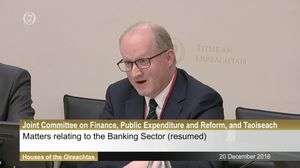
Governor of the Central Bank Philip Lane at a meeting of the Joint Committee on Finance, Public Expenditure and Reform, and Taoiseach today
Further to reports that 8,200 mortgage accounts – in which homeowners were overcharged because they were wrongly denied low interest tracker rates by 15 banks – had been identified by the Central Bank…
From a meeting of the Joint Committee on Finance, Public Expenditure and Reform, and Taoiseach today…
It emerges at Oireachtas finance committee that, in fact, around 15,000 people will have been affected by Tracker scandal. Not 8,200.
Further to the announcement from Finance Minister Michael Noonan that Ireland must pay an additional €280million to the EU next year – because of the recent GDP growth of 26.3%, as recorded by the Central Statistics Office…
Sinn Féin TD and finance spokesman Pearse Doherty and Stephen Collins, political editor of The Irish Times, spoke on Today with Seán O’Rourke about the development.
Seán O’Rourke: “Pearse Doherty, are you assured by a comment from the Public Expenditure and Reform Minister Paschal Donohoe on Morning Ireland, saying that bill has to be met, as a result of our EU membership, it will not influence the spending plan for Budget 2017.”
Pearse Doherty: “Well, Minister Noonan actually provided me with this figure on Tuesday, €280million additional and made that point that it doesn’t affect our fiscal space. And this is about just how the rules are applied and the fiscal space has been agreed in April and therefore it’s set. It will have an impact next year and that’s where we need to actually tease out how we calculate the fiscal space for next year. But I think there’s a deeper issue here and me in Sinn Féin and myself, in particular, have been challenging the previous government on this, since 2013. Our economic, the way we calculate our economy is absolutely broken, it’s bust in this country. It’s been a way out for quite a long number of years. We all agree that the 26% isn’t real, but neither was the 7% that we were suggesting was happening last year as well because the same type of factors were at play. At a lesser extent.”
“But the fact that we’re actually paying more to the European Union budget as a result of this year isn’t something new. I have figures going back to 2010, as a result of redomiciled plcs – these are companies that were domiciled in Ireland but don’t pay any tax here. And the actual additional contribution that we had to pay to the EU budget every year, because of that average, between €45 and €60million per year. So this is something that’s been going on, over and over again. In 2014, when we started to, we raised our GDP figures because of the activities of illicit trades that’s, you know, prostitution, drug sales and all the rest which gives us a bump in GDP, we actually had to pay €6.5million to the European contribution.”
Meanwhile…
Yesterday.
In the Dáil…
Anti-Austerity Alliance-People Before Profit TD Richard Boyd Barrett raised the €280million bill after he asked why the Government recently opposed an EU proposal to begin country-by-country reporting of corporation tax by large multinational firms.
He was speaking during a debate on corporation tax.
From the debate:
Richard Boyd Barrett: “A few weeks ago, the Government opposed an EU proposal to introduce public country-by- country reporting of corporation tax for large multinational companies on the spurious grounds of subsidiarity. Are we going to bring in public country-by-country reporting ourselves?
Mary Mitchell O’Connor: “Last April, the European Commission adopted a proposal for a directive to introduce public country-by-country reporting of corporation tax by large multinational enterprises.Since then, my Department has been considering the detail of the proposal and consulting with stakeholders. The Department also ran an open consultation in the course of last May. The task of assessing the proposal is continuing and, at EU level, the negotiations have begun. Although they are at an early stage, it is clear that the proposal raises a number of practical, legal and technical issues. These will need to be addressed over the coming months. Until we know the scope and content of any final EU measure, it is too soon to consider national measures on this type of public reporting. However, Ireland is already to the fore in introducing similar reporting obligations for large multinational companies. Under the Finance Act 2015, certain Irish-resident parent companies and subsidiaries of non-Irish companies must file a country-by-country report on tax with the Revenue Commissioners each year. The first of these reports are due to be submitted to the Revenue by the end of next year. Several countries, including the US and all EU member countries, have committed to introducing this form of country-by-country reporting and to sharing the information among their tax authorities.”
Boyd Barrett: “The Minister may have heard this week that we are already paying a big price because of aggressive tax avoidance by multinational corporations. We will have to pay an extra €280 million to the EU this year because of the artificial inflation of the growth figures. Already, even before that, our contribution to the EU is grossly inflated and distorted because it is, in proportion to population, double that of countries such as Portugal and others due to the tax avoidance strategies of multinationals based in this country. It is in our interests to have public country-by-country reporting of the big multinational companies to stop them engaging in aggressive tax avoidance. Yet, incredibly, when offered the opportunity to do that by the European Union, we used the spurious excuse of subsidiarity to reject that proposal. What the Minister seems to be saying is that we cannot do it on our own. I agree with that, but why the hell did we not sign up to a pan-European proposal to do it, instead saying that we could not sign up to it because it infringes our sovereignty? It does not make any sense.”
Mitchell O’Connor: I reject tax avoidance. We cannot do it on our own. If we were to publish the figures the Deputy is referring to, it would allow some companies to gain a possible commercial advantage over others because matters would be deemed to be commercially sensitive. Other jurisdictions might not share the information with us if they knew we were going to publish the reports. It would not help the tax transparency agenda and a system of country-by-country reporting. I cannot do it.
Acting Chairman (Deputy Catherine Connolly): I thank the Minister. That brings Question Time to a close, and we are moving…”
Boyd Barrett: “There are 21 seconds remaining.”
Connolly: “We are moving on. I asked for the Deputy’s co-operation. I have three different clocks here. I am going to move on to Topical Issues.”
Listen back to Today with Seán O’Rourke interview in full here
During tonight’s debate on the Commission of Investigation into certain IBRC transactions, including the sale of Siteserv to Denis O’Brien…
When I met with the Minister yesterday I highlighted that my main concern would be that the investigation does not end on Prom [Promissory note] night and that it extends into the time when the IBRC was in liquidation.
There are many issues that straddle both time periods and it is vital that the investigation can properly follow these threads.
For example, the purchaser of Siteserv, was already significantly indebted to IBRC. We know that on the 7th of March 2013 – one month post liquidation – that he wrote to the special liquidator seeking to reschedule his outstanding loans over a further 3 year period.
We know that he claims to have been allowed a similar extension by virtue of a verbal agreement he claims he had with the CEO of IBRC (Mike Aynsley).
We also know that, according to IBRC, the credit committee had never approved such a previous agreement yet Mr O’Brien maintains it was in place and he requested that the special liquidator be made to honour that verbal agreement.
I wish the minister to clarify if the assertion of such a verbal agreement will be enough to satisfy the Terms of Reference regarding the ‘contractual obligations’ required in relation to investigating issues that straddle pre & post liquidation.
We know that the credit committee met on the 23rd of May 2013 – two months after Mr O’Brien’s approach to the special liquidator and at that time the outstanding balance owed to IBRC by Mr O’Brien was in the region of €325million.
It is worth, at this point, asking the question as to why someone, so heavily indebted, was allowed to make significant purchases from IBRC rather than being asked to pay down his outstanding loans. Were other bailed-out banks financing this buying exercise? Was he borrowing from Peter to pay Paul?
Interestingly, an article that appeared in the UK edition of the Sunday Times in January 2012 showed that in 2011 & 2012 the IBRC refinanced some of Mr O’Brien’s loans and increased their security stake in some of his investments. It seems illogical that in the same time period they allowed him to purchase Siteserv for example.
The point here is that some of the documents I am referring to relate to the Special Liquidators era hence the need for the period to be covered by the terms of reference.
In recent days, The Chairman of IBRC (Mr Dukes) has made much of the fact that the Central Bank conducted a review, prior to July 2012, and apparently found no problems.
Contradicting that assertion however is a relevant piece from the FOI documents from inside the Department when they said
“We are concerned that the Central Bank report compiled on the transaction vindicates their position. To be clear we are concerned with a number of the decisions taken by the bank in relation to this transaction.”
….Yet It was not until I received an FOI of July 2012 internal Dept memos did we learn that the Department officials were expressing serious concern over the effectiveness of the CEO and the management team and they had serious concerns over the way a number of large transactions, including the Siteserv sale had been handled.
….Another significant issue that raised its head in some of the early reporting of this controversy but has since been replaced by other developments is the share activity in Siteserv prior to its sale.
Various sources of information told me that the Siteserv share activity in November 2011 – the period during which the bidding process was underway – was irregular and that there had been a significant share spike around the time it was sold resulting in a nice windfall for some lucky investors.
Unfortunately it was indicated to me that some of those investors may not have been so much lucky as they were well-informed. Indeed the Chairman of IBRC confirmed in an RTÉ interview that Denis O’Brien for example, had been given advance notice of the sale before it was announced. Did others have similar information?
The unfortunate thing here is that while I know what insider trading is, I don’t yet know how we deal with it here in Ireland. On foot of my information regarding share activity, I wrote to the Irish Stock Exchange who advised me that it was not within their remit and that I should talk to the Central Bank.
I wrote to the Central Bank who told me it was outside of their remit. I then wrote to the Office of the Director of Corporate Enforcement whose reply came back today to tell me that it does not appear to come within the remit of their office.
….In my speech on May 28th I referred to loans held by Mr O’Brien that were due to be repaid in full in 2011 and 2012. We know they were not repaid in that timeframe.
Effectively, once the agreed term expired, those loans were in default and became callable on demand. IBRC’s own terms and conditions allowed them to charge default interest rates yet they chose not to do so in this case.
Many sources have come forward both before and since that speech, to say that they had personal experience of being both performing and non-performing borrowers of IBRC and their experience of their loans being called in, in a ruthless fashion and other defaulting borrowers talk of the punitive interest rates applied to them.
…..The plight of the former Irish Nationwide Mortgage holders and the way in which they have been treated by IBRC compared to the very favourable environment that seems to have been provided to Mr O’Brien for example is perhaps an indication.
Catherine Murphy, Independent TD for Kildare North
Maíria Cahill spent the day in Leinster House answering questions and talking about the wider issue of abuse.
A Dáil debate is scheduled today from 2:30 pm regarding allegations of sexual abuse by members of the republican movement arising from the Maíria Cahill case.
Pearse Doherty: “More than a month ago I was contacted by a serving member of An Garda Síochána who relayed to me very disturbing allegations in regard to Garda practices in the Westmeath division but not exclusive to that division. I subsequently met with this garda and have had a number of telephone conversations with him since. On the day that the former Minister for Justice and Equality, Deputy Alan Shatter, resigned, that garda called me and told me that as a result of that resignation he now had more faith in the confidential recipient process and was going to arrange a meeting. That meeting took place today. Garda Keith Harrison claims that as a result of arresting a member of the drugs unit in Athlone for drunk driving, that Garda management maliciously set out targeting him while the arrested garda was afforded protection by Garda management. He claims that a managerial review of his high work returns and practices was instigated and persons who had past interactions with him in the execution of his duties were invited by the Garda to make complaints against him. He claims that during this period from September 2009 until March 2011, he was office-bound while the garda he arrested, who had been found with a high concentration of alcohol, was still driving official vehicles and carrying an official firearm. Garda Harrison makes serious claims about how the drunk driving case was struck out of court on dubious rulings and how evidence relating to the case was stolen by a member of the Garda. He also claims that a member of the Garda of officer rank stationed in the Westmeath division prevented successful prosecution of individuals in a number of cases.
“On Monday, I met with Garda Harrison again. At that meeting there was also Garda Nicky Kehoe, who is another serving Garda whistleblower, and who has made serious claims in regard to the connection of a major heroin dealer in the midlands and a senior member of the drugs unit. Both those serving gardaí at that meeting were joined by former garda and prominent whistleblower, John Wilson, who is advising both men. I also invited our justice spokesperson, Deputy Pádraig Mac Lochlainn, to attend which he did. At that meeting copies of sworn affidavits were given to me from both gardaí. Garda Harrison claims that he had suspicions about a member of the Garda who was working within the drugs unit who may have been knowingly allowing the sale and supply of drugs within the Athlone district and that he had raised this with management, but he claims that it fell on deaf ears. At that meeting I was also presented with a written record of a meeting between Garda Nicky Kehoe and a civilian who has come forward in recent days who corroborates the claims that have been made by Garda Kehoe in regard to heroin dealing and a member of the Garda.”
Later
“Garda Harrison – who in 2007 was invited to Áras an Uachtaráin to receive from President McAleese his award for bravery for his second life-saving incident – in his own words sums up the fear of those who have come forward and those who are thinking of coming forward. In his sworn affidavit he said:
I was once a well-respected, ambitious and unblemished member of An Garda Síochána. Through systematic and relentless bullying and intimidation and unmerited scrutiny, I have, in my view, been totally undermined and destroyed. My good name and that of my family has also been tarnished and I now feel I have no option but to take this action. I feel I could not address this prior to now as who was I to turn and have faith in them to do the right thing? Who would believe me over Garda management? Would I make an unbearable situation worse for myself, by turning on the wolves that preyed on me? Never in my life have I felt so alone, tortured and disappointed. I have huge concerns about my future in An Garda Síochána and how much more is going to be thrown my way.
Mick Wallace told the Dail:
“The Guerin report, from our point of view, is not anything new because we heard most of these stories back in 2012 and raised some of them in this Chamber and at a press conference in December 2012 but nobody really wanted to know. Garda Sergeant Maurice McCabe had outlined how practices, procedures and cover up was the order of the day and nobody seemed to want to face up to the truth about that. It is good that Mr. Guerin has called a spade a spade because it helps to move matters forward in a positive way.”
“Since then our offices have been snowed under with stories and reports from different people and I do not know how it will all be dealt with. There are hundreds of them and they are very sad to listen to. I do not know how this should be handled but something will have to be done. One such story comes from a former garda called Jack Doyle. His story gained some attention around 2000. He revealed some serious drug involvement by gardaí in the Cork area and at the time the Garda authorities confirmed that undercover gardaí had been involved in the importation of illegal drugs into the State in what they described as controlled operations. However, a spokesman said that these operations were necessary in order to bring the leaders of criminal drug gangs to justice. Garda management rejected calls for an inquiry into claims made by Jack Doyle, saying nothing inappropriate had occurred.”
“We got a 27-page report from Jack Doyle into the background to what went on. I will read less than a page of it. He was speaking with one of the drug runners with whom he had become acquainted:
He recounted to me how they had many opportunities to arrest the boss of the criminal gang but failed to do so. When asked why, he replied, “They have a senior garda in their pocket.” He then recounted an incident in Rosslare when he was returning with a shipment of drugs. A customs officer stopped him and was about to search his jeep when two plain-clothes gardaí commandeered the jeep and drove out of the terminal at speed, being pursued by customs officers. A high-speed chase ensued and the gardaí lost their pursuers. As a result of this incident he said he would never personally bring drugs in again.
He then proceeded to tell me about the many runs he had done, bringing in cocaine, ecstasy, cannabis and firearms. Massive amounts of drugs were coming in and quantities were allowed to get into the hands of the criminal gang. He told me how he was being well looked after financially by both the criminal gang and the gardaí.
“He then went on to tell me where he had left a handgun in a wooden area in Cork. He contacted a particular detective sergeant and told him of the location, and drawing a map in the area pinpointed it. On finding the location, two gardaí threw in a number of firearms to beef up the find. He explained that the press reported it as a subversive arms find. When I asked him why they would do this, he replied, “To further their careers in the force.”
“Their careers have progressed and one of them is now an assistant commissioner. He was appointed by the former Minister, Deputy Shatter, and this same individual was involved in the Boylan case which entails a very similar story to Jack Doyle’s. Jack Doyle’s career did not progress. He turned up at his place of work one day and was told, “Jack, you’re not coming in here. You’d better go home. You’re finished, Jack. But, listen, you’ll be grand; we’ll look after your pension.” He was forcibly retired. That one of the gardaí involved is now an assistant commissioner – he could actually be the next Commissioner – emphasises how important it is that the new Commissioner should come from outside the State with a new hierarchy built around him or her as otherwise problems will not go away.”