Tag Archives: Prime Time

NearyNEary2

The moment when everyone knew.

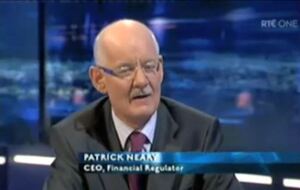
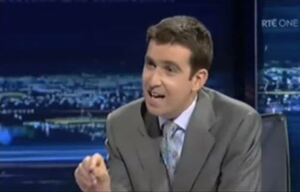
CEO of the Financial Regulator Patrick Neary with a tenacious Mark Little on RTÉ’s Prime Time back in October 2008, in the wake of the bank guarantee.

Mark Little: “You said, September 19, ‘Irish banks are resilient and have good shock absorption capacity to cope with the current situation’. Do you regret making that statement now?”

Patrick Neary: “Absolutely not. I think the issue that was facing the Government this week is connected with the supply of liquidity in the financial markets. It’s very important for all members of the public that they have access to cash. Banks are sources of information for members of the public. You need cash to go about your daily, daily lives, for the economy to function properly. The supply of cash in the international markets has been drying up for a number of months. But the world changed, a couple of weeks ago, with the collapse of Lehman Brothers. I think, after that, there was great nervousness in the international financial markets. We saw flight to quality, we saw banks unwilling to lend to each other. We saw banks, preferring to deposit with the European Central Bank, the Bank of England, the Fed, anywhere but lend to each other. And that affected the Irish bank…(vid goes silent)..cash, to supply cash to the economy and that was the great worry.”

Little: “Isn’t that just, at the very most, only a partial reality? The reality is a fundamental weakness in the Irish banking sector. And that’s an exposure to a crumbling property market?”

Neary: “Completely different issues altogether. The issue facing us today…”

Little: “Is that not the source of the potential collapse of banks here?”

Neary: “I don’t accept that at all. We’ll come to that in a minute and we’ll talk about the activities of banks. But let me say, the issue that was facing the Government. And I have to say the prompt response of the Government was addressing a very serious…(vid goes silent)..”

Little: “They had no confidence in the Irish banks and the reason was that they had lent recklessly in a crumbling property market.”

Neary: “We’ll deal with the lending in a moment.”

Little: “No, no, I’m just asking you a question. That’s what the market said. Do you not recognise there was a fundamental weakness in the banking sector, aside from global conditions.”

Neary: “I just want to first of all address the issue that faces us today.”

Little: “No you’ve already explained that. My question to you is.”

Neary: “All right, let’s move on.”

Little: “Do you accept there is a fundamental weakness in the Irish banking sector and that’s its overexposure to the property market?”

Neary: “I do not accept that at all. These issues are totally unrelated. The issues of lending, the loan portfolios, the risks in the loan portfolios are addressed by having appropriate levels of capital in place. And, in fact, the regulator has been very active since 2006 in putting these measures in place.”

Little: “Why didn’t you stop the kind of behaviour that was described in Una’s (RTE reporter) report earlier. Why didn’t you stop, for example, people getting loans seven times their salary? 95% mortgages? Why didn’t you stop that behaviour?”

Neary: “The important thing to make sure that the banks are adequately able to deal with the challenges that may emerge as the economy weakens is that they have adequate levels of capital to absorb any losses.”

Little: “Let me ask you about the issue of how exposed the banks are. Now they have over a €100billion outstanding loans to property developers and builders. How much of that are they going to get back?”

Neary: “I believe there will be certain impairments over the next couple of years, as the economy declines.”

Little: “What are we talking? Are we talking about 5, 10, 15, 20billion in bad loans?”

Neary: “You can’t speculate about that.”

Little: “So how can you say the banking system is sound if you don’t know the level of bad loans.”

Neary: “The important thing is that difficulties emerge in a loan portfolio. In the normal course of the life of that loan portfolio, that’s what they…”

Talk over each other.

Neary: “That’s what, that is our day job. Our day job is…”

Little: “The taxpayer now has a potential liability. I’m asking you now about the solvency of the banks.”

Neary: “Yes.”

Little: “What is the estimate? Your estimate of bad loans for the banks going forward?”

Neary: “You could not speculate on that. The important thing…”

Little: “So how can you say that the banks are financially sound?”

Neary: “The important thing is that risks emerge over the lifetime of the loan portfolio and it is important that there is adequate capital there, to absorb those risks and by any estimate, the Irish banks are so well capitalised compared to any banks anywhere, across Europe. That I am confident that they can absorb any loans or any impairments that emerge in the ordinary course of business over the foreseeable future.”

Little: “Let me take you back to a couple of years ago. You were expressing concerns, as I say, about these risky loans, about people getting loans six, seven times their salary. Why didn’t you stop it?”

Neary: “I most certainly did take very decisive action because at time, two years ago, when we were…”

Little: “Did you stop that behaviour?”

Neary: “You must absolutely provide choice to customers and customers must be able to make decisions, informed decisions and have these choices open to them. Our job is to assess the risks and to make sure that the system is able to absorb those risks, which I think the measures, we introduced back in 2006, did.”

Little: “So you don’t accept that the banks took any risks before this crisis?”

Neary: “The banks. It is part of banking that they do take risks.

Little: “Unnecessary?”

Neary: “And it is absolutely part of banking supervision and regulation, that banks are able to absorb the effects of those risks and I believe the Irish banks are adequately, more than adequately capitalised, and they’re very resilient and they will be able to absorb these risks.”

Little: “Ok, you’ve said that before. Let me move on to this guarantee. This guarantee gives incentive to banks to continue whatever risky behaviour they want because the taxpayer is going to foot the bill eventually, if anything goes wrong, right?”

Neary: “We’re in an absolutely different environment now. This guarantee has brought a new world. It’s a completely different situation. The taxpayer is there, since the Government initiative, the taxpayer is there to guarantee the banks and the idea behind that is…”

Little: “My question to you is: what are you going to do to stop risky behaviour in the banking sector? For example, will you stop dividends being paid out to shareholders?”

Neary: “The Government will, and has, sought the advice of the regulator and the Central Bank as to what the regulatory framework should be, to ensure greater accountability and transparency…”

Little: “Is that a yes or a no?”

Neary: “For the taxpayer. And we are working on what the regulatory response should be and, in fact, as we speak we have people in the office. They’ve been working through the weekend..”

Little: “I’m not sure about the answer to that question. Will you do anything to stop..”

Neary: “To make sure the Government gets the appropriate advice so that the taxpayer can be reassured so that the measures and…”

Little: “Ok.”

Neary: “And the scheme put in place, under the Act, gives assurance to the taxpayer that…”

Little: “Ok, Pat Neary, is it moral, for banking executive, chief executives, to be getting multi-million dollar, multi-billion euro pay and bonuses at a time when the taxpayer is taking the risk for potential problems.”

Neary: “Certainly that is an area, executive pay, that will be considered as part of the requirements going forward. And it’s one of the areas that will be looked at and it will be included in the advice that we give to the minister next week…”

Little: “But the question is what have..(inaudible) Don’t worry about the regulatory framework. They (the public) want to know about the morality.”

Neary: “I think people out there want to hear me saying tonight is: that their money is safe and that there is adequate liquidity in the system for them to go about their daily lives, to be able to meet their daily obligations, for businesses to have liquidity available to them. That is the important message and that is what the Government has delivered through this initiative that soundness and safety of people’s deposits and that they can do their business.”

We were doomed.

90302328Last night’s Prime Time ‘Breach of Trust’ childcare investigation centred on three state-approved and part state-funded creches.

(1) Giraffe

Footage from last night’s Prime Time showed workers at the Giraffe creche, Belamine, Stepaside, South Dublin shouting at distressed children. Footage also showed children being left strapped in small chairs for hours, in one case, facing a fridge. Diaries detailing the children’s day may also have been fabricated.

The Giraffe creche is part of the Giraffe Group of 21 creches, owned by Giraffe Childcare. As an unlimited company its accounts are not publicly available. However it received just over €1 million from the State in funding for the 2011/2012 pre-school year and just under €1 million for 2012/2013 pre-school year. The creche also charges fees but the amount of the fees are not stated on its website.

All except one of the shares in Giraffe Childcare are owned by an Isle of Man company called Yokota. The other share is owned by an Irish trust company called Sanpel Ltd. The directors of Giraffe Childcare are Simon Dowling,Tony Kilduff, Mary Ann McCormack, Tony McCormack, and Siobhan Moore, who are also directors of Yokota. Mr Kilduff is also a director of the Mater and Cappagh National Orthopaedic hospitals.

In a statement made pre-programme Simon Dowling, MD of Giraffe, accepted that RTE had found clear evidence of inappropriate conduct by some staff and said he was “upset and disappointed” after seeing the footage. He unreservedly apologised to parents.

2011-09-16-10-05-17(2) Little Harvard

Footage of the Little Harvard creche in Rathnew, Co Wicklow, showed a one-and–a-year-old year old child being shut behind a closed door for a number of minutes as a punishment for misbehaving. It also showed children playing outside with materials from a nearby building site.

Little Harvard received the sum of €433,000 in State funding in 2011-12, with a further €463,000 paid out towards the running of those facilities in 2012-2013. It also charges fees (details here) http://littleharvard.ie/pricing/

Little Harvard has other crèches in Leixlip, Rathfarnham, Bray and Blanchardstown. It is run by Little Harvard Childcare Limited, whose shareholders and directors are Regina McGovern and James Hargrave. The Little Harvard in Rathnew, Co Wicklow. Little Harvard Childcare Ltd had accumulated profits of €324,194 at the end of 2010, according to abridged accounts for that year. At the end of the previous year the figure was €19,987. No actual profit figure for the year is given in the accounts.

In a statement made pre-programme, Little Harvard Creche said it was disappointed that the footage focused on “isolated incidents” and did not reflect the commitment, care and love provided by staff to the children every day. A spokesperson said Little Harvard is investigating the incidents and taking all steps necessary to ensure that shortcomings are not repeated.

90302307(3) Links

Footage of Links creche in Malahide shows children being cursed at by care workers. A child who will not go to sleep has his mattress taken away. At one point one staff member says to another “Don’t be afraid to be tough with them.. cos you have to be… cos they’re all little bullies”

This is immediately followed by footage showing a baby who will not go to sleep being picked up roughly and slammed back down into the mattress, apparently in an attempt to get it to sleep, while the song ‘Twinkle Twinkle Little Star’ plays in the background.

Links is run by a company Links Childcare and Montessori Ltd, founded almost a decade ago by Deirdre Kelly. It operates ten creches in Dublin. Its directors and shareholders are all members of the Kelly family, who are also directors of P Kelly Delicatessen Ltd and P Kelly Motors Ltd.

Links was paid €329,000 under the pre-school scheme in 2011-12, and €353,000 in 2012-13. It also charges fees but there is no pricing on its website, which also states that Links provides the additional features of spanish, speech and drama classes and hip-hop.

The Links website states:

“Deirdre Kelly has always been hands on ensuring high quality and early years’ education…Parents value her opinion and she is known affectionately as Dublin’s answer to Supernanny because of her advice and tips ranging from discipline, eating habits, toilet training, education, routines and health right down to advising parents on the best available nappy rash cream! (a well-kept secret).”

A statement on behalf of Links was issued pre-programme by Stephen O’Byrne of MKC Communications, a political lobbying public affairs firm and a board member of the Irish Society for the Prevention of Cruelty to Children. Links has accused the programme of “putting the interests of RTE in priority to the health and welfare of the children involved”. A complaint has been made by Links to the Gardai that RTE obtained information by deceit, trespassed on the creche, and breached the data Protection Act.

Previously: The Prime Time Creche Sting: A Parent Writes

(Sam Boal/Photocall Ireland)

giraffe4Today’s Herald reports that two members of staff at the Giraffe creche in Stepaside have been suspended after a sting by a RTE Prime Time reporter posing as a care worker.

Anon writes:

My kid’s in that creche and us parents are sitting round in shock trying to find out what the hell’s going on and so far only Giraffe is talking to us.

Except for those whom RTE showed video footage to noobody’s been asked for permission with respect to the video footage nor told if their child is on it.

RTE didn’t provide the footage to the HSE inspection team or to Giraffe (they’ve provided 30-second edited clips and have upset some parents with them.

The last HSE inspection was less than a year ago and Giraffe said it was a glowing report (we’re looking to get a copy now);

The RTE reporter was on the fast-track to be fired by Giraffe (according to Giraffe) because there were serious questions raised by other carers about her childcare standards (refusing to change nappies thus driving up the workload on the other carer in the room, and constantly leaving the children so she could wander around the creche filming).

According to Giraffe, the reporter submitted complaints to the HSE some weeks ago but neither stated she was an RTE reporter, nor that she had video footage to support her complaints (which would have sped up the whole process). Again Giraffe are the only ones talking to us.


Gardai and HSE to probe creche after RTE sting (Conor Feehan, Independent.ie)

WallaceIndependent TD Mick Wallace, above, spoke to Pat Kenny earlier this morning about claims made by Justice Minister Alan Shatter that Mr Wallace had been on his mobile phone when he was stopped and advised by Gardaí that he could receive a fixed ticket charge and penalty points, before being warned not to do it again.

Mr Wallace told Mr Kenny he was shocked and thrown by the claims.

He said he genuinely couldn’t recall the incident and even thought Mr Shatter had made it up.

He said he then got a text from a journalist on Saturday, in which he was asked:

“Were you stopped and warned at the Five Lamps on the North Circular Road?”

He told Pat he then did eventually recall an incident involving the Gardai but he was neither stopped nor warned:

Mick Wallace: “I was parked at the lights and a Garda vehicle came up beside me. And I was on the phone…which I know, I was wrong, I shouldn’t have been on it. The guard..I rolled down the window, the guard rolled down his window. There was two guards there. And I said ‘oh’, I just had my hand up and they said ‘it’s OK’. And, left it at that. And we just, we made small talk after for maybe about 15/20 seconds and the lights went green and I drove on straight and they pulled out. The guards were friendly.”

Pat Kenny: “And did you apologise to them at the time, when you rolled down the windows ‘sorry, guard, I’m on the phone here.”

Wallace: “Yes, I would have done, I stopped being on the phone and I said ‘look, sorry guard’. And they said ‘it’s OK’. And we went on to talk about something else.”

Alan Shatter is to speak – possibly creepily – about all of this at midday.

More as we get it.

Listen here.

Previously: How Did He Know?

Sasko Lazarov/Photocall Ireland

-2-1pt

https://www.youtube.com/watch?v=FXTEt3KSrYw

Miriam O’Callaghan was joined on last night’s ‘Prime Time’ by Sarah McGuinness (middle) of TFMR (Termination For Medical Reasons) and Dr Berry Kiely (top), medical adviser to the Pro-Life Campaign.

To debate the lack of provision for women who experience a fatal foetal abnormality in the proposed abortion legislation.

It was a new low.

Miriam O’Callaghan: “Well now to the ongoing debate about the proposed new abortion legislation. On so many levels we know this is such a sensitive debate. None more so perhaps than the very tragic aspect that is fatal foetal abnormality. This hasn’t been provided for in the new proposed legislation. Some people feel very strongly that this is a serious omission, others of course disagree,. Well to debate that I’m joined here in studio by Sarah McGuinness and also by Dr Berry Kiely. Sarah, first of all I know you had a very personal history with your baby daughter Molly. Tell me about that.”

Sarah McGuinness: “We were diagnosed very late Miriam actually at 26 weeks. We were told by the maternity hospital that our daughter had the condition, anencephaly. For anybody that’s not aware, that means that she will have little or no brain. She’ll have no skull. And we were told by the consultant that she would not survive outside the womb. Em..After the shock and everything else em, then we said “Okay”, we just thought that straight away they would induce me. Where they would bring me in the next day and induce me. And the consultant told me under Irish Catholic law, there is nothing they could do for me until I was at least the 40 weeks, that I would have to carry her another 3 months. And we were just floored and then she said “Or you travel”.
And of course Miriam this was all new to us and we were like “What?” and she said “Oh you travel to England and have your baby delivered early there”. So after the shock and after getting water and I suppose after just digesting what she told us, I’ll never forget I just said to her “What would you do in our circumstance?” and she said “Your baby has no chance of survival outside the womb. I would travel”.
So anyway the week after, after the…the hospital offered us no support. They weren’t allowed to but we were told that Liverpool Women’s Hospital was a great hospital to go to. They deal specifically with women with fatal foetal abnormalities. They give the second opinion when you go there. They will not perform an early delivery or a termination unless they’ve double checked that your baby has a fatal condition. And anyway over there together with my husband and my father and my husband’s mother ah we were there and they delivered my my baby over there.
So this was around Christmas, this was December 2009 and we traveled Miriam at that time with people going over celebrating holiday festivities. And we came back on the boat, my father decided we’ve to come back on the boat for more comfort for me. And again we came back with people in holiday festivities and we had to leave our daughter in a morgue in the hospital in Liverpool.”

O’Callaghan: “Oh I’m so sorry. Would it have made a big difference to you Sarah to be able to have that here, not to have to go to Liverpool?”

McGuinness: “Oh of course. Oh my God. The trauma, the added trauma. We were given the worst news of our life that our daughter was not going to survive and then to be told “Well there’s nothing more we can do for you unless you carry your baby for another 3 months”. So you’re leaving the care providers that have looked after you throughout your whole pregnancy, who are very very good but their hands are tied. So you’re leaving them, you’re leaving your friends, you’re leaving your family and making this awful trek over across the water.”

O’Callaghan: “Berry Kiely, when you hear a story like Sarah’s you can understand why a lot of people would feel that is an omission in the legislation that that is not catered for.”

Dr Berry Kiely: “A story like Sarah’s is heartrending there’s no doubt about that. My heart goes out to you Sarah. It’s an incredibly difficult tragic situation. It has to be, it has to rank among the worst bit of news that any mother can get. And I don’t think anything that I say or anybody else would say, you know I have no desire if you like to like to wound Sarah in any way or to make that more difficult for you because it genuinely is.
But I think at the heart of this debate is the issue of whether or not we want to care for and cherish and respect all, all human lives, including the unborn and including those with a terminal illness as in the case of Sarah’s baby. And whether if you like, because the fact that a child has a terminal illness. Em how do we react to that? How do we respond to it?
If you were to think if Sarah’s baby was already born and had a diagnosis of a terminal illness, what would we do? Obviously we would give whatever treatment the baby, you know, what would be helpful to the baby and we would give Sarah and her and her husband and her family all the support.”

O’Callaghan: “Excuse me sorry to be cutting in but from Sarah’s point of view then just because you said it to me a moment ago just there. I suppose if you have that diagnosis and you’re going to carry a baby and you know it’s totally incompatible with life. That’s what you’re talking about here. Is it not…is it very unfair on a mother to have to do that?”

Kiely: “It’s very difficult. There’s no doubt about that but I think also even a phrase like ‘incompatible with life’, you have to ask yourself what does that mean? How long is this baby likely to live? Some won’t even be born alive but some will. Some will live for minutes, some will live for days. There have even been some who have lived for months and you’ve to ask yourself “What do you do in this situation?”. When you know somebody is dying, and you know that there’s nothing, there’s nothing I can do. There’s nothing anyone can do to change that fact.”

O’Callaghan: “What would you say to that?”

McGuinness: “We were told that women in our group have been told that we’re all in the same position that the diagnosis is fatal. We can only go by what the care providers tell us, what these qualified consultants tell us and they told me Miriam there was absolutely no chance for my daughter. So why would people in this country make me grow a baby bigger just to watch it suffer and die?
An anencephalic baby will not live. Yes, they might live a few hours but why at 26 weeks would they make me grow a baby even bigger just purely to let it suffer and die? Why? There’s no terminal illness there, the baby is going to die outside the womb. Why why put a woman through that? Why put a baby through..? Why make me watch my baby scramble for a few breaths and die? A baby cannot survive without their brain, that’s just heartbreaking. Why make it worse on families in this country?”

O’Callaghan: “Berry..”

McGuinness: “Miriam, can I just make one point? Ireland and Malta are the only countries in Europe that this happens to. If this had happened to me in Belgium or Poland or England, I wouldn’t have this extra heartache.”

O’Callaghan: “Let Berry Kiely come in I suppose on that point…”

Kiely: “She’s absolutely right if there had been in another because those countries don’t actually have that culture of respect for life.”

O’Callaghan: “But what about those?”

Kiely: “No. Hold on a minute.”

O’Callaghan: “Okay.”

Kiely: “Those are actually cultures, by and large, if you’re terminally ill you can get euthanasia. And this is, it’s equivalent. It’s a similar type of argument. I mean, as I said, my heart goes out to Sarah and to every other woman. I mean a friend of mine was in a very similar situation earlier this year and I saw her going through it all.

Now her baby lived for two days which turned out to be a great joy for her that she had those two days and that was sort of wonderful for her.”

O’Callaghan: “Now let me put it in a question and I think it is interesting, like in the case of Sarah it’s just so sad.”

Kiely: “Absolutely.”

O’Callaghan: “Because her baby had a fatal foetal abnormality. I understand though could you possibly have a situation that it could’ve been included in the legislation for that kind of abnormality? But not exclude, not include something like a syndrome or something like a child could possibly live for 12 years? I mean in that case of her baby, that baby was honestly not going to live Berry.”

Kiely: “Not going to live but there are for example in the medical literature babies with anencephaly who have lived for months. So where do you draw the line? Where do you decide this is, this much yes, that much no? Because ultimately it comes back to us saying, are we saying that because somebody is going to be very seriously ill, very seriously handicapped, very seriously damaged, that that particular baby is one in which we don’t have to cherish and we don’t have to look after. Now can I just say sorry before we go because this is really important.”

O’Callaghan: “Briefly Berry. I do need to get Sarah because she is the mother here.”

Kiely: “This is really important because what Sarah was not offered and what I think she should be offered and what every mother in her situation should be offered but we’re not offering it because we don’t have it in this country which is perinatal hospice which would provide infinitely more support than what we are able to provide.”

O’Callaghan: “Okay. Let Sarah come back.”

McGuinness: “Frankly, I find that very upsetting that someone put an idea of a perinatal hospice to me when again all I can go by was the care providers told me, my baby was fatal and would not survive.”

Kiely: “I’m sorry you were given that advice.”

McGuinness: “A perinatal hospice would not have helped me in my case. Molly was going to die no matter what. The outcome was going to be the same.”

Kiely: “Perinatal hospice looks after you in your pregnancy….”

McGuinness: “But why make a woman break her heart even further for another 3 months. Let me go to work and people asking me “Is your, is your nursery all ready? How are you keeping?”. What about women’s mental health? You would have to lock yourself away. I would’ve in my case for another 3 months , Miriam.”

Kiely: “That’s what perinatal hospice helps you deal with. Perinatal hospice comes into effect once the diagnosis is made, it’s not after the birth.”

McGuinness: “So what’s a perinatal hospice? You’re going to lock me away for another 3 months?”

Kiely: “Why would you want to lock you? It’s to give you that help and that support and the the network of women perhaps going through a similar situation suffering with the same….working out all of those…helping you work out all of those.”

O’Callaghan: “Shouldn’t that be a mother’s choice though Berry I suppose in that fatal foetal? I’m just asking…”

Kiely: “Well can I ask you? No but what about then the people in a situation like this who would argue for post-birth abortion, that if the baby is born alive and does live for a while but the mother finds this very difficult to deal with. Should that mother have the right to have her baby killed even though it’s still living?”

O’Callaghan: “But no one is saying that.”

Kiely: “But that’s an important issue.”

O’Callaghan: “But no one is suggesting that I don’t think Berry Kiely.”

Kiely: “But they are unfortunately Miriam that’s the problem. Again, I come back to the same point, what’s at root here is whether or not we cherish the lives of those who are seriously ill?”

O’Callaghan: “Okay. A last word to you Sarah McGuinness.”

McGuinness: “All we’re looking for Miriam is a choice. Stop treating women like this. We want a choice. It’s just barbaric the way women in this country are being treated.”

O’Callaghan: “Okay. Well look Berry Kiely I appreciate you coming in tonight. Sarah McGuinness thank you very much and I’m very sorry about your daughter Molly.”

McGuinness: “Thank you.”

Kiely: “Me too.”

Watch here

Previously: When Dr Boylan Met Dr Kiely

Father Vincent Twomey appeared on last night’s Prime Time on RTE 1, with Miriam O’Callaghan, to discuss the fate of Cardinal Sean Brady in the wake of this week’s revelations.

Twomey: “May I just preface my remarks by saying I’m here very reluctantly. I didn’t want, I’ve refused several invitations to speak on this thing. I was very glad two years ago when this thing first broke. I was out of the country, in a mission area, where there was no connection, I couldn’t get any mobile. So I didn’t have to comment. But even then I felt, whatever about the man’s individual situation and I think as Joe (Fr Joe McDonald, another guest on the show, who refused to call fro Cardinal Brady’s resignation) said it’s very easy for us to stand in judgement today. But considering the damage that was done by that awful man, Brendan Smyth. Considering the repercussions, one can only say that, somehow or other, you know the Cardinal unfortunately has lost his moral credibility.
“Now I personally am very fond and have great regard for Cardinal Brady. I think there’s a sense of a Greek tragedy about all of this. In the Greek tragedy people do things intentionally, doing the good thing, in fact they do some awful, dreadful things happen, as a result of their actions. And they have to pay for it. Oedipus for example. And they pay for it, even the Greeks realise, by suffering. And I think Cardinal Brady must be suffering enormously at the moment. But the sufferings of the, of the victims, the enormity of what happened, the whole situation with regard to what happened there. Cardinal Brady, in his own defence, quite rightly said he did what he thought was his duty. Well I think that was the problem. I think there are issues coming out of this whole thing which the church, internally, has to look at far more seriously. How is it that this legalistic approach, this preoccupation with law ‘I’ve done my duty, therefore everything is OK’. What’s behind that? Where’s the humanity? The imagination? That actually can’t realise that these children had suffered so much.
On the otherhand I do think it is incumbent on us to actually try to really face up to the situation that happened then honestly. And not to hide anything.”

Miriam O’Callaghan: “And I hear you’re saying you’re very reluctant to be here, to do this, but would you call on Cardinal Brady therefore to resign?”

Twomey: “I think calling is easy to say. I was asked my opinion before I came here. Did I think he should resign? And I’ve already said publcly, reluctantly, very reluctantly, that I think he should resign. But I’m not calling for his resignation. But I do think..his position…If he were a curate, if he were even a parish priest today, it would still be bad. It would have to be examined, yeah. But being the Primate of All Ireland, being the head of the church in Ireland, president of the episcopal conference, that’s a different position altogether. And I think for the good of the church I think it is really tragic as I said, but I’m afraid I’m of the opinion that he should resign.”

Watch here (@14mins)