
Tag Archives: Saturn

Saturn.

The sixth rock (well, gas giant with a rocky core) from the Sun is not always visible because, quite often, our Moon passes in front of it. To wit:

Such a Saturnian eclipse was visible along a small swathe of Earth — from Brazil to Sri Lanka — near the end of last month. The featured colour image is a digital fusion of the clearest images captured by successive videos of the event taken in red, green, and blue, and taken separately for Saturn and the comparative bright Moon.

The exposures were taken from South Africa just before occultation — and also just before sunrise. When Saturn re-appeared on the other side of the Moon almost two hours later, the Sun had risen. This year, eclipses of Saturn by the Moon occur almost monthly, but, unfortunately, are visible only to those with the right location and with clear and dark skies.

(Image: Cory Schmitz)

apod

1-158 2-158 3-154 4-154

Images of the rings of Saturn pix 1,2: (outer (B) ring, pix 1,2; inner (A) ring, pic 3 and a detail of a density wave, pic 4) taken by NASA’s Cassini spacecraft, now in the midst of its ‘ring grazing’ phase as it moves in to study the outer and inner disks of orbiting ice and rock.

These images are twice the resolution of anything previously achievable and allow objects as small as 550m (about the height of the CN Tower in Toronto) to be discerned.

Full resolution photos here.

Previously: The Seas Of Titan

dyt

PIA08113b-16

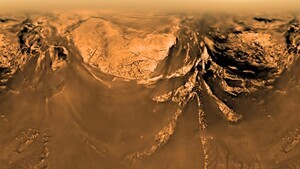
An extraordinary descent to the surface of Saturn’s largest moon, using actual footage from the Huygens Space Probe, which landed there in 2005. To wit:

The probe sampled Titan’s dense, hazy atmosphere as it slowly rotated beneath its parachutes, analyzing the complex organic chemistry and measuring winds. It also took hundreds of images during the descent, revealing bright, rugged highlands that were crosscut by dark drainage channels and steep ravines. The area where the probe touched down was a dark, granular surface, which resembled a dry lakebed.

MORE: Huygens: ‘Ground Truth’ From an Alien Moon (NASA Jet Propulsion Lab)

Meanwhile…

tumblr_ojwuxuDgXH1qz6f9yo1_500

By instachaz

thisisnthappiness

pia18432-16 Screen Shot 2014-10-31 at 02.00.48

Of this extraordinary image, CIT Jet Propulsion Laboratory sez:

As it soared past Saturn’s large moon Titan recently, NASA’s Cassini spacecraft caught a glimpse of bright sunlight reflecting off hydrocarbon seas.Also in the image: an arrow-shaped complex of bright methane clouds hovers near Titan’s north pole. The clouds could be actively refilling the lakes with rainfall. A “bathtub ring,” or bright margin, around Kraken Mare — the sea containing the reflected sunglint — indicates that the sea was larger at some point, but evaporation has decreased its size.

jetpropulsionlaboratory

No, it’s an extreme close up of Saturn’s sixth largest moon Enceladus taken by NASA’s Cassini orbiter. Normally, the moon would appear bright white. Here, the 500km wide iceball is glamour-lit by sunlight reflected off Saturn, resulting in a healthy tan.

NASA sez:

As most of the illumination comes from the image left, a labyrinth of ridges throws notable shadows just to the right of the image center, while the kilometer-deep canyon Labtayt Sulci is visible just below. The bright thin crescent on the far right is the only part of Enceladus directly lit by the Sun. The above image was taken last year by the robotic Cassini spacecraft during a close pass by by the enigmatic moon. Inspection of the lower part of this digitally sharpened image reveals plumes of ice crystals thought to originate in a below-surface sea.

via