
 Like Hugo Bosses, in fairness.
Name the year anyone?
Join The Irish Volunteers – Oglaigh na hEireann Rare Recruitment Army Poster (EBay)
Thanks Sibling of Daedalus



Like Hugo Bosses, in fairness.
Name the year anyone?
Thanks Sibling of Daedalus
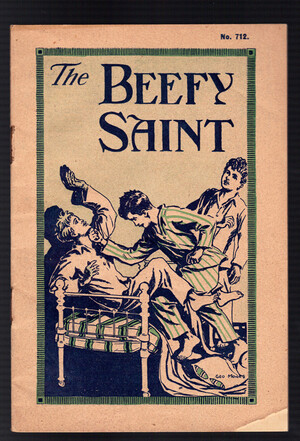
“What do you think of a man who could run all day beside a trotting horse, and be fresh enough to preach that evening? A kind of a mixture of rubber, steel, electricity and the love of God, that’s what Francis Xavier was. He was what you might call a beefy saint.”
The Beefy Saint, by Fergal McGrath SJ, Chapter 1: The Rocky Mountain Priest)
A religious pamphlet published in 1922, specifically for Irish boys, set in a fictional boy’s school ‘St Ronan’s’ and designed to educate them about manly saints including Francis Xavier.
Good times.
Thanks Sibling of Daedalus

Ella Zulia.
Landed in Dublin on this day, 1904.
Sibling of Daedalus writes:
The wire-walker Ella Zuila the most famous Australian public entertainer of her time, though now almost forgotten:
Ella didn’t just walk the wire; she cycled it; wheeled a child over it in a barrow; walked it in stilts and with a full-body blindfold, and, on one memorable occasion, hung from it by her knees to catch her fired-out-of-a-cannon husband.
Sadly, Ella’s career came to a tragic end in Dublin, on this date in 1904, when she and her tricycle fell off the high wire in the Round Room of the Rotunda. There was no safety net, and she was too badly injured ever to perform again. She died in 1926. A little plaque to her in the Rotunda wouldn’t go astray, surely?
Pic via US Library of Congress

 The cenotaph in remembrance of Michael Collins and Arthur Griffith on Leinster Lawn, Leinster House, Dublin, 1923, top, and its slender 1950 replacement, above
For the day what’s in it.
Sibling of Daedalus writes:
A report on on the radio today stated that no memorial to Michael Collins exists in Dublin apart from a small bust in Merrion Square. It is worth noting that in fact there WAS and it was removed in the 1940s.
It was originally a temporary memorial [in plaster by Albert Power] to be replaced by a permanent structure but De Valera had it removed during The Emergency (Dail question about the matter here). Then replaced it in 1950 by the ‘almost invisible obelisk’ by Raymond McGrath.Nice downsizing, Fianna Fail…
Pics via Archiseek, Oireachtas

 Arrah Wanna.
A racially-sensitive, Irish-themed Pocahantas.
Sibling of Daedalus writes:
Interesting popular American comic-hall song from 1906, ‘Arrah Wanna: an Irish-Indian Matrimonial Venture’, about a bagpipe-playing Irishman who wins the hand of a beautiful squaw, Arrah Wanna’ by promising her ‘a wigwam made of shamrocks green‘ cleverly getting round her requirement that ‘some great race must call you Big Chief’ by telling her that he’s the best runner in the district.
The song was enormously popular and spawned a sequel ‘Since Arrah Wanna married Barney Carney’ (above).
The happy couple are shown with the local chief who was subsequently called in to adjudicate on their matrimonial differences…
Lyrics here
Listenhere
Pics via Duke Library and Authentichistory.com

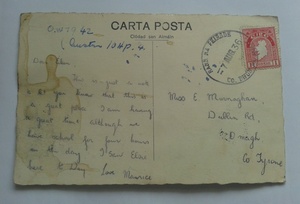
Rannafest, Co Donegal, August 1936.
Dear Eileen
This is just a note to let you know that this is a great place. I am having a great time although we have school for four hours in the day. I saw Elsie here today.
Love
Maurice
Sibling of Daedalus writes:
The card is addressed to Eileen Murnaghan, Omagh, Co Tyrone. I think Maurice is Eileen’s older brother Maurice Murnaghan, from Omagh, son of the doctor there, Dan Murnaghan. Maurice later became Professor of Physiology at UCD. I wonder if he ever got to have a word with Elsie…the genders in Rannafast seem to have been fairly rigidly segregated, from the photo on the card (top)….
Postcard via Ebay
 The Tayleur, pride of the White Star Line.
Unsinkable, they said.
That’s how they rolled.
Sibling of Daedalus writes:
It was the biggest ship of its time, and ‘the safest ever built’, the clipper ship, The Tayleur, owned by the White Star Line, which ran aground off a reef on the east coast of Lambay, Dublin, in 1854.
Like the the Titanic, The Tayleur was on its maiden voyage, but there was no iceberg (the new-fangled iron hull had distorted the compasses), and certainly no policy of women and children first; out of its shipload of Irish emigrants bound for the Australian Gold Rush, only 3 women (out of 250) and 3 children (out of 50) survived.
Among them was a baby, tied to a bed-tick, found still alive among the wreckage washed up on Portmarnock Strand the following day.
Known as ‘The Ocean Wonder’ he was adopted by a woman who had lost her baby in the disaster.
Not all survivors were so lucky. Many North Dublin coastal inhabitants of the time made a healthy living from wreckage, and contemporary accounts record some of them as more interested in cutting diamond-ringed fingers off the bodies of the dead than helping the living.
The ship’s African cook fared particularly badly with locals who, reputedly unfamiliar with non-Europeans, refused to help him on account of his skin colour…
Good times.
The Wreck Of The Tayleur (LoughShinnyVillage)
Lambay Island (MalahideHeritage)
Pic via Newton Les Wilows
 Tom Greer, A Modern Daedalus (1885)
Was he a bird?
Was he a plane?
No. He was literally a human drone.
“An Irish lad invents a one-man flying device which straps to the shoulders. The UK Government attempts to persuade him to use it against Ireland. Though he longs simply for peace, UK military action forces him onto the side of the revolutionaries, and a squadron of Irish fliers gains independence for their oppressed island home.” (Encyclopedia of SF)
Sibling of Daedalus (no relation) adds:
The hero was Jack O’Halloran and if you look at the cover those little things round his waist are bombs. He struck Dublin Castle from the air and sank a dreadnought in Dublin Bay.
‘A Modern Daedalus’ was a mediation on the desirability for home rule by peaceful means and based on the folktale of flying Derry boy Hudy McGuigan.
It was enormously popular among boys at the time and may have influenced not only Joyce (Portrait) but also Michael Collins (guerrilla warfare) and, who knows, maybe even Marvel Comics…
Good times.
 The Battle of Clontarf, 23 April 1014.
Ireland’s game of thrones, as Instagrammed imagined by artist Hugh Frazer (above).
THE major tiff between the Irish (led by High King Brian Boru) and the Vikings.
In reality other Irish, with a few Vikings to help out with ‘pillaging’ and general admin.
Sibling of Daedalus writes:
We won the battle, but lost King Brian, beheaded in his tent by a fleeing Manx viking called Brodir invited over to kill him by his estranged Viking Princess wife, Gormflaith. Brodir himself was killed himself shortly afterwards by somebody called Wolf the Quarrelsome, whom he had annoyed on the battlefield. The outcome of the battle discouraged Viking invaders, but Brian’s death caused the Irish leadership to disintegrate into chaos. The only real winner was Gormflaith’s son Sitric Silkbeard, King of Dublin, who had been sensible enough to keep his forces within the walls of Dublin for the entire battle. He remained King of Dublin for the next twenty or so years.
We’ll wait for the box set.
Painting via Isaac Arts Centre