Tag Archives: Sibling of Daedalus

iron-cage

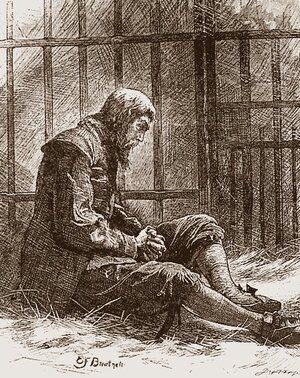
Cromwellian Dublin.

No city for slackers/businesswomen.

“… it is therefore ordered and agreed upon, by the authorities aforesaid, that there be beadles appointed in every parish of this city to be maintained by the inhabitants of each parish, and that forthwith there shall be a large cage set in the Cornmarket, where the beadles and constables are to imprison all beggars, idle women and maids selling apples and oranges and all idle boys and all other idlers, who are to be kept there until they shall be examined and punished.. the said cage to be built at the city’s charge.”

From the Dublin Assembly Roll,, 1659

Sibling of Daedalus writes:

“No sign of the Cage (situated at the junction of High Street and Thomas Street, Dublin) remains today; it was destroyed when King Charles II (a monarch with a soft spot for idlers and orange-sellers) returned to the throne the following year…Those unfortunate enough to end up in the Great Cage were, if they were lucky. and thought capable of reform, released after ‘chastisement’. The truly irredeemable idlers, on the other hand, were transported to the West Indies to work as indentured labourers. Broadsheet commenters take note…”

Gulp.

Sibling of Daedalus

PNP256386Dublin 1740.

The hungry rising.

Sibling of Daedalus writes:

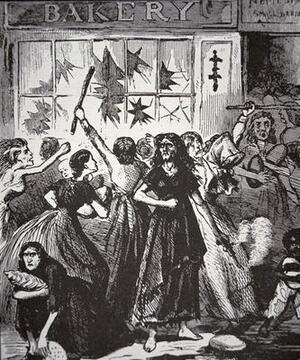
“Tonight is the anniversary of the start of the Great Dublin Bread Riots which began in the early hours of 31 May 1740 and lasted until the 2nd June. According to this account:-

“Several hundred persons banded themselves together, and, proceeding to the bakers’ shops and meal stores, took the bread and meal into the streets, and sold them to the poor at low prices… Some days after the riot the Lord Mayor issued a proclamation giving permission to “foreign bakers and others” to bake bread in Dublin; he also sent to all the churchwardens of the city to furnish him with information of any persons who had concealed corn on their premises; he denounced “forestallers,” who met in the suburbs the people coming in with provisions, in order to buy them up before they reached the market; thus in a great measure justifying the rioters who were whipped and transported. The bakers began to bake household bread, which for some time they had ceased to do, and prices fell”

The riots took place against the context of the other Great Famine of 1740 during which it has been suggested 38% of the population died.Some of the rioters paid for the bread; others did not, all were threatened with excommunication by their respective churches. Quite a few ‘respectable’ citizens participated in the riots, and were subjected to transportation as a result. Harsh times indeed.”

Sibling of Daedalus

Extract Via History of the Great Irish Famine

dalkey

Squatting rights and fake gold?

To Dalkey then…

Sibling of Daedalus writes:

“We all know about the Great Dalkey Land-Grab of 2008. But did your readers know that the practice of squatting and gold-digging in Dalkey has been going on for over a century?
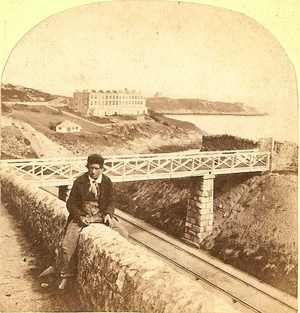
Back in the day the Commons of Dalkey was common grazing land which spread over Dalkey Hill nearly to Bray. When stone quarrying started on Dalkey Hill (“the Long Rock”) in 1817 the workers from the quarries built makeshift places of residence on the commons.
Largely unnoticed at first, the Dalkey miners came to public prominence in 1834 when the daughter of one of them, Miss Etty Scott (a fine-looking girl by all accounts) made claim that a horde of Viking gold was buried under the hill.
Miss Scott’s assertion resulted in the establishment of a Dalkey Goldmining Society and much digging, which ended ignominiously with the only thing discovered in the hill a bag of angry cats left there by prankster Trinity College medical students*
There was a happy ending for the Dalkey miners however; a case around the same time involving squatters on Ballymore Eustace held that they were entitled to ownership of the land occupied by them for the past twenty or so years, and they sold their plots (on which most of the big houses of Dalkey were subsequently built) to building speculators for substantial sums of money.
Sadly, the fair Etty (described by ballad singers of the day as ‘Dalkey’s beautiful dreamer’) failed to benefit from the sale of her father’s plot, having died of consumption, or possibly chagrin not long after the failure of her abortive gold mining enterprise…”

The Dalkey Gold Dreamer (Enterprising irishman)

*the cats were covered in phosphorescent to make them glow in the dark.

Pic via homethoughtsfromabroad

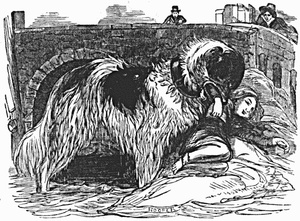
dog[A Newfoundland saves a young girl  from the River Liffey  a child]

Baby saves dog.

Meh.

Dog saves baby.

Now you’re talking.

Sibling of Daedalus writes:

“Just browsing through ‘Brown’s ‘Biographical Sketches and Authentic Anecdotes of Dogs’ (as you do) when I came across this daring canine act of bravery at Carlisle (now O’Connell) Bridge.

One day, as a little girl was amusing herself with a child, near Carlisle Bridge, Dublin, and was sportively toying with the child, he made a sudden spring from her arms, and in an instant fell into the river. The screaming nurse and anxious spectators saw the water close over the child, and conceived that he had sunk to rise no more.
A Newfoundland dog, which had been accidentally passing with his master, sprang forward to the wall, and gazed wistfully at the ripple in the water, made by the child’s descent. At the same instant the dog sprang forward to the edge of the water. While the animal was descending, the child again sunk, and the faithful creature was seen anxiously swimming round and round the spot where he had disappeared. Once more the child rose to the surface; the dog seized him, and with a firm but gentle pressure, bore him to land without injury.
“Meanwhile a gentleman arrived, who, on inquiry into the circumstances of the transaction, exhibited strong marks of interest and feeling toward the child, and of admiration for the dog that had rescued him from death. The person who had removed the child from the dog turned to show him to the gentleman, when there were presented to his view the well-known features of his own son! A mixed sensation of terror, joy, and surprise, struck him mute. When he had recovered the use of his faculties, and fondly kissed his little darling, he lavished a thousand embraces on the dog, and offered to his master five hundred guineas if he would transfer the valuable animal to him; but the owner of the dog felt too much affection for the useful creature, to part with him for any consideration whatever.
‘”

For anyone interested in the exact location, it seems to have been at Aston Quay and it seems to have happened some time in the late 18th century. The name of the dog is unknown, but it apparently belonged to Colonel Wynne. Long-time readers of Broadsheet may remember another post 9link below0 about a different Newfoundland dog which took part in a daring sea rescue some years later, and now haunts St Patrick’s Cathedral…

Previously: The Dog That Haunts St Patrick’s Cathedral

Sibling of Daedalus

Dargan

Raise a ticket stub to William Dargan.

Without him you’d be on the bus.

Sibling of Daedalus writes:

“Readers taking the train or DART home today might be interested to know that it is the birthday of William Dargan, who not only brought the railway to Ireland but was the only Irishman ever to have a statue erected to him in his own lifetime, displayed at the Irish Industrial Exhibition  which took place on Leinster Lawn [Dublin] in 1853, and which he underwrote.
Queen Victoria attended the exhibition and was very taken with Dargan, whom she found ‘touchingly modest and simple’, going so far as to press his arm to show him that she had ‘the… intellect to understand and… heart to appreciate’ his work.
Dargan, an Irish patriot whose fortune declined in later years, invited the Queen to tea at his home in Mount Anville, but steadfastly refused to accept a knighthood. Meanwhile, the Queen’s husband, Prince Albert, remarked sniffily that the Irish public ‘looked like Italian beggars’. I am not sure what happened to his larger-than-life statue (shown above) but I think there is still a mural of the dashingly frockcoated Dargan up on the wall at Bray station?”

Anyone?

Sibling of Daedalus

Print via MonkstownParish.ie

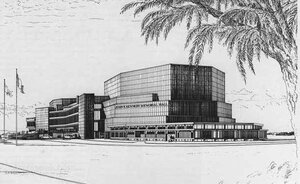
0058(The proposed design for the John F Kennedy Memorial Hall, Beggar’s Bush, Ballsbridge, Dublin by Raymond McGrath lead architect at the Office of Public Works)

Sibling of Daedalus writes:

The design for John F Kennedy Memorial Hall, a national concert hall to be situated at Beggar’s Bush, Ballsbridge, Dublin. It was to consist of a 20 storey tower, fronting a reflecting pool and flanked by lower office blocks, containing seating for 2000 people.
Plans were dropped in the late 60s, post Chappaquiddick, although rivalry among Dublin architects, rather than concern at the tarnishing of the Kennedy legacy, was probably the contributing factor. The original plans for the hall are apparently still up on the wall of Ryan’s Pub, Beggar’s Bush…

Anyone?

Pic via Archiseek

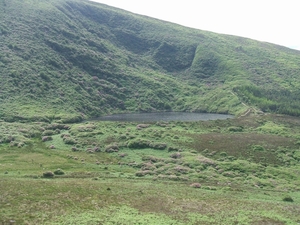
1395082_2e2d0341Bay Lough in the Knockmealdown mountains, Co Tipperary.

Home to Ireland’s Loch Ness Monster.

Very scary Mary.

Sibling of Daedalus writes:

I was wondering if any Broadsheeters are familiar with a monster with the body of a horse, and the head of a woman, who lives in the lake of Clogheen in the Knockmealdown mountains?
This is nothing to worry about. It’s simply the ghost of a six-foot-tall local witch called Mary Hannigan, better known as ‘Petticoat Loose’ because her skirts kept coming unbuttoned.
Mary’s misdeeds during her life  included murdering her husband, killing neighbours’ cattle and randomly hitting local dairymaids with flying milking stools. It led to her spirit being condemned to empty the lake with her sewing thimble until the end of time.
When she appears (which is rare), she asks, somewhat rhetorically: ‘When will the day of judgement come?’ before disappearing back under the water.


The Legend Of Petticoat Loose

Pic via Geograph.ie

baldwinbewarethecat1570gryffitheditionanimals
Grimalkin (top).

He carried more ‘evil’ than the usual cat.

Sibling of Daedalus writes:

Possibly the first novel ever published, definitely the first horror novel ever published, ‘Beware the Cat’, by printer’s assistant William Baldwin (pub. 1561) told the lurid tale of a Irish cat, Grimalkin.

Grimalkin roamed around the countryside demanding meat (“aon feoil?”) and eating sheep, foal and even humans if his request wasn’t readily complied with.

The hero of the story (a cattle stealer himself: there are no simple answers in this story) kills Grimalkin in self-defence, but comes to a sticky end. On returning home “all weary and hungry he set down by his wife and told her of his adventure, whereupon a kitling his wife kept, scarce half a year old, had heard, up she started and said ‘Hast thou killed Grimalkin?’

And therewith she plunged in his face, and with her teeth took him by the throat, and ere she could be pulled away she had strangled him.”

Some say Grimalkin was a metaphor for the Irish, others for Catholics, either way the story shows it’s best to be very very nice to cats…

Good times.

Read ‘Beware the Cat’ (updated version of 1570 edition) here

Thanks Sibling of Daedalus

-1(Supergrass ‘Gallows Paul’, the last man to be “publicly’ castrated in Dublin).

Keep this to yourself.

We’ve been snitching on our MATES  for years.

Sibling of Daedalus writes:

Following on from your Clamper Snout post yesterday, I thought your readers might be interested to know that ‘private thief-taking’ in Dublin has a long and dishonourable history, dating back to the 18th century, when many criminals found it more profitable to turn policeman for reward than to continue with their life of crime.

Sadly, informing was a risky business, as shown by the story of Dublin’s most famous thief-taker, Paul Farrell (‘Gallows Paul’). While on his way to prison for corruption in 1734 Farrell was removed from his cart by the notorious Kevin Street Mob, who sliced off one of his testicles, cut out his underlip and hacked him in several parts of his body before hanging him on a tree in the Liberties where he was found a day and a half later, dead.

Farrell was not the first man to be publicly castrated in Dublin, but he may well have been the last; I haven’t found evidence of any subsequent cases. All this happened very close to the scene of your post. A warning to contemporary clamper informers, perhaps?


Previously: Why I Became An Informer For The Clampers

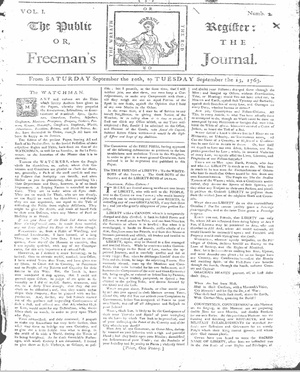
freemenThe much-storied Freeman’s Journal.

First published on this date in 1763.

Sibling of Daedalus writes:

In the late 18th century, The Freeman’s Journal fell under the control of  Francis Higgins, known as the Sham Squire, who had made his fortune in dubious circumstances.

Heavy set with distinctive helmet hair, the Sham used the paper as a mouthpiece to praise himself, promote a pro-government agenda and spent much of his time suing other newspapers who wrote things about him. *cough*. Good times.


Pic via Irish Newspaper Archive