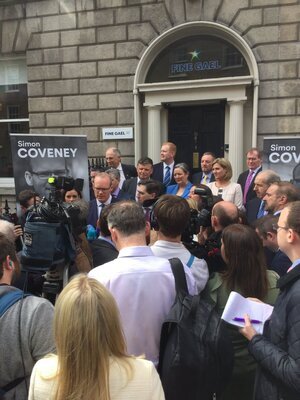

Tag Archives: Simon Coveney

Last night.

In Cork.

During the fourth and final Fine Gael leadership hustings, a man called Joseph (top) asked about direct provision. He said thousands of Irish people can see the direct provision system is an act of disrespect to humanity.

He then asked how either Simon Coveney or Leo Varadkar would address this, if they became Taoiseach.

He also said:

“The [Bryan] McMahon Report recommends safeguards to ensure that no one is left in the asylum system longer than five years. What are your intentions regarding the people who have been in the asylum system for over five years, especially those who are not eligible to have the single application accessed under the new single procedure or people who are on deportation orders?”

From their responses:

Simon Coveney said:

“First of all, in relation to people who’ve been here for many years and who are essentially in limbo, because they are, because for many people, it’s actually almost impossible for the Department of Justice to establish a number of the facts that they’re trying to establish around people who are here as to whether they should be eligible for asylum or not.

“And so people just are here in that state of unknowing what the future holds and I do think if we advocate, as we do, for undocumented Irish in the US, to have a path to be able to regularise their own position. I believe, also in Ireland, we should allow for an opportunity for people to regularise their position over time if they’ve been here for many years.

“I also think that it is no way to actually cater for people who are waiting for asylum decisions here, beyond a certain period of time, for people to be in direct provision. People who want to make a contribution, people who are essentially living with very small amounts of money per week and with the State subsidising their lives, but really unable to make any positive contribution to society for various different reasons in terms of barriers that are put in place.

“And I do think we need to move away from that. In a way, of course those, that ensures that we make decisions firmly and fairly in relation to asylum applications and of applications in relation to refugees.

“But I do think what we have at the moment is a system that takes far too long to make decisions and therefore we’re asking families and individuals to stay in conditions which are not conducive to contributing in a positive way to society. And I know Joseph well, he’s a great guy. But there is change in this area that’s needed and of course that puts more pressure on a minister like me, in terms of social housing provision which is why we’ve committed €5.5billion to a social housing build programme that’s going to add 47,000 social houses.”

Leo Varadkar said:

“I suppose the idea of direct provision, when it was first established, I think it was probably back in the 1990s at this stage, was that people would be in direct provision for a couple of months while their applications for asylum or refugee status would be decided on and if they got status, they would then leave direct provision. If they didn’t, then they’d obviously would have to leave the country if they were found not to be eligible for refugee status or asylum status.

“The real problem is that people are now staying so long in direct provision. And there actually are people who have status, who’ve been given leave to remain, who’ve been given refugee status, but are still living in direct provision because there is no housing available for them. That’s a terrible situation to be in for people, they are still living in Mosney for example, the old Butlin’s camp, who have been given status but there is no homes for them to go to and I think that’s really, really difficult for us as a society to stand over.

“I do think things will improve. We brought through new legislation, Minister [Frances] Fitzgerald, the Minister for Justice, has finally, after a lot of hard work, successfully brought through the International Protection Act. And that’s going to change things, cause at the moment you can apply for different statuses, you can apply for different types of statuses at different times. And under the new rules, you’ll apply for all types of status on day one.

“So, at the moment, you might apply for refugee status, not get that, apply for leave to remain, then not get that, then judicial review it, she’s going to streamline that whole process so decisions are going to be made a lot quicker and I think that’s a real step forward and it’s a tribute to her and Dave Stanton, in fact, for getting through that legislation.

“One thing I’d like to see examined. I haven’t studied it in detail myself  so I don’t want to make a definite commitment on it but I do think people who are in the country for a long period of time, whose status hasn’t been decided on, we should consider giving them the right to work. It must be a very frustrating thing to be in a country, you’re waiting on a decision, you want to work, you want to contribute, you want to make money for your family, you want to give something to the society you’re now living in and I think that’s something we need to take a long, hard look at.”

Earlier: A Bad Dream

Protectionism

Minister for Housing Simon Coveney on Tonight with Vincent Browne last night

Last night.

On Tonight with Vincent Browne.

In a pre-recorded interview with Fine Gael’s Minister for Housing Simon Coveney, who is running in the Fine Gael leadership race against Minister for Social Protection Leo Varadkar…

Mr Coveney said he is different to Mr Varadkar who, earlier this week, said he wants to lead a party for “people who get up early in the morning.”

In addition, Mr Coveney said  “those people are as important to me as people who pay for everything” referring to people in receipt of social welfare payments.

The Housing Minister also called for people to judge him based on his actions, pointed to his €5.5billion social housing plan.

From the interview…

Simon Coveney: “I think there is a choice for the party that’s quite different.”

Vincent Browne: “Tell us the choice, between one person who says what and the other person says. Tell us both.”

Coveney: “I will. What I have been talking about is a party that represents everybody. Unlike most parties in the country at the moment, many of the smaller parties in particular, focus on niche areas in society and only represent that group of people and then actually get political traction on the basis of division and anger and protest.”

“What I’m talking about is Fine Gael representing someone who is unfortunately in a sleeping bag tonight on the streets of Dublin, as well as supporting people who are creating thousands of jobs. And supporting them and celebrating that success.

“This is a party that I joined and it’s a party that I’ve been a part of for nearly two decades of my working life that I believe has to get the best out of everybody regardless of their limitations or disabilities or social disadvantage or whatever. And…”

Browne: “Ok, that’s what you stand for…tell us how…”

Coveney: “I am not the kind of person that talks about Fine Gael only representing the person that gets up early in the morning.”

Browne: “And that’s what you stand for. Now tell us how that differs from what Leo Varadkar stands for?”

Coveney: “Well I think that is my vision for the country, is one…no, let me finish now and I’ll get to your question.”

Browne: “Ok, good.”

Coveney: “My vision is one of social justice, as well as economic progression. And I think that the approach that I have, that Fine Gael needs to reach out to people who don’t naturally support us and who may never support us in the future but our responsibility to try and get the best out of those people in society, not in some kind of dependancy way but in an enabling way.”

“I think that is a very different message to what I’ve heard from Leo Varadkar this week when he talks about Fine Gael being the party of the person that gets up early in the morning to work. Of course those people need to be represented by Fine Gael because they pay for everything. But there are many people who need the State’s intervention to allow them fulfil their potential and those people are as important to me as people who pay for everything.”

Browne: “Ok, he’s talking…”

Coveney: “I think that is very different vision for the party.”

Browne: “Ok, he talks about a sense of, culture of entitlement in the country. Do you perceive that?”

Coveney: “I mean, I think there is a politics in Ireland at the moment, that calls for the State to deliver people’s rights on everything. A right to a house, a right to healthcare, a right to education, a right to a decent income.”

Browne: “Justice. That’s justice.”

Coveney: “Yeah it is… but the way…”

Browne: “Are you not in favour of that?”

Coveney: “The way in which you achieve it is to ensure that the State enables people to make a contribution to society, as well as a dependency on a government. And I think that is the big difference between me and the hard left. And I think, you know…judge me on what I’m actually doing. I mean, in housing policy at the moment, Vincent, people will talk about the numbers and so on. We have a huge social housing build programme that’s now under way, it’s a €5.5billion project and so on. But the real change, actually, that I’m looking to bring to social housing policy in Ireland is forcing integration.”

“I no longer accept the hard-left arguments that we should designate whole parts of cities and fill them with social housing estates in a mono-tenure way. Instead we have to ensure that social houses are part of private developments and that private housing is part of new social developments…”

Browne: “Are you suggesting that Leo Varadkar is part of the hard left?”

Coveney: “No, I’m not. I’m not suggesting anything about Leo Varadkar, I’m talking about myself.”

Previously: ‘They’re Loud And They’re Growing’

Social Housing And Affordable Housing Are Not The Same 

Related: Homeless families with nowhere to sleep sent to Garda stations (Kitty Holland, The Irish Times)

Dublin councils accused of preventing housing development (Olivia Kelly, The Irish Times)

Watch back in full here

More as we get it.

Fight, etc.

Rollingnews

Top pic via Shane O’Reilly

Meanwhile…

Don’t let the door, etc.

From top: An eviction letter to a tenant of Robin Hill, and another outlining how existing tenants will have to pay a deposit and new bi-monthly energy bills; Minister for Housing Simon Coveney

You may recall a post from last week about the Robin Hill apartment complex in Sandyford, Dublin 4 which went up for sale last week, after it went into Nama and was subsequently sold to Cerberus.

The post detailed claims made in the Dáil by People Before Profit-Solidarity TD Richard Boyd-Barrett.

The TD said five of Robin Hill’s tenants are now facing eviction and also said those who were not being evicted straight away were told they must pay an additional €250 per month in heating and hot water charges which were not previously included in the rent.

Mr Boyd-Barrett subsequently spoke about Robin Hill and the Tyrrelstown amendment to Seán O’Rourke on RTE Radio One.

This amendment was added to the Planning and Developlemt (Housing) and Residential Tenancies Bill 2016 before Christmas.

It had originally proposed that where a landlord proposes to sell 20 or more units in a development – within six months – the sales would be conditional on existing tenants being able to remain in the property unless there were exceptional circumstances. This figure was later reduced to five and then increased to 10.

Mr Boyd-Barrett told Mr O’Rourke:

“The vulture fund or landlord can evict nine people and then six months later, by the way, the legislation will allow them to evict another nine people. And six months after that, another nine people.”

Further this this.

This afternoon.

Eleanor Burnhill, on RTÉ’s News At One, reported on eviction notices that some of the residents of Robin Hill have received from an agent acting on behalf of Grant Thornton.

They have until June 25 to vacate Robin Hill.

Ms Burnhill reported that she obtained a statement from the Minister for Housing Simon Coveney about the matter.

“He says he is aware of the Robin Hill case. The statement says the Minister has indicated that if there is evidence that legislation is being circumvented, by companies selling off units in batches of less than 10, he will revisit this area generally.

“The officials on behalf of the minister are attempting to make contact with Cerberus to discuss the issue as soon as possible.

“And in relation to the area of hot water charges that you heard in that report, he says that if there a suggestion that new charges not previously covered by the existing tenancy agreement, if they’re being introduced, then the tenants have it open to appeal to the Residential Tenancies Board, as they have done.“

Listen back to Ms Burnhill’s report in full here

Previously: ‘The Minister Did Not Contact Me’

Pics: Eleanor Burnhill/Rollingnews

Robin Hill apartment complex in Sandyford, Dublin; Leaders’ Questions on Tuesday

You’ll recall the Tyrrelstown amendment.

It was added to the Planning and Development (Housing) and Residential Tenancies Bill 2016 before Christmas.

It had originally proposed that where a landlord proposes to sell 20 or more units in a development – within six months – the sales would be conditional on existing tenants being able to remain in the property unless there were exceptional circumstances.

During a Seanad debate on this amendment, the number was changed from 20 to five.

But on foot of advice from the Attorney General, the Minister for Housing Simon Coveney  increased this figure, from five to 10.

Readers may also wish to note how director of advocacy Focus Ireland Mike Allen in January stated that “a third of families who are becoming homeless in Dublin are becoming homeless because their landlord has been forced to sell up“.

Further to this.

Richard Boyd Barrett spoke about the Tyrrelstown amendment in an interview with Seán O’Rourke on RTE Radio One this morning, in regards to an apartment development, called Robin Hill, in Sandyford, Dublin 4, which went into Nama and was then subsequently sold to Cerberus.

Dún Laoghaire-Rathdown County Council requested to buy 15 of the apartments in May of last year but was told it would have to buy the entire complex.

This morning, Jack Fagan, in The Irish Times reports that the complex is on sale, in one lot, from today with a guiding price of €14million.

According to Mr Boyd-Barrett, some of Robin Hill’s tenants are now facing eviction.

During the Seán O’Rourke show:

Seán O’Rourke: “I quote the minister [for housing Simon Coveney] from what he said yesterday. He said, and this is regard to protecting people who are there in an apartment block being sold. He said, if 10 or more properties are being sold in one sale, then people who have tenancies in the apartments affected get protected through that sale and I said I’ve asked Richard, in other words you, to send me the details of any cases or any individual issues he has. Now surely that reflects an openness on the minister’s part?”

Richard Boyd-Barrett: “No, first of all, when I raised this issue on Tuesday, the minister did not contact me and ask me, he didn’t in the Dáil, or afterwards, ask me for the details of Robin Hill. That’s simply not true.”

“Secondly, what the legislation refers to, actually means is, that the vulture fund or landlord can evict nine people and then six months later, by the way, the legislation will allow them to evict another nine people. And six months after that, another nine people.

“So, this figure of 10 – which was never explained why we had to include it. We, at the time of the legislation sought to bring that down to zero. In other words that, if you were selling a multi-unit development, you would have to sell it with the tenants in situ and guarantee the security of tenure and the Government resisted that, for reasons I don’t understand but it now seems for reasons that benefitted vulture funds who are trying to profiteer at the expense of tenants they want to evict or massively increase rents.”

Meanwhile.

On Tuesday.

In the Dáil.

Readers may wish to recall the exchange Mr Boyd Barrett had with Taoiseach Enda Kenny during Leaders’ Questions, in respect of Robin Hill.

Richard Boyd Barrett: “I will cite a very concrete example of how decisions the Government made in the past six months have contributed directly to this shambles and the hardship that follows. Robin Hill, a development of apartments in Balally in Sandyford, was originally built by the McEvaddy brothers in 2008. The development, which consists of 52 apartments, went into NAMA at some point.

For most of the time it has been in NAMA, at least 15 and possibly as many as half of the apartments have been empty while the housing crisis spirals out of control. In May 2016, Dún Laoghaire-Rathdown County Council asked whether it would purchase 15 of the vacant units. It was told that it could only buy the entire block.

Shortly after the Project Eagle scandal broke in September, NAMA agreed the sale of Project Gem, which included these apartments, to the vulture fund Cerberus. The sale, which was one of the biggest sales of property in the history of the State, went through.

Since then, Cerberus has moved to start evicting the tenants in a block that is still half empty. Of the 21 remaining tenants I have met, five are to be evicted in June.

Others whom Cerberus feels it cannot evict straight away have been told they must pay an extra €250 per month in heating and hot water charges that were previously included in the rent. They were never charged for that previously. In other words, this is a back-door rent increase of about 20%.

These empty units are sitting there while we have record numbers in homeless accommodation with evictions to follow. This would have been avoidable if NAMA had not sold this development to a vulture fund but had given it to the local authority as it requested and if the Minister for Housing, Planning, Community and Local Government had ensured his Bill before Christmas included a provision to prevent new owners from evicting tenants when apartments are sold, as we warned would happen, or finding back-door ways to ratchet up rents. Is it not the truth that the crisis is avoidable and has resulted from the Government’s policy failures?”

Enda Kenny: “No, it is not the truth. The problem here is the supply of houses throughout the country. Anyone can understand that there is real pressure in certain segments of the housing sector. The Deputy can nod his head if he likes. I read a report this morning that said that 49 houses priced between €400,000 and €700,000 were snapped up inside a day by those who could afford them. There are no difficulties in certain areas.

It is true to say that there is a serious issue here. A total of 40,000 vacant units have been bought by the State in the past five years.

…

Boyd-Barrett: “A fantasy figure has just appeared, namely, that the State has apparently purchased 40,000 houses. The more accurate truth is that NAMA has flogged off thousands of homes or, worse, as the Balally example indicates, has sat on empty properties in public ownership and when local authorities sought to purchase them, it refused and chose to sell them to a vulture fund instead.”

“The vulture fund is now moving to evict people, bypass the Minister’s totally inadequate legislation and ratchet up the rent on tenants it cannot immediately evict. I suspect, and the tenants fear, that they will be evicted in phases because under the Tyrrelstown amendment, no more than ten tenants may be evicted at one time, which is leading to landlords evicting tenants en bloc. That is almost certainly the case and the Taoiseach allowed it to happen by selling apartment blocks.”

“How many more Balallys are there? How many more in Project Gem? How many more people will get eviction notices from vulture funds to which NAMA sold properties at a massive discount rather than give them to the local authorities. There are 50,000 empty properties in Dublin. The Balally situation indicates why there is a supply problem in spite of that. That is the real issue. It is not an absolute supply problem, it is a man-made one resulting from the behaviour of NAMA and the vulture funds, which are sitting on empty properties, evicting people in order to inflate property prices and rents and make more profit from the misery of those they evict or who cannot afford to rent such properties.

Kenny: “Let me clarify what I meant when I said that 40,000 properties have come back into use.”

Bríd Smith: “That is not what the Taoiseach said.”

Pearse Doherty: “That is not what was said.”

Kenny: “I take the Deputy’s point. One thousand properties were purchased by the State at a cost of €203 million.

Doherty: “One thousand.”

Aengus Ó Snodaigh: “That is 39,000 fewer than the original figure the Taoiseach gave.”

Transcript via Oireachtas.ie

Listen back to this morning’s Today With Seán O’Rourke here

Listen back to yesterday’s interview with Minister for Housing Simon Coveney here

Dundrum complex with 51 apartments guiding for €14m (Irish Times)

Pic: John Fleming Architects

This morning.

Further to the results of the Citizens’ Assembly on the 8th amendment and abortion.

Today FM’s Juliette Gash tweets Fine Gael TD and Housing Minister Simon Coveney’s position on “abortion on demand” after she spoke with him at the Global Irish Civic Forum.

Listen to Ms Gash’s report here

Meanwhile…

Yesterday.

In an interview with Shane Beatty, of Kildare FM, Fianna Fáil leader Micheál Martin, Mr Beatty raised the recommendations of the Citizens’ Assembly and Fine Gael TD Richard Bruton comments in the Dáil on Wednesday where he said Fine Gael won’t be bound by the assembly’s recommendations.

At the beginning, Mr Martin said he himself has a “pro-life disposition”.

They then had the following exchange:

Shane Beatty: “Just to be clear, if someone is raped by their father, for example, and becomes pregnant as a result, what’s your view on abortion in that case?”

Micheál Martin: “Well it’s not that simple Shane…”

Speak over each other

Beatty: “Well, someone’s either pregnant or not pregnant…”

Martin: “Sorry?”

Beatty: “Someone’s either pregnant or they’re not pregnant.”

Martin: “They are indeed…”

Beatty: “…so it’s not that complex?”

Martin: “Well it actually is in terms of the… in terms of, are you talking within 10 weeks? Are you talking about within 20 weeks for example?”

Beatty: “I’m talking about a father raping his daughter.”

Martin: “Well it’s not that simple. It’s just not that simple in terms of…”

Beatty: “She becomes pregnant as a result, you don’t see that as a simple ‘yes’ or ‘no’?”

Martin: “Well I don’t actually, it’s not a simple ‘yes or no’, that depends on a number of issues. That’s why…”

Beatty: “Would there be any circumstance, would there be any circumstance where a father raped his daughter, yes, go on…”

Martin: “Seán.”

Beatty: “Shane.”

Martin: “I know people today who are alive whose mothers would have been, in one particular case, was raped and she was the outcome of that. And she gets very angry when people suggest that she should never have had a life. So this is not simple, and I think it’s an issue and I think that will be one of the issues that will come before us in the Oireachtas, to decide on that.”

Listen to the interview in full here

Screen Shot 2017-04-26 at 11.53.07Screen Shot 2017-04-26 at 12.01.50

A table in Monday’s Irish Times; Minister for Housing Simon Coveney

You may recall how, last Sunday morning, Dublin Institute of Technology lecturer Lorcan Sirr tweeted that only 2,076 new houses were built in 2016 compared to the official figure of 14,932.

He also tweeted a table detailing the number of new house completions, excluding one-off houses, built in each county last year based on figures confirmed by the Building Control Management System. These state just 848 such properties were built as opposed to the Department of Housing’s figure of 8,729.

An article with the same figure, and more, obtained under Freedom of Information, appeared in The Irish Times on Monday. This article also had a table with the same information as Mr Sirr’s table.

The claims followed similar concerns about the department’s housing figures previously raised by architect Maoilíosa Reynolds in an article in The Sunday Business Post two Sundays ago.

Further to this…

Minister for Housing Simon Coveney has written the following letter to The Irish Times

The article on homes built in 2016 demonstrates the dangers of obtaining and interpreting data without proper context or testing its validity.

The table accompanying the article is inaccurate; the published figure of 848 units presented as the total output of estate houses and apartments built in 2016 is in fact the number of Certificates of Compliance on Completion submitted to the Building Control Management System (BCMS) for all works, not just residential construction, in the first quarter of 2017.

I have said repeatedly that the Building Control Management System was designed for compliance for building control purposes. It was not designed for gathering statistics and the published article is a perfect example of how statistics can be misrepresented and inaccurately presented.

There are several reasons why the BCMS data does not currently record and reflect housing completions, although the Department Housing, Planning, Community & Local Government is actively exploring its potential in this regard. Some of these reasons include the fact that Certificates of Compliance on Completion are required for certain works that submitted a commencement notice on or after March 1st, 2014. Developments commenced before that date, including many developments started but not finished during the downturn may still be under construction.

Certificates of Compliance on Completion are not required for one-off houses that have chosen to opt out of the statutory certification process since September 1st, 2015.

A single Certificates of Compliance on Completion may cover multiple buildings or works, this is in order to reduce the administrative burden and cost for industry, so simply counting certificates can underestimate total units constructed.

The requirement for these Certificates of Compliance on Completion is relatively new, at a time when construction activity has been relatively low, with the result that the process and issuing of Certificates of Compliance on Completion is only becoming established.

The recording and reporting of statistics on housing completions is a complex area. We have several different statistics from various reputable sources that measures different issues as well as many different views in relation to which statistics we should use.

We have, however, used ESB connections as an overall proxy for housing completions and have done so since the 1970s, so it is, and will continue to be, an important long-term comparator, and an important indicator of trends in the number of new homes being made available. It is important to note that the ESB figures are by no means the only dataset we use.

We have, for example, detailed information on residential construction activity from local authorities – at the end of 2016, the four Dublin local authorities reported 144 active construction sites, encompassing the construction of some 5,200 new dwellings.

…Suggestions that I am trying to mask the completion figures are nonsense. Everything my department does is open and transparent and the one thing that is apparent from all key statistical sources (eg planning permissions, commencements, completions) is that housing supply activity is increasing, underpinning that Rebuilding Ireland, and its core objective of increasing housing supply, is beginning to have a positive impact.

It has been a slow and complex process to realise the upswing in housing supply and the Government will continue to focus on actions and initiatives to increase supply across all tenures during 2017 and beyond.

Simon Coveney, TD
Minister for Housing,
Planning, Community & Local Government,
Custom House,
Dublin 1.

Anyone?

How many new homes were built last year? (Irish Times letters page)

Previously: ‘When Gardaí manipulate figures, there are inquiries’

‘If You Want To Solve A Problem…’

Further to architect Maoilíosa Reynolds writing an article in the Sunday Business Post two Sundays ago.

In which he raised serious concerns about the Department of Housing’s seemingly disingenuous methodology when it comes to calculating house building figures – namely basing the number of house completions on ESB connections…

And him calculating that the actual figure was about half the official figure of 14,932…

And, when asked about basing the official figures on ESB connections, Housing Minister Simon Coveney telling Keelin Shanley on RTÉ’s News At One last week, “All I can do is use the same methodology that we’ve always used”…

Housing lecturer at Dublin Institute of Technology Lorcan Sirr wrote an article in yesterday’s Sunday Times, saying:

“That the department responsible for housing will not publish the number of houses built in a year is an extraordinary state of affairs in a housing crisis. When gardai manipulate inaccurate statistics, there are inquiries; the department evidently needs interdepartmental assistance with the concept of transparency.”

Mr Sirr also spoke on News At One earlier today about new housing figures he has obtained, under Freedom of Information.

They show that just 2,076 houses of all types were built last year, or 14% of the official number.

Number’s up for Coveney (Lorcan Sirr, Sunday Times)

Listen back in full here

Previously: ‘If You Want To Solve A Problem…’

Pics: Lorcan Sirr

Screen Shot 2017-04-20 at 14.07.22
Minister for Housing Simon Coveney

You may recall how yesterday new figures from the Central Statistics Office (CSO) showed the national average house price rising by almost 11% in the year to February.

Some economists have blamed the Government’s Help To Buy scheme for fuelling the sharp rise in prices.

Further to this…

Last Sunday.

Architect Maoilíosa Reynolds wrote an article for the Sunday Business Post in which he raised serious concerns about the Department of Housing’s seemingly disingenuous methodology when it comes to calculating house building figures.

He explained that official house completion figures are based on connections to the ESB network. To this end, the department says 14,932 new homes were “delivered” in 2016.

But, he said:

“There are significant problems with this. When a dwelling has been vacant for two years or more, the ESB network requires the owner to apply for a new connection (MPRN). This is a safety measure designed to make sure vacant units are safe and wired correctly. Using this method, existing completed Nama vacant units, part-completed ‘ghost estate’ units and local authority refurbished voids, when re-connected to the grid, are all classified as new completions. In the five-year census period, almost 20,000 existing houses have been re-connected and therefore officially reclassified as new builds.”

Mr Reynolds also raised concerns about how commencement figures are calculated – and crucially inflated – for large housing estates.

He wrote:

“In larger, estate-type projects, the established practice is to lodge one commencement notice for an entire scheme which may not be completed for several years. A 400-unit estate which begins building today may only deliver 50 units in 2017 – but all 400 will be counted as commenced this year. As a result, estate commencement numbers are inflated.”

As for residential planning permissions, he wrote:

“Up to 40 per cent of residential permissions do not get built for various reasons – lack of finance, ‘value-add’ exercises or extensions to existing permissions.”

Bizarrely, Mr Reynolds explains that one metric can be trusted and that’s the Department of Housing’s own detailed database called the Building Control Management System (BCMS).

He explained:

“A presentation by Department of Housing representatives to Engineers Ireland last month disclosed BCMS completion figures – not published on the Department’s website – for 2016. According to the presentation, there were just 3,505 certificates of compliance issued for all building types (not just residential).

In some instances, a single certificate of compliance covers more than one unit, so it is thought that the true number of homes represented by completion certificates could be as much as 30 per cent higher. But the reality is we don’t know.

Assuming the 30 per cent figure is correct, this means that certificates of compliance may represent 4,556 units delivered, a figure that includes 243 local authority and 400 units for conversions of existing non-residential to residential (Department’s own estimate). Add in average figures for one-off housing commencements at 2,972, a maximum delivery number of 7,528 is reached, or just 50.4 per cent of the official figure of 14,932.

This is best-case scenario. The number is likely lower, as BCMS tracks all building types, but does not disaggregate residential from other activity.

This means that in 2016, new-build output was half the official figures and a minimum of 7,404 existing vacant, refurbished voids and ‘ghost estate’ units reconnected to the grid were double-counted as new completions.”

Why housebuilding figures aren’t reliable (The Sunday Business Post)

Further to this.

Keelin Shanley was speaking to the Minister for Housing Simon Coveney on RTÉ’s News At One this afternoon when she raised the matter of Ireland’s official housing figures.

Keelin Shanley: “If you want to solve a problem, the very first thing you have to do is quantify that problem and know exactly what you’re dealing with. There has been discrepancy over figures that are coming out. We see 4,400 new home transactions over the last 12 months, comparing to a figure of 15,000 coming from the department. Can you explain the difference here? Because a number of experts have tried.”

Simon Coveney: “No, look, we measure new house completions that same way now as we have done every year since the 1970s. It’s based on ESB connections so , in other words, when somebody comes into a house, they put in place an ESB connection to actually insure that that house has been lived in, that is what determines new completions. Last year, it was over 15,000. The year before just over 12,000. This year the anticipated figure will be about 19,000. And so…”

Shanley: “So, ESB connections, rather than new homes put in place. These can be homes being brought back in or…”

Coveney: “I can only, like, you know, I mean, if we, you know, if figures were showing a different result, you’d ask me a different question. All I can do is use the same methodology that we’ve always used. To measure new completions, so that we can see improving trends. And we are seeing a dramatic increase in house building activity in Ireland, mainly around the cities. It’s only starting in other…if you look at Co Galway, one of the biggest counties in the country, only one housing estate built in the last six years. If you look at a county like Tipperary, not a single housing estate built in the last five or six years. And we’re about to have 200 houses built outside Clonmel. So we are seeing increases. It is ramping up quickly but it will take time for that to turn into new homes, good quality communities and housing estates and significant [inaudible] needed in city centres.”

Talk over each other 

Coveney: “Planning applications, for example in Dublin, for apartment complexes is up more than 200%. So the willingness is there. But look, we can’t…”

Shanley: “There is a lag..”

Coveney: “…ignore the fact that, but over the last six or seven years, we had a broken economy and at the heart of that was a broken construction sector we had a banking sector that didn’t function, many, many developers and builders went out of business. 200,000 people lost jobs on building sites. In the last 12 months there’s an extra 13,000 people working on building sites so we are rebuilding literally from a very, very low base. It is going to take some time to deliver a response on that, but it’s happening.”

Shanley: “Minister, nobody disputes that, we’ve seen it. And that’s fair enough. I think everybody accepts that there is a lag. But even so, over the last 12 months, that figure of 4,400 new home transactions or 15,000 completions from the department, it’s still a very long way off from what’s actually needed and that’s with time. You know, they’re the most recent figures….”

Listen back in full here

Rollingnews

12

This afternoon.

Government Buildings, Dublin 2

Fine Gael Minister for Housing, Planning, Community and Local Government Simon Coveney, with Paschal Donohoe, Minister for Public Expenditure and Reform, announcing details of allocations to local authorities of the €200m Local Infrastructure Housing Activation Fund (LIHAF).

A total of 34 public infrastructure projects across 15 Local Authority areas have been approved.

The Local Infrastructure Housing Activation Fund (LIHAF) is “a key element of Pillar 3 of Rebuilding Ireland: An Action Plan for Housing & Homelessness” to provide “public off-site infrastructure to relieve critical infrastructure blockages”.

Anyone?

Yay.

Rollingnews

Previously: A Rental Revolution