Monthly Archives: June 2011

Our money’s on the hairy guy.

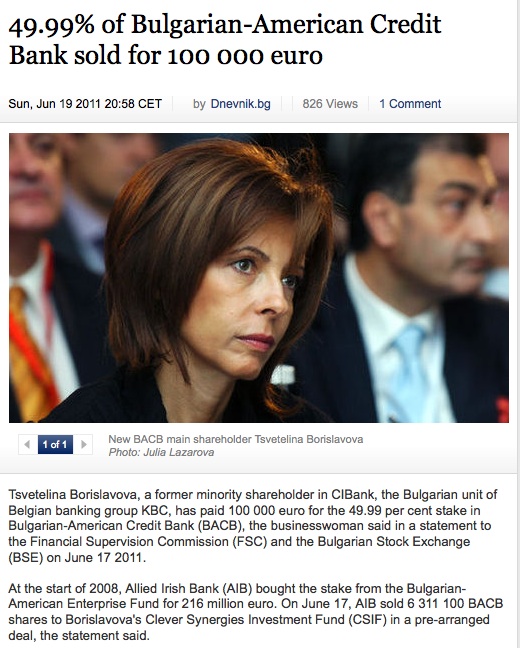
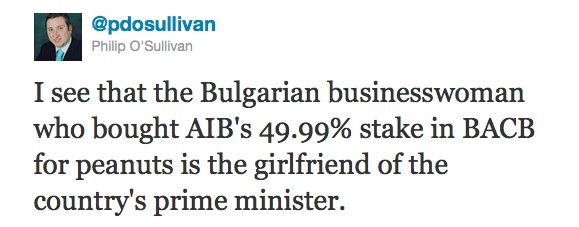
According to maverick investigative journalist Jurgen Roth AIB may have literally been given an offer they couldn’t refuse when they sold half a bank for €100,000 this week.

He told Sofia news agency Novinite back in February:

“The story is incredible, but was confirmed through inquiries to to those concerned. The matter on hand is Bulgarian State-support, through some very unconventional actions, for the powerful and shady business group known as TIM, which many media connect to organized crime,” Roth writes.

Roth says that in January of this year, the investment fund Expat Capital Sofia had asked permission from the Bulgarian National Bank (Central bank) to purchase fifty percent of the shares of the Bulgarian-American Credit Bank (BACB) in Sofia.

These fifty percent were owned by AIB, purchased at a cost of €260 million three years earlier.

The first response from the Bulgarian National Bank had been positive. For this reason Expat Capital Sofia had commissioned KPMG to carry out a Due Diligence verification.

After finding out the KPMG’s report is satisfactory, Expat had submitted an offer to the Irish Bank, for the purchase of the shares for EUR 7 M. At the same time, representatives of AIB had been invited to Sofia to receive final approval for the sale of their stake.

This is not going to end well.

They had arrived in mid-February without even imagining what was in place for them and for Expat at the Bulgarian National Bank. They were personally received by the BNB Head, Ivan Iskrov, who explained to them it would be better if they give up the EUR 7 M and rather offer their share to the Central Cooperative Bank, and for BGN 1 – the equivalent of EUR 0.5, according to the German journalist.

“The proposal had been provided in writing to the representatives of the Irish Bank on February 23, 2011. The Central Cooperative Bank is part of the TIM group, regularly mentioned by media in connection with high-profile organized crime. What explanation is there about bankers from Ireland and representatives of Expat Capital being offered to sell the shares for BGN 1 to the TIM group, and to knock out EUR 7 M?”

It’s not personal.

It’s business.

German Journalist: Bulgarian PM Protects Shady Business (Novinite)

Earlier: AIB Paid €260 Million For Half A Bank And Sold It For €100,000
Thanks Vernicious

Apart from Ben Dunne and Margaret Heffernan, obviously.

And Foster & Allen.

And the church, Iveagh House, team after team of dim rugby players and others too numerous or dead to mention.

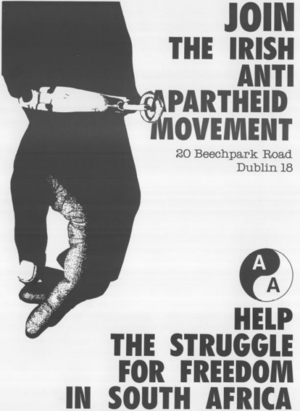
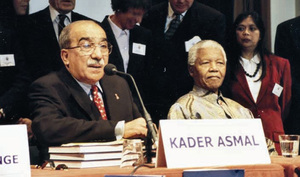
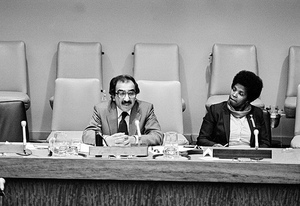
Kader Asmal, stalwart of the Irish Anti-Apartheid Group, Dean of  the faculty of Arts at Trinity College in the 1980s, Minister for Water in the first democratic South African government, Mandela confidante. 1934-2011.

“We had very little funding that we did not raise ourselves – and here I should pay tribute to the many musicians who sang for us at concerts, and often turned down lucrative offers to tour South Africa as well. Poets like Seamus Heaney read for us, Sean O’Casey and Samuel Beckett were among the first signatories of a list of playwrights who refused to allow their plays to be performed in South Africa. In 1984 Mary Manning, a young trade unionist working in a supermarket in Dublin, refused to register the sale of an Outspan grapefruit. She and 10 others who supported her were suspended, and went on strike for three and a half years. For those three and a half years we organized a Saturday picket outside the store, but management refused to respond to our letters and refused to meet us. In 1987 the Irish Government imposed sanctions on South African fruit and produce.”

Louise Asmal, widow of Kader Asmal.


Kader Asmal Dies In SA (Irish Times)

Louise Asmal quote and Anti-Apartheid posters via Irish Election Literature

It’s got really big pockets.

Basically you get to wear your luggage.

And you also get, according to Andrew Gaule (above), co-founder of Rufus Roo The Big Pocket Jacket Company, a low-cost option for carrying additional baggage on budget airlines.

Sez Andrew:

“I looked into it and saw that airlines can’t do much about things in your pockets, so last August I stitched together a prototype from parachute material and went through check-in.”

The coat can fit shoes, books, a laptop, two wine bottles and two extra hidden pockets are designed especially for “fiddly items you are liable to lose”.

Such as your dignity and the respect of your fellow passengers.

Yours for £29.50.

Thanks Spaghetti Hoop

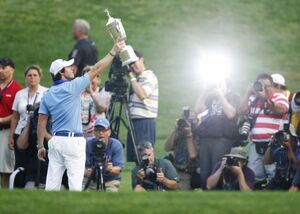
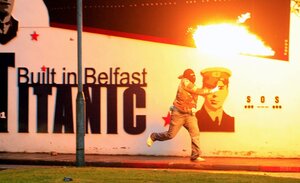
They have much in common, the boy wonder of the golfing world who returned to his native Ulster on June 21 and the lads who that same night fought running street battles in an enclave of Belfast called Short Strand.

Yet as U.S. Open champion Rory McIlroy, 22, disembarked at an airport named for his country’s most famous sporting export, George Best, and headed home to a hero’s welcome in Holywood, just outside Belfast and only five miles from Short Strand, hundreds of men of McIlroy’s generation, born and brought up within that five-mile radius, donned masks to cover their fresh faces and armed themselves with petrol bombs, stones, guns—and even golf balls.

Obviously McIlroy, blessed with prodigious sporting talent, has always enjoyed greater prospects than most of his contemporaries, but many ordinarily gifted Northern Irish men and women also grow up with some vision of a productive future. What distinguishes these children from others is not religion: McIlroy is Catholic; Graeme McDowell, another Ulsterman who won the U.S. Open in 2010, is Protestant. Nor is it pure economics. McIlroy’s father worked long hours as a cleaner and bartender to finance his son’s ambitions. But money and location do count. It’s hard to see beyond the rubble-strewn sidewalks of Short Strand to a better way of life.

Rory’s Return To A Divided Northern ireland (Catherine Mayer, Time)

(Rueters/AP)
Thanks Andrew Smyth