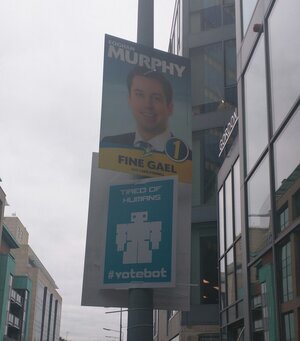


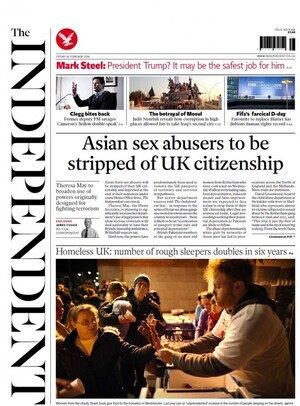


MORE to folly.



MORE to folly.

Yikes.
In Galway this evening.
Via Happy New Cait
Meanwhile…

This evening.
Sydney Parade, Ballsbridge, Dublin 4
Thanks David F

Tuesday’s Irish Examiner showing the letter sent by the foster father of Grace to the then Minister for Health Michael Noonan in August 1996
Further to yesterday’s post about Grace, Finance Minister Michael Noonan and barrister Garry O’Halloran’s calls for Mr Noonan to resign…
Two sisters, Bridget and Margaret, spoke to Joe Duffy on RTÉ’s Liveline this afternoon.
They did the interview because a third sister, who has limited speech and poor mobility, lived in the same foster care home as Grace for brief respite periods on several occasions – in 1983, 1987 and 1989.
Bridget and Margaret said their sister, who is now in her 40s, was first placed there by her South Eastern Health Board social worker, when she was aged 12.
At the time, she would have had the mental age of a two-year-old.
The sisters both recalled an incident where the foster parents contacted the sisters’ family, abruptly telling them to take the girl home. When the family went to collect her, the girl was left alone at the end of the foster home’s driveway.
Asked if the sister could have communicated with them, if she had been abused, Bridget said:
“I don’t think so, no. Only through crying and being terribly anxious.”
Margaret explained that the gardai had contacted her 18 months ago to say that “there was a minor complaint made, nothing to worry about.”
Margaret then gave them a statement about the incident in which her sister was left at the end of the driveway.
Then, on December 9, 2015, Margaret received a letter from the HSE saying that her sister would be a part of a Resilience Ireland report.
She also received an apology from the HSE and clarification that a Garda investigation was under way.
Margaret said she cannot get any other details and is facing having to make requests for information under the Freedom of Information Act.
She also made an appeal for other families affected – it’s believed 40 children lived in the foster home – to get in touch.
Margaret said: “If [any other families affected] would like to talk or come together as a support group, I mean we should have been told before it came out in the media really. We should have been informed, we should have been warned. Not hear about our family member in the media.”
Bridget also said that they’d like to hear from the social worker who was working with their sister. She said the HSE hasn’t offered any support or contact with any other families involved because of “confidentiality” reasons.
Bridget added: “And they said it could be a long time before we found the truth out really, you know, and that’s, that’s hard as well to take on.”
Towards the end of the interview, Mr Duffy asked the sisters to articulate what they’re hoping for.
Bridget: “Just, well, we just hope that she, she wasn’t in this situation but we don’t know and just for other families out there, who are feeling the same way as us, if they want to get in contact, we can [be] stronger in numbers really and to just sit down and talk about it. If they’ve got any, any information that could help us…”
Joe Duffy: “And Margaret is a part of you saying, ‘actually maybe we shouldn’t dig?’”
Margaret: “No.”
Duffy: “Maybe…”
Margaret: “No. Sure we have all the right to dig.”
Duffy: “Oh, I know that, I know that, I know that, absolutely. But is part of you saying, ‘oh god..'”
Margaret: “Oh of course you’re afraid what you’re going to find out…”
Bridget: “And what do you do with the information when you get it?”
Margaret: “Who’s going to be held responsible for all of this? The HSE? Who?”
Mr Duffy didn’t ask the sisters about the Irish Examiner’s report earlier this week which showed that Grace remained in the foster care home for another 13 years after the foster father – now deceased – sent a letter to the then Health Minister Michael Noonan asking that she be allowed to stay.
The letter was sent after the health board ruled that Grace be removed and after the family lost an appeal against that decision.
Mr Duffy also didn’t ask the sisters for their thoughts on barrister Garry O’Halloran’s calls for Mr Noonan to resign and for Commissioner Noirin O’Sullivan to investigate Minister Noonan.
Listen back in full here
Previously: Grace, Noonan and Monageer
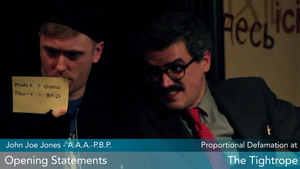
Mark Cantan writes:
“On Monday, at The Tightrope,[Anseo, Camden Street, Dublin, a bunch of improvisers took on the characteristics of the main political parties and held a comedy debate. Thought you and your readers might appreciate the highlights…”
Starring: Moderators – Neil Curran, Seán Flaherty; John Joe Jones (AAA) – Aaron Fever; Martin McMartin (Sinn Féin) – Mark Cantan; Nigel Furlong (Fianna Fáil) – Neil O’Rourke; Séamus O’Shea (Fine Gael) – Rick Doody; Susan Limp (Labour) – Diane O’Connor; Alan Fisk (Social Democrats) – Luke Benson; Natalie Snootin (Renua) – Kelly Shatter; Cassandra Ní Coinín (Green Party) – Denise McDermott.
Fight!
Hmm.
Rob Loughlin writes:
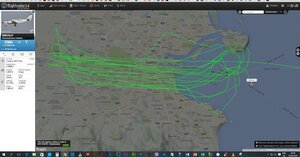
Spy plane from here over Dublin at 3.20am this morning for a few hours…
Anyone?

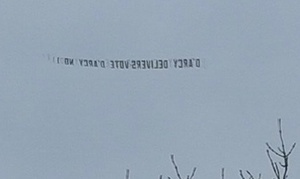
This afternoon.
Anne Marie O’Connor writes:
The moratorium won’t let them on the airwaves so Fine Gael [candidate Senator Michael Darcy have taken to the skies in Wexford.
Pic by @Vic712
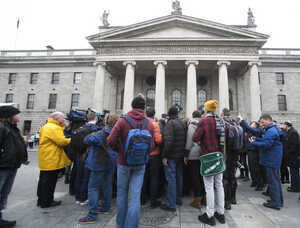
Media surround Sinn Fein President Gerry Adams this morning outside the GPO, O’Connell Street, Dublin
By presenting voters with a stark choice between “stability” and “chaos” elements of the establishment media went too far in General Election 2016.
Ciaran Tierney writes:
Has there ever been a General Election campaign in Ireland before in which the role of some elements of the mainstream media seemed so clear? Not to report the truth, or to compare policies, but to cheer on the establishment parties and spread an irrational fear of change.
For months now, we’ve been told that this election is giving us a choice between “stability” (voting for the parties who either bankrupt the country or imposed austerity on thousands of us) and “chaos” (God forbid if those upstarts from Sinn Féin or the small left wing parties came within a million miles of power).
Sometimes the mask slips, and you wonder whether Irish democracy is any better than the kind of electioneering you would find in modern day Russia or even North Korea.
Such as when the nation’s biggest selling newspaper gives over its main story to attacking Sinn Féin policies for three days in a row. That’s not balanced election coverage, that’s naked propaganda.
There is nothing wrong with challenging a party which has a sinister past, especially if they are a rising force on the brink of gaining power for the first time in the Republic.
But where is the investigative journalism into the policies of the Fianna Fail party which caused the economic crash less than a decade ago? Are they really ready to return to power?
And where is the acknowledgement that, by going into power with the DUP and embracing the peace process, Sinn Fein have actually come a long way in the space of a few years?
Where is the analysis of why the Labour Party abandoned their core voters (and all their principles) or why Fine Gael think it’s perfectly acceptable to punish so many for the sins of so few?
The same newspaper sent a representative, a crime reporter, onto the nation’s most popular chat show at the weekend.
He managed to insult hundreds of thousands of people on Friday night by suggesting that anyone who supports Sinn Fein’s position on the Special Criminal Court is a drug-dealer, a killer, or a thug.
People have a right to be concerned at the prospect of former terrorists going into Government, but blatant scare-mongering is another thing.
…It was hard not to see his Late Late Show appearance as a hatchet-job on Sinn Fein just a week before the election.
On the day after his TV appearance, thousands of people marched through the streets of the capital to protest against austerity. The Right 2 Change march merited just one paragraph, and not a single photo, in one of the nation’s biggest selling Sunday papers the following day.
Six days before the election, thousands of people insisted that austerity was still a big issue. They said that the march was about so much more than Irish Water. But a Rupert Murdoch-owned ‘paper decided their march did not merit any coverage, even though so many of them took over the city centre.
Across the city, another editor was putting together a piece which suggested ten different reasons not to vote for Sinn Féin. Which was fair enough, but you’d be waiting a long time for ten different reasons not to vote for the party which bankrupted the country in the first place.
Sadly, the people who cover politics in Ireland largely move in the same circles as the political masters they write about. They broadly share the same views, seeing nothing wrong with the bank bailout or Ireland’s failure to stand by our Greek cousins when they sought debt relief last year.
To support Syriza in their hour of need would have involved challenging the status quo and an admission that the Irish were wrong. And nobody in the Irish Government wanted that.
So we get “fluffy” pieces from the campaign trail, in which reporters get access to our leaders as long as they play by their rules.
…In this election, we should be grateful for social media. The landscape has been transformed.
When people see videos of 100,000 people marching through Dublin city centre on Facebook, getting next to no coverage on national television, they begin to ask about pro-Government “spin”.
More and more, people are beginning to ask questions about the information they are being fed.
We see Irish Water protesters being labelled as the “sinister fringe” on the TV news, but the only footage we see of Gardai beating up protesters is away from the mainstream media.
On Facebook or Twitter, you can see photos of thousands upon thousands marching through the streets of the capital to protest against austerity, even if those images rarely end up in the national newspapers or on TV.
You can see the establishment politicians make fools of themselves, by trying to defend the indefensible in unguarded moments on Twitter.
You can find out about the parties’ policies by accessing their websites and avoiding the scare-mongering among some elements of the media.
By all means, question the policies of left wing groups such as PBP-AAA and Sinn Fein. A hung Dail, with so many Independents, is a scary thing. Perhaps they would lead Ireland to ruin. Fianna Fail certainly should know – they led Ireland to ruin only five short years ago.
People don’t like to think they are being brainwashed or led a merry dance by those who have hidden agendas or a vested interest in holding onto power.
There is some vile stuff out there on social media, but it’s only there that you get a real taste of the anger running through the housing estates and parts of rural Ireland over the past five years. That anger rarely gets a look-in on national TV or our newspapers.
We have so many sources of information in 2016 that people can see right through the “spin”, in a way which would have been unthinkable before the advent of Facebook and Twitter.
That can only be a good thing, when we’re sometimes faced with the kind of propaganda which would not seem out of place in North Korea or Cuba.

Jackson Pollock’s route to abstract expressionism by British cartoonist and animation Henry Dunbar.
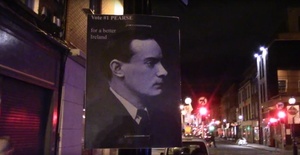
https://www.youtube.com/watch?v=DvG44aXIR1U&feature=youtu.be
The lads.
Seven Signatures writes:
If only we could vote for people like these…
Fight!