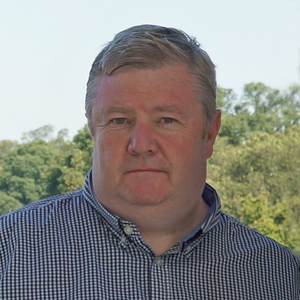
From top: UK Prime Minister Theresa May and Taoiseach Enda Kenny; Derek Mooney
Instead of passively waiting for our near neighbour to tell the EU their opening position Enda Kenny must act now to set out our vision of a post-Brexit border.
Derek Mooney writes:
If Enda Kenny intended his nonchalant response to Theresa May’s Brexit speech to convey the image of a Government that is perfectly prepared and in complete command of the situation, then the ploy has not worked.
Instead, his under reaction and this is all in line with what we had prepared for approach only makes his government look like it either does not grasp the enormity of the situation or – even more alarmingly – it is behaving like Tennessee William’s Blanche Dubois, and must depend on the kindness of strangers.
It is an impression that is not eased by reading the transcripts of the Leaders’ Questions exchanges between An Taoiseach and Michéal Martin and Mary Lou MacDonald last week.
On several occasions during his replies, particularly to the Fianna Fáil leader, An Taoiseach said: “We are at the start of this process”.
But we are not at the start of this process. The clock started on this messy and complex business within minutes of the announcement of the UK referendum result early on the morning of June 24 last. We are well into this process with the Article 50 negotiation talks ready to start in just under ten [10] weeks.
I cannot believe that the Taoiseach seriously meant to suggest that he and his officials needed to wait until the British Prime Minister was ready to formally set out her Brexit strategy, yet that seems to be the impression he was content to give.
In the Government’s formal response to May’s speech it “welcomes” the fact that Prime Minister May “…made clear that her priorities include maintaining the common travel area and avoiding a return to a hard border with Northern Ireland.”
She does indeed say that in point 4 of her Twelve-Point Brexit strategy. But she also said a lot more. Point 4 comes between Point 3; where she says that she will ensure that:
“…no new barriers… within our own Union are created” and Point 5; where she bluntly says that: “Brexit must mean control of the number of people who come to Britain from Europe.”
There is the problem: how can you have something that is clearly a border when it comes to keeping EU citizens out of the UK (Point 5) but it is not between the two islands (Point 3) and yet it is not a border when it comes to allowing the traditional common travel area to continue (Point 4)? It is the Schrödinger’s cat of borders?
Leaving aside the physical incongruity of it being a non-border border – a situation made more improbable when you add in the complexity of the UK not being in the customs union, but kind of being associated with it (Point 9) – and just look at the politics of this conundrum.
May has made a firm commitment to her voters in England that she will stem immigration. Won’t this domestic political imperative trump her broad wishes on our Common Travel Area? Especially, as Dr Kevin Cunningham pointed out on Twitter, when a NatCen (UK) social research survey from last November shows that 45% of British voters support introducing passport checks between the UK and Ireland with only 29% opposing it. An Taoiseach is being naïve if he genuinely thinks Point 4 can be taken at face value.
This situation is made even more complex, as Fianna Fáil’s Darragh O’Brien pointed out last week, when you factor in that Prime Minister May did not make any mention of the special status of Northern Ireland.
After Brexit it will be a region with a million or so Irish – and by extension EU – citizens who will find themselves outside the EU despite their will and without representation – a matter I will return to later.
I have no doubt that officials in the amalgamated international, EU and Northern Ireland division of the Department of An Taoiseach (sounds like a non-ICTU trade union from the 70s, does it not?) have been working on contingency positions to address many of the permutations that the UK could have taken: in/out of the single mark, EFTA, customs unions yadda, yadda…, but that has been on top of their usual daily work dealing with Northern Ireland, the EU and the rest of the world, items that probably generate enough work to fill a normal day.
Instead of passively waiting for our near neighbour to tell the EU their opening position, we should be putting more senior officials to work on Brexit on a full time basis and start setting out in detail both the major difficulties that Brexit poses for us in terms of our economy, our trade, our security and our day to day relationships with Northern Ireland and Great Britain and the measures we propose to address them. To do otherwise is a false economy.
This is a first rule of lobbying – don’t just go with a list of gripes, go with a researched and structured set of solutions. Make it as easy as you possibly can for the powers that be to give you want you need.
We have more skin in this game, North and South, than anyone else with the possible exception of Scotland. We are not merely one of 27 on the EU side of the negotiations – though we clearly are on the EU side of the table – we are unique among those 27 in having to live daily with the consequences of Brexit.
These consequences will be considerable, as the economic integration of the North with the rest of the island has risen considerably since the Good Friday Agreement, as pointed out by the Bruegel think-tank.
The retention of the Good Friday Agreement in any post Art 50 negotiation is a sine qua non for us as it sets out the relations between these two island on three individual strands – within Northern Ireland, between the North and the South of this island and east-west between the two islands.
While some of the key negotiating figures on the EU side, including Michel Barnier and Guy Verhoefstadt, have already indicated that safeguarding and protecting the Good Friday Agreement is a priority, they cannot hope to understand or grasp the finer details of its provisions better than our most senior officials.
There also needs to be a voice for the many Irish citizens in Northern Ireland who, as I pointed out earlier, are also EU citizens. One of the benefits of that EU citizenship, is the right to be represented in the EU Parliament. While it is not a right we all may equally appreciate – I suspect the prospect of having it taken away may awaken some to its value and significance.
The Irish government should be arguing for continued representation for Northern Ireland in the EU and the retention of its three MEPs – rather than allowing Mrs May to set the agenda for how a large number of Irish/EU citizens are represented and championed post Article 50.
Derek Mooney is a communications and public affairs consultant. He previously served as a Ministerial Adviser to the Fianna Fáil-led government 2004 – 2010. His column appears here every Monday. Follow Derek on Twitter: @dsmooney
Top pic: Getty