




Author Archives: Admin

This morning without permission these boxes were put in my office. Shortly afterwards the SF Dáil Political Manager came in shouting “F*ck off out of this floor, F*ck off out of this area & F*ck off out of this office before something happens”….. 21 years I gave these people. pic.twitter.com/gn8OVktf2u
— Peadar Tóibín (@Toibin1) April 18, 2019
Oh.
Previously: It Starts Here

The Butlers Chocolates Afternoon Tea at the Morrison Hotel
Further to our competition yesterday, Broadsheet reader Stephen Stewart wins the Butlers Afternoon Tea for Two at the Morrison Hotel.
Stephen, who is “broke”, will be taking his mother to celebrate her 70th birthday.
Mmf.
Thanks all.
Yesterday; Oooh! Fancy
The limited edition Butlers Chocolates Afternoon Tea at The Morrison is priced at €30pp including tea and coffee or served with a glass of prosecco for €37.50 and available until Sunday April from 12pm to 6pm.
Book here
Thanks Sinead






MORE to folly
Oooh! Fancy
at
The Butlers Chocolates Afternoon Tea at the Morrison Hotel
Like tea?
Enjoy chocolate?
Read on.
Sinead writes:
This Easter, The Morrison on Dublin’s Ormond Quay has teamed up with Butlers Chocolates to create a special, limited edition Butlers Chocolates Afternoon Tea, the perfect Easter treat to be enjoyed in the chic surroundings of The Morrison!
Packed with mini chocolate treats, the top tier includes a selection of bespoke Butlers Chocolates’ creations…The middle tier is filled with finger sandwiches…The lower tier carries mini fruit scones accompanied by pots of thick clotted cream and raspberry jam.
DELICIOUS!
We have Butlers Chocolates Afternoon Tea for Two to giveaway to a Broadsheet reader.
To enter, please complete this sentence
“I absolutely deserve the Bulters Chocolate Afternoon Tea for Two at the Morrison especially this Easter owing to______________________________’
Lines MUST close at 6.45pm extended until 9.15pm MIDNIGHT!
The limited edition Butlers Chocolates Afternoon Tea at The Morrison is priced at €30pp including tea and coffee or served with a glass of prosecco for €37.50 and available until Sunday April from 12pm to 6pm.
Book here


From top: scenes from a protest yesterday outside Leinster House by Supervisors and Assistant Supervisors of Community Employment (CE) schemes ; Bethany Langham
In 2008, the Labour Court in Ireland recommended that it is the responsibility of the Government to provide pensions for the Supervisors and Assistant Supervisors of Community Employment (CE) schemes in Ireland.
Eleven years later, the Government continues to ignore this ruling on the basis that they are not the employers of CE Supervisors.
CE schemes are designed to help those in long-term unemployment gain the confidence and skills necessary to re-enter the workforce.
There are approximately 22,500 participants on 1250 CE schemes in different communities around the country each with a Supervisor who takes care of the day-to-day management of the scheme.
In some cases where there are more than 26 participants on a scheme, there may be an Assistant Supervisor as well. Each CE scheme has a sponsor or multiple sponsor groups who help to oversee the scheme on a voluntary basis.
The Department of Employment Affairs and Social Protection (DEASP) oversees CE schemes. They provide financial support (including supervisors’ wages and employer PRSI) and have final say on the approval of new schemes.
A third party, non-profit, subsidiary company is set up to govern each scheme. The DEASP lodges money for wages, training and materials grants into the bank account of this subsidiary company. The voluntary sponsor of the scheme then transfers this funding out of this bank account and into the relevant locations.
The Government is the sole funder of these schemes and these subsidiary companies are essentially used as an extra layer of bank accounts.
Conor Mahon, who is a CE Supervisor in County Galway, describes the DEASP as his “shadow employer”.
He says the DEASP dictate…
“…how much holidays we get, how much sick leave we get… we’re audited by them. Every aspect of [CE] is micromanaged at every level”.
According to Mr. Mahon, even a small donation made by a member of the community who values the work of CE, results in a “hoopla with the department questioning it [demanding a] letter of explanation”.
Ahead of a planned strike in February 2019, a letter was sent to the sponsors of each scheme from Nora Durcan, Principle Officer in the DEASP.
In this letter, Ms. Durcan instructed how the sponsors should manage the schemes during the strike, reminding them that the DEASP will review funding allocated for the scheme “having regard to the industrial action taken”.
At a Dáil debate on January 29, 2019, Taoiseach Leo Varadkar claimed:
“It would be very unusual for a Government to reject a Labour Court recommendation… I am not sure I have ever seen Government bodies doing it”.
Fianna Fáil TD, John Brassil, reminded the Taoiseach of the 2008 Labour Court Recommendation (LRC) advising that the Government provide CE Supervisors and Assistant Supervisors with pensions.
He also referred to a Private Members’ Bill from 2018 which received a two thirds majority to implement this LCR.
The Taoiseach replied:
“In that case, the State is not the employer… but instead funds, or is the major funder of the body that employs the people.”
The Government’s stance on this matter is that the employer of the CE Supervisors should make provisions for a pension for them. Yet, the DEASP pays employer PRSI for CE Supervisors and Assistant Supervisors.
The Taoiseach is also manipulating the facts.
The subsidiary companies who govern each CE scheme are solely funded by the Government. Unless the Government makes provisions for extra funding for pension schemes, this matter will remain unresolved.
Minister for Public Expenditure, Paschal Donohoe, expressed his admiration for the Labour Court at a Dáil debate in March 2017.
He claimed that the Labour Court and Workplace Relations Commission handle thousands of issues each year and consequently “In order to ensure their continued role in matters of deep importance, it is crucial that the Government supports them”.
His opinion seems to differ in this case. Minister Donohoe claims that if the Government was to honour LCR 19293, the incurred costs due to other groups requesting the same rights, would be in the region of €400 million.
According to Mr Mahon, this scoping document includes…
“…every person or entity that gets funding from the Government [or] that does something beneficial for the community.”
Mr. Mahon adds:
“We have the LCR that none of the rest of them have”. These scare-tactics of Minister Donohoe are based on ‘the worst-case risk scenario’.”
In 2008 when CE schemes were governed by FÁS, a statutory body, €10 million was set aside to fund the provision of a pension scheme for CE Supervisors and Assistant Supervisors.
With the economic downturn, it was agreed on their behalf that this money would be rerouted into other areas of the country that needed the funds more urgently at the time. Since then, a change in Government saw that this money was never returned.
In 2015, Brendan Howlin, the then Minister for Public Expenditure and Reform, agreed to negotiate on this issue. However, according to Eddie Mullins, the SIPTU Sector Organiser for this case, “this [current] Government has basically back-tracked on it”.
When asked if he had ever seen the Government treat a group of people the way they are treating CE Supervisors and Assistant Supervisors, he said:
“No, it’s most unusual that they would treat a Labour Court recommendation the way they’re treating it”.
He regards the behaviour of the Government as “absolutely despicable” .
In 2015, at the Lansdowne Road Agreement, it was agreed that a High-Level Forum would be set up to deal with this issue.
On April 24, 2018, three years later, a Dáil debate was held on the subject of CE pension schemes during which Deputy Willie O’Dea of Fianna Fáil described the Forum:
“It’s members must be very high-level and busy because it has only had 5 meetings since its inception”
On that day, CE Supervisors and Assistant Supervisors from around the country made their way to Dublin for the debate which proved to be a further display of indifference by Government.
As stated by Deputy O’Dea:
“these people have been insulted by the Government tonight… because the Ministers responsible, in particular the Minister for Employment Affairs and Social Protection, did not have the gumption to come in here and read out the miserable script… for not providing them with their justified claim”
Economically, CE Supervisors are suffering. Equal to this is the emotional drain as a result of fighting for their rights and being ignored by the Government for so many years.
Celia Killeney has been a CE Supervisor in Galway for 21 years.Despite being on the same wage for the last 11 years, due to inflation and the rising costs of living, Celia claims she is financially worse-off than she was in 2008.
When asked how being ignored and used by the State has made her feel, she replied “devalued, worthless” and that she feels “it is absolutely disgraceful for a human being to be treated like this”.
A rally organised by SIPTU and FORSA took place outside Leinster House yesterday. Hundreds of CE Supervisors, Assistant Supervisors and supporters took part.
At a press briefing before the rally, it was announced that CE Supervisors and Assistant Supervisors will engage in five consecutive days of industrial action commencing on the 13th of May 2019.
Bethany Langham is a Galway-born, Dublin-based video and broadcast producer. She is currently doing a part-time masters in journalism and media communications.







MORE to folly
Dude?
atWell that was weird @paddycosgrave invited me to his office for an interview and then asked me to leave before he had answered any questions.
More on @drivetimerte at 5pm pic.twitter.com/DYVHNHZg9Q
— Philip Boucher-Hayes (@boucherhayes) April 16, 2019
Um.
Meanwhile…
Web Summit founder Mr Cosgrave revealed on Monday that he was involved in running the Irish Tax Agency page, which had anonymously targeted ads at European users of Facebook.
In a statement, a spokeswoman for Facebook said “we do not allow pages that are misleading or deceptive on Facebook which is why we have removed the Irish Tax Agency page for violating our policies against impersonation”.
The ads contained the tagline “reduce your taxes on global revenue to 1 per cent”. Users are told that “companies have saved billions in tax by relocating to Ireland from high tax EU nations”.
Facebook removes Paddy Cosgrave’s tax campaign page (Irish Times)
















MORE to folly

Teach Solais LGBT+ resource centre in Galway city
The West of Ireland’s only LGBT social space is in danger of being quietly extinguished.
John Donlon writes:
You might be forgiven for thinking, as you enter its unassuming premises off Galway’s Eyre Square, that Teach Solais is not a hugely consequential space.
Nothing could be further from the truth however, as this humble venue persists as the only LGBT space of its kind in all of the West of Ireland.
The result of years of hard work and planning on the behalf of Amach! LGBT Galway, even now the space is kept open largely by goodwill, blood, sweat and tears.
Its primary aims include providing a sense of belonging and community for LGBT people in the west; a place to come together in non-alcoholic setting. As per its Irish name, the space acts as a lighthouse, guiding lost souls through a stormy sea to safe harbour.
When I caught up with Cameron Keighron, Chairperson of Amach!, they reflected on the hard work that had already been done in bringing Teach Solais into being.
While the venue was secured in 2015, it has only been open since 2017 and has to date relied on Cameron, other Amach! board members and Community Employment Scheme workers to operate.
They’ve worked on providing a full social experience via the centre, by way of meditation classes, a running club, soccer club, self-defence classes and work with LGBT Ireland.
Cameron feels like they are just putting together a lot of pieces that were already there; they’re put together in once space.
He says:
‘We provide a lot of information, especially with how isolated it can be in a rural context; people come in and they have a question, or they need some condoms, we’re there to provide that information in a safe and confidential way that is accessible to them’.
In addition, the space is readily made available to other community groups in the city, including LGBT Ireland, Bi+ Ireland, and Galway Pro-Choice.
Says Cameron:
‘We open the space up for community groups to have a more affordable space and a more permanent space available to them’.
There’s a lot of intersectionality between the cohort that we’re targeting and the cohort that they’re targeting. We’re not just an LGBT centre so you don’t have to be an LGBT group to use the centre or to come in, you just have to respect the ethos of the centre’.
This hard work is all in jeopardy, however, as the space has never been given the core, renewable government funding that constitutes the lifeblood of spaces like this.
Originally set up thanks to a one-off, €25,000 fund from Galway City Council and accompanied by a €45,000 payment from the Maureen O’Connell fund, without regular, budgeted government support the space’s days are numbered.
This need lead them to start engaging with local politicians and other community groups to find out how they were funded. By and large the HSE were funding them, so Amach!
approached the relevant HSE Community Health Organization (Area 2, Galway, Mayo and Roscommon).
Though there was no new funding available the HSE were very supportive and advised them to continue to work with local politicians to contact other avenues of the HSE
Hildegarde Naughton TD helped to organise a meeting with Catherine Byrne Minister of State at the Department of Health with responsibility for Health Promotion and the National Drugs Strategy.
She suggested that they apply for a grant called Sexual Health and Crisis Pregnancy. Just before they submitted their application for that, Minister for Health Simon Harris visited the centre where they talked about it, so he too was aware it was going through.
Within days they got an email back letting them know they were unsuccessful, which was disheartening and disappointing for them to say the least.
They were then moved or advised towards applying for funding under Section 39 (Non-Acute/Community Agencies being provided with funding under Section 39 of the Health Act, 2004.) under which a lot of other community or advocacy groups are being funded.
Cameron recalls:
‘We applied for just over €90,000, and originally we were awarded €1,000, upon appealing then they upped that to €5,000’.
‘hey feedback was that the budget they had to work with doesn’t have enough surplus money for the budget that we submitted. It’s not that the HSE is bad or the HSE doesn’t want to fund us. The HSE do, they actually recognise the work that we do.
They recognise that this is saving money in the long term. If we can give people advice, information, it ultimately saves on the health service in the future’.
The impression one gets is of a system which has not kept pace with or allowed for the emergence of new, genuine public resources which have been put together with genuine, long-term grassroots action and devotion.
Says Cameron:
‘The reality is that funding streams like Section 39 haven’t really increased all that much in the last number of years. There’s still the same amount of groups that they were always funding, but now there’s more groups that need funding, but their money hasn’t increased.’
‘The government needs to ring fence core funding for groups like ours in a specific LGBT+ fund that’s protected, that rolls over on a yearly basis. There’s no point in giving us money for one year because in a year’s time we’ll be back in the same position’.
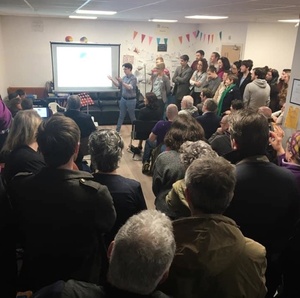
There does seem to be broad political support for the space and securing its future; with a recent public meeting (above) on the topic attracting Fine Gael, Fianna Fáil and Independent TDs along with representatives from the Green Party, People Before Profit, Social Democrats and Sinn Fein.
A shared sense of multi-partisanship was on display, with the elected representatives present at the time displaying an encouraging outlook regarding the space and its work being more important for the community than any potential political point-scoring.
As much as there is an undeniable hopefulness around the space; Cameron also admits trepidation about the future.
He says:
‘The community are scared. We’ve built this place up to be a vibrant hub for the LGBT community, the first real physical element to visibility for a really under-represented group in the west of Ireland.’
‘People rely on it for a social network, the vast majority of the time, people are coming into the centre; they all take care of each other. It really fosters a sense of family, community, the community that are coming there they really need it. They view this as another home.’
This duality, of a hard job well done but also of a space built on sand would seem to be taking its toll on Cameron and the rest of the Amach! Crew running the space.
‘We all find it really rewarding, the work that we’re doing here. We wouldn’t be here if we didn’t like it. It’s also getting to the point that the vast majority of us, myself included, are heading towards burnout. There’s only so many times you can write grant after grant after grant and get a negative response.
It’s really frustrating and it’s really disheartening because we don’t know if it’s us that’s doing something wrong. We don’t know if it’s that the funding stream isn’t the right one. In these situations, the LGBT community in the west of Ireland, a lot of the community groups feel the frustration of you feel like you’re not being heard.’
If you are interested in helping Teach Solais keep its doors open, you can contribute here.
John Donlon is a Galway-based freelance journalist.
Top Pic: Connaucht Tribune