
Author Archives: Admin

90383267

Mairead

Pro-choice rally last Summer (top); Law lecturer Mairéad Enright (above)

Are you drunk?

A piece of proposed legislation has been created by a group of feminist academic lawyers in the event of a repeal of the 8th Amendment.

It was originally drafted for Labour Women.

However, it has not been adopted by Labour Women.

One of the authors, lecturer in law at Kent Law School, Mairéad Enright writes:

In drafting, we were guided by four principles. First, and perhaps most importantly, we were determined to design a law that would regulate abortion in Ireland by primary reference to the bodily integrity, welfare, agency, autonomy and self-determination of pregnant women while still recognising a public interest in preserving foetal life where possible, with the pregnant woman’s consent.

By achieving this, we hoped to express a legislative commitment to no longer viewing a pregnant woman’s body as the mechanism by which the State fulfils its perceived responsibilities towards the foetus, but rather as the body of a woman who maintains her agency and her constitutional rights notwithstanding her pregnancy.

In that sense, we proposed a piece of law, which would aim to be transformative, to a significant degree, of the prevailing discourse around Irish abortion law. The point is not that we think foetal life is unimportant. Rather, we wanted to show what woman-centred abortion legislation would look like in an Irish context. To that end, we inserted key Guiding Principles in Head 3 that should be applied whenever the legislation is being interpreted or applied. These radically shift the approach to abortion from that the status quo. Head 3 provides:

(1) Access to abortion is guaranteed in accordance with the provisions of this Act.

(2) In making any decision under the Act, or in providing medical care and services under this Act, the Heads shall be interpreted in the manner most favourable to achieving positive health outcomes for the pregnant woman, and to the protection of her rights, including the rights to:

a. life;
b. freedom from torture, cruel, inhuman and degrading treatment;
c. bodily integrity and autonomy;
d. self-determination, including the right to informed decision-making in relation to medical treatment;
e. private and family life, including the right to privacy;
f. health, including the right of access to appropriate health-care in a safe, prompt and timely fashion, and the right of access to healthcare information.

(3) Access to abortion services will not be impeded because of race, sex, religion, national, ethnic or social origin, disability, HIV status, marital or family status, immigration status, sexual orientation, age, birth or other social status.

(4) Sustaining embryonic and foetal life in pregnancy is an important social role, which should be voluntary and consensual.

That said, this is not pro-choice legislation in the ‘free safe and legal’ mould, not because the authors are not pro-choice (we are), but because we were drafting for the Labour Party, which is not, as yet, committed to providing free, safe and legal abortion after repeal of the 8th Amendment. (The explanatory notes to the draft legislation highlight points at which we feel the legislation may be too conservative).

Bearing in mind the restrictions entailed in drafting abortion legislation for a political party in Ireland at the time, we strayed beyond mainstream political consensus to the extent that we felt European and international human rights law clearly enabled us to do. As such, we suggest that our draft law may represent a useful yardstick against which to measure later legislative proposals by a future Irish government.

Second, the proposed law designates grounds for abortion which, to a significant degree, challenge the mainstream consensus on what a new Irish abortion law should contain. Politicians advocating for reform have tended to accept that a new law should permit abortion not only on grounds of risk to the life of the woman, but on the grounds that the pregnancy has come about through incest or rape, or that the foetus is incapable of surviving outside the womb.

There is also some agreement that abortion should be available on a limited ‘health’ ground – certainly one which would reassure doctors that they could act to end the pregnancy of a seriously ill woman whose life is not at risk. Our proposed grounds go somewhat beyond such mainstream consensus.

In particular: we do not provide for a separate rape ground, in order to avoid any suggestion that a woman should be required to prove that she has been raped or to participate in any criminal process; we provide for two health grounds: a simple one applicable in early pregnancy, and a requirement to prove severe or disabling damage to health in later pregnancy and we do not confine the foetal anomaly ground to situations in which the foetus is certain to die within the womb if the pregnancy continues.

The proposed law aims to enshrine an approach to medical practice that replaces pro-natalist paternalism with a welfare orientation, seeing the pregnant woman as the patient and abortion as a medical procedure. This is intended not only to nudge a reorientation of Irish maternal medical practice, but also to empower medics to follow the course of medical treatment that they believe is best for their primary patient (i.e. the pregnant woman) as determined by doctor and patient together.

We were concerned that the legislation should ensure — to the extent possible — that abortion is actually available in practice, while also respecting the deeply held convictions of members of the medical profession and of the public in respect of the status of the ‘unborn’. This was of fundamental importance. It is quite clear that the legal availability of abortion can be frustrated by harassment, unregulated conscientious objection, and failure to provide services.

In order to try to achieve this we focused on three areas: conscientious objection, provision of services and protection of locations in which services are provided, and review of negative decisions as to the availability of abortion in any particular case.

The authors of the proposed legislation were: Lecturer in law at Kent Law School Mairéad Enright; Professor of law at the Durham Law School, Fiona de Londras; senior lecturer at Kent Law School, Vicky Conway; senior law lecturer at University College Cork, Mary Donnelly; senior lecturer in medical law at Queen Mary University of London Ruth Fletcher, barrister Natalie McDonnell; Birmingham Fellow at Birmingham Law School, Sheelagh McGuinness; law lecturer at UCC Claire Murray; law lecturer at Kent Law School, Sinead Ring and lecturer in ethics at Keele University, Dr Sorcha Uí Chonnachtaigh.

Read the proposed legislation in full here

An IHRL-compliant post-8th Amendment Abortion Law for Ireland. #repealthe8th (Human Rights In Ireland)

molloy

Fr Niall Molloy

The family of Fr Niall Molloy will meet the Minister for Justice Frances Fitzgerald tomorrow – almost 30 years to the day since the priest’s death.

Fr Niall was killed in bizarre and unresolved circumstances at Kilcoursey House, Clara, Co Offaly on July 8, 1985.

Fr Niall’s nephews Bill Maher and Henry McCourt will discuss the government-commissioned review released in March.

While it recommended no further inquiry into the case as the passage of time “made it impractical” it also disclosed fresh anomalies in the case.

This will be the first time relatives of Fr Niall have met a serving Minister for Justice. All previous requests were refused..

Previously: Fr Niall Molloy on Broadsheet

FIGHT!

90375912Lynch

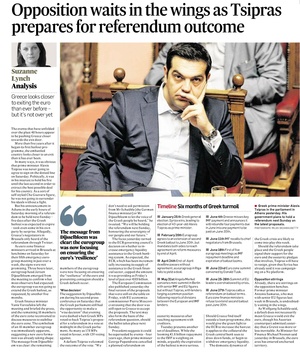
Paul Murphy (top) and the opinion piece by Suzanne Lynch in yesterday’s Irish Times

This morning, Anti-Austerity Alliance TD Paul Murphy and Suzanne Lynch, Irish Times’ European Correspondent, spoke to Seán O’Rourke on RTÉ Radio One’s T0day with Seán O’Rourke ahead of Sunday’s bailout referendum in Greece on Sunday.

What began as a chat about Greece turned into a discussion about pro-EU bias in the media.

Seán O’Rourke: “I see, I quote, in the Daily Telegraph today, from the Greek finance minister Mr Varoufakis effectively threatening to sue the EU institutions and to seek a court injunction to block any effort to expel it from the euro and they’re talking about taking advice and considering an injunction at the European Court for Justice if any such move is made because it’s just not provided for in any of the European treaties.”

Suzanne Lynch: “It’s possible, they haven’t confirmed that yet, here in Brussels, about that report but I mean there’s a lot of legal [inaudible] about a lot of aspects about what’s happened over the last week, not least whether the referendum in Greece is even legally possible because you’re not supposed to have referendums on fiscal measures.
So there’s legal questions everywhere you turn here on this issue and then one of your correspondent or your contributor there was making the point that the ECB is kind of acting, I suppose the implication, without, you know, beyond its mandate by effectively forcing the Greek government to impose capital controls. A lot of people in the ECB would say that already the ECB has being going past its mandate by keeping the banks going for this long with emergency funding. So, you know, no matter what way you look at this, really the argument is there on every angle I think on this saga.”

O’Rourke: “What’s your take on that speech made yesterday by the President of the European Commission Jean Claude Juncker – effectively using language that could be considered to be quite emotive and maybe not the most wisely judged of languages as well. ”

Lynch: “Yeah, that goes without saying, that his reference to suicide was badly judged. One can only think he wasn’t speaking his first language, that he meant something else but yeah, absolutely, I mean people are saying here that while he was trying to rally the Greek public, he may have actually achieved the opposite in this speech. But it was very wide-ranging.
He spoke for nearly a half an hour, he touched on everything from when Greece first joined the European Union in 1981, he talked about how personally he’d been involved in the association. He talked a lot about solidarity and how, you know, this isn’t about protecting one country against 18 others and he said a number of times about the other Eurozone countries, that you have to think of those countries.
And, again, he mentioned Ireland, he mentioned other bailed-out countries but I think he was implying these other poorer, east European countries in the European Union and the Euro, countries like Bulgaria, Slovakia, there’s huge opposition to any further concessions to Greece from those kind of countries. Their GDP is much lower than Greece. Their pensions are much less generous than the Greek pensions and that’s the reality so, you know, it’s very hard to sell this idea of further concessions to Greece. There are a lot of those poorer east European countries in particular.”

O’Rourke: “What do you say to that point, Paul Murphy?”

Paul Murphy: “Well I say first of all, about the Jean Claude Juncker speech, that it was peppered with falsehoods. The idea that the Greek side walked out of the negotiations is false. He claimed that the …”

Lynch: “Well I don’t think that’s the case, Paul, they did, they broke off negotiations on Friday. That’s exactly what happened.”

Murphy: “Well that’s…no it’s not what happened. You’re taking the line…”

Lynch: “What happened?”

Murphy: “…from the so-called creditors.”

Lynch: “No I’m not taking the line, I’m telling, I’m pointing out the fact there’s been constant spin from the Greek side on this aswell. So you think they didn’t walk out from the negotiations on Friday?”

Murphy: “Correct. Varoufakis was asked to leave at a certain stage so the Euro group could continue without him which is an unprecedented measure.”

Lynch: “That’s Saturday, that wasn’t Friday, that’s Saturday. You’re confusing, the Friday I’m talking about, in the negotiations.”

Murphy: “OK, I think the role of the media in this, to be honest, I think Suzanne Lynch’s articles have been consistently biased and taking the side of the so-called creditors, the Troika. In a recent article, she referred to Tspirias as a ‘self-styled Che Guevara figure’ – that’s not unbiased journalism. It’s taking the line of the establishment and repeating the propaganda here. Juncker claims …”

O’Rourke: “Before you go any further, I want Suzanne Lynch to come back on that, if she wishes. Suzanne?”

Lynch: “I think I’ll just leave that actually, Seán.”

Murphy: “But I just think the behaviour there of..”

Lynch: “Well I’ll say on thing: that was an analysis piece that I wrote. In the irish Times there’s a strong division between news and analysis and I’m not going to get into a sense of my work with Paul Murphy on radio. I would like him to get back to the factual issues. The Greek negotiators did break off negotiations on Friday, that’s exactly what happened.”

Murphy: “No that’s not accurate. So, on a factual issue, Mr Juncker caiamed that the reposal of the institutions does not include any cuts on pensions , that is completely inaccurate. Even the correspondent for the Financial Times tweeted, sorry this is not true, creditors bailout includes phasing out a solidarity grant , this is a pension cut regardless of what Juncker says. He claimed that the measures that the Commission is putting forward are socially just and not accurate, they’re abolishing heat oil subsidies, they’re enabling people who are less than €1,500 to have money taken directly from their wages. They’re heaping more tax on ordinary people, through payment on VAT. on basic goods, etc, and so there’s a massive spin going on about this, right? And the line is, the Greeks broke off negotiations, they’re unreasonable, they’re not capable, they’re unprofessional, etc, etc, etc. What they’re ignoring here is the question of democracy. What everyone fears is democracy…”

O’Rourke: “Going back to the point , you’ve dealt with that now, Juncker’s speech at some length but what about the point Suzanne Lynch has made and, by the way, sorry, I don’t think it’s right for you to accuse somebody of bias. I think Suzanne Lynch is a professional, honest journalist, reporting things that she sees and, by the way, to describe a man as a self-styled Che Guevara is a compliment.”

Murphy: “No it’s an insult, it’s a ridiculously insulting comment…I’m not questioning her integrity as a journalist.”

Talk over each other

O’Rourke: “Romania, the Czech Republic, or Latvia or Lithuania, these people are in countries that have a far lower GDP and income per head of population then the people in Greece. They’re not in favour. I mean where does democracy apply to them?”

Murphy: “No, but nobody, working people across Europe should not be paying for this crisis. The crisis should be paid by the banks in Europe, the bondholders in Europe, which are responsible for the crisis.”

Lynch: “But they are paying for the crisis, they have leant them billions of euro and that’s the problem.”

Murphy: “No, no they’re not. Suzanne, if you’re going to be accurate, you’ll know that 90% of the money that went to Greece from the Troika did not go to the Greek economy ,it went back out, it went on to the balance sheet of the Greek people and they’ll pay for it now, forever, unless they reject this deal and it went back out to bail out the banks. That’s what ‘s happening here, just like what happened in Ireland and I think people across Europe can hopefully see this. This is not a question of the people of Greece agains the people from elsewhere in Europe, it’s a question of ordinary people, the 99% across Europe versus the 1% represented by the Junckers and the Merkels and the Hollandes and the rest of them.”

Silence.

O’Rourke: “Suzanne?”

Lynch: “I just want to get back to the facts actually not engage in any of this kind of more ridiculous discussion with Paul Murphy there. The fact is that the two deadlines today, the IMF repayment of €1.6 million, it looks like Greece will not pay that repayment but, more importantly, the second bailout expires. I think this is probably more significant because this could give the trigger for the ECB to react further and to withdraw the emergency funding and essentially let the Greek banks go.

So what we might see today, and what I’m reporting today, is there’s definitely a sense that there’s a diplomatic incentive to get a deal agreed by the end of today. But what does seem likely is that , in any event, the second bailout that expires today, it’s very late now to get that extended. Enda Kenny said that as well this morning because, technically, it has to a lot of parliaments. Five other parliaments, including the German parliament. So that looks unlikelt. I mean the only possibility is that maybe Greece would apply for a third bailout because they, legally, again can request that.

So, I mean, there is this conundrum and this, somebody called it a parody of a referendum, in that Tsipirias called a referendum for next Sunday on something that will not exist anymore because that bailout expires today. And also, I think it’s showing again very bad political judgement by Alexis Tsipirias, he’s actually putting this to the people when they will have been faced without about five days of bank closures and capital controls so, of course, that’s going to galvanise more people, maybe to vote Yes and say, ‘hang on we’re not sure about this route, we better get back to the negotiating table’.”

Listen back in full here (starts at 16 mins)

Related: Analysis: Tsipras’s gamble backfires as Greece nears exit

(Photocall Ireland)

cloud1

cloud2

This morning.

More bizarre cloudage.

Over the River Liffey (top) and Bridewell, Dublin 8.

What’s going on?

Earlier: We Come In peace

Thanks Shea and James Stratford

Timelapse via Atticus

Update:

ballyfermot

Over Ballyfermot, Dublin 10

Thanks Declan Dempsey

1 2

They’re mutating.

Pics by Dermot kelly

Update:

cloud

Hovering over Harold’s Cross , Dublin 6 at 11.30am

Thanks Rod Collins