

https://www.youtube.com/watch?v=jrNijjU-2IE
A shot by shot comparison by ImDb comparing the trailers for the original Blade Runner (1982) with this year’s upcoming Blade Runner 2049.
Previously: I Used To Do Your Job



https://www.youtube.com/watch?v=jrNijjU-2IE
A shot by shot comparison by ImDb comparing the trailers for the original Blade Runner (1982) with this year’s upcoming Blade Runner 2049.
Previously: I Used To Do Your Job
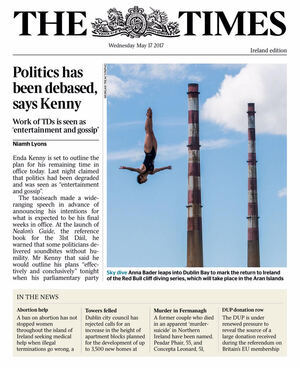






MORE to folly
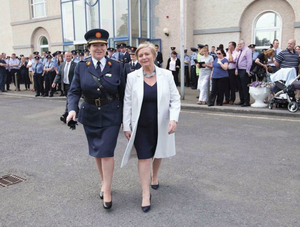
Garda Commissioner Nóirín O’Sullivan and Minister for Justice Frances Fitzgerald
Earlier today.
Tánaiste and Minister for Justice Frances Fitzgerald announced the 12 members of the Commission on the Future of Policing in Ireland and the final terms of reference for the commission.
It will report back to her in September 2018 but, in her announcement, Ms Fitzgerald said:
“Crucially the Commission may bring forward immediate proposals and rolling recommendations for implementation, that it considers are required to be addressed in the short-term, in advance of its final report.”
In addition, Ms Fitzgerald said:
“I am determined to continue shining a light to uncover bad practices and issues that must be resolved…It is clear from recent events that systemic issues which have emerged require the establishment of this expert group on policing to report in a timely way on the further changes now necessary to meet the requirements of a modern police force.”
The 12 members are Kathleen O’Toole, Noeleen Blackwell, Conor Brady, Dr Johnny Connolly, Dr Vicki Conway, Tim Dalton, Sir Peter Fahy, Dr Eddie Molloy, Tonita Murray, Dr Antonio Oftelie, Professor Donncha O’Connell and Helen Ryan.
From the Department of Justice…
Ms Kathleen O’Toole is currently Chief of the Seattle Police Department. She held the position of Chief Inspector of the Garda Inspectorate between 2006 and 2012 prior to which she was the Commissioner of the Boston Police.
Ms Noeleen Blackwell is a human rights lawyer who is Chief Executive of the Dublin Rape Crisis Centre. She was formerly the Director General of the Free Legal Advice Centre (FLAC).
Mr Conor Brady is a former editor of the Irish Times and the Sunday Tribune and was a member of the Garda Síochána Ombudsman Commission from 2005 to 2011. He has written extensively on the history of An Garda Síochána and has served as a visiting professor at the John Jay College of Criminal Justice in New York.
Dr Johnny Connolly is Irish Research Council Enterprise Scholar at the Centre for Crime, Justice and Victim Studies at the School of Law in the University of Limerick. His research project, co-funded by the Irish Research Council and the Irish Council for Civil Liberties, is titled ‘Developing a comprehensive human rights based response to drug and gang-related crime and community violence’.
He has previously worked as a Visiting Research Fellow in the School of Social Work and Social Policy at Trinity College Dublin and as a Research Officer at the Alcohol and Drugs Research Unit of the Health Research Board. He has published widely on justice issues and is board member of the Irish Penal Reform Trust.
Dr Vicky Conway is a lecturer in law in the School of Law and Governance in DCU where she teaches criminal law and criminology. She has previously held positions at the University of Kent, Queen’s University Belfast, the University of Limerick and the University of Leeds. Vicky is a graduate of UCC (BCL, LLM), the University of Edinburgh (MSSc Criminology) and Queen’s University Belfast (PhD, PGCert Higher Education).
Dr Conway is a leading researcher on policing in Ireland with an emphasis on the intersection between social change, police culture and police accountability. She has published two monographs on policing in Ireland (The Thick Blue Wall: The Morris Tribunal and Police Accountability in the Republic of Ireland and Policing Twentieth Century Ireland: A History of an Garda Síochána), edited a book on criminal procedure and written numerous articles on policing.
Her research has been funded by the British Academy and the European Commission. She was appointed a member of the Policing Authority in December 2015. She has held visiting scholar positions in North America, Australia and Ireland. Vicky is a member of the board of the Association of Criminal Justice Research and Development and has previously been a board member of the award winning Committee on the Administration of Justice in Northern Ireland.
Tim Dalton is a retired Secretary General of the Department of Justice and Equality.
Sir Peter Fahy has served in 5 UK forces spending 5 years as Chief Constable of Cheshire and 8 as Chief Constable of Greater Manchester Police with 13,000 staff under his command. In his time as a police chief he championed Neighbourhood Policing and drove through significant change programmes.
For 8 years he was director of the Strategic Command Course at the police staff college Bramshill. He held national positions in charge of race and diversity and workforce development and was national police lead for the Prevent counter terrorism programme. He is a life member of the US Police Executives Research Forum having previously served on their board.
When he left policing in November 2015 he took up a post as chief executive of the street children charity Retrak and among other responsibilities works with African police forces on how they deal with vulnerable children. He is also Chair of the Plus Dane Housing Association and a trustee of the Catholic Diocese of Salford along with a number of other trustee positions. He is an honorary professor at the University of Manchester.
Dr Eddie Molloy is Independent Management Consultant, Director Advanced Organisation. He specialises in strategy, large-scale organisation change and innovation.
Ms Tonita Murray is an international police development consultant with over 40 years as a civilian in government ministries directing the police and in the Royal Canadian Mounted Police (RCMP). She has specialised in police reform, policy development, training, leadership and management.
During her career in the RCMP she was one of the leaders of organisational change and a Director General of the Canadian Police College. From 2003 to the present, she has been engaged in police reform in Afghanistan and Kenya, including gender mainstreaming and gender sensitive policing. She has published on police management and reform, accountability and governance, women in policing and on the Afghanistan police reform effort.
Dr Antonio M. Oftelie is Executive Director, Leadership for a Networked World and Fellow, Technology and Entrepreneurship Center at Harvard. Dr Oftelie conducts research, teaches, and advises on how law, policy and technology can be aligned to create exceptional environments for organizational innovation and adaptation.
Based in the John A. Paulson School of Engineering and Applied Sciences at Harvard University, Antonio administers the Harvard Innovation Award program, is faculty lead for the Public Safety, Health and Human Services, Chief Financial Officer, Next Generation Operations, and Public Sector for the Future summits, and since 2004, has developed and taught in more than forty Harvard executive education programs.
As an application of his research, Antonio advises senior government and business executives on organizational transformation by helping them to adapt their mission and strategy, ideate new business and service models, build dynamic capacity, and create performance and value measures.
Professor Donncha O’Connell is an Established Professor of Law at the School of Law, NUI Galway where he has just completed a four year term as Head of School. He is also a Commissioner of the Law Reform Commission and was, for four years, a board member of the Legal Aid Board.
Professor O’Connell was a Visiting Senior Fellow at the Centre for the Study of Human Rights, London School of Economics in the academic year 2009-2010. From 1999-2002 he was the first full-time Director of the Irish Council for Civil Liberties (ICCL). He has also served on the boards of the following human rights NGOs: INTERIGHTS; Free Legal Advice Centres (FLAC) Ltd; and Amnesty International – Ireland.
He was a member of the EU Network of Independent Experts on Fundamental Rights that advised the EU Commission on a wide range of human rights issues from 2002-2007 and, latterly, the Senior Irish member of FRALEX, a legal expert group that advised the EU Agency for Fundamental Rights (FRA) in Vienna from 2007-2010.
Ms Helen Ryan was the Chief Executive Officer of Creganna-Tactx Medical from 2005 – 2013, a global supplier to the medical device industry specialising in products, technologies and solutions for minimally invasive therapies. The company is currently ranked among the world’s top 10 medical device outsource providers.
During Ms Ryan’s time as CEO, the company grew five-fold to become the largest indigenous medical device company. The expansion included three company acquisitions, a strategic joint venture in Asia, and the raising of significant debt and equity financing. The organisation grew from 100 people at a single site in Galway to over 1,250 people across a global network of four sites in Ireland, the USA and Singapore.
Prior to joining Creganna-Tactx in 2003, Ms Ryan worked with Medtronic and Tyco Healthcare (Covidien) in Product Development and R&D functional management roles. She is a fellow of the Institute of Engineers of Ireland and a member of the Boards of Enterprise Ireland and of the Galway University Foundation. She is a past Chair of the Irish Medical Devices Association, and serves as a non-executive director of a number of companies.
Rollingnews


Artist Lorenzo Quinn’s striking contribution to the 2017 Venice Biennale – rising from the lagoon to support the walls of the Ca’ Sagredo Hotel – a visual comment on the effects of climate change (including rising sea levels that continue to threaten the Medieval architecture of the old city).

Free THURSDAY?
In the Leeson Lounge, Leeson Street, Dublin 2 at 9pm.
Spoken wordsmith Kevin Barrington writes:
“Wriot” – a night featuring some of the best figures on the city’s growing spoken scene along with music from all round Renaissance man Phelim Drew and the sweet sounds of Davina and the Messengers. As always there will a couple of surprise guests in store.
And occasional randomers too.What’s more, it’s free in. Just throw a donation in the hat. So come along for a wild night of riotous entertainment.
FIGHT!


https://vimeo.com/217336882
A majestic 22 minute distillation of Star Trek: The Motion Picture (1989) set to Daft Punk’s Tron: Legacy (2010) soundtrack. Editor Patrick Collins sez:
I always thought the two film’s scores were very reminiscent of one another and I wanted to use that to give this recut a more updated feel while still maintaining some aspect of the pacing and staging of the original (very long) film and it’s big special effect scenes.
Full screen and headphones a must.
(H/T: Neil Curran)

Could only half hear but sounded like the taoiseach said “will you come with me” to Gerry.
“Not for a while.”— Ellen Coyne (@ellenmcoyne) May 16, 2017
And on it goes.
Watch Dáil proceedings live here


From top: An eviction letter to a tenant of Robin Hill, and another outlining how existing tenants will have to pay a deposit and new bi-monthly energy bills; Minister for Housing Simon Coveney
You may recall a post from last week about the Robin Hill apartment complex in Sandyford, Dublin 4 which went up for sale last week, after it went into Nama and was subsequently sold to Cerberus.
The post detailed claims made in the Dáil by People Before Profit-Solidarity TD Richard Boyd-Barrett.
The TD said five of Robin Hill’s tenants are now facing eviction and also said those who were not being evicted straight away were told they must pay an additional €250 per month in heating and hot water charges which were not previously included in the rent.
Mr Boyd-Barrett subsequently spoke about Robin Hill and the Tyrrelstown amendment to Seán O’Rourke on RTE Radio One.
This amendment was added to the Planning and Developlemt (Housing) and Residential Tenancies Bill 2016 before Christmas.
It had originally proposed that where a landlord proposes to sell 20 or more units in a development – within six months – the sales would be conditional on existing tenants being able to remain in the property unless there were exceptional circumstances. This figure was later reduced to five and then increased to 10.
Mr Boyd-Barrett told Mr O’Rourke:
“The vulture fund or landlord can evict nine people and then six months later, by the way, the legislation will allow them to evict another nine people. And six months after that, another nine people.”
Further this this.
This afternoon.
Eleanor Burnhill, on RTÉ’s News At One, reported on eviction notices that some of the residents of Robin Hill have received from an agent acting on behalf of Grant Thornton.
They have until June 25 to vacate Robin Hill.
Ms Burnhill reported that she obtained a statement from the Minister for Housing Simon Coveney about the matter.
“He says he is aware of the Robin Hill case. The statement says the Minister has indicated that if there is evidence that legislation is being circumvented, by companies selling off units in batches of less than 10, he will revisit this area generally.
“The officials on behalf of the minister are attempting to make contact with Cerberus to discuss the issue as soon as possible.
“And in relation to the area of hot water charges that you heard in that report, he says that if there a suggestion that new charges not previously covered by the existing tenancy agreement, if they’re being introduced, then the tenants have it open to appeal to the Residential Tenancies Board, as they have done.“
Listen back to Ms Burnhill’s report in full here
Previously: ‘The Minister Did Not Contact Me’
Pics: Eleanor Burnhill/Rollingnews

https://www.youtube.com/watch?v=vkouoKU5n0U
Actor and impressionist Ross Marquand inserts various fellow actors into films they were never in.
Deftly, mostly.
Previously: Nano Impressions
