
Author Archives: Admin

C3gJwFSWYAEer3O

This afternoon.

The European Commissioner for Competition Margrethe Vestager appeared before the Joint Committee on Finance, Public Expenditure and Reform, and Taoiseach.

It followed last year’s ruling by the European Commission that Apple received illegal State aid and owes Ireland €13billion in tax.

From her opening statement to the committee:

At the moment, our decisions on tax rulings are being appealed by the companies and governments involved. So it wouldn’t be appropriate for me to go into the details of the legal arguments at this point. But I am very glad to have this chance to explain how we have gone about our work on state aid and tax rulings.

Our recent decisions on illegal state aid, in the form of special tax treatment, are based on principles that have been part of the law for many years. Those principles are essential to make the single market work for all countries, big or small.

The European Court of Justice made clear in the 1970s that preferential tax treatment could be state aid, in the same way as a grant given in cash. Because both undermine the level playing field, by giving some companies a benefit that isn’t available to their rivals.

The Commission gave guidance in 1998 on when corporate tax rules can lead to State aid. And the European courts confirmed in 2006 that dealings between group companies had to be on market terms to avoid State aid.

So the rules on state aid and special tax treatment have been clear for a long time. What has changed recently is that multinational companies have been pushing the boundaries of aggressive tax planning.

Since that came to light, we have investigated tax ruling practices throughout the EU.

Our investigation into the Irish tax ruling began in 2013, after Apple told a US Senate hearing about what it called a “tax incentive arrangement” with Ireland. Since then, our work on tax rulings has gone far beyond that case, and beyond Ireland.

We have asked every EU Member State for information on tax rulings. And we have followed up with in-depth investigations in the most serious cases.

Those investigations have been carried out with the full involvement of the companies and governments concerned. They have led to four decisions so far, involving aid to Fiat in Luxembourg, to Starbucks in the Netherlands, to a number of large companies in Belgium and to Apple here in Ireland.

Those decisions should help the single market to work better, by giving all companies, big or small, the chance to compete on equal terms. And we will continue our work, to make sure that there is an effective deterrent against corporates’ tax planning practices that are against the state aid rules.

But let me be clear about two things.

First, these cases do not mean that we object to tax rulings in principle. Tax rulings as such are perfectly legal. They give companies clarity on how their tax bills will be calculated, or how certain tax rules will be applied. We simply want to make sure that they are not used to rubber stamp a way of allocating profits that does not match economic reality.

And second, these cases do not mean that the Commission is claiming authority over tax rules – national or international. They do not affect the sovereign right of Member States to determine their own corporate tax systems, or to set their own tax rates. They are simply about special treatment for certain companies.

I believe that fighting against aggressive tax planning practices should make countries like Ireland an even better place to invest. Ireland has a highly skilled workforce and modern infrastructure. It has chosen – and this is its sovereign right – to set a low corporate tax rate. And enforcing the state aid rules means Ireland, and other EU Member States, can also offer investors a place in a fair and open single market – at the tax rate they each decide.

Readers will that note that the deadline for Apple to place money in an escrow account ahead the Government’s appeal over the Apple ruling has passed.

Readers may also wish to note that, two weeks ago, the Sunday Business Post reported that Revenue is paying around €600,000 to Brussels-based tax experts to fight the Apple judgment.

Good times.

Transcript: Statement to the Joint Committee of the Irish Parliament on Finance, Public Expenditure and Reform, and Taoiseach

Meanwhile…

Ms Vestager greets Irish reporters and photographers before taking questions.

Screen Shot 2017-01-31 at 15.17.47

C3gi-0OWAAEhuOv

This afternoon.

In the Dáil.

Social Democrat TD Catherine Murphy introduces the party’s Media Ownership Bill 2017 (above).

Unopposed.

Yay!

Earlier: ‘Challenging Vested Interests Without Fear Or Deference’

Bill pic: Gavan Reilly

catherinemurphy

Catherine Murphy, Social Democrats TD at the Newsocracy2 conference

This morning.

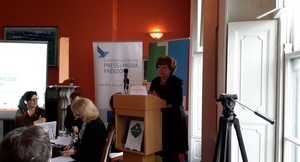
The Writers Museum, Parnell Square, Dublin

At the European Centre for Press and Media Freedom (ECPMF) Newsocracy2 conference.

Catherine Murphy, co-leader of the Social Democrats, said:

It’s a common misconception that my interest in media ownership issues arose because of what has now become the almost infamous weekend of so-called ‘constitutional crisis’ following by a speech in the Dáil regarding the Siteserv controversy

In fact in 2012 one of the first tasks I set my then new assistant was to write a Private Members Motion on media ownership. Now due to arrangements within the Technical Group that Motion never got the chance to be debated in the Dáil, it was a significant piece of work undertaken by my office and one that we have continued to pursue over the years.

Ironically my Siteserv investigations actually had no root whatsoever in the area of media control or ownership.  I had started questioning how the Irish water contracts had been awarded and that led me down a rabbit hole within which the two issues overlapped.

I first raised concerns regarding the contracts and the personalities involved back in September 2014 and continued asking questions throughout late 2014,  the Irish people had  become owners of a bank which cost them upwards of €30bn and the distressed assets were to be sold, I felt my role was to make sure those distressed assets were disposed of for the maximum possible amount,  in other words I was acting in the public interest in pursuing those contracts.

In April 2015  the Sunday Times broke the story on the front page.   During this time I was confronted with various cease and desist letters from Mr Denis O’Brien’s camp.

Once the Sunday Times story ran it became a snowball and my questions and FOI’s made it clear to me at least that a serious investigation into the sale was warranted.

This led to a ridiculous scenario proposed by Government that KPMG – who had acted as advisers on the sale of Siteserv – would then be charged with reviewing the sales process.

I felt strongly this was not the appropriate measure and so in May 2015 my team and I complied a piece of legislation which would give the C&AG the powers to undertake the investigation. In order to introduce that Bill I had to make a 5 minute speech explaining what the Bill was about and why I was presenting it.

In that speech I outlined my concerns regarding the sales process and why I wanted a thorough investigation.

I could not have predicted the fallout of that speech. All media outlets immediately reported everything I had said but within hours everything had changed. The Irish Times had pulled their report from their website. The Journal.ie had removed it from their site and RTÉ – the National Broadcaster was reporting the fact that they could not report the contents of my speech.

At the same time RTÉ  was in court and subject to a case involving an injunction by Mr Denis O’Brien,  who is a serial litigant,  I was not party to those proceedings and therefore could not have been aware there was crossover between the two.  The Judge had issued a blanket ban on reporting the subject matter in this case.

The only media outlet which kept the story live was the small independent online news site Broadsheet.ie. Fundamentally the issue of parliamentary privilege was side-lined by all apart from Broadsheet. A speech, given by an elected representative on the floor of the National Parliament was being erased from the news cycle and the public record was effectively being tampered with.

Citizens who rely on mainstream media were left uniformed on a matter that had been raised in THEIR parliament. It was the ultimate disservice to citizens by the media upon which they are forced to rely. One powerful individual had effectively controlled the media by the mere threat of legal action.

Unbelievably this same individual also happened to be the largest private media owner in this country. (and still is!)

A weekend of confusion ensued when legal departments in newsrooms up and down the country refused to trust Article 15:13 of the Constitution when faced with a threat from this powerful individual.

Article 15:13 enshrines the concept pf parliamentary privilege and the reporting of any utterances made in the Oireachtas. O’Brien’s threat had challenged that concept and newsrooms had been chilled into acquiescence.

There were a few instances of people printing the speech and giving it out on the streets.  Social Media was widely used to share it,  at all times it remained on the Oireachtas/Parliament Website.

Broadsheet held out and on Sunday, the Sunday times ran the story and my speech in full. Others eventually followed suit but not before an entire weekend of confusion had ensued.

The reverberations of that weekend are still being felt with journalists and politicians acutely aware of how real the threat to our press freedom is and how a gagging order on the national parliament very nearly came to pass.

The following Tuesday the judge in the injunction case against RTE clarified that the injunction could not have applied to a speech made in the Dail.

The incident reinvigorated by interest in what I see as a fundamental pillar of democracy – a free and open media, capable of speaking truth to power and objectively challenging vested interests without fear or deference.

When we are faced with a situation where any powerful individual not only owns the significant majority of our print & broadcast media but also exerts such a severe chilling effect on titles not under his control then it is very clear we have a serious problem.

That is why today the Social Democrats will introduce the Media Ownership Bill 2017 into the Dáil and host a debate in Private Members Time on February 8th. The Bill sets out to retroactively apply the guideline which states that anything above a 20% shareholding in a media business may not be in the public interest.

Change is long overdue and we feel strongly that our Bill is a vital first step  in bringing about change in this area.

FIGHT!

Yesterday: Free Tomorrow?

C3fq2gmWYAAURvr


This morning (11am).

On an Irish Rail train.

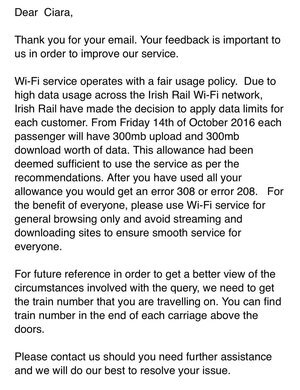
Ciara O’Brien writes:

New record. Log on, get this error message (above) after eight minutes of doing …nothing. No streaming video, all dull wor. Also, I use the same system every day on Dublin Bus with zero trouble. This wifi is unfit for purpose…

Anyone?

11.22am UPDATE:

C3fwDaOWMAEtMcC

Oh.

Ciara writes:

So this is the response. suggestion for Irishrail: if you want people to travel for business, you might want to fix wifi so it’s usable…

FIGHT!