

Odockatee tweetz:
Cork St, Dublin 8. Site of proposed new park(summer 2016). Speech bubble says “it’d be done quicker in Dalkey”



Odockatee tweetz:
Cork St, Dublin 8. Site of proposed new park(summer 2016). Speech bubble says “it’d be done quicker in Dalkey”

The first water meter getting installed in Maynooth, Co Kildare on August 8, 2013
Irish Water should stop installing water meters in homes, the Commission for Energy Regulation (CER) has declared, warning that the cost of completion will cripple efforts to improve water quality and supply.
In a submission to an Oireachtas committee which is investigating options, the CER – Ireland’s water regulator – said finishing the programme was not a priority.
So far 58 per cent of households have had meters put in place – the installation efforts have been strongly opposed in some places – but several hundred thousand properties remain to be linked. No money has been put in Irish Water’s 2017/18 capital budget to finish the work.
Meanwhile…
You may recall the publication of the Report on the Funding of Domestic Public Water Services in Ireland by the Expert Commission on Water Charges in November.
Further to this.
Today, at 2pm, the report will be discussed at a meeting of the Joint Committee on the Future Funding of Domestic Water Services.
Representatives of the Department of Housing, Planning, Community and Local Government, Irish Water, and the Commission for Energy Regulation will attend the meeting.
Watch the meeting live, from 2pm, here.
Regulator says Irish Water should not proceed with metering (Sarah Bardon, Irish Times)
Previously: Denis O’Brien, Fine Gael And The Water Meter Deal
Rollingnews
UPDATE:
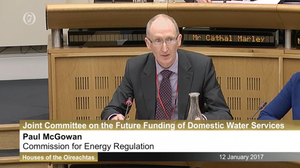
At the meeting of the Joint Committee on the Future Funding of Domestic Water Services…
Paul McGowan, of the Commission for Energy Regulation (CER), said it is not calling for the installation of water meters to be abandoned completely.
In response to a series of questions from Fine Gael TD Kate O’Connell – in which she queried the CER commenting on water meters and asked why the CER thinks it’s appropriate for the project, which, she said, is 75 per cent finished, to be abandoned…
There was the following exchange:
Paul McGowan: “Specifically, in relation to metering, we were asked the committee a number of questions in relation to metering and that was the basis on which we offered ideas and views in relation to the future of metering, at the committee’s request. So, that was the genesis of those answers.”
“Metering is a regulatory matter, I would say. It forms the basis in utility regulation for a large element of charging regimes, right across energy, water and other utilities. We recognise that the first phase of the metering was a decision that was taken by Government and that was [inaudible] so to speak to Irish Water, and to us, as a decision. And future consideration of further roll-out of metering.
“For example, to apartment buildings and those houses, or customers, who haven’t been metered in the first place was always going to be something that we would be looking at, in due course, in the overall cost-benefit, the cost of doing it and what would the benefits be.
“And that ultimately we would have worked with Irish Water to determine what’s the most efficient approach to close out the metering programme. So it is, it is something that a regulator would have a very close interest in.”
Kate O’Connell: “So, would you say, sorry, I probably phrased it incorrectly at the start. What you’re saying is that abandoning, or not abandoning it, stopping it, it’s to do with areas that there’s challenges about the metering, it’s not overall metering?”
McGowan: “Well to come back to that..”
O’Connell: “Yeah, I need you to clarify your statement essentially.”
McGowan: “To be very clear, we did not say that we should abandon…”
O’Connell: “Right, okay.”
McGowan: “To be absolutely clear. What we said was that, at this time, to proceed with another major programme of metering investment, given that the, as we see it, the proposal from the expert commission, was that the vast majority of water should be paid by the State and that only excessive use charged to customers. In that context, we said that, at this time, there are other priorities for capital investment but that we can come back and look at whether there was a case for further metering in due course.”
“But in the meantime, there were other options that could be looked at. And that was the context within which we replied to the committee. We did not boldly state that metering should be abandoned. We just said, at this time…”
O’Connell: “Park it.”
McGowan: “Yes…”
Watch the meeting live here
UPDATE:
Ervia chief executive Michael McNicholas says Irish Water did not spend €73m on consultants, rather they were ‘internatioanl experts’.
— Philip Ryan (@Philip_Ryan) January 12, 2017
And Water Committee hears the cost of billing is €25 million – a year!
— Páraic Gallagher (@paraicgallagher) January 12, 2017
Speaking about costs…
Mr McGowan said:
“Irish Water, at this stage of its evolution, is a high-cost utility. We would expect that because it has inherited 34 different water authorities but our analysis would indicate that they’re up to twice the cost of an efficient utility so what we will be doing over this revenue control, and the following revenue controls, is ensuring that they deliver the efficiencies to get down to the level of efficient operation, a level of cost of an efficient operation.”

Jar Jar Jr. – DIY beats from Cork
What you may need to know…
01. Jar Jar Jr (or jar jar jr, to use the proper nomenclature) is the nom-de-plume of Cork beatmaker Robert O’Halloran.
02. He’s amassed quite the cult following for himself, particularly in the last year, where fan-made videos of his tracks have racked up massive views, including over 300,000 for fan visuals for his track ambitions.
03. The wider music internet has taken notice, with playlist site/aggregator Indie Shuffle placing him in their hip-hop best-of for 2016, alongside DJ Shadow, Chance the Rapper and Jurassic 5. As you do.
04. Streaming above is the video for ah well, released last month via his own Soundcloud, and featuring UK rapper/poet Looms. Visuals directed by Aleks Podhorowska.
Thoughts: Progressing from jazzier beatmaking to lo-fi compositions and collaborations in recent times, Jar Jar Jr.’s 2016 surely serves as a portent for bigger things this year.

This morning.
In Dublin.
Paddy Logue tweetz:
The last of the Christmas trees…
Yesterday: The Trail Of The Lonesome Pine

A short by Michael Marczewski. To wit:
…a group of little autonomous robots performing a range of repetitive functions, driven by mechanical devices. But as the mechanisms mercilessly start getting faster and faster, things take a turn for the worse for the helpless robots.


BREAKING: Occupiers of Apollo House will leave the building this morning to comply with court order to vacate
— Sean Defoe (@SeanDefoe) January 12, 2017
The residents will be housed in another shelter that’s been ‘independently sourced’ – isn’t McVerry or other service provider #apollohouse
— Sean Defoe (@SeanDefoe) January 12, 2017
Taxis are now pulling into Apollo House to bring residents elsewhere pic.twitter.com/Y7FgpN0Z4R
— Sean Defoe (@SeanDefoe) January 12, 2017
Meanwhile…
Even the #apollohouse dog is getting ready to leave pic.twitter.com/V25EFmxYWm
— Sean Defoe (@SeanDefoe) January 12, 2017
Mmmf.
Previously: Common Sense, Love And Respect
UPDATE:
Home Sweet Home has released the following statement:
Since Home Sweet Home (HSH) was launched, the following has been achieved:
- No homeless person died on our streets over Christmas 2016, or since.
- Single-night beds in hostels were turned into minimum six-month beds where wanted by residents.
- Night-time only beds have been made 24-hour beds.
- New and specific provision has been made for couples in emergency accommodation.
- Two new facilities have been gained which will support ‘own key’ independent living for our most vulnerable citizens where appropriate.
- Residents of Apollo House have enjoyed a warm, happy and special Christmas and New Year thanks to the generosity of the public and volunteers.
- A new level of public awareness has been brought to this homelessness and housing emergency focussing not just on bed numbers, but on raising the bar on the minimum standards of care available to all homeless people.
- During the Apollo House occupation, 76 people previously sleeping on our streets have been transitioned into stable beds.
It is regrettable that, in recent days, the State has failed to take this opportunity to publicly support this effort to address a national emergency, instead seeking to deny clear commitments made and to use law to effectively force some people back into unsuitable accommodation for their needs.
This has meant that citizens who are entitled to support services cannot access them in Apollo house due to a court order. This is unsafe and therefore untenable.
Home Sweet Home announced on Monday, January 9, that it is to be a permanent intervention in the nation’s housing policy and discussion. This does not involve forcing people who are in recovery to enter a ‘wet environment’ against their wishes where they are endangered.
Accordingly, Home Sweet Home, as a public campaign, will house those currently in Apollo House elsewhere until Minister [for Housing, Simon] Coveney and the support services deliver what they committed to last Friday, January 6 – the short and long-term needs of residents being met according to their needs.
Home Sweet Home will not be making these locations public in the interest of residents’ privacy but details will be provided to support services so that all supports will be available.
Home Sweet Home will ensure that all of the matters agreed with Minister Coveney will be delivered and will continue its campaign to deliver on its Emergency Housing Plan published on January 5, 2017.
Via Sean Defoe
Pics: Rollingnews
First snow in Teerelton Co.Cork Ireland 10 am on 12-01-2017 pic.twitter.com/1S4PddW7WT
— Peter Bosman (@PeterBosman11) January 12, 2017
This morning.
In Teerelton, Co Cork.
Thanks Peter Bosman


MORE to folly

Rosi Leonard, of Home Sweet Home and the Irish Housing Network
This afternoon.
Sr Stanislaus Kennedy spoke to Ray D’Arcy on RTÉ Radio One.
During the interview they discussed the occupation of Apollo House.
At one point, Rosi Leonard, of the Irish Housing Network and Home Sweet Home campaign, joined the show by phone.
From their discussion:
Ray D’Arcy (to Rosi Leonard): “You’ve definitely got more coverage for the homelessness situation in Ireland, than anybody else has in a long time. What’s the end game?… Or what’s the end game?”
Rosi Leonard: “The end game, the long game, is that we end this housing crisis. And that’s beyond Apollo House, that’s the intention of Home Sweet Home, it’s the intention of the Irish Housing Network. The current game… I mean Apollo House should never have to be the answer. But Apollo House is a massive, vacant building – one of thousands – in our country. And it was a very practical intervention. It was very much an intervention to ensure dignity. And we created a standard in Apollo House that now Government are saying that they can’t do. And we’re a group of volunteers who did it in three weeks. It was more out of common sense and love and respect to the community, that we created those standards. Not any of this bureaucratic nonsense that they keep throwing back at us.”
“The short-term goal is that the people of Apollo House are housing in suitable conditions and that they see this, the Government see that they cannot disrespect and disempower people. People are empowered now, they have a voice. And we want that to continue.”
D’Arcy: “We’ve been talking to Sr Stan for the last half an hour or so and we mentioned that she’s been working with the homeless for the last, over 50 years. Sr Stan, would you like to say anything to Rosi there?”
Sr Stanislaus Kennedy: “Well, I think the aim is laudable, to end the housing crisis. Because it is a scandal. However, I think, I would prefer to see them stick, do it within the law. And I would encourage them to do that, do it within the law.”
Leonard: “But how many times has Government defied the law by letting people die on our streets? I mean that’s really what this comes down to. We talk about the law and yet, where are we prosecuting Minister Simon Coveney for not doing anything about the housing crisis that is now seeing 60 families every month living in a hotel.”
“I have met children, through the Irish Housing Network, who are six years old, being treated for depression because of the way they feel in these hotels, the way they see their lives panning out. And all I would say to that, is that we need to actually look at ourselves now as a country and say what are we willing to accept because right now it seems that we are willing to roll over.”
Kennedy: “No, I know all that. I think we’ve been on record several times talking about the situation of families, and particularly children – the 2,500 children – who are in emergency accommodation at this moment. All I’m saying is, I would prefer to work within the law. Keep at it but I think your campaign has drawn attention to it and well done on that.”
Listen back in full here
Meanwhile…
A skeletal timeline on various recent campaigns to end homelessness in Ireland…
July 1998: Sr Stanislaus Kennedy writes a letter to The Irish Times saying an unprecedented Exchequer surplus of over 1.2 billion pounds, announced a week previous, could enable the State to end homelessness. She said in 1997, 877 people under the age of 18 used the services of Focus Ireland – up from 352 in 1994.
July, 2001: A three-year plan to end homelessness in Cork is announced. The strategy is called Homelessness – An Integrated Strategy for Cork 2001-2003 and the Southern Health Board announces that 600,000 pounds will be distributed to different voluntary organisations, including Cork Simon Community, St Vincent de Paul and Good Shepherd Services. It’s reported that up 350 homeless people seek shelter in Cork city every night while up to 20 sleep rough.
2002: The official homeless figure in Ireland is recorded as being 5,581.
October 2003: It’s reported that begging and street drinking in Dublin city centre has almost been eradicated as a result of a programme in place since July – operated by Dublin City Council, gardaí and the health services.
It’s reported:
“Parnell Square to St Stephen’s Green has been designated a ‘public domain zone’ as part of the programme. As well as 2,800 arrests in the area, including 70 for begging, there has been a programme to help people access accommodation, health services and addiction treatments.”
An Independent Dublin City Councillor, Ger Dorgan, is reported as saying the initiative was an attempt by the council to “sanitise” Dublin city in advance of Ireland hosting the European presidency in 2004.
February 2004: At the Simon (Community) National Conference in Dublin, the director of the six Simon Communities in Ireland, Conor Hickey, says Ireland is poised to “make a real breakthrough in the fight to end homelessness”.
He says if if the annual bonus on the Special Savings Incentive Accounts (SSIA) scheme was reduced from 25 per cent to 24 per cent €21million more would be available to the Exchequer and could be used to end homelessness.
May 2004: The Cork Simon Community AGM is told more than 100 people, between the age of 16 and 25, are homeless in Cork while, in total, 500 people are homeless.
The charity launches a €21million four-year action plan and pledges to raise more than €7million from its own fundraising activities to go towards the cost of the plan.
December 2005: It’s reported that the government is more than 20,000 social housing units short of its social housing target set out in the National Development Plan; and that it has yet to respond to the National Economic and Social Council recommendation that 10,000 – 12,000 social housing units should be made available between now and 2012.
June 2006: Simon Community Ireland launches its three-year strategic plan, Ending Homelessness, Creating Homes. In an article in The Irish Times, Anne Connolly, chair of the Simon Community of Ireland, writes:
“Simon estimates that the provision of high-quality accommodation in the private rented sector – with a support worker – would cost €12,000 in a year. The average cost of hospital psychiatric care is €120,000 a year. To provide the same person with supported housing in a community environment would cost €40,000.”
Ms Connolly is also reported as saying that, while Simon did not have any official data or figures, it has seen an increase in the number of individuals from Poland, Lithuania and Latvia sleeping rough.
October 2006: Focus Ireland, the Simon Communities, the Society of St Vincent de Paul and Threshold launch their Make Room campaign, calling on the Government to end homelessness by 2010.
They also call for the provision of 10,000 social and affordable housing units every year to 2010 and €2 billion being put into the National Development Plan.
January 2007: It’s reported that there are 6,000 homeless people across Ireland with 80 per cent of these people living in Dublin.
Vincent Browne, Brian Ormond, Caroline Morahan, and Eamonn and Brian Fallon, of daft.ie, lend their support for the Make Room campaign, urging members of the public to sign an online petition.
February 2007: Ahead of the general election in May, the leader of the Labour Party Pat Rabbitte says, in a pre-election speech:
“When we build houses we must also build sustainable communities. My firm commitment for change is Labour’s new ‘begin to buy’ scheme for affordable homes in good neighbourhoods.”
“We will also legislate to protect the consumer rights of home buyers, to regulate management companies and estate agents, and to control management charges. We will end homelessness and reform the planning system to better serve communities.”
May 2007: General election takes place with Fianna Fáil returning 77 seats (down 4); Fine Gael 51 (up 20); Labour 20 (no change); Green Party 6 (no change); Sinn Fein 4 (down 1) the Progressive Democrats 2 (down 6).
June 2007: A Fianna Fáil, Green Party and Progressive Democrats majority coalition government – supported by four Independent TDs – is formed.
July 2007: The charities behind the Make Room campaign call on the parties in the newly formed Government to honour their pre-election pledge to end homelessness by 2010.
October 2007: In a pre-Budget submission to the Minister for Finance Brian Cowen, the Simon Communities of Ireland calls on the Government to increase its funding for services for homeless people by 5 per cent and invest €2.5billion in new social housing units over 2008. This does not happen.
December 2007: In its annual review for 2006, the Simon Communities of Ireland said 55 people, who used Simon’s services in 2006, had died.
The average age of those who died was 42. Of the 55 who died, 25 died in Cork, four in Dundalk, eight in Galway and 18 in Dublin. The general cause of death was “ill health”.
August 2008: The Government announces a four-year strategy to end long-term homelessness, called The Way Home: A Strategy to Address Adult Homelessness in Ireland 2008-2013.
The 83-page document emphasises the use of private-rented accommodation over emergency hostel beds.
Housing Minister Michael Finneran vows that, by 2010, no homeless person will be sleeping rough or staying in emergency accommodation for more than six months.
It’s also reported:
“About 40 key services for homeless people which were due to come on stream this year have been shelved due to a funding freeze (at €33million, same as 2007) imposed by the Health Service Executive (HSE).
“Homeless agencies in Dublin and Cork say they are turning away dozens of homeless people as a result of their emergency beds being used to capacity.”
In addition, it’s reported that an implementation plan [including in regards to funding], to accompany the strategy, may not be ready “for some months’.
It’s reported that around 5,000 people in Ireland are homeless, 43,000 households are on local authority housing lists and 36,000 children live in families on social housing waiting lists.
October 2008: Simon Communities of Ireland claims that, in Dublin alone, there are 10,000 unsold private units, almost half of which have two bedrooms, and calls on the Government to buy some of these properties in order to provide accommodation for homeless people.
September 2010: It’s reported that the number of people sleeping rough and using emergency homeless services in Dublin has risen by 20 per cent over the past 18 months – from 812 people per month in 2009 to 908 per month, during the second quarter, in 2010.
December 2010: As the Government fails to reach its goal of ending long-term homeless by 2010, Kerry Anthony, of DePaul Ireland, is reported as saying:
“I’ve been saying for some time now that I don’t think we really understand the full impact the recession is going to have on homelessness.”
“The figures haven’t fluctuated much to date but we know there are an awful lot of people defaulting on their mortgage repayments, we know about 90,000 people are defaulting on electric payments and 23,000 on their gas payments.”
February 2011: General election takes place with Fine Gael taking 76 seats (up 25); Labour 37 (up 17); Fianna Fáil 20 (down 57); Sinn Fein 14 (up 10), Socialist Party 2 (up 2); People Before Profit 2 (up 2); Workers and Unemployed Action 1 (up 1); Green Party 2 (down 6). Fine Gael and Labour formed a coalition government.
February 2013: The Government sets 2016 as the target for ending long-term homelessness.
The Irish Independent reports:
“The Government has vowed to eradicate long-term homelessness by the centenary of the 1916 Easter Rising.
“The strategy will revolve around property leasing rather than purchases, access to NAMA housing stock and fast-tracking homeless people from emergency shelters to special transitional housing.”
“Housing Minister Jan O”Sullivan defended the new strategy and its 2016 target as achievable despite the fact the former Fianna Fail-led government failed to deliver the same target with greater resources by 2011.”
Previously: Chain Reaction
Leah Farrell/Rollingnews

