Author Archives: Bodger

From top: Tallaght Garda Station: Plaze Hotel, Tallaght

Yesterday.

Dail Eireann.

Dublin South-West Fianna Fail TD John Lahart complained about the lack of Garda stations in his constituency.

During his address he said:

Tallaght Garda Station, the main Garda station in my constituency along with Rathfarnham Garda station, was designed in the 1970s and built in the 1980s. It is completely outdated.

The Garda in Tallaght now take two floors of the Plaza Hotel, adjacent to Tallaght Garda station in order to be able to fulfil the functions they must fulfil
.

Two floors.

Anyone?

Dail Eireann debate, April 27 (Oireachtas.ie)

Pics: RTE/Booking.com

Thanks Bebe


Secretary General at the Department of Health Robert Watt

Oh.

This afternoon.

Robert Watt says it is not ‘reasonable’ to attend another Oireachtas committee for questions on Holohan-Trinity affair (Independent.ie)

Meanwhile…

Ah now.

RollingNews

This afternoon.

Russian energy giant Gazprom has shut off gas supplies to both Bulgaria and Poland’s state-owned gas companies after the two countries refused to pay in roubles.

The European Union has accused Russia of trying to “blackmail” the bloc with gas, accusation which Russia has denied.

Meanwhile…

Via Paule Deane, UCC:

The impact of a long term interruption of Russian gas into Europe was studied in detail by our group in UCC. We used a computer model of the EU energy system to understand what would happen in each country if gas from Russia was not available.

Our research showed that, while gas would still flow across Europe, any interruption in supply would lead to higher electricity prices, It would also mean higher climate emissions as gas would need to travel further to reach the demand centres and older coal power stations would be used more to pick up the slack for less gas.

Europe has significant potential to import liquefied natural gas (LNG) via ships into places like the UK, Spain and France and this availability significantly helps to mitigate against interruptions in supply. Ireland does not have LNG capacity, but benefits from the UK resources which are diverse and secure.

Over a period of three to six months, the EU is likely to be able to survive a disruption to Russian gas imports. However, the picture becomes complicated when longer interruption is considered. Running the European economy for several years without Russian gas would be remarkably challenging….

Gulp.

What happens in Ireland if Russia turns off the gas supply? (Paul Deane, RTE)

CNN

Monday.

Meanwhile…

This morning.

All better.

Getty

Thanks Minister Without Portfolio

Um.

This morning.

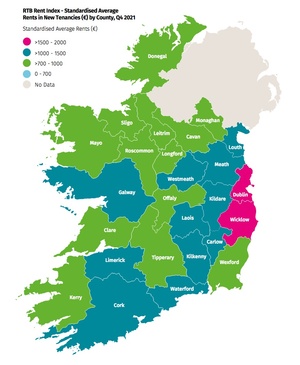
The Residential Tenancies Board’s  published its Q4 2021 Rent Index revealing the cost of new tenancies has increased by 9% nationally in the final quarter of 2021.

The average cost of new tenancies in Dublin is now nearly €2,000 per month – an increase of 100pc since 2011, when average rents were €985.

Social Democrats Housing Spokesperson Cian O’Callaghan said:

“Based on these figures, renters in Dublin today will pay €12,000 more in rent per annum than they did in 2011 – and that’s just the annual increase. The average annual amount they will spend on rent in Dublin is nearly €24,000.

For context, workers on the minimum wage – a paltry €10.50 per hour – earn just €21,840 in a year. How are workers on the minimum wage – and there are plenty of them – supposed to survive when average rental costs now exceed their annual gross pay?

“Rents are now unsustainable, not just in Dublin, but all over the country…There were double digit rental increases in 14 counties in the final quarter of last year.

“Another alarming figure from the RTB report is that the number of new tenancies, at the end of last year, had dropped by nearly 50pc. This indicates that renters are staying longer in their tenancies, given the volatility of the market, and that there has been an exodus of landlords from the market.”

Report here

Hello you.

This morning.

Via TG4:

Eipidéim is a new presenter-led history and science documentary series starting Wednesday, May 4 on the untold stories of the other great epidemics of Ireland’s past

Eipidéim presenters, social historian, Síobhra Aiken and medical doctor, Maitiú Ó Tuathail (top) go in search of the answers to these questions.

Through the historical records, they uncover the dramatic stories of those who suffered from these diseases that raged through Ireland leaving devastation in their wake.

Indeed.

From top: Baggott Street Hospital, Dublin 2: Housing Minister Darragh O’Brien

This morning.

Via Irish Times:

Temporary accommodation may be needed for up to three years for Ukrainian refugees, with each local authority mandated to develop a significant housing centre in their area.

….Minister for Housing Darragh O’Brien  told Cabinet that he intends to use legal powers available to him to heavily restrict local authorities’ capacity to waive rates, in an effort to combat vacancy.

Ministers were told that powers would be used to allow a range of temporary facilities to be built bypassing planning – including medical, residential, education and childcare facilities.

Ministers were told that each local authority will be asked to identify one building in public or private ownership and develop a plan for its refurbishment.

Several large buildings have already been identified, many of them Health Service Executive properties.

Cabinet was told they include Baggot Street hospital and former institutions St Ita’s in Dublin and St Loman’s in Mullingar, as well as St Brigid’s nursing home in south Dublin and St Peter’s in Castlepollard.

Temporary housing for Ukrainian refugees may be needed for up to three years (Irish Times)

RollingNews

Meanwhile…

This morning.

Meanwhile…

Developer Michael O’Flynn

Last night.

Prime Time on RTÉ One.

One of the country’s leading property developers has criticised plans to house Ukrainian refugees in temporary modular homes on State land.

Michael O’Flynn, CEO of the O’Flynn Group, said that the State should instead be considering more permanent housing solutions.

“Temporary modular buildings will be taken down in a number of years. That is not a solution,” Mr O’Flynn said.

It is hoped that construction will begin on the initial phase of 500 modular buildings as soon as possible, according to Housing Minister Darragh O’Brien.

“I cannot believe we’re going down that road,” Mr O’Flynn said.

Modular homes ‘not a solution’ for Ukrainian refugees – developer (RTE)

This morning.

Via The Victorian Commons:

…The idea was that each year Parliament would meet in Dublin for a session devoted entirely to Irish business. This had been suggested in June 1835 by the Leominster MP Thomas Bish, who moved to address the king on the subject, although his initiative attracted so little interest that the Commons was counted out before it could proceed further.

By mid-1848, however, Ireland had suffered an unprecedented famine and witnessed an abortive rising by the Young Ireland movement. In the wake of these events ways were sought to make Parliament more responsive to Ireland’s plight….

…The Society for the Promotion of Periodical Sittings of the Imperial Parliament in Dublin argued that holding an annual parliamentary session in Dublin would encourage the capital investment required to develop the country’s natural resources and stimulate trade, and might also coax the ‘wealthy and educated’ back to Dublin, which was then regarded as a ‘city of desolate palaces … without an aristocracy, and tenanted by struggling shopkeepers and half-famished artizans’.

No change there then.

Fight!

‘Rotatory Parliaments’: The 1848 campaign for parliamentary sessions in Ireland (The Victorian Commons)