



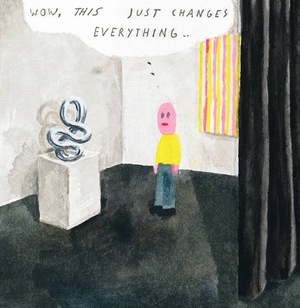


The sardonic work of German illustrator Stephen Dybus.
Author Archives: Chompsky
Hot Wheels
at


Behold: the 1965 Ford GT40 Roadster – or rather, one of twelve non-racing prototypes of the Le Mans conquering race car, and the only one to survive in mint condition.
Yours for between €6 and €8 million.
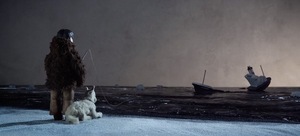
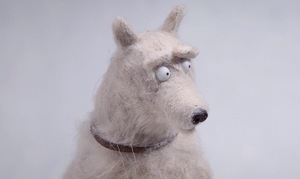
A darkly comic stop-frame short by Leuan Lewis and George Warren about a lonely Inuit struggling to survice after an oil tanker disaster of the Alaskan coast kills all the wildlife.
Wall Eyed
at


The playful, melancholic murals of street artist Hayley Walsh.
Dogs? Rabbits? Teddy Bears? Probably none and all of those.
No Stars
at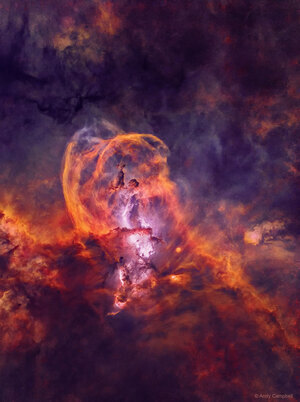
Behold: NGC 3582 a stellar nursery also known as the ‘Statue Of Liberty Nebul’a where bright stars are being formed constantly. But not in this picture. To wit:
The complex nebula resides in the star forming region called RCW 57, and besides the iconic monument, to some looks like a flying superhero or a weeping angel. By digitally removing the stars, this image showcases dense knots of dark interstellar dust, fields of glowing hydrogen gas ionized by these stars, and great loops of gas expelled by dying stars. A detailed study of NGC 3576, also known as NGC 3582 and NGC 3584, uncovered at least 33 massive stars in the end stages of formation, and the clear presence of the complex carbon molecules known as polycyclic aromatic hydrocarbons (PAHs). PAHs are thought to be created in the cooling gas of star forming regions, and their development in the Sun’s formation nebula five billion years ago may have been an important step in the development of life on Earth.
(Image: Andrew Campbell)
Trails
at


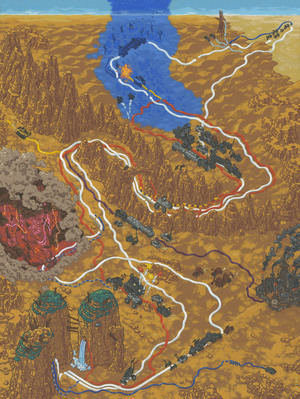


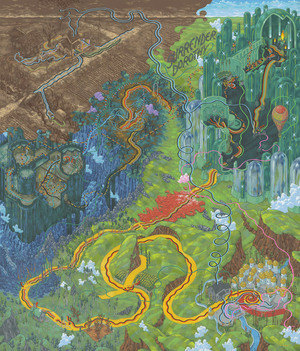
New hand-painted maps illustrating cinematic journeys by cartographer Andrew DeGraff.
(From top: Fargo; Mad Max: Fury Road; Guardians Of The Galaxy; Silence Of The Lambs; Indiana Jones And The Temple Of Doom; Labyrinth; Monty Python And The Holy Grail (with a key to the main characters); The Lord Of The Rings, The Shining and The Wizard of Oz.)
More of Andrew’s excellent Cinemaps here.
Previously: Plot Maps


A short by Emily Downe based on an interview with a professor in artificial intelligence that explores the notion that the human brain tends to anthropomorphise even the most rudimentary forms, and how – in the modern age – we might end up doing exactly the same thing to machines. To wit:
What does it mean to be conscious in a world that is becoming increasingly artificially intelligent? Can machines really see?
Flashy
at
A spectacular two-image composite of lightning striking communication antennas near the top of Volcán de Agua (Volcano of Water) in Guatemala earlier this month.
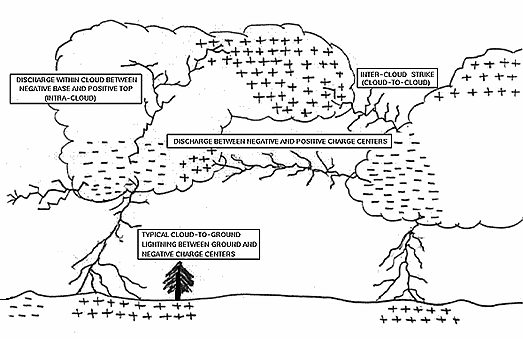
Details of what causes lightning are still being researched, but it is known that inside some clouds, internal updrafts cause collisions between ice and snow that slowlyseparate charges between cloud tops and bottoms The rapid electrical discharges that are lightning soon result. Lightning usually takes a jagged course, rapidly heating a thin column of air to about three times the surface temperature of the Sun. The resulting shock wave starts supersonically and decays into the loud sound known as thunder. On average, around the world, about 6,000 lightning bolts occur between clouds and the Earth every minute.

(Image: Sergio Montúfar (Pinceladas Nocturnas)


Another fascinating animation from German educational design studio Kurzgesagt. In this instalment, the Complement System. To wit:
An army of millions and trillions of tiny bombs, which work together in a complex and elegant dance to stop intruders in your body.
Previously: Electromagnetic Pollution