



Author Archives: Chompsky




Zen
at






Hot Wheels
at



Behold: the 1988 Lamborghini Countach 5000 Quattrovalvole – designed by Marcello Gandini, it entered production in 1974 and spent the next two decades adorning the bedroom walls of teenage motorheads worldwide.
This American export, presented in the classic Nero over beige leather livery with gold wheels and accents, massive rear wing and flared fenders, is in immaculate condition and has even been divested of its line-wrecking US-spec bumpers.
Yours for $385,000 (€331,500) if you’re passing through Cleveland Ohio.
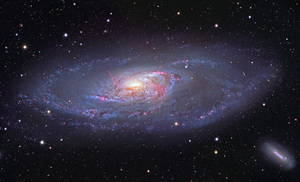
Behold: NCG 4258 – close to the Great Bear (Ursa Major) and surrounded by the stars of the Hunting Dogs (Canes Venatici), discovered in 1781 by French astronomer Pierre Mechain and later added to the catalog of his friend and colleague Charles Messier as M106. To wit:
Modern deep telescopic views reveal it to be an island universe – a spiral galaxy around 30 thousand light-years across located only about 21 million light-years beyond the stars of the Milky Way. Along with a bright central core, this stunning galaxy portrait, a composite of image data from amateur and professional telescopes, highlights youthful blue star clusters and reddish stellar nurseries tracing the galaxy’s spiral arms. It also shows off remarkable reddish jets of glowing hydrogen gas. In addition to small companion galaxy NGC 4248 at bottom right, background galaxies can be found scattered throughout the frame. M106, also known as NGC 4258, is a nearby example of the Seyfert class of active galaxies, seen across the spectrum from radio to X-rays. Active galaxies are powered by matter falling into a massive central black hole.
(Image: NASA, Hubble Legacy Archive, Kitt Peak National Observatory; Amateur Data & Processing Copyright: Robert Gendler)

Yesterday. Ranelagh Gardens, Chelmsford Avenue, Dublin 6
Colum Cronin tweets:
Home to Ireland’s first hot air balloon flight in 1785

Just now.
Middle Abbey Street, Dublin 1.
(Pic: Oisín Kane)
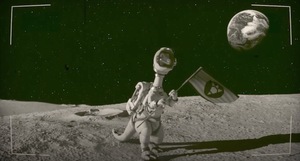

https://www.youtube.com/watch?v=jcNlhZ8l5k8
A short by John-Louis Aeberhardt wherein we enter a world where dinosaurs have not only survived but evolved to the point where they are ready to face their greatest enemy: the asteroid.