


Author Archives: Chompsky

Behold: the Pencil nebula supernova shock wave – plowing through interstellar space at over half a million kilometres per hour. To wit:

Near the middle and moving up in this sharply detailed color composite, thin, bright, braided filaments are actually long ripples in a cosmic sheet of glowing gas seen almost edge-on. Cataloged as NGC 2736, its elongated appearance suggests its popular name, the Pencil Nebula. The Pencil Nebula is about 5 light-years long and 800 light-years away, but represents only a small part of the Vela supernova remnant. The Vela remnant itself is around 100 light-years in diameter, the expanding debris cloud of a star that was seen to explode about 11,000 years ago. Initially, the shock wave was moving at millions of kilometers per hour but has slowed considerably, sweeping up surrounding interstellar material. In the featured narrow-band, wide field image, red and blue colours track, primarily, the characteristic glows of ionised hydrogen and oxygen atoms, respectively.

(Image: Greg Turgeon & Utkarsh Mishra)

apod

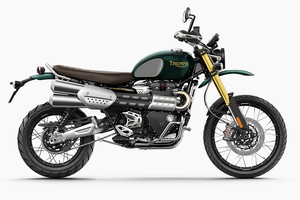
Behold: the Triumph Scrambler 1200 Steve McQueen Edition – a celebration of the actor’s link with the marque, which featured heavily in his collection of over 200 hogs.

Based on the top of the line 1200 XE scrambler spec, the limited edition 1200cc bike is decked out in the competition green livery of the disguised TR6 Trophys famously featured in ‘The Great Escape’ (1963) with a vintage leather saddle, laser-etched McQueen signature and a unique serial number for each of 1000 models.

The bike will cost $16,400 in the US and probably more in the unlikely event of you ever cornering one this side of the pond.

hiconsumption

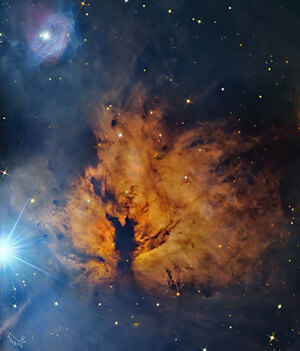
What lights up the Flame Nebula? What is the Flame Nebula sez you. To wit:

Fifteen hundred light years away towards the constellation of Orion lies a nebula which, from its glow and dark dust lanes, appears, on the left, like a billowing fire. But fire, the rapid acquisition of oxygen, is not what makes this Flame glow. Rather the bright star Alnitak, the easternmost star in the Belt of Orion visible on the far left, shines energetic light into the Flame that knocks electrons away from the great clouds of hydrogen gas that reside there. Much of the glow results when the electrons and ionized hydrogen recombine. The featured picture of the Flame Nebula (NGC 2024) was taken across three visible colour bands with detail added by a long duration exposure taken in light emitted only by hydrogen. The Flame Nebula is part of the Orion Molecular Cloud Complex, a star-forming region that includes the famous Horsehead Nebula.

(Image: Team ARO)

apod