
Author Archives: Chompsky

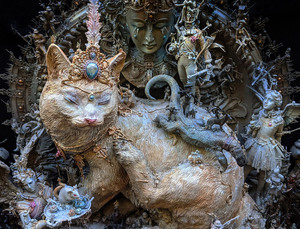
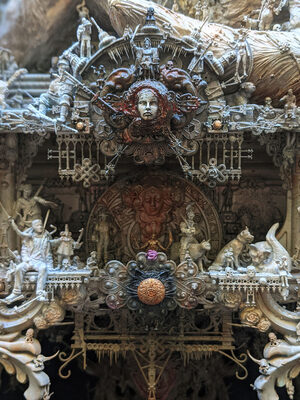
‘Tabby Tyrant’: a new assemblage of myriad found items by ’postindustrialism Roccoco master’ Kris Kuksi (you may recall his extraordinary tank-mounted cathedral).

The Kansas-based artist  describes the themes of his sprawling, metallised friezes as:

…historical narratives, biblical subjects, animal worship, architecture, symbolic views on commerce and development, as well as human psychology and behaviour.

He talks more about his process here.

colossal

Behold: the BMW 2002 Turbo – BMW’s first turbo powered production car, originally launched at the 1973 Frankfurt Motor Show.

Discontinued in 1974 – a casualty of the global oil crisis – only 1,672 2002 Turbos were ever made, making it an especially sought-after classic BMW.

This one – period correct, with its original livery, 2.0l, 170bhp five speed transmission, Alpina wheels, central exhaust, BMW Classic certification and a three year restoration – is a doozy.

Bidding starts at €100,000.

uncrate

Behold: a spectacular view from the International Space Station of an aurora generously slathered like salsa verde onto the Earth’s thermosphere just before midsummer 2017. To wit:

About 400 kilometres (250 miles) above Earth, the orbiting station is itself within the upper realm of the auroral displays. Aurorae have the signature colours of excited molecules and atoms at the low densities found at extreme altitudes. Emission from atomic oxygen dominates this view. The tantalizing glow is green at lower altitudes, but rarer reddish bands extend above the space station’s horizon. The orbital scene was captured while passing over a point south and east of Australia, with stars above the horizon at the right belonging to the constellation Canis Major, Orion’s big dog. Sirius, alpha star of Canis Major, is the brightest star near the Earth’s limb.

(Image: Jack Fischer, Expedition 52, NASA)

apod

Not a celestial ad for Mickey D’s, just a rare conjunction of two familiar arcs in Scandinavia’s night sky. To wit:

Perhaps the more familiar one, on the left, is the central band of our Milky Way Galaxy. This grand disk of stars and nebulas here appears to encircle much of the southern sky. Visible below the stellar arch is the rusty-orange planet Mars and the extended Andromeda galaxy. For a few minutes during this cold arctic night, a second giant arch appeared to the right, encircling part of the northern sky: an aurora. Auroras are much closer than stars as they are composed of glowing air high in Earth’s atmosphere. Visible outside the green auroral arch is the group of stars popularly known as the Big Dipper. The featured digital composite of 18 images was captured in mid-December over the Lofoten Islands in Norway.

(Image: Giulio Cobianchi)

apod