
Author Archives: Chompsky

Behold: vast jets emanating from the Centaurus A galaxy, aka Caldwell 77, each one more than a million light years long. To wit:

These jets of streaming plasma, expelled by a giant black hole in the centre of this spiral galaxy, light up this composite image of Cen A. Exactly how the central black hole expels infalling matter remains unknown. After clearing the galaxy, however, the jets inflate large radio bubbles that likely glow for millions of years. If energised by a passing gas cloud, the radio bubbles can even light up again after billions of years. X-ray light is depicted in the featured composite image in blue, while microwave light is coloured orange. The base of the jet in radio light shows details of the innermost light year of the central jet.

(Image: ESO/WFI (visible); MPIfR/ESO/APEX/A. Weiss et al. (microwave); NASA/CXC/CfA/R. Kraft et al. (X-ray)


apod

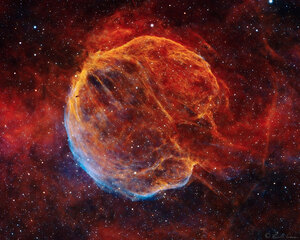
Behold: CTB-1, aka the Medulla Nebula – a mighty supernova remnant, but from where does it draw its brainpower? To wit:

CTB-1 is the expanding gas shell that was left when a massive star toward the constellation of Cassiopeia exploded about 10,000 years ago. The star likely detonated when it ran out of elements, near its core, that could create stabilizing pressure with nuclear fusion. The resulting supernova remnant, nicknamed the Medulla Nebula for its brain-like shape, still glows in visible light by the heat generated by its collision with confining interstellar gas. Why the nebula also glows in X-ray light, though, remains a mystery. One hypothesis holds that an energetic pulsar was co-created that powers the nebula with a fast outwardly moving wind. Following this lead, a pulsar has recently been found in radio waves that appears to have been expelled by the supernova explosion at over 1000 kilometers per second. Although the Medulla Nebula appears as large as a full moon, it is so faint that it took 130-hours of exposure with two small telescopes in New Mexico, USA, to create the featured image.

(Image: Russell Croman)

apod

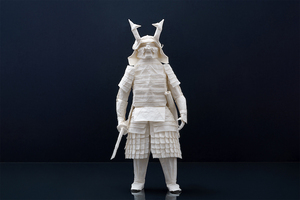
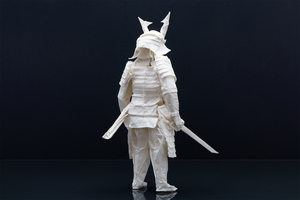
Finnish origami artist Juho Könkkölä spends around fifty hours scoring and folding a single 95cm² sheet of Wenzhou rice paper before he even begins sculpting the otherwise unbroken, uncut surface.

Using a combination of wet and dry origami techniques, he creates (among many other things) 28cm tall samurai warriors complete with plated armour, traditional helmet, and swords. Sez he:

There are several hundreds of steps to fold it from the square and there are probably thousands of individual folds

He talks more about his process here.

colossal

Behold: the fantastic star-formation region near the edge of NGC 2174, aka The Monkey’s Head Nebula in the constellation of Orion, about 6,400 light-years away. To wit:

It follows mountainous clouds of gas and dust carved by winds and radiation from the region’s newborn stars, now found scattered in open star clusters embedded around the center of NGC 2174, off the top of the frame. Though star formation continues within these dusty cosmic clouds they will likely be dispersed by the energetic newborn stars within a few million years. Recorded at infrared wavelengths by the Hubble Space Telescope in 2014, the interstellar scene spans about 6 light-years. Scheduled for launch in 2021, the James Webb Space Telescope is optimized for exploring the Universe at infrared wavelengths.

(Image : NASA, ESA, Hubble Heritage Team (STScI/AURA)

apod