




New land art on the richly pebbled Pembrokeshire coast by Welsh artist John Foreman – precise, hypnotic, fleeting.
All done this year.
All gone now*.
Previously: Just Stoned
*except maybe the grassy one.



New land art on the richly pebbled Pembrokeshire coast by Welsh artist John Foreman – precise, hypnotic, fleeting.
All done this year.
All gone now*.
Previously: Just Stoned




Behold: the 1974 Volkswagen Thing – originally developed for military use, just under 91,000 of these spartan convertibles were built between 1968 and 1983.
The civilian version – with its four removable doors, clip-off soft top and fold flat windscreen – was the alfresco driving experience of its day.
This survivor has had a complete overhaul of its 1,776cc flat-four engine and a host of necessary upgrades including disc brakes, racing seats, muffler, roll bar and electronic ignition.
Yous today for €14,500+ (but you’d want to be quick)
..a luminous plasma spheroid bound together by your own gravitation.
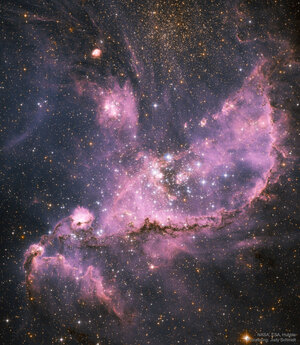
Behold: the star-forming region NGC 346 – 200 light years across, nestled among the clusters and nebulae of the Small Magellanic Cloud. To wit:
A satellite galaxy of the Milky Way, the Small Magellanic Cloud (SMC) is a wonder of the southern sky, a mere 210,000 light-years distant in the constellation of the Toucan (Tucana). Exploring NGC 346, astronomers have identified a population of embryonic stars strung along the dark, intersecting dust lanes visible here on the right. Still collapsing within their natal clouds, the stellar infants’ light is reddened by the intervening dust. Toward the top of the frame is another star cluster with intrinsically older and redder stars. A small, irregular galaxy, the SMC itself represents a type of galaxy more common in the early Universe. These small galaxies, though, are thought to be building blocks for the larger galaxies present today.
(Image: NASA, ESA, Hubble; Processing: Judy Schmidt)


There’s nothing more peaceful and reassuring as the night sky. Until, as German educational design studio Kurzgesagt reminds us, you realise it’s full of huge objects whizzing about at terrifying speeds. To wit:
..space is big, and so the stars of the Milky Way are very unlikely to hit us. Unfortunately, they don’t have to hit anything to make us have a really bad time on earth. And there are already stars starting to get very close.
Previously: In And Out

From an online pandemic support resource for Colorado healthcare workers.
We’re all in there somewhere.


The cosmos is filled with faintly glowing gas, invisible to the naked eye but revealed with a telescope and a very sensitive camera. To wit:
…this twelve-degree-wide view of the northern part of the constellation Cygnus reveals a complex array of cosmic clouds of gas along the plane of our Milky Way galaxy. The featured mosaic of telescopic images was recorded through two filters: an H-alpha filter that transmits only visible red light from glowing hydrogen atoms, and a blue filter that transmits primarily light emitted by the slight amount of energised oxygen. Therefore, in this 18-hour exposure image, blue areas are hotter than red. Further digital processing has removed the myriad of point-like Milky Way stars from the scene. Recognisable bright nebulas include NGC 7000 (North America Nebula), and IC 5070 (Pelican Nebula) on the left with IC 1318 (Butterfly Nebula) and NGC 6888 (Crescent Nebula) on the right — but others can be found throughout the wide field.
(Image: Bowen James Cameron)




Behold: the 1967 Shelby Mustang GT350.
This V8 survivor, immaculately preserved in dark moss green with twin inboard headlights, hood scoop, and period-correct ten-spoke aluminium wheels, has just 117,000km on the clock.
Yours for about €90,000 (+ shipping)
(UPDATE: bids rose to final sale around €133,000)