

Author Archives: Eamonn Kelly

From top: Minister for Culture, Heritage and the Gaeltacht, Josepha Madigan at the National Famine Commemoration Ceremony in St. Stephen’s Green, Dublin, yesterday; Eamonn Kelly

There was a Q&A in the Dáil recently (May 14) between Paul Murphy TD and Minister for Culture, Heritage, and the Gaeltacht, Josepha Madigan, on the subject of arts funding.

In his statement Paul Murphy said that Fine Gael seem only to pay lip service to the value of the arts, justifying poor funding for the arts as “realism”.

The first sentence of the minister’s response to Murphy’s question, in true neo-liberal eff-you style, featured the phrase “reality check”, followed by some figure juggling, a false comparison with Britain’s Covid-19 welfare payment, and a disingenuous claim that arts workers are receiving the highest share of Covid-19 payments, “after workers from accommodation, construction, administration and the retail sectors.” So, not the highest.

It was a typical and tiresome neo-liberal dodge. But what was clear was that the question concerning the value of the arts, was being answered from a value system in which the arts and humanities don’t really have a place. Neo-liberalism is “reality” and the Arts are… not reality.

Cultural Eco-System

Arts are part of the cultural eco-system known as the Humanities. Neo-liberalism would have you believe that you can pick the “best” from this eco-system, and promote just those choice parts, for dreary profit. But this, like much of neo-liberal ideology, displays the brute ignorance at the heart of that ideology.

You can’t pick and choose which items to promote and flog off in an eco-system. It’s all interdependent. It’s like saying that, in sport, we’ll only have a Premier league and no lower leagues or school leagues.

As soon as you do that, you destroy the system that feeds and nurtures the “best”. The entire eco-system is the “best”. In the Humanities eco-system, it is the activity of the arts and sciences, at all levels, that is of value, not the best-selling “product” that occasionally emerges from arts and science activities.

Creativity is the foundation upon which the capitalist profiteering engine was built.

This cultural power base formed in a slow accretion of various inventions, discoveries and insights across the ages; the result of an accumulation of imaginative activities that are quintessentially human, from which emerged the multitude of creative ideas, engineered into physicality, that gave rise to the modern world and modern technologies.

Neo-liberal capitalism, standing on the shoulders of this complex network of collective accumulated creative triumphs, often seems as arrogantly blind to that eco-system’s contribution to its own power base, as it is blind to the connection between the perpetual growth ideology it champions and impending climate catastrophe.

Neo-liberalism, in the long game of cultural intelligence, may be just a fancy name for stupid.

To Have Or To Be

Erich Fromm, the humanistic philosopher, in one of his later books, “To Have Or To Be”, defined a neat paradigm to illustrate two broad ways of being that are in conflict with each other in the capitalist system.

He wrote that humanity is oriented either towards “Having”, which is capitalism; or towards “Being” which is, broadly, the orientation that defines the Humanities.

This might explain why many creative people often feel they don’t quite belong in what people like Josepha Madigan are content to call “reality”.

The arts, far from being airy fairy fringe activities, are actually central to the human project. Through the arts, progress is imagined. This has been the case since cave paintings gave every tribe member the opportunity to study the animals they would hunt, aiding in focusing their attention and creating an inner mental picture of the target; the artist providing details that the non-artist may not even see in “reality”.

When artists unwittingly play the capitalist game and set out to justify themselves on capitalist grounds, accepting the capitalist restrictive value system as “reality”, they surrender the one quality that makes art truly invaluable: the ability to explore and think freely and objectify the “reality” that society has chosen for itself.

But in neo-liberal reality, the space occupied by the Humanities is perceived as being without real value. This is dangerous, because it must soon follow that predictions and warnings arising from humanistic studies will be deemed as equally without value as the activities that produce them, effectively blinding the culture to its own future, depriving it of the core intelligence it has always relied on for survival.

Pretty soon no one is working any more until they get paid a capitalist wage or are funded by a government throwing scraps to the sector, and practices become rusty.

Artists may gravitate towards sycophancy, further weakening the cultural objectivity the sector is supposed to provide. The grassroots of creativity begin to wither and die from neglect, not unlike the manner in which a coral reef might die.

Creative Obsolescence

Neo-liberal Capitalism is as wasteful of humanity as it is of any of the other raw materials it crushes and processes to turn its quick profits. In terms of the use and exploitation of native talent, the capitalist system treats human beings like objects of mass production.

It squeezes individuals into tight restrictive imagination-killing “jobs” – because the concept of a job is a capitalist value – and in doing so wastes all that is potentially creative in that individual.

When you devalue the Humanities by assessing their usefulness in a bogus value system, as neo-liberals do so casually and so routinely, you not only devalue that cultural eco-system that includes the arts, you also simultaneously promote ignorance and forgetfulness; the most extreme form of this regression being the Trump administration.

This ushering in of ignorance is a natural end-game for such a market-driven ideology as neo-liberalism.  From neo-liberal capitalism’s point of view, ignorance and forgetfulness are good for markets, since you can re-package and re-sell as new what was already known and then forgotten about.

Neglect of creativity, through under-funding and undervaluing, may be neo-liberal capitalism’s unconscious way of building obsolescence into, not only the products of human creativity, but into human creativity itself.

In this context, asking What use are the Arts? Or attempting to convince neo-liberals of the value of the arts, may be the totally wrong approach, since this approach takes place in the restrictive confines of neo-liberalism’s narrow understanding of “reality”.

Maybe it’s not so much that society needs to support the Arts, nor that the Arts need to become “realistic” by neo-liberal capitalism’s values; Maybe it is that society, if it hopes to avert climate disaster, needs to reorient, as Fromm recommends, and become more like artists and creatives.

Ways of Seeing

The autistic savant Temple Grandin said in a Ted Talk that the world now more than ever needs all kinds of minds, all kinds of imaginations to solve the problems we are facing.

She knew that in the so called “normal” world that her kind of mind, and minds like hers, were being side-lined, measured only by their monetary potential.

But she is a genius in visualising physics. She sees the arcs of physical movement in the natural world as vividly as you or I see objects in the living room. She can visualize the invisible. And yet she is ranked as second-best in a world measured by economic profit alone.

To not support the arts and sciences is to fling away as useless the potential of the human imagination, the same one that invented the civilization now apparently owned by a couple of hundred billionaires.

The real question to be asking, more glaringly obvious since the advent of the coronavirus, might be, what use is neo-liberal capitalism?

Eamonn Kelly is a freelance Writer and Playwright.

Previously: Eamonn Kelly on Broadsheet

Rollingnews

From top: Ryan Tubridy (left) and Taoiseach  Leo Varadkar on RTÉ One’s  The Late Late Show last Friday; Eamonn Kelly

Last Friday, May 1, International Workers Day, Caretaker Taoiseach, Leo Varadkar, addressed the nation, outlining a wind-down of Covid-19 restrictions. There was consternation in some quarters that the address had not been followed by a press Q&A.

This aspect of proceedings, the questioning, would be taking place on RTÉ One’s The Late Late Show that evening, with Ryan Tubridy acting as a kind of nominated journalist invited to grill the leader.

Varadkar’s spin unit burn up an estimated €100,000 of public money per month to make Varadkar’s neo-liberal Fine Gael look good.It’s instructive that even with that type of funding they somehow always fail to put on an entirely convincing show.

This show was no different. That’s what happens when you don’t value or respect the arts; you think if you fling enough money at it that any bozo can act the clown.

The setup, ironically enough, sounded like something from Chavez’s Venezuela or Putin’s Russia. The great leader cocooned with just one selected media person empowered to ask questions.

A carefully managed Q&A featuring an RTÉ stalwart who, strictly speaking, isn’t really a journalist per se, but more of a light entertainment personality with impeccable political establishment credentials.

Afterwards, social media pounced on the fact of Varadkar having to consult his notes during the interview, which probably pleased the FG spin unit no end, since the moment, whether intended or merely happy accident, acted like a magician’s distraction, sending many critics of Varadkar’s neo-liberalism in the wrong direction.

Because this show was about schmoozing the Irish electorate into swallowing the idea that neo-liberals were the best gang to tackle climate change, despite the truckloads of evidence rolling in from laboratories all over the world that neo-liberalism, the ugly face of late-stage capitalism, is actually an aggravator of climate change.

What Neo-Liberals Do

Neo-liberalism has two main goals: rolling back the welfare state and privatising everything. To sell these goals as good ideas it schmoozes people into believing that the return of “lots of good jobs”, which neo-liberalism is forever promising, and which Varadkar promised on The Late Late Show, will be worth the trade of personal freedoms; potential homelessness; lower wages; higher rents; private medical services and climate catastrophe.

Naturally neo-liberals tend to thread carefully while trying to sell this bag of goodies. Their moves are like the moves of cat-burglars, or comedy camouflage experts, encroaching with minute advances after long periods of apparent stillness.

The surprising thing is, they are often successful in selling the awful package. For instance, in the last election, despite the evidence of mounting social injustice, homelessness, emigration and suicide, a full 20.9% of the electorate still went out, presumably of sound mind, and voted for Leo Varadkar and Fine Gael.

But why would the spin unit think it a good idea to attempt to sell the party as the best bet for a Green future on a light entertainment show?

The Sell

This idea of The late Late Show being a light entertainment show was in fact a bone of contention back in the mid-1960s when Gay Byrne, the innovator of the show, had made it more than a simple light entertainment show, turning it into a forum where the Irish people could meet and talk about issues that affected them and the society.

But, as I mentioned in a previous piece, this aspect of the show was deeply resisted by some, among them Ryan Tubridy’s grandfather, Todd Andrews, who wanted Byrne off the show, intent on making the platform an apolitical light entertainment vehicle.

I mention this now because it was Byrne’s innovative development of the show as a forum for a national conversation that now made it valid for Leo Varadkar to appear on the show, having decided against a press conference, to avail of that understanding of The Late Late Show as a national forum.

The opportunity to sell the big idea opened up when Tubridy asked about the ongoing talks with the Greens to enter coalition with Fine Gael and Fianna Fáil.

Leo Varadkar had just begun his answer to the question when Tubridy, who has a tendency, unlike Gay Byrne, to pay more attention to his questions rather than his guests, dived in with another question.

But Varadkar panicked and pulled him back saying that the previous question was important and needed a bit more time for a fuller answer.

And so it proved to be, because the question had opened up the interview to allow neo-liberal Leo to argue that neo-liberal politicians are better equipped to meet climate targets than left wing parties would be.

Because, according to the neo-liberal view presented by Varadkar, the Left would spend their time “fighting” with the business community.

Isn’t that just wonderful? The very flaw at the heart of neo-liberalism, essentially enriching business at the expense of community, and by doing so, contributing to global climate devastation, is offered as the solution to climate change, because neo-liberals get on well with the business community, the same community whose hunger for perpetual growth is contributing to climate change.

And this wonderfully slippery message delivered direct to the Irish people with their guard down, from the cosy homely hearth of The Late Late Show, where the nation had gathered to hear the government plan for the lifting of restrictions, and to sympathise and empathise with the victims of an ongoing health emergency.

We Are…Not the Left

The claim betrays the vacuity of ideas at the core of Varadkar’s neo-liberal ideology.

Lacking the ability to define themselves by any particular standard other than neo-liberalism, which must remain a partially hidden agenda, since its outcomes are so damaging to fundamental social justice, Varadkar’s Fine Gael instead define themselves by repeated reference to leftist ideas.

In other words, what Varadkar’s neo-liberal party stand for is, not being the Left.

Varadkar suggesting, with a straight face, that Fine Gael’s relationship with the business community is a safer bet for meeting climate targets than anything the Left might initiate, is either a statement borne of ignorance of the damage the ideology he champions is wreaking on the environment; or, he simply doesn’t give a damn about the climate, no more than he ever seemed to give a damn about the 10,000 homeless he smilingly helped conjured into existence.

Nevertheless, here he was, claiming that he would somehow out-left the Left, despite being hopelessly Right, and somehow become Green while also creating “lots of jobs”, predicated on the out-dated neo-liberal model of limitless growth in a finite system.

He was, in other words, like old Fianna Fáil, attempting to be all things to all sectors.

The Schmooze

Ryan Tubridy helped with the schmooze like an awkward well-intentioned youth trying to help a blind man across a busy road; but in such a way as to suggest prior briefing.

His contribution was concerned with reassuring those voters who had concerns of a Left nature: specifically, concerns related to social housing and the Covid-19 welfare payments.

When the topic of construction workers returning to work was brought up, Tubridy rushed in to mention social housing. To which Varadkar replied, as other Fine Gael personnel have been doing in recent times, that social housing is continuing and ongoing. Even apparently despite the lockdown.

That must be amazing news for the 10,000 homeless now quarantined in hotel rooms, with their landlords happily exporting buckets of public cash to the Cayman Islands.

The second contribution by Tubridy came when he asked Varadkar about the possibility of extending the Covid-19 welfare payments, to coincide with the return to work of various sectors, as outlined in the resuscitating the economy plan.

The answer was in the affirmative, to which Tubridy helpfully chimed in: and that’s a nice gift for May Day. May Day being worker’s day and a red-letter day for the Left (excuse the pun).

However, as soon as Tubridy had so helpfully underlined the apparent coincidence of a rare Fine Gael promise to condone a welfare payment, the promise delivered on May Day, a backstage light flickered and the Fine Gael spin unit was momentarily revealed in silhouette, pulling levers.

Varadkar’s Neo-Liberalism

Varadkar’s neo-liberal Fine Gael are probably not engaged on some grand plan towards world domination. It’s likely more mundane than that. They have simply chosen sides and basically do all the things that you’re supposed to do when following a neo-liberal agenda. It’s like following a recipe: first you privatise the public services….

Presumably after you’ve dismantled all public services and impoverished everyone but a few billionaires, something wonderful is supposed to fall into place, inaugurating some neo-liberal Shangri-La.

Fine Gael’s particular political machine is designed to pursue these old models based on out-dated and discredited capitalist and neo-liberal ideas. It runs clickety clack on neo-liberal tracks. They don’t seem to understand that you can’t continue with “business as usual” and hope to avert climate catastrophe.

But they do understand simple logistics like “meeting targets”. That’s why they love the Greens’ 7% emissions target. They could politic that kind of thing all day and on through the night.

It’s right up their alley, since it consists of figures that can be bent and twisted and hidden and “re-clarified” until… well, until doomsday. It’s the very thing they do exceptionally well.

Fine Gael entering into a coalition with the Green Party will place demands on the Fine Gael party that the party has never had to face, since such a coalition will require the party to totally reappraise and reform its core neo-liberal ethos, which conflicts so profoundly with the aims of the Green movement and climate repair.

Many people are now coming to the realisation, particularly since Covid-19, that it is time to lockdown capitalism itself for a while, to allow the climate to literally breath and recover from the virus of capitalism. This type of thinking immediately reveals Fine Gael policy as hopelessly out of date and out of touch.

Plus, the last election clearly showed that there is little appetite in Ireland for the ruthless American style brand of neo-liberalism that Leo Varadkar represents.

On this score it might be wise of the Greens to insist, as a condition of entering coalition, that Varadkar steps down from the Fine Gael leadership, to allow his own party to more easily adapt their political model to the rapidly changing times.

Eamonn Kelly is a freelance Writer and Playwright.

Previously: Eamonn Kelly on Broadsheet

Rollingnews

From top: Gerry Ryan in 1997; Eamonn Kelly

Gerry Ryan: The Legacy (RTÉ One). A Review

If you ever suspected the system might be rigged in favour of an elite, RTÉ certainly offered lots of food for thought for that idea in their tribute – to the late Gerry Ryan who died this week ten years ago.

Gerry Ryan hailed from the middle-class suburb of Clontarf. He attended Trinity and went into pirate radio and then RTÉ. His mother was from a theatrical family, this connection resulting in Eamonn Andrews being Gerry’s godfather.

Gerry went to school with one of Charlie Haughey’s sons and knew Haughey himself the way you’d know the dads of your pals.

Charlie Haughey by the way was the son-in-law of Sean Lemass, taoiseach at the time, who appointed Todd Andrews (no relation to Eamonn Andrews) to the chair of the RTÉ authority from where his first directive to the director general was to “fire that f**ker Byrne” from The Late Late Show.

Todd Andrews disliked Gay Byrne’s journalistic objectivity. Two generations later the same chair of the Late Late Show went to Andrews’ grandson, Ryan Tubridy, leaving Gerry Ryan, the natural successor in any meritocracy, deeply disappointed.

The Ryan Line

What came through loud and clear from this potted history of one RTÉ life was the sheer tightly woven scale of the political connections operating in RTÉ since its inception, and the Fianna Fáil influence over the station, along with the huge monies that were bandied around to keep broadcasters of Ryan’s talent on the books.

Charlie Haughey was presented in the documentary as a kind of role model of style and influence who impressed the young Ryan; not as the taoiseach widely considered to have had a corrupting influence on the country’s political culture, the consequences of which we are still living with.

The man who was implicated in, for instance, the widespread Ansbacher tax evasion scam involving vast numbers of individuals from the church-going professional middle classes. The wily Charlie Haughey who, in the wake of the 2015 TV drama about his life was described in the Irish Times as:

“Charvet Charlie…his stately home, his befurred, entitled mistress, his grovelling Uriah Heep ministers, the phone-tapping, the tails, the threats, all remain too close, too familiar, too infuriating to be classified as fascinating or entertaining…”

Gerry Ryan too was presented in a kindly manner as a victim of over-eating and heavy drinking and lack of exercise rather than just another middle-class cocaine tooter contributing to the criminality that the eternally shocked middle-classes abhor when it suits them.

They conveniently make no connection between the boy that was dismembered several weeks back in some kind of twisted gangland retaliation, and the smug overpaid over-connected middle classes driving the whole nasty underground industry.

Class and Cronyism

Though it would be tempting to conclude that Gerry Ryan was undone by the nepotism at the heart of RTÉ that saw a Todd Andrews heir take the top presenting job that Ryan felt entitled to, it is far more likely that the decision to award the show to someone other than Ryan was taken in the full knowledge of Ryan’s drug-taking.

However, on the tribute programme, innocence of this aspect of Ryan’s life was the clarion call. Like Manuel in Fawlty Towers, nobody knew anything.

So, in the narrative spun by the tribute, Gerry Ryan becomes a lonely victim of success; Charlie Haughey becomes urbane and sophisticated; Ryan’s cossetted middle-class and well-connected upbringing is portrayed as “ordinary”; the reek of nepotism at the heart of RTÉ is blithely ignored; and hardly anyone quite knows what cocaine is.

As a result, what the programme really showed, if inadvertently, was that the three elephants in the Irish living room are class, cronyism and accountability.

Where the only option for any form of social mobility is either through a direct connection to power, or to be endlessly “nice” and “agreeable”, remaining as deaf, dumb and blind to politics and difficult moral questions as the proverbial three monkeys.

Nice Guys Come First

In a sense the Gerry Ryan tribute fulfilled RTE’s commitment to public service broadcasting, albeit more by accident than by design, in that it lifted the lid on the nepotism, the high living, the comfortable connectedness and the big money at the heart of RTE, while also demonstrating the fine art of political spin as it is applied in the creation of anemic cultural narratives.

As a working-class person who has often felt unwelcome and out of place in Ireland’s largely middle-class arts community, (you can’t help but faux pas all over the place, and you are a non-starter in the sugary passive aggressive angles being worked to corner scarce funding opportunities) I long since suspected that the arts, like the other professions, including politics, were all essentially populated by people from the same postal addresses and colleges.

This programme more than confirmed that suspicion, while also shedding light on the arts sector’s largely silent contribution to political matters, along with that sector’s often obsequious behaviour towards government. The idea, it seems, is to “nice” your way into the funding.

This important work involves the maintenance of a hard, permanent smile, through thick and thin, until your rictus breaks your face in half when you realize your funding has been cut by the neo-liberal government you have been supporting with your silence.

As Barbara Ehrenreich showed in her excellent book “Bright-sided”, being endlessly agreeable and polite and calling it “positive”, in the hope of someday being favoured by those already installed in power, only makes a slave of you in the end.

You become so habituated to nodding your head in agreement that you lose the capacity to dissent; inadvertently contributing with your obsequiousness to the ongoing rot of cronyism at the heart of the culture you are, as an artist, purporting to mirror.

It’s not that RTÉ can’t interrogate a subject and spin a meaningful narrative. This is exactly what the Ryan tribute programme did.

The problem was it set out to protect its own class and interests; to exonerate its own tainted champions and to tidy up the neat middle-class world that it serves; re-painting all those pesky moral complications that were littering the place, in nice, fresh, bright, cheerful colours.

And that, more than anything, was a perfect illustration of how the Irish arts and cultural sector has sold out its own function in the interests of maintaining the political status quo.

Eamonn Kelly is a freelance Writer and Playwright.

Previously: Eamonn Kelly on Broadsheet
Rollingnews

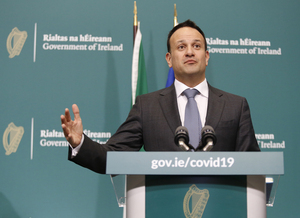
From top: Taoiseach Leo Varadkar claimed  people asked to be laid off so they could claim the €350 Covid-19 payment; Eamonn Kelly

Leo Varadkar told a press conference the other day that he had heard stories of people asking employers to lay them off to take advantage of the €350 coronavirus welfare payment.

He presented no evidence for this and simply used his platform as acting taoiseach to denigrate workers who, it was implied, were looking to turn the coronavirus crisis to their own financial advantage.

There were any number of anecdotes the acting taoiseach might have told to raise a giggle at people angling for an extra buck during a crisis.

Like retailers boosting prices on goods during the coronavirus crisis; or AIB deducting bank charges direct from the accounts of people who had just been laid off due to that crisis; or the plentiful anecdotes of private landlords over-charging tenants during the housing crisis in a private rental market made attractive by a neo-liberal government determined not to provide social housing. Ireland is rife with system-gamers exploiting crises, and we have the social casualties to prove it.

However, minister Varadkar chose to target low-paid workers for his derision, as is his form.

And the manner in which he told the anecdote, that slow grin, as if he had never heard of such cheek, revealed that same old ingrained prejudice against poor people that this privileged man has enforced time and again through social policy and sly insinuation.

The allegation is of course totally anecdotal. But Mr Varadkar, currently acting taoiseach, should really back this public statement up with names of employers and workers who, he claims, were attempting to game the system. In the interests of transparency.

He owes it to those workers who have been working around the clock providing basic services to all during the crisis, to at least identify those among their number who, he claims, were attempting to skive off work under false pretenses and claim the coronavirus welfare payment.

A payment, incidentally, which is striking in its generosity, with the minister declaring that the standard jobseeker’s allowance of €203 just isn’t enough to live on. That’s news.

That the payment is being divvied out by a politician who lost their seat in the last election, but is still somehow the minster for social protection, might cause a cynic to suspect a motive behind such generosity. An upcoming election might favour the politician behind such a generous gesture. A lost seat might be won back. Bought back, even.

The Culprits

There is a clue in Leo Varadkar’s statement as to the identity of the workers and employers at the root of the anecdote. It lies in his reference to 20 hours and an extra €11.

This can only be a  Community Employment (CE) scheme, or something similar, and the employer in question can only be a CE supervisor, who work closely with the DEASP.

So the anecdote most likely has its roots in a CE scheme, with a CE worker, who may or may not have been joking, putting this proposition to a CE supervisor who, apparently, reported it back to the DEASP, from where it was likely passed to Mr Varadkar’s PR representatives, who appear to have used the story in the hope of gaining some political capital by denigrating a target group; this time “lazy” low-paid workers on the make in a crisis.

In this attempt to gain political capital we see once again the familiar Varadkar ploy of targeting a weak group, incapable of political response, in an attempt to turn the anger of their peers upon the target group.

The bottom line being, as in the now infamous welfare cheats campaign, to create division and suspicion among those sections of society most adversely affected by austerity, low wages, premium accommodation costs, a financially crippled health service, and all the other familiar inequalities that are a consequence of the neo-liberal policies pursued by Fine Gael.

But Mr Varadkar lacks the courage of his convictions, holding back from going all the way with his scapegoating.

Rather than leaving those alleged system gamers in quiet community employment anonymity as the subjects of an amusing anecdote for comfortable socialites, he ought to, if he wants to be seen to be following through consistently on his charges, expose the individual culprits fully to public shaming. It’s clear that this is his intent in bringing up the subject. So let him go all the way.

Maybe set the culprits up on a scaffold in Smithfield and have over-worked staff of essential services fling rotten fruit at them. If you’re going to scapegoat, at least do it with a bit of pizzazz and give the public a show. All else is just unverifiable spin with a mean-minded twist and an intent to target the defenceless to gain political capital.

Such a mean-minded attack might even be construed as a deliberate and calculated act of relational aggression. An underhanded mode of behaviour that is not only beneath the office of taoiseach, but is beneath the standards of any decent person.

New Understandings

But we can take it by now that Fine Gael don’t just toss out ideas like this in an idle fashion. There is something behind it. Could it be an attempt to sow divisiveness between workers? Heroes vs lazybones? But why?

The clue might be found in Mr Varadkar’s own manifesto of 2017 when he was hungering after the Fine Gael leadership and the prize of becoming taoiseach by the back door.

In that manifesto was a proposal, based on a Tory template, to prevent workers of certain defined occupations from striking. Such occupations would first be defined as “essential services”, and the proposal would be to ban them from striking, because such strikes would be deemed too damaging to the public good.

Such a ban would of course curtail workers’ options in challenging disreputable employers seeking to exploit them.

Now the coronavirus restrictions have given Fine Gael and their right-wing associates an opportunity to clearly define “essential services”, and the payoff for the right might well be a ban on strikes by those workers they are currently characterising as “heroes”.

Beware the compliments of a flatterer, so said Machiavelli to the Prince.

Such a move would put essential workers at the mercy of government and employers in terms of pay and benefits, with no recourse to protest on their own behalf without breaking the law. To say no to employer exploitation would be a criminal act.

In the future, the only bonuses essential workers might be seeing may be the occasional public round of applause. Like artists and musicians, they may well find themselves expected to work for the experience and the “exposure”, and because they “love what they do”.

Gaming the System

An argument was made in the Irish Times a week or so ago that Fine Gael ministers have governing skills that new ministers might not have, and since we are in the midst of a crisis, it might be best to leave Fine Gael personnel installed in their previous government positions, despite the election results.

That sounds reasonable enough given the circumstances. Though when you consider that the government in question is the same one that ran down the health service in a privatisation drive, among other neo-liberal strategies undermining social equality, the situation doesn’t seem quite as rosy.

A clear picture emerges of a fox smiling in a hen-house and saying, Sure, I’ll take care of everything. You relax. Don’t bother your pretty little heads about anything.

There was also the suspicion that the article in question was one of those fake articles from the Fine Gael spin unit, placed as a genuine article in a reputable newspaper, to help the cause of remaining in power even when some of their ministers have lost their seats.

Writing your own news and op-eds; leaving ministers in place to divvy out generous amounts of public funds; devising new strategies to divide and disempower workers, while cleverly attempting to suspend parliament under the guise of public health concerns.

Now that, is gaming the system.

Eamonn Kelly is a freelance Writer and Playwright.

Friday: Tested Negative And Petty

Previously: Eamonn Kelly on Broadsheet

Rollingnews


From top: the entrance to St. Michael’s Hospital, Dun Laoghaire, County Dublin where Covid-19 testing is taking place; Eamonn Kelly

The coronavirus impact on the economy is having the effect of achieving something that was only theoretical a few short weeks ago: the necessity to halt capitalism’s perpetual demand for spending, consumption and growth.

The coronavirus has offered an opportunity to radically change the capitalist paradigm.

Cash is the lifeblood of an economy. But if it can’t come from free market trade, as is happening now, where will it come from? Will the economy just bleed out and die?

David McWilliams, in the Irish Times, writes that this problem is exacerbated by panic, leading to cash hoarding, much like shopping hoarding.

He offers a radical solution, sourced to Milton Friedman, for such situations, writing:

“The Central Bank of Ireland should print money and deposit free cash into every citizen’s account and every business account.”

This of course would be a short-term measure, but even the concept opens everyone’s eyes to new economic possibilities, particularly in his analysis of the meaning and worth of cash in a deflating economy.

McWilliams points out that the “normal” way to inject cash into an ailing economy is to inject it into the banks, saving the banks, as in 2008, who then dispense it back out into the economy. Notice that banks get “free money” and no one flinches.

This other method, proposed by Friedman, involves cutting out the bank middle-men and putting cash straight into people’s accounts, to offset panic and a cash hoarding wave that would lead to a runaway self-perpetuating loop, bleeding out the economy.

Obstacles to Growth

What is also becoming apparent through the coronavirus crisis is that the global system of capital has two main problems, identified by Prof Pierluigi Viale, the director of infectious diseases at Sant’Orsola-Malpighi Polyclinic in Bologna, in a different context.

In a warning to other countries to act immediately against the virus he identified the two main obstacles to radical action.

“The problem is politics and economy,” he says.

These are also, coincidentally, (or maybe not) the two main obstacles to action on climate change.

Professor Viale said:

“It is not easy to convince a nation to sacrifice. I am sure that in a few days they too will start moving, they have no choice. Sooner is better than later”.

The exact same conundrum faces the world in terms of climate change, the only difference being that the time frame for action with climate change is longer, offering space for denial and inaction. But the core obstacles of economy and politics are precisely the same ones.

We saw it here and in Britain and the US in the early days of the virus (ten days ago?!) when the politicians were still prioritising the economy over people’s health by seeking to minimise the deadly nature of the virus.

This again is a mirror of the political classes’ reaction to climate change, putting the economy first, when it is patently clear that you can’t have an economy without a world to run one in.

In this respect, politics and economy, as they are currently shaped by neo-liberals, are actually obstacles to growth in terms of fresh thinking, the very thing required to tackle climate change.

The differences between neo-liberal core beliefs and practical common sense have been thrown into stark relief by the pandemic, with neo-liberals initially revealing their natural ideological preference for the health of the economy over the health of the public.

But this ethical miscalculation was corrected by the nature of the virus itself, which immediately began to demonstrate that public health must precede economic health.

That a virus doesn’t observe borders or class preferences. That you can’t have business as usual if public health is under threat. That the economy too will eventually bleed out unless the political class act to protect public health.

The exact same rules apply to action on climate change. Public health and climate health must be prioritised over short term economic measures.

We saw this anomaly here, in its micro form, when the Fine Gael government were pointing to “healthy” growth figures in the economy, yet homelessness was at crisis point and steadily rising and children in hotels were experiencing measurable stunted growth.

That stat-driven type of economic approach has now been revealed as just a clean bureaucratic way of eating your young.

Personal Financial Security

When it finally became clear, even to neo-liberals, that mass closures of businesses for a long period of time – maybe even months – would be necessary to contain the virus, the first realisation was; what are people going to do for money? If capitalism can’t create cash, if only temporarily, how are people supposed to live?

The answer came hot on the heels of the question: State intervention, the very thing that neo-liberals and late stage capitalists had been opposing and rolling back and undermining for so long.

Fringe ideas, like basic income, which had gradually been becoming more mainstream with the realisation of capitalism’s adverse contribution to climate change, now took centre stage as one of the more practical ideas to deal with the necessary closures to contain the coronavirus.

Long-time proponents of universal basic income such as Andrew Yang called for a change of thinking around the concept of economy; identifying, as David McWilliams has done, “personal financial security” as a key measure to deal with the crisis.

Said Yang:

“Treating this as a pandemic is one thing. Treating this as an imminent economic depression and societal catastrophe spurred by a pandemic is another. You should flood the zone with buying power and a sense of personal financial security as fast as possible.”

This concept of personal financial security for all is the exact opposite to the concept of engineered scarcity that the neo-liberal agenda promotes in order to encourage continued and unnecessary consumption and corresponding political weakening of adversaries.

Again, the virus invites, almost as an afterthought, an interrogation of neo-liberal politics that finds its basic concepts desperately wanting when it comes to considerations of the public good.

Once neo-liberalism is disarmed in this way, as it has been in recent weeks, alternative thinking leads inevitably towards solutions based on the concept of social security, which is also a necessary re-think in the inevitable winding down of capitalism to allow for climate recovery.

The coronavirus and the restrictions imposed by the pandemic, offer an opportunity for real change.

A New Paradigm

The virus, with its short time frame demanding immediate action, is a slap in the face to capitalist complacency, in comparison to climate change’s slow deterioration, which can be put on the long finger, seemingly indefinitely, until a restriction is imposed by the elements.

When a disease is slow moving – and late-stage capitalism’s contribution to climate change has been described as a disease by some commentators – it is more amenable to denial.

The virus doesn’t leave any space for denial. Even the drinkers and race-goers who attempted to continue as normal were quickly corrected by the speed of the viral spread.

Every measure employed to combat the virus will be needed to combat climate change, but in a less drastic form. The virus has provided a revelation really as to how capitalism might be amended and curtailed to give the climate some breathing space for recovery.

Old Dangerous Ways

The only problem now, as Naomi Klein has noted, is that the old right-wing orders will be tempted by the virus crisis to behave primitively, by using the opportunity to restrict democratic freedoms and consolidate their economic power.

The old strategies designed to perpetuate the late capitalist business model of endless consumption in a finite system may continue to be pursued; ignoring the valuable lessons demonstrated by the virus crisis and condemning the world to climate catastrophe.

Already in the United States the old corporate models that always result in bailouts for corporations, coupled with opportunistic attacks on social security, are underway in what Naomi Klein refers to as old ideas lying around waiting for the right social conditions to allow them to be enacted.

It could be that the coronavirus is the wake-up call that late-stage capitalism needs to radically amend global financial systems in the interests of climate repair.

A last gasp opportunity to change the capitalist paradigm and to question the twin obstacles of neo-liberal politics and economic prioritising that prop up the old destructive system.

But the danger of being duped by wily neo-liberal politicians into exchanging freedoms for a sense of security will likely continue. That’s the game after all.

Eamonn Kelly is a freelance Writer and Playwright.

Previously: Eamonn Kelly on Broadsheet
Rollingnews

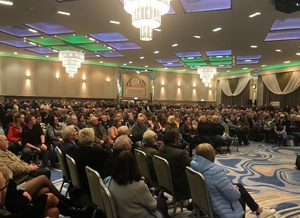
From top: Sinn Féin rally at the Rochestown Park Hotel, Cork last month; Eamonn Kelly

In an article by the acting taoiseach, Leo Varadkar, in The Sunday Independent (March 1) there was a strange bookending to his innings as taoiseach.

Back in 2016, as Minister for Social Protection, Leo Varadkar launched his bid for leadership of the Fine Gael party, which resulted in him becoming taoiseach, with the now widely discredited welfare cheats campaign.

Here an “enemy” was identified and accused of availing of monies under false pretenses. The accusation was made without a scrap of evidence, and was rejected by former social welfare inspector, Bernadette Gorman, who described the campaign as “Tory” in nature and as “class warfare”.

Ms Gorman told RTÉ’s Today with Seán O’Rourke show:

“In my book it is all about his aspirations to be leader,” It is a hate campaign. Never was there a campaign like it coming after a period of austerity.”

The acting taoiseach on Sunday did something similar, again accusing a target group of appearing “to live way beyond their means” and calling for an inquiry into their finances.

Again, the strategy appeared to be to target an “enemy” for smearing, in the hope that the target group would be rejected by the larger society. This time the target was Sinn Féin.

The Medium Is Not the Message

Everyone, even those people who invested their trust in Leo Varadkar as a leader of sound judgement, must be more than a little surprised by how petulant and childish he has been in defeat.

His call for investigations into Sinn Féin’s finances on the grounds that they appear to be living beyond their means is verging now on the absurd.

But the most absurd part of it all, and Fianna Fail are equally guilty of this, is that both parties have chosen to ignore the message sent to them by the electorate and have instead embarked on separate campaigns to smear Sinn Féin.

What neither seems to realise is that Sinn Féin, while they were the greatest beneficiaries of the electorate’s dissatisfaction with the outgoing government, were actually little more than the medium by which the electorate’s message was delivered.

By constantly harping on about Sinn Féin, and by now trying to smear that party, the acting taoiseach is essentially ignoring the wishes of the electorate, which was pretty much a core complaint of that portion of the electorate that voted against Fine Gael in the first place. That they were not serving the people or listening to the people.

The message was a call for greater equality of outcome, which would mean amending neo-liberal policy in order to put people first.

But Fine Gael have turned a deaf ear to that message and have decided instead to smear the messenger; namely, Sinn Féin.

Scare Tactics

FG also have a pattern of scare-mongering, which goes nicely with their pattern of scapegoating. Back in February 2016, the Business Post reported a Fine Gael strategist saying of the electorate:

“We’ll scare the shit out of them for the last 10 days.”

The then taoiseach Enda Kenny warned of “consequences” if the Fine Gael-Labour coalition was not returned in preference for a Fianna Fail-Sinn Féin coalition.

He said:

“I do not want to see the flight from this country of either capital or jobs or lack of investment coming in here.”

The current strategy seems similar in terms of the scapegoating and the scaremongering, this time with Sinn Féin cast as the villains that will bring the country to ruin, as well as being now the alleged “cheats” in receipt of money they’re not entitled to.

In its desperation Fine Gael is flinging all it has at the problem. Tellingly, all it has to fling is scapegoating and scaremongering.

While Irish America is stunned by FG and FF’s efforts to keep SF out of government, as are Northern Unionists, what many don’t appear to realize is that this has little to do with Sinn Féin. FF and FG are simply resorting to tactics they have always used.

Ultimately, the real target is the electorate.

It is as if they regard the electorate as a dumb mass to be easily tricked to go this way or that way, much like a mindless herd of cattle to be shunted around the place by threat, connivance and deception.

Now with this election, the usual scare tactics and demonisation have flailed around and found nothing to work on except Sinn Féin’s past, the very thing the entire peace process was designed to move on from. The very thing that Varadkar’s self-righteous Brexit posturing was trumpeting.

But more than that, this focus on Sinn Féin shows that the fundamental disrespect for the electorate still remains. Because it was the electorate that voted for change. But that has been ignored, as if it is of no importance.

RTÉ still refers to Leo Varadkar as “the Taoiseach”. He is in fact an acting taoiseach, and ought to be referred to as such by the state broadcaster. The electorate voted him out.

To not refer to him as the acting taoiseach is just more of the same disrespect. As if the election never happened. As if the electorate doesn’t matter. As if his resignation a couple of weeks back was just an empty gesture.

Bookends

Whatever about leveling false allegations of cheating against defenseless welfare recipients, 70% of whom were old-age pensioners or disabled people, this time Leo Varadkar may have made an error of judgment in attempting the same strategy with a political party of equal weight to his own by casting charges of “cheating” at them.

Welfare recipients, for obvious reasons, had no option but to take the slur on the chin. People of equal social status and political power may prove to be more proactive in their response. While the electorate, because they are the real intended dupes, may prove less inclined to join in the scapegoating this time around.

Eamonn Kelly is a freelance Writer and Playwright.

Previously: Eamonn Kelly on Broadsheet

Rollingnews


From top: Acting Taoiseach and Leader of Fine Gael Leo Varadkar speaks to the press at at Leinster House on February 17; Eamonn Kelly

The attacks on voters for change by various journalists since the election has been very revealing of a cultural elite feeling itself under threat.

The FF and FG response to the election has been basically to attempt to discredit the alternative parties, mainly Sinn Féin, that the electorate backed for change.

And this line is supported by quite a number of influential “mainstream” journalists. Sometimes overtly, as in Pat Kenny’s and Paul Williams’ outbursts, but often more subtly.

For instance, Harry McGee writing in the Irish Times (February 24) about Leo Varadkar’s warning of “intimidation and bullying” from Sinn Féin, presents the article in such a way as to portray Leo Varadkar in a very favourable light, ending with a description that makes the taoiseach seem still engaged with building “that” future of 2040.

As if the confusion and what The Guardian described as “hysteria” of the post-election reaction is beneath him.

And while Una Mullaly and Fintan O’Toole among others, have far more objective views expressed in recent articles, there are many who still seem genuinely appalled by the results of the election.

Kathy Sheridan’s “Memo to Sinn Féin” in the Irish Times (February 19), while it concentrates on Sinn Féin, all but ignores the key issue at the heart of the election result: namely that Varadkar’s neo-liberal programme was creating social inequality.

And while many would agree that some of Sinn Féin’s language has been a bit uncomfortable at times, the result of the election is more about the electorate and Ireland’s structural inequalities than it is about Sinn Féin’s world view per se.

The message to FF and FG from the electorate was that the neo-liberal policies they are pursuing were being rejected.

But rather than taking this on-board, FF and FG and their media supporters are attempting really to insist that everyone who isn’t with them is tragically mistaken in their judgement.

But by taking this view, they are defending, not common economic sense, which is how they frame it, but they are actually defending structural inequality.

Public Relations

Everyone knows that media outlets take political stands and speak for certain viewpoints. But Breda O’Brien’s columns in the Irish Times during the election were a case in point of how loose the divisions between politics and journalism really are, with barely a pretense that such a division is even necessary.

One article in particular (January 25) while ostensibly concerned about “smashing” Tweedle-dee and Tweedledum politics, actually turned out to be something of a party-political broadcast on behalf of Aontú.

This is a familiar feint of her articles, where she sets out to discuss one thing and, wouldn’t you know it, ends up talking about Aontú, again, usually as the solution to the problem profiled.

But is that okay? It seems to me to be taking liberties. It’s like someone lost their job description, and in the absence of accountability they can pretty much use the space as they please. Why not support consumer products while you’re at it?

I was of the opinion that journalism should stand outside politics. That this is its role in a functioning democracy. That once it climbs into bed with a political party it’s no longer journalism in the accepted sense of being an independent voice outside political influence.

From that perspective, journalists who persist in promoting a leader who has been humbled at the polls on a question of policies that are actively creating inequality, are either agreeing to admire the Emperor’s new clothes, or have taken a conscious decision to stand with policies aimed at economic exclusion for some, in order to protect and enrich the interests of more privileged sectors of the community.

Since it has been shown that the type of policies pursued by Fine Gael do lead to social inequality, as discussed in my essay on Joseph Stiglitz’s book “The Price of Inequality” it follows that partisan journalism of parties creating neo-liberal policies, are also promoters of social inequality, using their journalistic platforms and status to this end.

The Price of Everything

It can be argued then that the damage to social inequality that neo-liberal policies cause, doesn’t stop at low wages, homelessness, hospital waiting lists and so on, but also finds its way into the fabric of cultural institutions, informing the way business is done and how “normality” is perceived.

Everything, including journalism, is then affected and demeaned and hollowed out by a system that knows the price of everything and the value of nothing.

It is in reaction to this alienating creed, that new ideas like basic income have been proposed to counter the effect of inequality by these systems of late-stage capitalism. And it was in reaction also to Fine Gael’s neo-liberalism that the established parties suffered so badly in the election.

Many people simply voted left in the election, for change. But all have been denigrated by various establishment journalists who, most likely, are acutely aware that political change, particularly in the back-scratching yes-man Irish political and socio/cultural system, could be a serious lifestyle threat.

They more than anyone must be aware of the clamour of youthful journalistic graduates, with plenty to say, banging on the gates of a profession that is itself in decline.

But it is a system that seems based on “agreeableness” as the main mode of promotion, whose consequence is silence and head-nodding in the affirmative. Not good attributes for meaningful journalism.

Already this silence is beginning to settle on the election result as the official narrative develops in its own sweet Pollyanna way.

The swing to the left in the election has also upset the comfortable middle-class parlour games that normally follow an Irish election, revolving as they do around the fortunes of mainly FF and FG, and whatever potentially comical fall guy either happen to rope into coalition to later saddle with all the blame.

The whole sorry cartel has been cracked wide open, and both establishment parties and their establishment media supporters seem quite lost as to how to deal with this new spin on events.

It is as if they are looking at a now suddenly more empowered electorate, and wondering, Who are they, crashing our exclusive party?

In the Name of Love

It is likely that FF and FG will reach a deal, no matter how brazenly self-serving it may appear. Coming together to form a government which they will no doubt insist is in the national interest, to protect everyone from the “barmy left”.

Their journo supporters will go on about how divisiveness was avoided and rationality was preserved as Micheál and Leo heroically overcame their historical differences in the national interest.

There might even be a Bono moment, where Micheál and Leo shake hands, the civil war declared over, and Bono sings “In the Name of Love”, quietly, on acoustic guitar, leaving not a dry eye in the house.

The establishment media yes-men will bring out the bunting and celebrate the new “peace”, while privately blowing party trumpets for the survival of the habitat that sustains their own sub-species.

Eamonn Kelly is a freelance Writer and Playwright.

Previously: Eamonn Kelly on Broadsheet

Rollingnews

From top: The planned €22m white water rafting facility at George’s Dock, North quays, Dublin 1;  Sinn Féin front bench members launch the party’s General Election 2020 manifesto last month; Eamonn Kelly

The various snide remarks about “Venezuela” coming from people in the two former main parties, reminds us, among other things, that there are two Venezuelas.

The one the Right conjure up to frighten people as a means of keeping themselves in power, and the other one that facilitates international finance to the detriment of ordinary people.

On Wednesday’s Morning Ireland, Dr Gavin Jennings, with Aidan Regan, who writes for the Business post, lent some clarifying light to the often-heard Fine Gael claim that Ireland is the fastest growing economy in Europe.

What emerged from the interview is that this wealth and growth is concentrated mainly in the ICTC sector, and most of the workers on the high salaries are not Irish, but are nevertheless having an impact on living standards in Ireland, particularly in Dublin.

For those workers there is no austerity, and never was. The wealth of Ireland’s economic growth, as with so much in Varadkar’s Ireland, is unequally distributed, and ordinary people simply can’t afford to live in the same rarefied economic air that the high-salaried workers in big tech can afford.

Most everyone smelled a rat recently when a white-water rafting leisure facility was proposed, to be located, surprise surprise, in the very district where all these big tech workers enjoy superior economic lifestyles.

Since the price of admittance to the facility was so prohibitive at €50, the thing was clearly not for the ordinary people of Dublin.

And since white water rafting is a quintessentially American leisure activity, and since the thing was planned for the heart of the high-tech district, you didn’t need Sherlock Holmes to figure out who the facility was for.

This is the constituency that Leo Varadkar in particular is serving, the one he rushed to reassure after his disastrous election. Despite the fact that less than 25% of those workers in high tech, according to Aidan Regan, even have a vote here.

This idea of using public money to build structures and facilities that benefit private enterprises is quite common in South America. As is the habit of appropriating people’s water supplies and selling it back to them. As are compliant governments who are happy to issue mining licenses to private interests to tear up a country’s national parks.

Even the language that came from the establishment this past week has been abusive and denigrating in tone, with ordinary voters being castigated by various right-wing party representatives and their media champions as being “stupid” and “reckless”.

It’s the type of language that says; please me, give me my way and we’ll be happy. Thwart me and there’ll be trouble.

But the Irish people, as Fintan O’Toole remarked recently, are quite politically conservative. In this election a preference was made for a fair crack of the whip in matters economic. To which the establishment has responded with barely concealed contempt.

Those of us old enough will vividly remember that this was the attitude of many Church authority figures towards ordinary people. And before that, no doubt, the same attitude prevailed among the colonial rulers. They were the all wise and we were the stupid. That was the deal, with Heaven as the goal. Balancing the books being the new Heaven.

Under Fine Gael and Fianna Fáil, many Irish people have been living in “Venezuela” for a long time now, serving a contemptuous elite and taking their insult as their due, in an arrangement designed by the privileged for the privileged.

Varadkar’s Fright

Leo Varadkar was always merely taoiseach by business arrangement. When he finally went to the electorate seeking a mandate, he was seen to be sweating through several counts in the count centre, in real danger of losing his seat.

The answer Varadkar received to his question, Will you trust me to continue with the work I’ve been doing? Was a resounding, No thanks, close the door on your way out!

Varadkar insisted that the onus was now on Sinn Fein to form a government of the left as he rushed away to reassure investors that Ireland was still safe for business.

Determined now to cause a scare as if the armies of Castro were gathering at the gates of the city, he addressed a conference of business leaders and investors and informed them that Fine Gael had created the Republic, wildly placing a stamp of personal ownership on a democratic republic that had all but shown him the door a couple of days earlier.

He told the forum:

“…we were the ones that founded the State. We’re the ones that founded the institutions. We’re the ones that made this country a republic. We stand by the State and republic and if we’re needed in order to give the country political stability with governance then we’re willing to talk to other parties about that.”

Realising, by the simple act of counting, that the Left didn’t have enough seats to form a Left government, he advised Sinn Féin to form a socialist republic government, laughing up his sleeve as he did so, and apparently sent out a directive to all his minions to always, from here on in, pair the Words “Sinn Féin” with the word “Fail”.

He told the audience of investors, financiers and businessmen that Sinn Féin had achieved their historic vote by “making a lot of promises to a lot of people in this country”. Everyone present was appalled to hear of such behaviour from a political party during an election campaign.

“So the responsibility now falls on them,” said Varadkar…

“….to build a coalition, to negotiate a republican, socialist programme for government that keeps their promises and to seek a Dáil majority for it.”

No doubt he was mindful of the aptly named “money message” lever in this regard, which would allow either himself or Micheál to veto progressive bills on a whim, as Fine Gael have been doing for a few years now.

It was a brilliantly impossible task. A sure-fire failure waiting to happen. But because Varadkar owned the Republic he felt entitled to dish out advice on how to establish a losing left socialist government.

And just to drive the point home he told the conference that if Sinn Féin “fail” to form a left socialist government…” (as they surely will if they don’t have the numbers.) “…we’ll consider the matter then. Anything is possible including a second election.”

In other words, Varadkar owned the football and he didn’t want to play anymore and he was going home, taking the ball with him.

Fine Gael’s Hildegarde Naughton was dispatched to Prime Time expressly to place the word “fail” next to the words “Sinn Féin”. But she made a clumsy job of it and everyone saw the workings of the trick.

Fine Fail

Louise O’Reilly of Sinn Féin said on Prime Time that Fianna Fáil and Fine Gael appeared to be rigging a situation of returning to government in a realignment of confidence and supply.

FF and FG are both mindful of the electorates’ demand for change, but rather than modifying their own policies, Fine Gael in particular are trying to be cute by saying that it’s Sinn Féin’s responsibility to deliver the more people-conscious policy changes demanded by the electorate, knowing full well that everything they might do in a minority Left will be easily blocked, ensuring “failure”.

However, if Fianna Fáil return to government, with Fine Gael in the supporting role in a modified confidence and supply arrangement, it will be both their responsibilities to deliver the policy changes that the electorate has demanded.

Otherwise it may seem that both have cynically conspired to use “doubts” about Sinn Féin’s past, in order to hold on to power and deny the will of the electorate.

When you couple this with the ongoing “money message” system that allows a taoiseach to effectively veto bills passed by Dáil majority, it is difficult to escape the conclusion that the established parties and their media champions already suffer from an advanced form of elitist contempt for their own electorate, typical of elites that flourish in dysfunctional South American countries.

Welcome to “Venezuela”.

Eamonn Kelly is a freelance Writer and Playwright.

Previously: Eamonn Kelly on Broadsheet

From top: Fianna Fail’s Jack Chambers and Claire Byrne debate climate change on RTE One’s Claire Byrne Live last Monday; Eamonn Kelly

They say you can’t put an old head on young shoulders, but with Jack Chambers someone has succeeded.

The only problem is, it’s not a wise old head, it’s just an old Fianna Fáil head, probably found abandoned in a storeroom after some 1980s cabinet reshuffle.

Jack went to the Parochial Interrupters School of Communications where arguments are won, not by logic, but by creating noise so that nothing is heard.

In Jack’s book that’s called a win. But that tackle he’s sporting is now widely recognised as so last century. The time when shouting at people was regarded as debate is long gone.

Once Claire Byrne got Jack mildly pacified, the conversation turned to carbon tax, a brilliantly vague political football to be humping around the place like we’ve all the time in the world.

The obvious questions were artfully avoided. Like for instance, will the billionaires be paying their fair share, or will it just be retail workers and civil servants footing the bill. Will the multi-nationals be fined, or will it be just families fined for burning the bale of briquettes they were given at the fuel poverty store?

Going on prior form you’d have to suspect the latter, with maybe campaigns launched by local councils involving undercover carbon wardens empowered to impose on-the-spot fines on casual farters.

The real problem with carbon tax was nearly touched on during the Claire Byrne show, but somehow the opportunity slipped away when everyone got distracted again by Jack Chambers yelling incoherently and jabbing his index finger at someone and everyone, making some lost point in a last gasp attempt to drag Fianna Fail back to yelling supremacy.

The problem with carbon tax, especially a carbon tax levelled at ordinary people, is our old friend late-stage capitalism.

Here’s how it doesn’t work.

An extra tax means that people will have to earn more money, which will put more pressure on capitalism to deliver more growth and jobs, which will mean further damage to the climate as everyone expands their operations to increase profits to pay their carbon tax. It’s like a snake swallowing itself.

A carbon tax only makes sense if you heavily tax the hundred or so multi-national corporations who are creating the bulk of emissions. They’re eating up the natural world for private profit, so that they can amass enough wealth between them to build orbiting space stations for themselves when the great extinction comes. Personally, I’d rather go extinct than live in a space station looking at old movies about how Earth used to be.

A crazy stat came up from an audience member on the show. Our sparrow population has decreased by 80%. Sparrows. They used to be the most common bird. Did you miss them? I bet you miss them now.

No matter how you spin the climate change argument it seems to always come back to the same question: do governments have the strength to take on the multi-nationals who are causing the bulk of emissions, or do the multi-nationals own all the governments?

The Long Game

Throughout history there have always been big brains working quietly away on some long game that no one else can see.

For instance, back when it was discovered that the world was round, the big brains realised that if it was round it was finite, as were all its resources, and so the British big brains, by way of the East India Company, set out to find out where everything was, doing an inventory like the world was a larder.

When nukes came on stream some big brains realized that the winners of a nuclear war would be those who first established an infrastructure among the ruins. Maybe print a newsletter declaring victory. To this end they factored into their targeting, safe zones to land engineers after the war.

Big brains of today are likely devising long-game strategies for any old climate extinction that might come along. The key to success in this venture, as any kid who ever played Monopoly will know, is to get all the resources first. Then you’re in business.

Once the apocalypse begins you can build your space station, commandeer Hubble, peer into the void for some other possible habitable planets while your floating around eating your squishy astronaut food.

Then, when the dust settles on Earth and everything is as dead as Mars, you can maybe look at building one of those domes you see in science-fiction movies and away you go again, publishing a newsletter declaring victory. Sound like fun?

The key to escaping climate catastrophe may be in trying to convince the billionaires that letting the Earth die in the interests of private profits might not be such a great idea after all.

And that they might be better advised to use the resources they’ve been squirreling away to do something heroic for a change, like maybe save the Earth, like a bunch of latter-day Flash Gordons, instead of milking all around them until the old sow is dead.

Because when it comes right down to it, if only a hundred or so companies are responsible for the bulk of climate damage, and since these companies are generally authoritarian in nature, it follows that only a hundred or so individuals need to be sold the idea of saving the world.

The hard part, for them, since they are all capitalists, is that this proposition will involve sharing, implicating them in an unholy redistribution of wealth, the very thing they’ve been brought up to condemn with every fibre of their wallets.

But as capitalists are often fond of saying, you can’t make an omelette without breaking a few eggs. In this case, you can’t save a planet without breaking a few out-dated cherished prejudices about wealth re-distribution.

An early socialist once said, what shall it profit a man if he should gain the whole world and lose his soul? In this case, what will it profit him to gain the whole world only to watch it wither?

But who’s going to tackle the billionaires and sell them the idea of climate heroism? Not Jack Chambers.

Shouting at them probably won’t work. Who’s going to say, it’s time to really invest in the future, men, and start putting the sparrows back in the trees.

Eamonn Kelly is a freelance Writer and Playwright.

Previously: Eamonn Kelly on Broadsheet

Watch back in full here

Yesterday: Horror Of Chambers

From top left to right: Sinn Féin leader Mary Lou McDonald, Social Democrats joint leader Roisin Shortall, Fine Gael leader, Taoiseach Leo Varadkar, Green Party leader Eamon Ryan, Fianna Fail leader Micheal Martin, Solidarity People Before Profit politician Richard Boyd Barrett and Labour Party leader Brendan Howlin, at the RTÉ leaders’ debate at the National University of Ireland Galway on Monday night; Eamonn Kelly

During a televised debate the Christmas before last, Fr Peter McVerry said, that there was no urgency in the government to address the homelessness crisis.

This official complacency was a feature of the conservative attitude during the leaders’ debate, a complacency that seemed to be echoed by the mainstream media pundits.

The media punditry began on RTÉ immediately after the debate and, like much of the attitude of the conservative parties, was characterised, not by urgency, but by a sense of novelty, of a happy late-night knees up as a “winner” was sought.

The message being that the debate was a bit of harmless sport staged for everyone’s amusement. Not to be taken too seriously. A contest the pundits in the main were happy to declare had not produced a “winner” and had therefore failed to produce anything of interest.

But there was a winner. It was the audience, who showed a clear preference for progressive ideas that are normally associated with the left. Ideas that are usually casually denigrated by the right for just that reason.

Two Ideas of Fiscal Management

What was on show during the leaders’ debate, in embryonic form, was a conflict between two competing ideas of fiscal management.

The view held by the established parties FF and FG, was firmly rooted in ideas of the past, of a Sean Lemass type of approach to economics that involves obsequiously pleasing multi-nationals who will “give” us jobs, and then later, when the books are balanced and good old-fashioned (not to mention discredited) trickle-down economics begins to do its thing, the poor can be housed in the new houses and bandaged up in the new hospitals. Until then, however, some will have to sleep and die on the street.

A by-product of this approach has been the neglect and often penalising of local indigenous business start-ups and a continued dependence on foreign capital to “help” us. Like as if we suffer from some kind of national learned helplessness. It’s awful, and it’s probably why we became such marks when the bubble burst in 2008. Everyone apparently made money out of us, except us.

This now dated approach to fiscal management involves slow, tedious plodding in a situation where the plodders themselves are never likely to be burned by their own policies.

Leo and his merry men won’t be pitching tents down by the canal any time soon, to wait in vain for the promised fruits of trickle-down.

The other view on show, taken mainly by the left of centre parties, is a recognition of changed times, the very thing the conservatives don’t seem to get, or if they do get it they view the challenges in the same plodding manner of “meeting targets” until everything magically aligns, a process that takes leisurely time for granted, the very thing unavailable at this time, particularly with climate change breathing down everyone’s necks, sometimes in the form of a big wind and floods, sometimes in the form of fire.

Changed times call for fresh ideas across the board, and to their credit, the ramshackle left are at least engaging in progressive ideas that take cognisance of the realities of climate change and late stage capitalism, and all that these twin challenges entail in their impact on jobs and wealth creation and distribution. Not to mention life and the survival of the species. Little things like that.

Though the left know they have to be careful with their “wild” ideas, because the Irish electorate, the older ones especially, are quite conservative.

So, for instance, Eamon Ryan of the Greens couldn’t come right out and say “basic income” for fear of causing a scare, even though all progressives realise by now that basic income is a real policy option to deal with a host of problems like climate change, job creation, crime prevention, trickle-down economics (since the tap was turned off by gush up economics), not to mention the timely prevention of out and out revolution and the possibility of your privileged complacent head ending up in a basket.

But the established parties continue to rely on old ideas way past their sell-by date. Ideas which are actually damaging to society, rather than progressive, not only in the effect of the destructive out-dated policies, but also, and perhaps especially, in the determination at all costs to close down fresh thinking in favour of doing things in the safe “old ways”. The ways that created homelessness and hospital waiting lists.

But the enthusiastic response from the Galway audience to the progressive ideas coming from Richard Boyd Barrett in particular, made it clear that a new, young Ireland is emerging that has a far greater grasp of fiscal realities than Leo Varadkar and Fine Gael would give anyone credit for.

Maybe it’s because the young, robbed of a future by the banks, are familiar with the fiscal realities of having to pay an over-inflated rent from a low-paid job because government policy has been to look after the top tier while everyone else stands in line waiting for trickle-down.

Maybe that’s why all the urgency is at the bottom and all the complacency is gathered like thick cream at the top.

Deaths by Policy Omission

One of the high points of the debate was [Social Democrat co-leader] Rosin Shortall’s revelation that in 2011 she had witnessed Fine Gael ministers deciding to cull a range of community projects, as part of an austerity drive, creating inequality as a by-product, which had the effect, in disadvantaged areas in particular, of creating seed-beds for crime. This from a party who present themselves as champions of law and order.

She went on to say that in 9 years Fine Gael had cut garda services by 40%, again causing negative outcomes in social inequality, while providing opportunities for crime.

In other words, Fine Gael policy, as predicted by economists Joseph E. Stiglitz and others, was causing the inequality that was giving rise to the social problems, including crime, which Fine Gael, architects of the growing social rot, were now talking about addressing as the party of “law and order”.

Given that over 200 homeless people have died over the last 4 years, according to statistics from the Dublin Regional Homeless Executive, and given that Fine Gael policy in particular has often amounted to an attack on community, creating social inequality, as described by Roisin Shortall during the debate, it is surely only a matter of time before the accepted legal distinctions between lies of commission and lies of omission, are also applied to policy-making and their outcomes.

With outcomes resulting in deaths, as in the case of the clash between Fine Gael’s outmoded privatisation ideology and homelessness, these homeless deaths are, arguably, killings by policy omission.

The Great Appropriators

Micheál Martin, sensing blood being drawn by Shortall, attempted to appropriate Shortall’s attack by saying that Fine Gael undermined community groups.

This was a feature of Micheál Martin’s play throughout the debate and something of a characteristic of Fianna Fail down the years, which can be summed up with, if you don’t have a good idea yourself, grab someone else’s good idea and flog away.

Micheál Martin seemed ever watchful for ideas from elsewhere and brazen about immediately appropriating anything which seemed to be playing well with the audience, so long as it wasn’t too outrageously leftie, such as some of the remarks coming from Richard Boyd Barrett.

When Mary Lou McDonald talked about homeless families living in the box-rooms of parents’ houses as a consequence of Fine Gael housing policy, Micheál grabbed that one too and even had the neck to re-present the story, only moments later, word for word, as his own original thought.

This kind of thing, while it might seem cute, only succeeds really in keeping the non-thinker stuck, because they will never think for themselves so long as they believe that stealing ideas is clever. If they happen to be running the country, well then everyone is in trouble.

By the way, there is a cosmic law of creativity that idea stealers never get. The more you give away the more you get.

Stealers think ideas are one-off commodities found elsewhere, and so they always leave themselves idea impoverished, apparently unaware that if they would just stop and think the ideas would arrive, the first law of creativity being, There’s nothing you can do that can’t be done.

Speaking of idea borrowers, Leo Varadkar is interesting in the way he endeavours to cast himself as a visionary of the future, despite his ideas being mainly of the past, even down to the rudimentary idea that anyone who doesn’t agree with his dated right-wing views is “hard-left” and possibly Stalinist in intent who’ll have us all in gulags before you can say “fiscal prudence”.

Again, there can be no room for fresh thinking with this kind of lazy commie bashing that comes direct from the U.S of A., where Leo, incidentally, did his political interning under Republican tutelage.

It’s all just another way of shutting down free thought at a time when fresh ideas are needed urgently. The closing down of ideas under such circimstances is a disservice to the public

Conclusion

The second debate was ultimately a contest of ideas. What was revealed was a total absence of fresh thinking from the government parties, against a sense of urgency and an exploration of fresh ideas from the opposition leaders.

Ideas which were welcomed by an audience clearly more up to speed with the issues at stake than the complacent government parties, whose leaders seem to be going through the motions with the expectation of just breezing back into power in some slightly inconvenient rearrangement of the present Dáil.

It remains to be seen whether or not the Galway audience was a fair reflection of the national electorate. It could be that Galway audiences may be a bit more progressive in the type of crisis creative thinking that is now required.

Life on the West coast of Ireland, due to weather conditions and the rocky terrain, has always offered something of an ongoing climate crisis, often requiring advanced creative thinking to remain balanced under extreme circumstances.

Eamonn Kelly is a freelance Writer and Playwright.

Previously: Eamonn Kelly on Broadsheet

Top pic: Niall Carson/PA Wire