
From top: JobPath was implemented, where Jobseekers were deceived by the DEASP into entering into agreements with private companies that stood to profit from the deception, argues Eamonn Kelly
We now know from the taoiseach’s apology concerning the CerviclCheck scandal that state instituions are capable of deceit; which, as Audrey Carville pointed out to Simon Harris on Morning Ireland on October 23rd, implies intent.
In light of this revelation it might be an idea to have a fresh look at the manner in which JobPath was implemented, where Jobseekers were deceived by the DEASP into entering into agreements with private companies that stood to profit from the deception.
Far Right Drifting
The JobPath agreement, known as a Personal Progression Plan, is essentially a contract between the individual and the private company, where the individual “chooses” to enlist the “assistance” of the private company in helping them to find work. A bit like hiring a life coach.
The problem for the DEASP lay in how to get people to willingly enter into these agreements, while also ensuring a healthy take-up of JobPath. If choice was left wide open, the Jobseekers might simply wander off and leave JobPath empty. The solution was to deceive the jobseekers into entering into contracts with the private companies.
The first, and perhaps the biggest and most crucial deception, was orchestrated by the then minister for Social Protection and now Taoiseach, Leo Varadkar, in the form of the now infamous “welfare cheats” campaign.
This deception was designed to deceive the wider public into turning a blind eye to the later deceptions planned for Jobseekers.
To their shame, in the centenary year of this declared republic of equals, the wider public went for it, including the mainstream media and the unemployed centres, (the Irish Times being a particular disappointment, becoming the Guardian’s ugly sister.)
All were more than happy to vilify a targeted social minority as “cheats”, deserving of every deception pulled on them. In fairness though to the unemployed centres, they are mainly staffed by CE schemes overseen by the DEASP, and subject to Stasi-like spot-checks. Nevertheless, if your main reason for being is speaking on behalf of Jobseekers, the decision to remain silent on JobPath was cowardly.
Rules can be made flexible and broken so long as no one cares about a minority group. And if that is the case for one group it can easily be the case for any group.
That’s why the manner in which JobPath was implemented should be of concern to everyone.
Because while it was okay with the wider community for the DEASP to share Jobseeker’s data with all and sundry – jobseekers being perceived as “cheats” and second-class citizens – the wider community woke up when the DEASP attempted to do the same with everyone’s data.
To deceive the jobseekers into signing the contracts/agreements, the main emphasis was on the careful replacement of key words in the social welfare literature; supplemented by direct threat, or coercion, overseen by a government party that aligns with Europe’s far right.
This alignment by Fine Gael with Europe’s far right was demonstrated in the recent vote in the European parliament on life-boat services in the Mediterranean.
The resolution lost by two votes, with Fine Gael giving four votes to the far right. While Green MEP Grace O’Sullivan said there was no racism or malice in the Fine Gael position, there must come a time when a party decides on how far right it might go.
In this instance, Fine Gael went all the way to the far right. Their excuse? The laughably apt [or deeply cynical?] “concerns” about data sharing.
Casual Deceptions
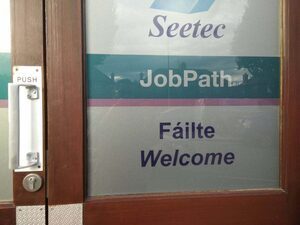
The official letters designed to draw Jobseekers into Seetec/Turas Nua offices, in what was really an entrapment, are termed “invitations”.
They open with good news tidings that the “lucky” recipient had been awarded a private sector personal advisor; and close with a threat of allowance cuts for “non-compliance”.
This schizoid approach of happy days and thwart me if you dare characterises the entire JobPath experience.The threats, tossed out so casually by comfortable public servants, are really, given today’s realities unthinking threats to poverty and potential homelessness, and are certainly understood in those terms by those at the receiving end of them, whose anxiety often evokes mockery in those delivering the threats.
The word “contract” was replaced by the word “agreement”, presumably to set the agreement between the jobseeker and the private companies beyond the remit of contract law. JobPath itself was carefully termed not a “programme” or a “scheme”, but a “service”.
Though it is unlikely that this particular service would be affording anyone consumer protections. This renaming also appeared to put the “service” outside the description of schemes in the Social Welfare Acts where a “scheme” must be appropriate to a person’s skills and education level, and can be refused by the jobseeker with “good cause”.
The concept of refusal with “good cause” itself is referred to in official letters and JobPath publicity and seems to refer to that clause in the Social Welfare Act where a person may refuse schemes, courses, programmes etc (but not “services”, because that word doesn’t appear in the clause), that are not “appropriate having regard to the education, training and development needs of that person and his or her personal circumstances…”
I asked two officials of the local DEASP office and an official from the JobPath office in Dublin as to what constitutes good cause for refusal. The question was evaded on the grounds that JobPath is a “service”.
The clearest straight answer I received, which was endorsed by the JobPath office in Dublin, was that good cause for refusal would come into play if the Jobseeker moved to another payment. Which is as good as saying that good cause for refusal doesn’t apply to JobPath.
Yet, reference to the concept of good cause for refusal appears in all official correspondence and publicity materials related to JobPath, like some kind of legal aside or safeguard.
If good cause for refusal does apply to JobPath, as it must, either that or it’s a decoration on the official literature, the best good cause to offer might be that you were misled into an agreement with a private company that stands to profit from the arrangement.
But the DEASP acknowledging this reason as good cause for refusal of JobPath might have the effect of making all agreements between jobseekers and the private companies void. So therefore, the concept of good cause for refusal can’t be allowed to exist, even though it must exist, to keep everything above board, kind of.
Good cause for refusal is one of those elusive mysteries on a par with Catch-22 and the Holy Trinity.
Equal at Last
The private companies Seetec/Turas Nua (Working Links), who are contracted and rewarded by the DEASP, are products of Tory attacks on the NHS since the 1980s; both companies making their money from Tory efforts to roll back the British welfare state; and both companies the subject of fraud investigations at one time or another in the UK.
Both companies, in a very real sense, are products of the Britain that resulted in Brexit. It may even be that Brexit itself came about as a result of a Tory desire to extricate Britain from troublesome EU human rights laws that were tying their hands in the war on the NHS.
While there is a certain pride afoot that Leo Varadkar and Boris Johnson got on so well in the Brexit negotiations, with our man standing as an equal at last with a British Prime Minister, the reality is that, in terms of neo-liberal ideology, both are essentially on the same team.
Varadkar wages his war on the Irish poor – 10,000 homeless is more than sufficient evidence, even for the totally blind – as Johnson’s Tory party wages war on the British poor. Both have even hired some of the same companies to do the dirty work: Seetec/Turas Nua (Working Links.)
And that, in the end, may be the true meaning of JobPath. The subtle changing of politics from familiar class and nationalistic divisions, to what are being called exclusionary economics: the identification and smearing, as a prelude to loss of liberty, of groups deemed “unaffordable” to society. It is the economic method by which the United States fills its private prisons with non-white people, creating, in the process, legalised slavery.
Among the people swept up in the JobPath “service”, were the grassroots arts community, who virtually redundant due to savage cuts in arts funding. T
hey joined teachers and other professionals, all of whom were subject to a revising of their skills, training and achievements in light of austere economic “realities”, identified by the private activation companies, which would necessitate down-skilling to make former professionals more placeable in low grade employments, with the private companies profiting from the projected placements.
A great enforced dumbing down was in operation, sanctioned by the state, and delivered by public service officials in the DEASP, and private sector individuals in the employ of the private companies, in an often spiteful, amused and scornful manner.
For those of us from the arts community, particularly those with a public profile, it seemed as if Irish begrudgery itself had been licensed to express itself through state instituions.
The system is such that the government is effectively placing unqualified persons into the heart of the artists’ creative process with the intention, apparently, of convincing the artist that art is a nonsense.
We can argue forever, which is probably the idea, as to whether a thing is a service or a scheme, or a contract or an agreement, and so on. But the bottom line is: is it okay for a state department in an EU country, signed up to EU and UN human rights protocols, to deliberately intimidate, mislead and deceive its citizenry into entering into contracts/agreements with private companies; agreements that benefit the private companies, irrespective of results, to the cost of the citizenry? Those costs to the taxpayer in paying the private companies via the DEASP; and to the jobseekers in forfeiting their skills and educational status.
Besides, changing the names of things to trick people into signing themselves over to the private sector as commodities, doesn’t really meet the stated aim of social protection, by any stretch; unless, I guess, you see yourself as protecting society from jobseekers, which is pretty much how the welfare cheats campaign was pitched and was so gleefully received by so many.
Continue reading →