
Category Archives: Misc

cvwrparxgaanu4v

Fintan Sheridan tweetz:

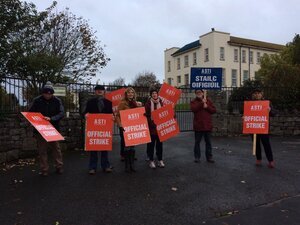
Great support for Asti union this morning on the very busy Fonthill Rd [Dublin 22].

cvwtcdtwaaeu0i0

Elaine Feeney tweetz:

Happy striking in the rain for parity in pay for junior teachers #strike

cvwfqy5xyaads8m

Teresa Mannion tweetz:

Picket line at Colaiste Éinde, Salthill, Galway.

cvwtw5bwyaefqxq

Aoife Kelly tweetz:

Parents supporting us with tea and sausage rolls [in Dublin].

cvw3zi3weaax9bo

John O’Connor tweetz:

Just met the teachers in Mayfield [Cork] who are on strike for equal pay.

cvwxmi3xyaaba-t

Donegal Democrat tweetz:

11 schools closed in Donegal as teachers go on strike. Pictured are teachers from Colaiste Cholmcille, Ballyshannon.

Most secondary schools closed over ASTI strike (RTE)

screen-shot-2016-10-27-at-02-43-57

Last night.

During a debate on the Judicial Appointments Commission Bill 2016, Independents 4 Change TD Clare Daly recalled her day in Naas District Court yesterday.

Her appearance in court followed a bench warrant being issued by Judge Desmond Zaidan for her arrest on October 13 after she left the court – before her case was called.

Grab a tay.

Clare Daly: “I am absolutely delighted that the Bill has been tabled. People often correctly give out about politicians but at least we have to go before them once in a blue moon and there is some element of accountability and right to recall whereas the Judiciary is completely and utterly a law unto itself. It is great that so many judges perform so well but we are stuck with those who do not. While I am glad Fianna Fáil introduced the Bill, the measures will only go some way to improving the quality of the judges we end up with.”

The idea that somebody could be in such a position of power because of political connections rather than merit and so on is absolutely reprehensible and I welcome the measures in this regard. However, we need to put the spotlight on this issue. Substantial reform in this area is critical. The lack of training and regulation of judges is a huge problem. When they behave irrationally, nothing can be done. The idea of justice not only being done but being seen to be done cannot happen in our State while the Judiciary is organised in the manner it is currently.

“I would like tell to story and I assure the Chair that the story, even though it involves a court case, will not go into details of the case in front of the judge but it is a graphic example of what I am talking about. It is incredibly fresh in my mind because it happened today and it involved me and a judge in Naas District Court. The history of this case is that I was summonsed to appear before Naas District Court on a driving offence. I allegedly drove at a speed of 59 km/h in a 50 km/h zone. Three weeks ago, I was called in respect of the case. The case was not listed for a hearing on that date; it was to be the first mention in court.”

“When I arrived in court, the case was No. 188 on the list and the judge is well known in the area, for whatever reason, for not starting judicial proceedings on time. Even though the court is scheduled to begin at 10.30am, he regularly appears much later than that. There is also a tradition of cases being religiously taken in order. In every court sitting I have ever attended as an observer, defendant or plaintiff, the judge normally goes through the list, dispenses with the cases in which a court date is being sought and keeps back the cases that are due for hearing in order to efficiently administer justice and ensure the management of the time of all the people who end up in the court on the day, including those who take time off work to attend because they have been summonsed as witnesses or defendants, solicitors, gardaí, prison officers and so on.”

My case was listed as No. 188 out of 188. The judge proceeded with the cases for the morning. I watched what was happening in them and then I instructed a solicitor on this minor driving matter and left the court at lunchtime. Later that day, I attended an Oireachtas committee meeting and I was not to know that the judge having reached case No. 175—–

Acting Chairman (Deputy Catherine Connolly): Is the Deputy relating this to the Bill?

Daly: I am. It relates to the fact that judges are not subject to any accountability whatsoever and to the huge costs the State can incur because of their irrational behaviour. When the judge was finishing up for the day, he had reached case No. 175 but decided to jump to the end of the list and call case No. 188. He called the solicitor before the court and asked him where was his client, even though I had instructed the solicitor, and what reason I had for not being there.

“The reason was I had been there in the morning and had watched how this judge had dealt with cases. I witnessed cases being called for which people did not turn up on similar charges or did not have a solicitor. No bench warrants or any other proceedings were dealt with. A judgment was simply given in those cases.”

“Judges are an incredibly powerful position. I respect our court system and I respect the fact that judges have discretion but that discretion has to be exercised proportionately and rationally and when it is not, there has be some body in place to call them to account. The judge could accuse me, without any recourse on my part, of disrespecting the court.”

“By doing that and issuing a bench warrant in those circumstances when I clearly was not a risk of absconding – the case not even listed for a hearing and he dealt with other cases earlier without issuing a bench warrant against those who were not there or who did not have a solicitor – the consequence of his action was that An Garda Síochána, which was an innocent victim, was subject to massive negative publicity that it had orchestrated this.”

A sergeant had to leave his post in Newbridge, drive in a squad car to Swords and spend the day there vacating the order at enormous expense to the State. I had to return to Naas District Court today to listen to the same judge lecturing me about disrespecting his court without giving me an opportunity to say anything about his irrational decision.”

“Our laws provide that nobody can do anything about that judge but he is causing huge problems with regard to the administration of justice given the inefficiency of the court sittings in his district. This needs to be radically reformed. I am glad that Fianna Fáil opted to introduce the Bill today because it is long overdue. This is only one aspect of judicial oversight and we need to go further.”

“I acknowledge a judicial council is included in the Government’s programme but some outrageous decisions and behaviour are taking place in our courts. In fairness, the presidents of the District Court, Circuit Court and so on can do nothing about it. That cannot be allowed to continue.

Judges have been appointed to areas or even communities in which they worked as a solicitor and this has led to conflicts of interest. They presided over cases involving people they formerly represented and proceeded to hear the cases, which is completely wrong.

“The option of challenging judges through a judicial review is not sufficient because one is putting oneself in a position of massive expense and accusing a judge of bias, which people do not want to do.”

“Other members have made points about some inconsistent decisions which have been made with far more awful consequences than mine. I wanted to use my case as an example of the utterly ludicrous behaviour of some of the people we have entrusted to manage our courts but no one can do anything about it.”

The saddest point about the case I referred to is that the judge in question is the sitting judge in Naas District Court. This means he can stay there for as long as he likes. From looking at him today, he has a few years left in him. The court could have him for about 12 more years.”

“The expense to the State of having 100 gardaí, solicitors and people tied up every day while he operates his court place, like I described, is utterly ludicrous and in radical need of change. I support this bill as a first step in that process.”

Transcript: Oireachtas.ie

Video: RTE

90432865DenisOBrienDec15_large

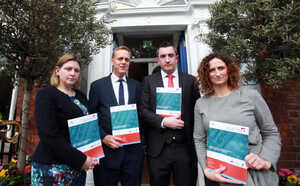
Report on the Concentration of Media Ownership; Media ownership report launch, from left: Barrister Caoilfhionn Gallagher, Jonathan Price, KRW Law, Gavin Booth, Sinn Féin MEP Lynn Boylan, in Cliff Townhouse in Dublin; Denis O’Brien

Further to the Report on the Concentration of Media Ownership in Ireland, commissioned by Lynn Boylan, Sinn Féin MEP on behalf on the European United Left/Northern Green Left (GUE/NGL) group of the European Parliament

A statement has been issued this afternoon by James Morrissey, on behalf of Denis O’Brien, in response to the report.

Redacted writes:

The Report on the Concentration of Media Ownership in Ireland makes for very interesting reading.

At the outset it is worth noting that it is self-described as “An Independent Study Commissioned by Lynn Boylan MEP on behalf of the European United Left/Nordic Green Left (GUE/NGL) Group of the European Parliament.”

An “independent study” commissioned by a leading member of Sinn Fein? Hardly.

The two most important controlling entities in the Irish media landscape are the national State broadcaster, RTE, and an individual businessman, Denis O’Brien” this Report states.

Yet there is no focus on RTE in the context of:

– The largest media entity in Ireland

– The only entity involved in TV, radio and print

– Revenues subsidised by licence fees amounting to €178.9 million

But then this ‘independent study’ was never intended to be a report on the concentration of media ownership in Ireland.

Sinn Féin is very diligent and adept when it comes to pushing its agendas, overtly and covertly.

After a disappointing General Election, An Phoblact [sic] went on the attack:

“State broadcaster came in for severe criticism as it slashed Sinn Fein’s coverage following a poll… which showed the party gaining ground… and for two days the voices of Sinn Fein were banned from the airwaves in a bizarre episode that was reminiscent of Section 31 and state censorship.” (March 7, 2016)

And on the eve of the Budget, Sinn Fein TD, Eoin O’Broin declared:

“Budget Day is all about choices. For decades, Fine Gael and Fianna Fail, have looked after the big guy – whether that be Denis O’Brien or Apple.”

I am absolutely convinced that the contribution that Apple has made in this country is unquantifiable in financial and social terms. What about the thousands of young women and men who did not have to emigrate and who got a chance to work, live and raise families in Cork?

I have said that Apple should not be punished for its tax arrangements in Ireland. Sinn Féin’s stance on Apple has been, I believe both anti-enterprise and anti-Irish.

“Sinn Fein has been waiting with some relish for the EU verdict,” wrote Pat Leahy in The Irish Times (August 30, 2016) “and leaped into action:  ’Give us back our money’ demanded MEP Matt Carthy. For good measure, Sinn Fein finance spokesman Pearse Doherty also called for a public inquiry into Apple’s tax arrangements.”

This report states that I am chairperson of Communicorp, as has various individuals including Dr. Colum Kenny, Dr. Roderick Flynn and Caoilfhionn Gallagher, legal firms Jonathan Price (Belfast) and KRW Law (London) and media organisations including The Irish Times and TV3.

It maybe [sic] a rather inconvenient truth, but I am not.

I suppose why let the facts interfere with the agenda and the messaging…

Is the media objective when it is talking and writing about itself? The media industry in Ireland is in decline. This decline has been ongoing for many years and it threatens and [sic] industry that has served this country exceptionally well, providing high levels of employment and spawned a number of writers who have deservedly achieved international acclaim.

Independent News & Media (INM) was days from forced closure back 2011.

Over €2 billion in shareholder value had been lost and the shares had collapsed from €27.30 to 41 cents as a previous board had racked up unsustainable levels of debt. I became am [sic] a substantial minority shareholder in INM (I am not on the board).

I am the owner of Communicorp which like RTÉ, TV3, The Irish Examiner and The Sunday Business Post operates in a very challenging environment. I understand The Irish Times is currently considering various funding options.

I believe that some media companies will not survive this decade without radical structuring including substantial funding.

I was surprised, for example, that RTÉ (and others) did not seek any comment from me on the ‘Report on the Concentration of Media Ownership in Ireland’ in the interests of balance and objectivity.

But maybe the powers that be in Montrose felt that they had been given a ‘free pass’ in the report that they chose just to quote from it?

I do not believe the Irish media is objective in relation to matters relating to itself. The prime reason is survival. Every media executive and journalist knows that the future of traditional media is bleak. It makes one entity undermining another easier to justify.

Sinn Féin/IRA certainly got the report they paid for. The cost of this report won’t have have bothered them too much.

They collected €12 million over 20 years in the US (Irish Times, March 7, 2015). The IRA is reported to have €400 million in global assets (Irish Times, August 29, 2015).

Brian Feeney, author, has suggested that a way should be found to stop “Sinn Féin people saying the IRA has gone away when self-evidently it hasn’t.”

The report references the words ‘chilling effect’ and the law in the same sentence. I bow to Sinn Fein’s superior knowledge on these topics.

Maybe instead of commissioning reports Sinn Féin would commit just some of its vast resources and support an ailing industry – become a fully-fledged broadcaster and publisher and create some jobs for a change?

Statement via Joe Leogue

Thud.

Meanwhile…


Previously: High Concentration

Morrissey And Mar’

screen-shot-2016-10-11-at-13-04-44

Minister for Finance Michael Noonan in the Dáil, on October 11, delivering his sixth budget speech since 2011

Minister for Finance Michael Noonan has delivered six budget speeches since 2011.

On October 14, 2015, in relation to Budget 2016, he said:

“There will be no return to the past where tax incentives for developers drove supply.”

On October 11, 2016, in relation to Budget 2017, he said:

“There is an acute shortage of new houses being built in Ireland and I am introducing a Help to Buy Scheme to address this problem.”

Further to this…

First-Time Buyer writes:

No one would deny that we have a housing and homelessness problem. However despite house prices increase ranging from 20% to 50%, there has been very little increase in output.

So what is the problem?… Land hoarding.

Brendan McDonagh recently told the Housing and Homlessness Committee that since the start of 2014, NAMA has sold land that could provide up to 20,000 units – but just 5% of that has so far been delivered in new homes.

In addition, local councils have zoned enough land to provide for 16 years’ demand but many of these sites are not being developed because owners are holding onto sites in the expectation that prices will rise, allowing them to maximise profits.

Unfortunately, councils have no legal powers to force owners of zoned lands to build, even if planning permission is in place and demand for homes is high.

The 3% annual level on unused development land that was introduced in the Urban Regeneration and Housing Act does not take effect until three years after the land is identified as being suitable for housing and the earliest owners will have to pay is 2019.

Furthermore, the CGT exemption that was brought in 2012/2013 allows people to buy land, hold it for seven years and not pay any tax on its sale. So, rather than selling the land people are sitting there waiting until 2019 before they’ll release it to the market.

Even at an individual level, the Government has ensured that properties are passed from one wealthy generation to the next rather than be placed on the open market.

The Government increased the inheritance tax threshold by 11% to €310,000 and Noonan has refused to close an openly abused loophole which allows parents gifting homes worth €1m or more to their children and avoid tax.

So, rather than address the supply side issues, the Government has decided to introduce a Help To Buy Scheme. This will do nothing to address the supply side constraints and, according to Davy’s economists, will simply push up house prices next year and the following year.

The best part though is that in 2015 the same Government commissioned an ERSI report entitled “Tax Breaks and the Residential Property Market” in which they concluded that “tax breaks aimed at stimulating house and apartment building should be avoided”.

The Governor of the Central Bank, Philip Lane, is one of the many critics of the new Help To Buy Scheme and has said that it will end up serving as a subsidy for builders…

Anyone?


tea-in-the-supermarket

Two years ago the BBC reported on shocking working and living conditions in tea estates in Assam, India.

Helena Tubridy (above} wondered where Barry’s sources its tea.

And waited.

Via The Dublin Inquirer

Neither Barry’s Tea nor Lyons was willing to share the exact names of all the tea estates that they source from.

Lyons gets some from Kenya, some from Sri Lanka, and some from Assam, said Adam Fisher, the media relations manager at Unilever, which owns Lyons.

“We source from an array of tea estates and though it isn’t possible to give you the names of all of them Lyons is mostly sourced from East Africa, including Kericho,” he said. It is fully Rainforest Alliance-certified, though….

Barry’s Tea, which is not Rainforest Alliance-certified, didn’t provide a list either. It sources 90 percent of its tea from East Africa and 10 percent from India, said spokesperson Camille O’Flanagan. “We work with some of the most reputable tea estates in every region.”

*slurp*

Where Do Barry’s Tea and Lyons Get Their Tea From? (Dublin Inquirer)

The bitter story behind the UK’s national drink (BBC News)

screen-shot-2016-10-26-at-13-08-10 screen-shot-2016-10-26-at-13-07-25

This afternoon.

During Leaders’s Questions.

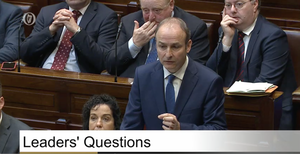
Fianna Fáil leader Micheál Martin raised what he called a “legacy issue which reflects all parties who’ve have been in Government over the last number of years” and that he wasn’t raising it as a mean to score political points.

The issue is how the State has dealt with child sex abuse in national schools in Ireland up to and since Louise O’Keeffe’s successful case in the European Court of Human Rights (ECHR) in 2014.

Mr Martin said the State’s response to the ECHR judgement has been “a significant failure and leaves a lot to be desired”.

From Leaders’ Questions:

Micheál Martin: “The State that introduced an ex-gratia payment scheme, in many respects the limits were too low; but also the prior complaint expedient that was put in, has effectively debarred a lot from seeking justice. Only seven settlements so far have been reached out of about 210 cases and those cases are still going through the courts.”

“I recently met a victim of, who has been involved in this situation for quite some time, of horrific abuse, at the hands of a Christian Brother in a school. The person who abused was subsequently convicted, okay, so there’s no doubt about the issue. And I think he was convicted of other abuse cases as well. And there are quite a number of other victims out there at the moment, Taoiseach. Now this man went through horrific abuse, has been up and down through the courts and religious orders and has received absolutely no compensation, not a cent, nothing from the State. And, recently, in the High Court, because many of these people discontinued their cases when the Supreme Court ruled that the State didn’t have an obligation, the High Court would not uphold the rights now to pursue it in law and, indeed, Judge Barrett made such a ruling. But he also said in his statement that ‘The Irish people…’, and I quote, this is at the end of the court case, the High Court: ‘…with their great and proper sense of justice may well conclude to the path of rightness in this matter should lead ultimately into a different end’. He added: ‘as an Irishman, I would respectfully agree’. Essentially, Taoiseach what has been going on has been quite, in my view, unacceptable.”

Later

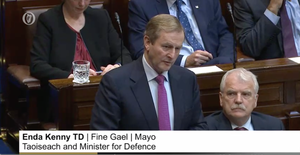
Enda Kenny:I don’t know how many victims of sexual abuse there are in the, there have been over the years in the primary system, no more than the secondary system I assume. We have the, we had the redress scheme, we had the case of all the Magdalenes – not that there was sexual abuse in the vast majority of cases. There is the mother and baby home report coming before the Minister for Children as well which we’ll have to see what that means. I can’t recall all the details of, of the file in this case. Your question is can something be done about this. I’ve no idea of the scale of what might be involved here. But I need to read the detail of the file and the legal outcomes here. People who are abused have to live with that for all of their lives and it’s a horrific issue to have to contend with, every waking moment. Now, I don’t want to go beyond that because to come into something that I haven’t the full facts and details about, it wouldn’t be appropriate on the floor of the Dáil here…

Later

Kenny: “Yeah, you see, you mention that there are 7 out of 210 that have been settled – that’s 210 that are before the courts now. But, you have no idea of the numbers who might wish to come forward and say ‘I was sexually abused in school X or Y by teacher or person X or Y. You have no idea of the scale of that. And, and, I think in the process, when the State dealt with the Louise O’Keeffe case, on the 28th of January, 2014, that judgement was issued and the State awarded made awards both in respect of pecuniary and non-pecuniary damages and costs and expenses. They also agreed in December of that year that out-of-court settlements would be offered to those extant cases of school child sexual abuse being brought against the State – where the cases came within the terms of the ECHR judgement and satisfied the statute of limitations. And in that regard the State claims agency could manage such cases on behalf of the State, has made settlement offers which have been accepted, as you say, in six cases. In July 2015, the Government approved proposals to offer ex-gratia payments of up to a maximum of €84,000 to those who initiated legal proceedings in such cases agains the State but who subsequently discontinued their claims against the State and where, similarly, the circumstances of the claims came within the terms of the ECHR judgement and where the claims were not statute barred prior to the proceedings being discontinued. I’ll follow through on the question.”

There you go now.

Previously: Grooming A Nation