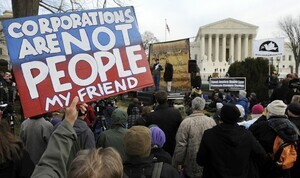
From top: Corporate ownership protest, Washington DC; Michael Taft
There has been a decades-long debate over who actually ‘owns’ the corporation, in the sense of who actually ‘controls’ it.
We may have an answer.
Michael Taft writes:
To ask ‘who owns the corporation’ is to invite a simple reply: the shareholders. After all, don’t shareholders vote at AGMs, doesn’t the law state that shareholders own the company. Doesn’t the company have to act in the interest of the shareholder?
Seems straight-forward. But it’s not. In fact, it has been argued that no one owns the corporation. If this is the case the implications could be significant.
The Financial Times’ Peter Kay argues the ‘no-one-owns-the-corporation’ line:
‘If I own an object I can use it, or not use it, sell it, rent it, give it to others, throw it away and appeal to the police if a thief misappropriates it . . . But shares give their holders no right of possession and no right of use.
If shareholders go to the company premises, they will more likely than not be turned away. They have no more right than other customers to the services of the business they “own”. The company’s actions are not their responsibility, and corporate assets cannot be used to satisfy their debts.
Shareholders do not have the right to manage the company in which they hold an interest, and even their right to appoint the people who do is largely theoretical.
They are entitled only to such part of the income as the directors declare as dividends, and have no right to the proceeds of the sale of corporate assets — except in the event of the liquidation of the entire company, in which case they will get what is left; not much, as a rule.’
So who owns the company?
‘The answer is that no one does, any more than anyone owns the River Thames, the National Gallery, the streets of London, or the air we breathe.
There are many different kinds of claims, contracts and obligations in modern economies, and only occasionally are these well described by the term ownership.’
There has been a decades-long debate over who actually ‘owns’ the corporation, in the sense of who actually ‘controls’ it: managers or shareholders or a combination of both.
We can get a better handle on this if we recognise that the corporation is a legal fiction – a ‘legal person’ that enables the corporation to operate in the world (buy, sell, own, sue, go into debt, break the law, etc.). As such, this legal person is not ‘owned’ in the popular sense of the word.
Tom Powdrill quotes a Contexte summary of the revisions to the EU shareholders’ rights directives:
‘Shareholders do not own corporations: The directive will explicitly acknowledge that shareholders do not own corporations – a first in EU law.
Contrary to the popular understanding, public companies have legal personhood and are not owned by their investors.
The position of shareholders is similar to that of bondholders, creditors and employees, all of whom have contractual relationships with companies, but do not own them. ‘
Even if one insists on the ‘ownership’ paradigm, one has to admit that the character of ownership has changed – from individuals to institutions with ownership being measured in weeks (an average of 35 weeks as opposed to 1970 when the average share holding lasted seven years); and sometimes in seconds due to high-frequency trading.
In this sense we can understand a corporation as a ‘space’, a dense series of contractual relationships that includes management, shareholders, bondholders and creditors, employees, etc.; in other words, the totality of relationships with all the stakeholders.
This list can be extended to communities, the environment, nation-states, supra-national organisations (e.g. the EU), etc.
And how are these contractual relationships determined? In the apparent instance, they are politically-determined (legislation that gives certain rights to different stakeholders). Ultimately, they are determined by the power-relationships between these different stakeholders.
So what? It’s still the same ol’ corporation that we have known and loved since the introduction of limited liability. I would say there are at least two reasons why this matters. First, is the concentration of ownership, control and power.
The New Scientist published a comprehensive survey of global multi-national corporations. In the first instance they found a core of 1,381 companies which collectively controlled the majority of world’s large blue chip and manufacturing firms (what’s called the ‘real economy’ – that is, the non-financial economy).
However, when they dug further they found what they called a ‘super-entity’ of 147 inter-locking companies controlled 40 percent of multi-national companies world-wide. Most of these 147 super-companies were financial institutions.
Second, the relationships within and between multi-nationals are more and more determined politically.
France’s decision to give more voting weight to shareholders who hold on to their shares longer (in the hope of incentivising long-term commitment); the OECD’s and the EU’s moves on tax transparency; the role of stakeholders in corporate governance legislation – all these can be interpreted as moves to make the corporation more accountable both to society and the productive economy. All these are political decisions.
Ultimately, though, this all suggests a new, potentially more democratic perspective.
If the corporation is not so much owned but exists through a series of contractual relationships between stakeholders and participants, then we can see the totality of the corporation as a ‘social’ or ‘collective’ asset that operates within a complex market of economic calculation and the international division of labour.
Once we break with the concept of ‘ownership’ (though we will always use this in a popular sense) and understand it as one of ‘control’ – this begs the question: who controls the controllers?
This is a both a political and economic issue; it is a systemic one. It is about power-relationships both within the corporation (the balance between capital and labour being a primary one) and the relation of the corporation with the rest of society, including the environment.
So if no one owns the corporation then can we all own the corporation? It is a democratic issue; neither simple nor unsolvable.
Michael Taft is Research Officer with Unite the Union. His column appears here every Tuesday. He is author of the political economy blog, Unite’s Notes on the Front. Follow Michael on Twitter: @notesonthefront