From top: Ministers Richard Bruton, Leo Varadkar, Charlie Flanagan and Simon Harris at the annual National Day of Commemoration Ceremony; Michael Taft
Minister for Social protection Leo Varadkar’s hope to increase unemployment benefits and reduce uncertainty for people losing their jobs is a small step in the right direction.
Michael Taft writers:
The Minister for Social Protection, Leo Varadkar, has been floating some ideas. The latest one concerns increased unemployment benefits – along the lines of basic European practice (sort of).
His idea is that workers who become unemployed would receive €215 per week for the first three months; €200 for the second three months; after that, they would receive the current basic rate of €188 per week.
Though this is quite modest it is certainly heading in the right direction. This is about the economics of social security and what is called in the literature ‘uncertainty avoidance’. For people losing their jobs, they are liable to a sudden drop in their income which puts pressure on their living standards.
The economy suffers because of their reduced purchasing power. And this skewers the labour market as many people grab the first job they can regardless of the skill match – thus leading to less than optimal results.
Other European countries get over these problems by providing pay-related unemployment benefit. In its simplest terms, a worker receives a percentage of their previous wage for a set period of time – before falling back to a basic, usually means-tests, payment. This protects living standards, maintains demand, and facilitates optimal job-hunting.
The pay-related benefit can be quite substantial.
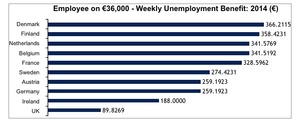
Ireland is not the lowest (the UK is, but Council Tax Benefit makes up on average more than twice the level of unemployment benefit) but it is well behind all other EU countries in our peer group. The Minister’s proposal would close some of the gap.
However, there is one big difference with the continental model. The Minister’s proposal is still a flat-rate. In other EU countries, the payment is linked to the previous wage; the higher the wage, the higher benefit. For instance, in Austria, the weekly benefit of €259 is for someone previously on €36,000 (the Irish average wage).
However, for an Austrian previously on €50,000 pay, unemployment benefit would rise to €335. This Minister’s proposal wouldn’t do that.
Also, the length of the payment is minimal compared to other countries where the pay-related benefit can last a year or longer.
The Minister has claimed his proposal would cost approximately €35 million. That is fairly minor cost. We should aim for a fully-blown pay-related payment with a high replacement ratio (unemployment benefit as a percentage of the previous gross wage) that lasts a year. There would be a threshold above which the payment would be frozen. And the payment would last a year.
Take the example of an employee who loses their job. She was earning €30,000. She will now receive 50 percent of her previous wage – €15,000. She will receive this for a year. If she is still unemployed after a year, her benefit will run out and she will switch to Jobseekers’ Allowance (a means-tested payment).
It is difficult to estimate the cost as we don’t have data on duration and previous income. In any event it would be phased in over three years or so.
But a back-of-the-envelope job – based on trebling the increase in the Minister’s proposals and doubling the length of time – would suggest a cost of €200 million (though it could be less depending on the income range of new entrants on to benefit and how long they stay on benefit).
This could be paid for – as it is on the continent – by an enhanced employers’ social insurance (Irish employers’ social insurance is one of the lowest in the EU; it would have to more than double to reach the European average). A fractional 0.25 percent increase would pay for the enhanced benefit – hardly onerous.
But there is benefit for business as well – the increased benefit would result in higher consumer spending. And the Government would benefit from the increased tax revenue – both income tax (unemployment benefit is taxable) and indirect taxes.
And for people the benefit is obvious: when they suffer the loss of employment, at least their income will be maintained for a period while they get back on their feet.
Let’s hope the Minister continues floating these kinds of ideas. Here’s a few more he may wish to let glide:
Pay-related sickness benefit
Pay-related maternity and paternity benefit
Pay-related validity pension and occupational injuries benefit
And, ultimately, a pay-related old age pension
We may yet join the rest of Europe in providing a modern social protection system.
Michael Taft is Research Officer with Unite the Union. His column appears here every Tuesday. He is author of the political economy blog, Unite’s Notes on the Front. Follow Michael on Twitter: @notesonthefront
Rollingnews