

Claire McGing tweetz
Compiled list of legislative changes for women 1896-1937. Notice the roll-back of women’s rights after independence.



Claire McGing tweetz
Compiled list of legislative changes for women 1896-1937. Notice the roll-back of women’s rights after independence.
Anita Elliott, of Clover Rua, writes:
To mark the centenary of the 1916 Easter Rising, we have a new print (€12 plus shipping) featuring the GPO Dublin, top, and we’ve added this drawing to our Tea Towel range (12.95 plus shipping) above.

From top: Carrying wood from Sackville Street, Dublin after the 1916 Rising Dr Rory Hearne
What right do we have to commemorate when the very men and women who took part in the Rising would abhor what is going on in Ireland today?
Dr Rory Hearne writes:
The 1916 rising commemoration on Sunday will start with a reading of the Proclamation at the GPO.
I wonder what will go through the minds of the dignitaries, politicians, the thousands lining the streets and those watching on TV when they hear these lines read from the Proclamation:
“The Republic guarantees religious and civil liberty, equal rights and equal opportunities to all its citizens, and declares its resolve to pursue the happiness and prosperity of the whole nation and of all its parts, cherishing all of the children of the nation equally”
Will they think of the 138,000 children in poverty across this country? Will they think of the 8000 children who went to the Capuchin day centre last year in order to get a hot meal? Or the 3 year old girl who was fed from a soup kitchen on O Connell Street last week?
Will they think of the 1,570 children living in emergency homeless accommodation in our capital city?
Will they think of the 90,000 on housing waiting lists? Or the 46,000 people living in homes owned by vulture funds? Or the 37,000 homeowners in long-term mortgage arears?
They should. I will be. I have thought a lot about the commemorations and I am disturbed by the hypocrisy and contradictions in them.
I cannot stop thinking about the shameful disgrace of thousands of children hungry and homeless in this country while we commemorate the Rising and Proclamation of this Republic.
A Republic which was founded on the very principles of ensuring such children would be cherished equally.
How can we genuinely commemorate the Rising and Proclamation without feeling an intense sense of guilt and shame at the current housing crisis?
What right do we have to commemorate when the very men and women who fought in the Rising would abhor what is going on in Ireland today?
The right thing to have done would have been to cancel the commemorations and in their place to hold a national crisis summit on the housing and homeless emergency.
Vulture funds and landlords are evicting families as you read this and just last week it emerged that Dublin rental prices are now higher than their peak. Rents are completely unaffordable for low income earners.
For example, the average monthly rent for a house in Dublin is almost 85% of the monthly minimum wage of €1546.3 (while the average national rent is 60% of the monthly earnings for someone on a full time minimum wage income).
It is troubling to see how the history we are commemorating is repeating itself. For many involved in the rising, particularly socialists like James Connolly, the terrible housing conditions that existed in the tenements in Dublin at that time was a strong motivating factor.
The bitter irony is that 100 years on housing conditions are again a major human catastrophe in this country.
There is also an eerie parallel with today’s housing crisis and our history as a colonised country. 100 years on we are again being colonised by external forces – this time its the foreign vulture funds who are taking over our housing, land and mortgage loans. In 1916 as with today, this colonisation is being facilitated by our own political and business (property industry) establishment.
But some things are very different. We now have control over our own destinies and so there can be no excuses for not solving the housing crisis. We can’t blame a foreign empire (although Europe did have a role in forcing the bailout and austerity – but it was our own political choices to cut social housing funding).
The biggest difference between 1916 and today is that we are now one of the wealthiest countries on the planet.
Therefore there are no excuses for children being without a home or going hungry. Did you know that €45 million is being spent on the various commemoration events this year? Wouldn’t this be better spent on addressing the housing crisis?
We know the solutions to the housing crisis.
Focus Ireland outlined this week a five Point Plan that it is calling on a new government to implement including a ‘cast iron commitment to ending the family homeless crisis, setting a firm deadline to achieve this, building at least 40,000 social houses over the next five years and holding a referendum on the ‘right to a home’.
The Dublin Tenants Association has also made a very logical call for the banks to be stopped from selling mortgages to third-parties (vulture funds), for a removal of the ‘sale of property’ as grounds for the termination of a tenancy and for NAMA to stop selling housing or debt secured by housing to vulture funds and other bodies.
It’s not as if we don’t have the land and finance to build much needed housing. There is a huge amount of state owned land held by local authorities while NAMA has enough land and finance to build 50,000 affordable and social houses.
There is also 2,233 hectares of undeveloped zoned land in the wider Dublin region which could provide 102,500 new housing units but developers and speculators are sitting on it waiting for prices to rise further. An emergency tax should be introduced to force building on this.
The problem is we just do not have the political and institutional will to do what is necessary.
Vested interests of the property industry, developers, vulture funds, landlords, estate agents, banks, and financiers are ensuring that the status quo does not change and thus the housing crisis continues to worsen week by week.
It is time to raise the public pressure to counter these vested interests and demand a housing system that is primarily based on meeting people’s need for a home and not based on relying on the private market – which is the property industry and speculators – which has failed over and over to provide affordable and secure housing.
I want to commemorate 1916 and I am proud of this history. But I am ashamed of our present. We have no right to commemorate 1916 in any way – other than to use it to reflect back to us our failure to deliver the basic right to housing to citizens of this Republic.
There is a very genuine commemoration of the Easter Rising and the Proclamation taking place on Easter Sunday and it is a Protest for the Homeless. It is being organised by Erica Flemming, who, along with her daughter is homeless. She explains that she feels she has to take to the streets and she is organising the protest in order to:
“stare at power in the eye and hold it to account for the experiences of poverty that are facing my child daily. Her playground is a hotel corridor: I rarely get to provide her with a home cooked meal. As I tuck her in at night, I can’t even afford her the dignity of leaving the room. This isn’t the Republic that people died for and I feel duty bound to demand that my daughter be cherished equally in the eyes of this State”.
Erica is organising a friendly, family orientated event on Dublin’s North Earl Street on Sunday at 1pm to “highlight that our children matter and that a home is the minimum we should be affording our children on this anniversary of an event associated with such strong themes of equality and what it truely means to live in a Republic”.
We can only truly commemorate 1916 when the housing crisis is dealt with and there are no children and their family like Erica’s who are homeless or suffering poverty.
For information on the Homeless Protest on Easter Sunday see here:
Dr Rory Hearne is a policy analyst, academic & social justice campaigner. His column appears here every Wednesday. Rory is an independent candidate for the Seanad NUI Colleges Panel. He writes here in a personal capacity. Follow Rory on Twitter: @roryhearne

Mormon missionary Free Mason Wells
He’s a latter day miracle.
A crew cut Zelig of Muslim extremist terrorist outrages.
‘This is his third terrorist attack,’ his father, Chad, told ABC News.
Mason was a block away from the Boston Marathon finish line, the site of the bombing, when it detonated.
He was also in Paris on November 13.
Mason is at a Belgian hospital and is expected to make a full recovery.
A Mormon official told Mason’s parents that ‘despite being on the ground and bleeding he actually had a sense of humour and remained calm through the situation.’
*cough*
Brussels attacks: Teenager also survived Boston and Paris bombings (MetroUK)
Pic: Mormon Church via AP


From top: Chartered Lands’ plans for the Carlton site on O’Connell Street and Arts Minister Heather Humphreys
You may recall how, in the High Court last Friday, Judge Max Barrett ruled that extra buildings and lane ways in the Moore Street – separate to numbers 14-17 – should be given State protection.
In the court, Arts and Heritage Minister Heather Humphreys’ department argued that the extra buildings were not of historical importance.
The ruling will impact Joe O’Reilly’s Chartered Land’s plans, above, to build a commercial development on the Carlton site on O’Connell Street.
Further to this, RTÉ’s Áine Lawlor asked Ms Humphreys about the ruling on News At One this afternoon.
Aine Lawlor: “I want to talk to you minster about the recent High Court judgement, particularly long, High Court judgement which pretty definitively ruled for those people who were looking for number 16 Moore Street and the areas around it to be kept from development and the fact that they won their case. Lot of those people now saying it’s now time for you and Peter Cooney from the Save 16 Moore Street committee, saying you should resign and your senior officials, because this was the wrong thing to do and cost the State many millions.”
Heather Humphreys: “Yeah well, first of all, the judgement was delivered last Friday, it runs to almost 400 pages and I and my officials, we’re still studying the judgement and the implications and you’ll be aware that the situation regarding Moore Street long predates my time and, as minister, number 14 and 17 were first declared a national monument back in 2007 and I’m the first person to have actually done anything about preserving those buildings for 14 – 17 Moore Street and we know that they are, they predate 1916, and they were the final headquarters for the 1916 leaders. Now work had started because they’re very, they’re in a fragile condition, 14 – 17, it’s fragile and work had started in November on conserving the buildings and bringing them back to exactly where they were in 1916. Now that work was delayed by protests and occupations in recent months. We have the court ruling and I do need time to consider it in full. And I’m not in a position, at this point, to outline my next course of action but I will consider the judgement and the case is due back in court on April the 5th when we will have further discussions with the judge but I just want to be clear that my priority is to continue the work on the buildings from numbers 14 – 17 Moore Street. And I wouldn’t be in a position to go into any further details at this point.”
Lawlor: “Minister, I know you’re the acting minister, but this is, you know, these are the buildings that have been designated and, indeed, in this very long judgement, the judge talks at length about the case of the Moore Street battle site, how evocative it is and how important it is and how much it impressed him. The state has lost its case. The Save 16 Moore Street people have won their high court case – are you going to appeal to the Supreme Court or are you going to accept the High Court judgement? Surely, this weekend of all weekends, you should be able to say?”
Humphreys: “Yeah, well, the point is 14-17 Moore Street, they are, they’re the four buildings that remain intact. They’re actually the only ones that remain intact and they are my priority because that’s what the last Council of War meeting was held..”
Lawlor: “Is the High Court judgement something you accept?”
Humphreys: “Well, first of all, the High Court judgement, I have to, I do have to look at, and I have to study it, it is 400 pages and we are back in court on the 5th of April to have further discussions with the judge so I must give it due consideration before I make any decision.”
Lawlor: “Do you not give our history more consideration and not leave it to the landowner to appeal if they want to proceed with their development there? I mean the State, surely, it’s interest ought to be our history rather than any development there?”
Humphreys: “Yeah, well I’m being clear, I want to see the work continued on 14-17 Moore Street and the work is to restore it. Now, I have to give, I really do have to give a 400-page judgement, I have to give it due consideration and I, as I said, I and my officials, we’re still studying it and its implications. And, as I said, I will, I have be back in court on the 5th and I will, I will give it consideration.”
Lawlor: “Thank you very much…”
Listen back here
Previously: Moore Protection


This afternoon.
Mountjoy Street, Dublin 7
John writes:
Thought you might like this, just spotted during lunchtime :)

This afternoon.
At Carey’s Lane, Cork city.
Thanks Niall
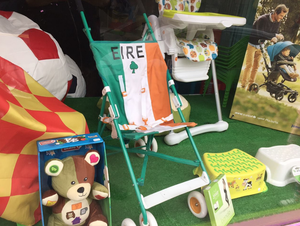

Today.
In Castlebar, Co. Mayo.
Robbie Harris writes:
A great way to celebrate the centenary with your kid!
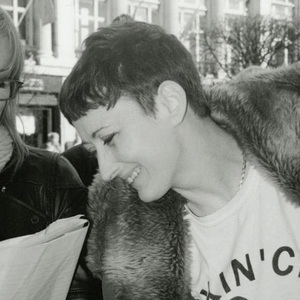
Journalist Dara Quigley
Dara Quigley, in the Dublin Inquirer, writes:
A few weeks after the equality referendum, I was sitting with a HSE counsellor in one of the drug outreach centres in the city.
“Well you have to admit,” she said in a nice, calm tone, “all that – addicts being treated with dignity and respect – I mean that was all a bit delusional. Wasn’t it?”
I tried to argue that even she had to admit that addiction is a complex issue and not one of moral absolutes, and sure hadn’t we just had a referendum to say we were all equal.
“That’s one of the things I like about you,” she replied. “No matter how bad things get you always manage to find humour in it.”
It wasn’t a debate I was going to win. And if it had been a few years earlier, and I had been a bit more impressionable, I might have believed and internalised her message.
However, thanks to a few special individuals, I had just about enough strength to hold onto my sense of self, and to think that maybe a better life wasn’t just something I deserved, but something that I and every other recovering addict and addict had a right to.
Today I can almost safely say that I believe that. And that is one of the unseen struggles of recovery from addiction. A constant battle between what you know is true, a desire to make it out the other side, pitted against a society which views addicts – particularly women addicts – as moral hazards to be contained and controlled.
Experts speak of clusters of addiction, almost as a contagion which needs to be neutralised. Or in some cases left on a too-high dose of methadone for decades: crime-prevention and a nice kick-back for the prescribing doctor and the HSE.
I can understand how easy it is to see the figures and reduce the people behind them to one label, one stereotype: junkie. It can be a struggle at the best of times. We live in a post-theocratic society, and, being a heroin addict, a junkie – even the most right-on liberals find it difficult to imagine anything other than the stereotype.
I know, I was surrounded by right-on liberals. To quote a Glaswegian MC and friend of mine, Darren “Loki” McGarvey, “I hang with middle-class professionals in spacious flats, who debate Irvine Welsh while I’m taking smack.”
Although once that started, friendships ended – sometimes in incredibly nasty ways.
Society has a way of preparing you for what’s to come, and socially I was being prepared to guard my own sense of identity – both from the drug and from the standard Irish tough-love model of shame and guilt. Respect and dignity were two things I was going to find myself piecing back together.
Smack is the drug which will cut right through any pretence and get ’em right in the middle-class sensibilities. One group of friends I had known for almost 10 years even found themselves a replacement token working-class woman: another mature student, studying the same subject as me, before making it clear that I had been replaced.
In retrospect it was all they knew how to do. The enormity of the problem was too much for anyone to take on, and it takes lot of effort to support someone who’s yo-yoing between addiction and bouts of clean living. Even the best of friends lose patience eventually.
And the guilt which comes from cutting a friend loose has to be justified. A law I’ve figured out is that the enormity of the moral outrage is inversely proportional to the time spent with you during addiction. Those who were most offended disappeared almost immediately.
Such is the stigma associated with chasing the dragon.
Again I found solace in hip-hop and Loki’s “2nd Wind” got me through a few tough days. “To re-enter a world where pariahs wait to greet me, maybe I’m confused have you not got a riot act to read to me? Apologies I’ll cover any damages, church mice bicker over crumbs from my sandwiches.”
The track, and the time he spent talking me down through the worst of it, it was the kind of support people in Ireland simply could not offer. Acceptance of your flaws and embracing them rather than the traditional 12-step “beg a higher power to remove your intrinsic defects”: it was the start of a life- and sanity-saving philosophy.
A few very special friends are still hanging in there. And fair play to you all, I was a selfish little shit. Past tense for the most part.
In the Kafkaesque world of recovery in Ireland, which at times seems designed to break you down until you are ready to be remade, sometimes there are still bad days. After reclaiming your autonomy from substance abuse, you have very little control over the path of your life, with never-ending waiting lists and seemingly random decisions being made on your behalf to balance a book somewhere.
And these days, instead of being remade in the image of whatever the name of the saint is on the roof you landed under, like true ideological soldiers of neoliberalism that we are, drug stabilisation programmes are CE schemes, where being technically employed doesn’t come with many rights for the participants, and if you don’t learn your place fast enough you could be bounced to any number of courses which aren’t particularly suitable.
After I had sworn and raised my voice a bit I was sent off for CBT. In the first class, one of the slides was in German. The facilitator laughed, “We do get them from Germany.” The next class, one of the slides encouraged us to think of ourselves as €100: you may not always feel like €100, and that’s okay, not everybody is €100 all the time. At that point I told them I was a journalist and happily enough it was decided that I didn’t need to be there.
Only a century of theocracy and a proud tradition of health care as charity while using the
weakest members as a disciplinary measure, the cautionary tale to keep the rest of the
population in check, can produce post-austerity hollowed-out drug programmes that have had their budget cut by 37 percent post-crash.
Still, the counselor who was busy – that day after the equality referendum – re-enforcing my position as “less than”, has been a lifeline. There was a lot I just may not have been able to deal with alone.
It had only been just over a two-month wait, which in public-service addiction-treatment terms is rapid response. “The first thing you learn is that you always gotta wait,” to quote Lou Reed’s “Waiting for My Man”. Through decades and space, addicts today listen to that and laugh.
Not that addiction is a barrel of laughs. The ones you have are gallows humour. Jokes and a vernacular riddled with references to death and decay, alliances dressed up as friendships, permanence a distant memory to be unwrapped at times when you need it most.
Now that sense of belonging is coming back, tai chi – not something I would have tried before – has turned out to be, along with writing, one of my most beneficial tools.
After the CE scheme decided that, even after taking a break, I “wasn’t a good fit”. At that stage, I was going to tai chi twice a week, slowly rebuilding the connection between my brain and my body as my muscles grew stronger. I’ve since proceeded to kung fu. They’re both incredible ways of rebuilding not just your body but your mind with long, standing-on-one-leg meditation sessions.
It was during one of those that I finally worked up the confidence to hit a few open-mic nights to, quoting Darren Loki, “push the envelope and cause a fuckin postal strike”. And I’ll be opening with the line, “You’re the revolution mate? I’m a full-sprectrum paradigm collapse on Russell Brand’s parade.”
It’s a long, slow road to building myself back up. I won’t lie and say I jump out of bed everyday with renewed hope.
Some days it takes every ounce of strength I have to get out of bed and eat, if I can eat at all. Others, the simple pleasure of sunshine on my face while I’m drinking coffee and doodling on a drawing pad, usually with a cigarette (but one thing at a time) is enough to make my heart swell and tears fall at the resilience of the human condition.
Some days I’m even proud of myself. Slowly, but surely, day by day, with every meal finished, every class of tai chi, every day I don’t pay some dickhead €20 to feel like a human being, I’m reclaiming my right to pride and dignity.
Dara: Every addict has the right to a better life (Dublin Inquirer)

This morning/afternoon.
Shiela Larkin writes:
Free burritos from new Mexican place at Station Buildings, Hatch street [Dublin 2]…

