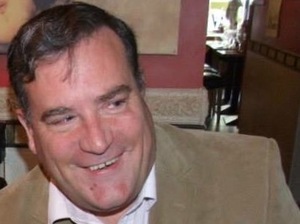
From top: RTÉ; today’s Irish Independent; Kevin Rafter
The main story in this morning’s Irish Independent, by Fionnan Sheahan and Kevin Doyle, is headlined ‘Revealed: Sinn Féin’s bid to intimidate RTÉ’.
It is based on an academic paper by Associate Professor of Political Communication Kevin Rafter, of Dublin City University, who looked at RTÉ’s coverage of the 2011 general election.
The Irish Independent article states:
A study of coverage in the 2011 general election shows Sinn Féin and the Labour Party got too much attention from RTÉ.
However, an internal RTÉ review found there had been “a campaign orchestrated by Sinn Féin supporters” to complain about time allocations to their party and candidates.
In addition:
…Gerry Adams’s party is now trying to bully RTÉ into giving it more favourable treatment in the General Election. Even RTÉ’s best-known current affairs broadcaster Miriam O’Callaghan is being attacked on the internet by Sinn Féin supporters.
In relation to Sinn Féin’s ‘bid to intimidate RTÉ’, the Irish Independent refers to a story in An Phoblacht published two days ago, and tweets sent to RTÉ presenter Miriam O’Callaghan about the fact that her brother Jim O’Callaghan is a Fianna Fáil candidate.
In reference to the An Phoblacht article, Mr Sheahan reports:
The party is complaining about RTÉ featuring its stance on the abolition of the Special Criminal Court last week.
“RTÉ News is being challenged by Sinn Féin about why its choosing of news stories with a slant against the party is being unfairly used to slash its election coverage,” the party said in its propaganda newspaper, ‘An Phoblacht’.
In addition, in a separate opinion piece by Mr Sheahan, he claims:
The Shinnerbots have been busy over recent days as the party has claimed it is being silenced by RTÉ. Supporters are sharing and reacting to their campaign claiming victimhood.
… Regulating the Airwaves: How Political Balance is Achieved in Practice in Election News Coverage also reveals an insidious campaign by Sinn Féin supporters to bully RTÉ into giving their candidates more airtime.
…The “orchestrated campaign” clearly worked.
So Sinn Féin is at it again.
Mr Rafter’s paper – Regulating the Airwaves: How Political Balance is Achieved in Practice in Election News Coverage – does state that an internal RTÉ review found there had been “a campaign orchestrated by Sinn Féin supporters”.
However the paper includes no details of the campaign.
It simply refers to a note about ‘a campaign’ by Sinn Féin in an RTÉ review and even refers to it as being ‘a low level campaign by Sinn Féin supporters’.
Further to this…
New laws, enacted in 2009, meant that the regulation of both public and private broadcasters were to be regulated by the Broadcasting Authority of Ireland.
However, Mr Rafter noted:
The BAI’s Code on Election Coverage did not contain any practical guidelines on how broadcasters were to ensure their election coverage was fair, objective and impartial. The document noted that it was ‘a matter for individual broadcasters to decide the most effective way to reflect all the interests involved in an election…’.
As such, broadcasters were left to their own devices in implementing campaign communication regulations. Moreover, the BAI did not actively monitor coverage for compliance. Members of the public with a grievance were facilitated through the normal broadcast complaints system overseen by the BAI, which essentially meant complaints could not be adjudicated upon during the election period.
Either way, in light of this legal change, Mr Rafter looked at the impact of these regulations on RTÉ and its coverage of the Irish general election in 2011 in three specific areas – RTÉ’s election news coverage, its political advertising and its leader debates.
To carry out his investigation, Mr Rafter focused on minutes of internal meetings at RTÉ during the campaign period and other documentation, including minutes of RTÉ’s Steering Committee – made up of senior managers from across RTÉ and whose purpose was to contribute ‘to the goal of objective, impartial and fair coverage by RTÉ of the election campaign and count programming’.
The committee also liaised with political parties.
In relation to members of the SC meeting with representatives of the main political parties – Fine Gael, Labour, Fianna Fáil and Sinn Féin – to discuss the leader debates, Mr Rafter states:
“Formal representations throughout the campaign were viewed as relatively low with individual programmes receiving what was described as the ‘usual amount of representations from the parties about perceived inadequacies in RTE´s coverage’. There were, however, repeated references to complaints from Sinn Féin supporters. At the conclusion of the election, an internal review noted that that there had been ‘a campaign orchestrated by Sinn Féin supporters’. Many of these complaints were about time allocations to parties and candidates. It was adjudged that there was ‘a low level campaign by Sinn Féin supporters’ who claimed their party was under-represented based on its standing in public opinion polls. This bias claim was, however, not borne out by internal data compiled by RTE during the campaign…”
It is this paragraph that is the basis for this morning’s Irish Independent story.
However, a closer look at Mr Rafter’s analysis shows a much more interesting story – how RTÉ struggled to give a fair amount of time to small parties and Independent candidates.
Mr Rafter explains that, traditionally, RTÉ allocated air time to different parties during a general election campaign based on the first preference votes each party won in the previous general election – with some flexibility extended when there were changes in public opinion or the emergence of new parties.
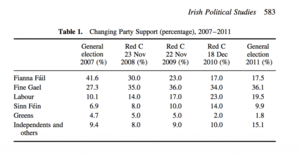
However, RTÉ was ‘unable to take account of the dramatic shifts in public opinion’ – shown in the table below – in the run-up to the 2011 general election:
Mr Rafter explained that, in November 2010, a list of 12 questions were distributed in an RTÉ staff memo outlining what aspects should be considered in regards to coverage.
But, Mr Rafter said:
“In truth, the unwieldy 12-point list offered little clarification. There was an absence of weighting criteria to specify the relative importance of each point in determining on-air coverage allocations. As the general election campaign drew closer, there was further internal discussion about the distribution of on-air time among the political parties. What is evident from minutes of these discussions is acceptance that the changed political landscape since 2007 meant the traditional policy based on the previous general election results was unsustainable.”
In January 2011, RTÉ then ‘privately examined’ several different ways of calculating a way of allocating on-air time and even engaged in ‘confidential discussions’ with ‘a number of academics to examine how RTE should deal with coverage allocation’.
Following these private discussions, there was a preference for the following four factors to be considered: first preference votes in the 2007 election; percentage of seats held by the party at the calling of the election in 2011; an estimate of the number of candidates nominated by each party in 2011; and an average of (a) average opinion poll results from 2007 to 2011, (b) percentage of first preference vote in the 2009 European elections and (c) percentage of first preference vote in the 2009 local elections.
But, Mr Rafter noted, while several different options were considered:
‘When the calculations were undertaken, however, the coverage allocation outcomes per party were in fact relatively similar.’
In particular there was a problem with the fourth factor, in regards to polls, given that smaller parties were not included in national polls.
Mr Rafter stated:
“This weakness was acknowledged with a proposal that category four for smaller parties would be calculated only on local and European results in 2009. The wider issue of basing coverage allocations in a national parliamentary election on the results from second-order electoral contests, where results can vary with ‘very little at stake’, does not appear to have been considered.”
Mr Rafter also stated that, in addition to these discussions being held in private, the BAI was not consulted about them.
Mr Rafter said that while RTÉ claimed to endeavour for its political party coverage not to ‘be reduced to a stopwatch exercise’ it was, in fact, ‘very much driven by time allocations’.
In a bid to monitor its coverage, RTÉ employed a researcher for the duration of the election to prepare reports on the proportion of on-air time given to candidates and parties – including the following table:
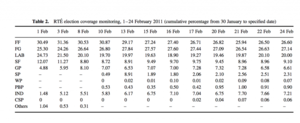
Mr Rafter explained:
“The data in Table 2 are drawn from the results of RTE’s own monitoring of its programme coverage during the 2011 election campaign. The data are cumulative, so for example, the figures on 8 February include all programme coverage from the start of monitoring on 1 February up until 8 February.”
“From the outset of the election campaign internal concerns were expressed in RTE about the proportion of coverage being given to independent candidates and those representing smaller parties. Examples of recorded comments include the following: ‘It was emphasised that all programmes must work towards getting the proportion of attention given to independents and smaller parties up to acceptable levels’, ‘…some concerns at the need to significantly increase the level of attention to others/smaller parties’, ‘Once again programme makers were asked to use every available opportunity to include others/smaller parties as the guideline for their proportion of attention was difficult to achieve’, ‘Concerns continue to be raised about the excessive level of attention to Labour and the under-attention for independents and others.’
Specifically, RTÉ’s review of its coverage – at the midpoint of the election – found the following:
Fianna Fáil was in the 30-31 per cent range when the guidelines stated FF should receive 31 per cent.
Fine Gael was in the 25-27 per cent range when the guidelines stated FG should receive 27 per cent.
Labour was in the 20-25 per cent range when the guidelines stated Labour should receive 13 per cent.
Sinn Féin was in the 9-12 per cent range when the guidelines stated SF should receive 7 per cent.
Green Party was in the 5-8 per cent range when the guidelines stated it should receive 5 per cent.
Others/independents were in the 3-8 per cent range when guidelines stated they should receive 18 per cent.
Mr Rafter noted from the minutes of RTÉ’s Steering Committee, that:
“Specific suggestions to address the problem included devoting more time to smaller parties and independents on afternoon television programmes and on Late Debate, a late night radio programme. The fact that these slots in the programme schedules attracted relatively modest audiences vis-a-vis appearances on prime time news and current affairs programmes was not mentioned.”
In addition, after the 2011 election, it was noted in minutes of the RTE Steering Committee from March 2011 that, ‘as with previous elections the level of attention given to independents remains problematic’.
Mr Rafter explained that RTE proffered different reasons for the imbalance of its coverage:
“Several justifications were postulated within RTE in the aftermath of the general election to explain the imbalance in coverage across the various political groupings. Sensitivity relating to coverage of independent candidates was evident.”
“Justifications – perhaps better described as excuses – included the fact that ‘independents with little or no track record find it difficult to get on radio or television’: ‘the role of political parties in government forming’; and the strength of established parties ‘given that elections are largely fought through political parties and track records are important in determining attention this is inevitable’.”
“The post-election rationale, however, contrasts sharply with the ongoing internal concern repeatedly expressed during the campaign itself and does little to explain why the evident coverage variations were not more seriously addressed in programme output during the campaign itself.
“This outcome hardly meets the BAI’s requirement to deal with election coverage issues at an early stage. Moreover, once decisions were taken internally within RTE, the provision of information to all interested parties, including it is assumed voters, was not a priority.”
Regulating the Airwaves: How Political Balance is Achieved in Practice in Election News Coverage (Irish Political Studies)
Revealed: Sinn Féin’s bid to intimidate RTÉ (Irish Independent)
Revealed: Sinn Féin’s ‘orchestrated campaign’ of intimidation against RTÉ (Fionnan Sheahan, Irish Independent)
How bullying RTÉ worked for Sinn Féin at the last election, so the party is at it again (Fionnan Sheahan, Irish Independent)