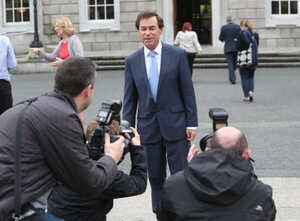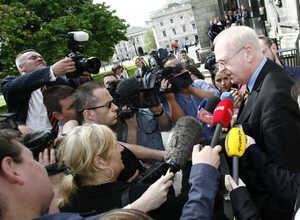



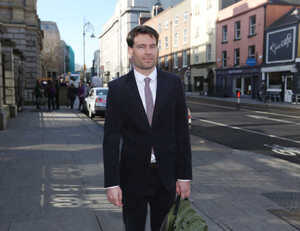


From top: UCD lecturer Julien Mercille, Irish Independent columnist Dan O’Brien and founder of Hibernia Forum Eamon Delaney
And that’s it.
You may recall the publication of the 456-page Banking Inquiry report during the week.
The report contained a chapter entitled The Property Sector, which included a section on Property Valuation which, in turn, contained a sub-section on Property Sector Relationships with the Media.
It was 1½ pages long.
And it concluded uncontroversially:
“Revenue from the property sector was a significant source of income for some media outlets, accounting for as much as 14% or 17% of all revenue for some newspapers. Editors denied that editorial independence was affected by their advertising relationship with the property sector.”
Further to this…
UCD lecturer and dreamboat ‘sheet columnist Dr Julien Mercille; chief economist at the Institute of International and European Affairs in Dublin, Irish Independent columnist and former economics editor at the Irish Times (2010 to 2013) Dan O’Brien; and former diplomat and founder of right-wing think tank Hibernia Forum Eamon Delaney spoke to Sarah Carey on Newstalk this morning’s Talking Points show.
Specifically, they discussed the media’s role in pumping up the boom, promising pillow soft landings and supporting austerity when their analysis proved faulty.
Grab a large tay.
Sarah Carey: “Julien Mercille, I’ll start with you because you laid out quite a coherent case against the media at the banking inquiry. Will you give us the elevator pitch on how it’s our fault?”
Julien Mercille: “Well, it’s against a certain type of media. I mean the case I make is that the media reflects the interests of its owners and that’s very, very easy to understand from other media. We don’t have a problem saying that the UCD student paper reflects the interests of the students, by and large, or a union paper reflects the union interests. It’s kind of obvious. But when we come to corporate media or State-owned media you say well that reflects the interests of the State, the Government or the corporate world, people sometimes say, ‘oh no, you’re a conspiracy theorist’ or something. And again it doesn’t mean that because it reflects the interests and views of the corporate world, it’s wrong. It can be right, it’s just a matter of saying it’s a certain interest and it’s a narrow range of interests that we see in the media. So, in relation to the housing bubble and the banking inquiry, the media was very much supporting the housing bubble.
There were some voices of dissent but we can name them very quickly because there’s probably only one or two people – David McWilliams is the most prominent one but everybody else was saying there either was no problem, there’s going to be a soft landing or what happens often is also they wouldn’t talk about it. So if you don’t talk about a big problem, a big bubble that’s growing and growing, that’s a kind of passive support so sometimes the media works more in that way. People don’t know there’s something important so they keep buying houses. And then there’s a problem and everybody says, ‘oh, we never saw it’. Whereas if you looked just across the sea, The Economist magazine had warned about the bubble in 2003. And not just a vague warning, a very precise warning saying house prices are overvalued by 40% I think and there were many housing bubbles at that time in the world so Ireland was not unique in that respect.”
Sarah Carey: “Are you saying that journalists were consciously bending to the will of what they thought their corporate bosses wanted or was it just something far more subtle in their neglect of the topic?”
Mercille: “Sometimes there were, at the banking inquiry again, we know that property industry called The Irish Times, for example, and said, ‘listen you better have good coverage because, you know, we’re not going to sponsor, we’re not going to advertise with you’, so there were a few explicit threats like that. But mostly I don’t think journalists were, every day, like, ‘ok, I cannot talk about the housing bubble’. I think the media is like any institution. People who work in the media mostly internalise the rules and they come not to think about them so much. It’s such a fast-paced work anyway and you don’t sometimes have the time to think about it. It’s the same thing for any institution, whether it’s the military or academia.”
Carey: “So, Dan O’Brien, the media internalised the problem and therefore were incapable of seeing it clearly?”
Dan O’Brien: “Well, can I come back to the first, the specific issue of the bubble and the property thing and then there’s the broader charge that Julien makes about media organisations doing their corporate owners’ bidding and Julien says that media people do what the corporate and Government interests want. Now I would really suggest to Julien that he get out a bit more because if you talk to politicians, most politicians hate the media, particularly Government politicians. They say that the media doesn’t report their achievements, it only looks at trivial things, it looks at their fights, it tries to catch them out all the time. The notion that the media is supportive of a government, like politicians just would laugh at that proposition. That’s politicians. Corporate, like the amount of times I’ve talked to people in business who believe the media are full of left-wing, anti-business people. They think the media is anti-profit, anti-business.
Again, they would just laugh at the notion that the media is dominated by pro-business cheerleaders. So, you know, different people have different perspectives. Julian, from his perspective, believes that, you know, the media is all dominated and basically just does business and Government’s bidding, I just think that’s fantasy. OK, so let’s move on to the bubble. I have two hats – I have one as an economist, I have one as somebody who contributes to the media. As an economist, I think we’re the people who deserve blame for missing out on the bubble, OK? Journalists are generalists, they can’t be experts on everything, that’s one of the great difficulties of media. If the majority of the economics community either thought there wasn’t a bubble or, as Julian said, didn’t raise it enough and I was guilty of that. I didn’t, I wasn’t living here so, you know, I should have said more in hindsight about the risks and that the failing of the economics profession when the average journalist was looking at what was going on and saying, ‘well look, most economists, who know more about this stuff than I do, say there’s not a problem or the risk is relatively low, well then, what are we going to write everyday. Somebody’s talking about a risk, are we going to put this on the front page everyday? No.’ So I, in my view, there were some failings in the media around the bubble and there are things that could be changed but did the media contribute in any big way to the inflating of the bubble? No. It was the banks, it was the columnists’ intellectual failings…”
Carey: “But what about property journalism specifically? I mean you know like that was, first of all, you had the revenues from property advertising, which were hugely significant. Julien pointed out that both INM and The Irish Times actually bought property websites and then you had the property porn, all those wonderful articles. You know no house ever had a flaw in it, the lovely advertorials, you know…”
O’Brien: “The notion that a journalist ceases, becomes a property editor for a newspaper and then puts aside the normal journalistic rigour and scrutiny and then writes, as you say, only positive stuff – you know, personally, I don’t think that’s the way to go. And, you know, that still happens. I don’t, you know, make decisions on how newspapers are run. Certainly, I don’t think that’s a good thing. But, you know, in terms of papers taking adverts for the sale of houses, now the last time I looked, selling a house was legal. If somebody comes to you and says, ‘I will pay to advertise to sell a product’, why would a company in an industry that’s in big trouble turn away those revenues? There’s nothing wrong with advertising if businesses want to advertise. Now when this issue of whether advertisers influenced editorial content, you know, I’ve read Julien’s work very closely – I don’t see evidence where he’s put that, where there’s definite evidence that advertisers actually influenced editorial content. I’m not saying it didn’t happen. I don’t know. But I certainly haven’t seen any convincing evidence from Julien’s work showing that advertisers influenced editorial content.”
Later
Carey: “So Julien, the problem here is just going back to that issue of confirmation bias in that we’re each seeing, you know, what we think is a bias in the media from a different perspective. So Dan’s question about evidence, you know, how much evidence were you actually able to compile on quantity of articles say not challenging the boom or challenging the boom or whatever?”
Mercille: “Well I have to say, before that, whenever you hear something from Dan O’Brien, you have to remember he has no credibility whatsoever, right? And I’ll tell you why.”
Carey: “Well I…”
Mercille: “I’ll tell you why, very clearly. From 2002, or something, until the bubble burst, he said himself, he didn’t see that. After that, 2008 until today, he was a cheerleader for austerity which doesn’t work – he doesn’t understand that. So 15 years of failure right there. So whenever he says something it has to be taken with a big grain of salt. Now his other, latest accusation – that in my work there’s no influence about advertisers – I don’t know what he’s reading, this is out there in the open. There’s good papers, interviewing journalists, saying, ‘we had pressures from the property sector telling us don’t do this, don’t write that’ and that’s fine.”
Carey: “Have you specific cases of that happening? Like you, do you know specific cases where journalists were explicitly told… now I’m…”
Mercille: “Yeah.”
Carey: “I’m very open to the idea of self-censorship and group think but in the case of specific examples…”
Mercille: “Of course there…”
O’Brien: “But so what? What difference…”
Mercille: “Look, she asked me the question, right?”
O’Brien: “Oh, sorry.”
Mercille: “There’s a paper published, I think it’s from DCU [sic], and they’ve interviewed journalists and they said exactly what I just said, ‘the property sector would tell us this and that’. Now the other thing that is important, it’s not, the media doesn’t work in a way that property people call every journalist and editors call every journalist, ‘hey don’t do this, don’t do that’ – people know what they have to do. So when the editors came in the banking inquiry and said, ‘I never felt any pressure from my owners’, I kind of believe them because they share the same values. They wouldn’t be in the position they are, if they didn’t share the same values. Now if the editors were really critical people, who were thinking for themselves and challenging the establishment, they would lose their job right away. So because they are there, of course they don’t feel any pressures from them, they’re as a team. So there’s a truth to that.”
Carey: “Ok, now what about Dan’s point though, that the overwhelming majority of the economics profession didn’t call the bubble. They were, there was a large buy into the idea of the soft landing.”
Mercille: “That’s true.”
Carey: “So, you can’t blame journalists…”
Mercille: “Yes, I can.”
Carey: “When they were being told, all round them. So, fine, you’re quoting one article from The Economist but I think even the IMF, you know, weren’t aware of all the risks. So, you know, what else were journalists to do?”
Mercille: “It’s interesting that I’m sitting here, and every time I go on the media, as the person on the panel who doesn’t like the media and journalists but actually I have much more respect for journalists than sometimes what Dan is saying. He’s saying that journalists just listen to economists and then they just copy what the economists said, it’s not their fault.”
O’Brien: “I never said that.”
Mercille: “You’re a journalist, right?”
Carey: “Yeah.”
Mercille: “The journalist should be robust. Just copying down what the economists? Journalists have to do more and be critical.”
Carey: “But they don’t. That’s the problem.”
Mercille: “Well, yeah, that’s why… I mean I respect the profession a bit more when I say they should. I don’t say they’re journalists, it’s not their fault. No, you have an obligation to research. Of course, the economics profession is also very pro-establishment, so it’s no wonder that they didn’t see the housing bubble. Now Dean Baker, who is one of the best economists in the world, in 2002, wrote a very good paper about the US housing bubble, warned about it very clearly, not vague speculations. Dean Baker writes papers with Paul Krugman, he’s not a backwater economist…”
Carey: “I’ll come to Dan now on that….”
Later
Carey: “So Dan, do you want to respond…”
O’Brien: “Look, I don’t, I don’t feel the need to defend myself. Whatever, but…”
Mercille: “Maybe you can’t defend yourself, Dan. That’s why.”
O’Brien: “I will actually, Julien. I actually worked at The Economist that you talked so glowingly about from 1998 to 2010. Some of the reports that you…”
Mercille: “You should have read the articles then that warned you about the bubble.”
O’Brien: “I was involved in the survey of Ireland, as it happens, that you’ve cited and you don’t quite seem to understand. The bottom line is, I did warn about risks, I came on TV here. I said, in 2006, I said, ‘don’t buy a house unless your income is guaranteed’. I said, ‘there’s a real risk, there’s too much debt’. I didn’t live here, I was asked, I was back and I was asked to go on a Prime Time show, exactly 10 years ago, so I did warn of risks. And, in terms of the post-crisis, I’ve been living here since 2010, I have taken a view that there was a need for fiscal consolidation. The economy is now growing again, it’s recovering. You say austerity doesn’t work, I don’t put it like austerity works, it doesn’t work, we had no choice in terms of bringing our budget back into balance and that was my view. So that’s you know, just, whatever in terms of [inaudible]..”
Later
Carey: “Eamon Delaney, obviously there’s a lot of concern in Ireland around media ownership and cross media ownership. But I’ve often wondered, as well, about cross media employment, you know, where you have journalists, like you and I who are, say, working for Newstalk and maybe writing for the Independent or maybe writing for the Sunday Business Post or writing for the Sunday Times occasionally – that how are journalists supposed to call out each other if they’re worried that the paper that they might be criticising or the broadcasting organisation that they might be criticising might be a future employer that they might need?”
Eamon Delaney: “I think that’s just something to navigate individually. You see, I don’t…”
Carey: “But do people navigate it individually by holding back?”
Delaney: “Like common sense, I think yeah.
Carey: “Define that?”
Delaney: “Well I think that, look, you know, I would be critical of some journalists who’ve written for Independent newspapers, over the years, but I wouldn’t do it in a way that was disloyal to the paper. I mean I’m actually one of those people who believes, you know, if I worked in a restaurant as a waiter, I wouldn’t badmouth the chef. You know? I don’t get this kind of phenomenon that we had a few years ago of a certain Sunday paper attacking the main owner of the paper, the main owner of this radio station as well – I thought it was insane. If I was employing someone, I’d want them to be kind of loyal to the owner and to the general ethos. But I do think, and it does happen, that journalists do disagree greatly even though they work with the same organisation – Patsy McGarry and John Waters used to have great scraps, they were both employed by the Irish Times, I think it’s just something you navigate and it’s a matter of common sense, you know?”
Carey: “Dan what about you? Or sorry, Julien, you want to come in on that…”
Mercille: “I think it’s very interesting what Eamon said. I mean, you’ve said very clearly what I’ve been saying for ever. You said, I’m expecting to be loyal to my owner. I mean this is very, very, very obedient. I mean…”
Delaney: “They’re employing you, I mean…”
Mercille: “It’s very obedient, a real journalist would say, ‘this guy hired me to find out the truth’, whatever it is.”
Delaney: “He can do that as well.”
Mercille: “Well you just said ‘I would be expecting that someone would be loyal to me and I’m always loyal to my owner’. I mean this is very, very revealing. People ask me for examples all the time, that’s it, there’s just one right there…and unconsciously you said it.”
Delaney: “Yeah, and I’ll say it again, I do think one should be loyal to one’s employer.”
Mercille: “Well again, that’s an ethos of journalism in Ireland: we should be loyal to our employer. What is that?”
Delaney: “Julien, you’re one of these people that thinks journalists are paid for by…the media needs…”
Mercille: “What is that? This is the best quote since I got to Ireland. And he repeats it, you know, he’s very proud of it.”
Carey: “Julien, to be fair, maybe to Eamon, I mean in the last four months you’ve written for the Independent, Sunday Business Post…”
Delaney: “Everybody, yeah.”
Carey: “The Daily Mail, yeah, you’re writing for everyone…”
Delaney: “Yeah.”
Carey: “So even taking into account the loyalty of the owner, which you did say, my point is that by writing for each one of them, you know, does that mean you can’t criticise each of them for failures?”
Delaney: “But I do, but I’m careful. I don’t, you know, yeah, I’m not gonna…”
Mercille: “So you criticise on the things that are not too important but you remain loyal.”
Delaney: “No I do criticise on things that are important…”
Mercille: “But that’s what you said, you have to remain loyal…”
Delaney: “No I’m loyal, I don’t believe in attacking the owner of the newspaper…”
Mercille: “You don’t believe in attacking the owner of the newspaper?”
Delaney: “Absolutely not.”
Mercille: “Ok, but that’s very obedient, you’ll get a job anywhere in journalism.”
Delaney: “If I was employed as a diplomat I wouldn’t sit down and start writing tracts against the minister…”
Mercille: “A diplomat is also, they’re also parrots, they’re also parrots, they talk for the government and get fired, they get fired if they don’t say the government line. That’s the PR industry.”
Delaney: “I can honestly tell you, on a personal level, I do have strong principles, on many things..”
Mercille: “Loyalty is one…”
Delaney: “Well, no, if I could just finish, there has never been an issue where I was writing for someone or I was avoiding something that I felt, never…”
Carey: “Right.”
Mercille: “Because you’ve internalised the principle so much that you don’t even feel the principle of attacking…”
Delaney: “You see this is like, you’re now telling me, this is like psychiatry like, I’m not internalising, you’re gonna tell me that I’m subconsciously self-censoring myself…”
Mercille: “No people can hear it very clearly.”
Delaney: “No, no..”
Carey: “Well Julien, if Eamon is saying that’s he never had a moment where he thought he wanted to criticise someone…”
Delaney: “Or a thing…”
Carey: “…but held back and didn’t out of fear of the consequences, is that what you’re saying, Eamon?”
Delaney: “Yeah, I’ve never, never…now I may have the same views as the owners of papers in that way we differ, you know, duly, we do differ, in the same way as someone say you were happy writing for the Irish government, yeah because I shared most of their views and still do, as a state. But I’ve never been stopped. I have been told I can’t write about something – interestingly one was to do with trade unions in which a paper, let’s not say what it was, was friendly to this particular trade union movement. So there you go that’s censorship from the left and a few other things to do with a few individuals and libel but not on any issues.”
Listen back in full here
Previously: For Those Who Shouted Stop He Salutes You