
Category Archives: Science

Behold: an especially clear and pleasing image of the Pleiades, perhaps the most famous star cluster in the sky. To wit:

 …the bright stars of the Pleiades can be seen without binoculars from even the depths of a light-polluted city. With a long exposure from a dark location, though, the dust cloud surrounding the Pleiades star cluster becomes very evident. The featured exposure covers a sky area several times the size of the full moon. Also known as the Seven Sisters and M45, the Pleiades lies about 400 light years away toward the constellation of the Bull (Taurus). A common legend with a modern twist is that one of the brighter stars faded since the cluster was named, leaving only six of the sister stars visible to the unaided eye. The actual number of Pleiades stars visible, however, may be more or less than seven, depending on the darkness of the surrounding sky and the clarity of the observer’s eyesight.

(Image: Raul Villaverde Fraile)
Another view?

apod

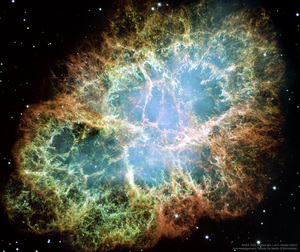
Behold: Messier 1 – the inextricable mess left over when a star explodes. To wit:

The Crab Nebula – the result of a supernova seen in 1054 AD – is filled with mysterious filaments. The filaments are not only tremendously complex, but appear to have less mass than expelled in the original supernova and a higher speed than expected from a free explosion. The featured image, taken by the Hubble Space Telescope, is presented in three colours chosen for scientific interest. The Crab Nebula spans about 10 light-years. In the nebula‘s very centre lies a pulsar: a neutron star as massive as the Sun but with only the size of a small town. The Crab Pulsar rotates about 30 times each second.

(Image: NASA, ESA, Hubble, J. Hester, A. Loll (ASU)

apod

It’s diffuse. And gaseous.

Scarlet for yeh.

Behold: M31, aka NGC 244, aka Andromeda  the closest large spiral galaxy to our own Milky Way. But not as it’s normally seen. To wit:

Some 2.5 million light-years distant it shines in Earth’s night sky as a small, faint, elongated cloud just visible to the unaided eye. Invisible to the eye though, its enormous halo of hot ionised gas is represented in purplish hues for this digital illustration of our neighbouring galaxy above rocky terrain. Mapped by Hubble Space Telescope observations of the absorption of ultraviolet light against distant quasars, the extent and make-up of Andromeda’s gaseous halo has been recently determined by the AMIGA project. A reservoir of material for future star formation, Andromeda’s halo of diffuse plasma was measured to extend around 1.3 million light-years or more from the galaxy. That’s about half way to the Milky Way, likely putting it in contact with the diffuse gaseous halo of our own galaxy.

(Digital Illustration: NASA, ESA, J. DePasquale and E. Wheatley (STScI) and Z. Levay)

apod

One, right?

Wrong. To wit:

.. take a closer look at the object on the upper right. That seeming-star is actually the planet Jupiter, and your closer look might reveal that it is not alone – it is surrounded by some of its largest moons. From left to right these Galilean Moons are Io, Ganymende, Europa and Callisto. These moons orbit the Jovian world just like the planets of our Solar System orbit the Sun, in a line when seen from the side. The featured single shot was captured from Cancun, Mexico last week as Luna, in its orbit around the Earth, glided past the distant planet. Even better views of Jupiter are currently being captured by NASA‘s Juno spacecraft, now in a looping orbit around the Solar System’s largest planet. Earth’s Moon will continue to pass nearly in front of both Jupiter and Saturn once a month (moon-th) as the two giant planets approach their own great conjunction in December.

(Image: Robert Fedez)

apod

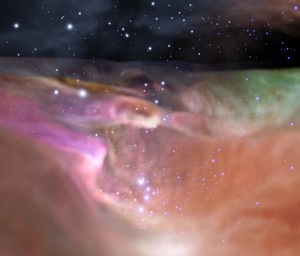
Behold: Messier 42, the Orion Nebula, or rather a visualisation of it based on astronomical data and movie rendering techniques. To wit:

Up close and personal with a famous stellar nursery normally seen from 1,500 light-years away, the digitally modeled frame transitions from a visible light representation based on Hubble data on the left to infrared data from the Spitzer Space Telescope on the right. The perspective at the center looks along a valley over a light-year wide, in the wall of the region’s giant molecular cloud. Orion’s valley ends in a cavity carved by the energetic winds and radiation of the massive central stars of the Trapezium star cluster. The single frame (top) is part of a multiwavelength, three-dimensional video that lets the viewer experience an immersive, three minute flight through the Great Nebula of Orion.

Any excuse…

(Visualization: NASA, ESA, F. Summers, G. Bacon, Z. Levay, J. DePasquale, L. Frattare, M. Robberto, M. Gennaro (STScI) and R. Hurt (Caltech/IPAC)

apod

Behold: SS 433 – one of the most exotic eclipsing x-ray binary star systems we know of. And that’s saying something. To wit:

Its unremarkable name stems from its inclusion in a catalog of Milky Way stars which emit radiation characteristic of atomic hydrogen. Its remarkable behaviour stems from a compact object, a black hole or neutron star, which has produced an accretion disk with jets. Because the disk and jets from SS 433 resemble those surrounding supermassive black holes in the centres of distant galaxies, SS 433 is considered a micro-quasar. As illustrated in the animated featured video based on observational data, a massive, hot, normal star is locked in orbit with the compact object. As the video starts, material is shown being gravitationally ripped from the normal star and falling onto an accretion disk. The central star also blasts out jets of ionised gas in opposite directions – each at about 1/4 the speed of light. The video then pans out to show a top view of the precessing jets producing an expanding spiral. From even greater distances, the dissipating jets are then visualised near the heart of supernova remnant W50. Two years ago, SS 433 was unexpectedly found by the HAWC detector array in Mexico to emit unusually high energy (TeV-range) gamma-rays. Surprises continue, as a recent analysis of archival data taken by NASA‘s Fermi satellite find a gamma-ray source — separated from the central stars as shown — that pulses in gamma-rays with a period of 162 days – the same as SS 433’s jet precession period – for reasons yet unknown.

(Animation: DESY, Science Communication Lab)

apod

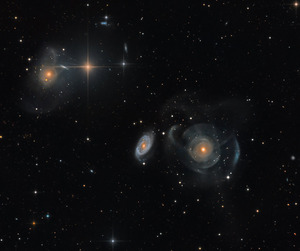
Behold : the twin galaxies of Arp 227 – a mere 100 million light years from here. To wit:

Swimming within the boundaries of the constellation Pisces, Arp 227 consists of the two galaxies prominent right of centre, the curious shell galaxy NGC 474 and its blue, spiral-armed neighbour NGC 470. The faint, wide arcs or shells of NGC 474 could have been formed by a gravitational encounter with neighbor NGC 470. Alternately the shells could be caused by a merger with a smaller galaxy producing an effect analogous to ripples across the surface of a pond. The large galaxy on the top lefthand side of the deep image, NGC 467, appears to be surrounded by faint shells too, evidence of another interacting galaxy system. Intriguing background galaxies are scattered around the field that also includes spiky foreground stars. Of course, those stars lie well within our own Milky Way Galaxy. The field of view spans 25 arc minutes or about 1/2 degree on the sky.

(Image: Martin Pugh)

apod

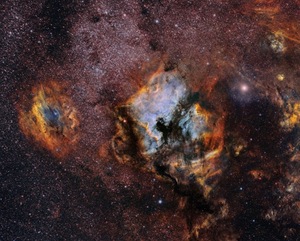
Behold: the spectacular skyscape of interstellar dust and glowing hydrogen gas near the northern end of the Great Rift and the constellation Cygnus the Swan.  To wit:

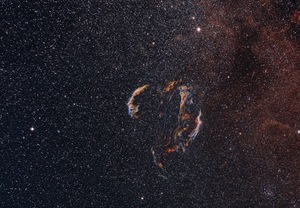
Composed using 22 different images and over 180 hours of image data, the widefield mosaic spans an impressive 24 degrees across the sky. Alpha star of Cygnus, bright, hot, supergiant Deneb lies near top centre. Crowded with stars and luminous gas clouds Cygnus is also home to the dark, obscuring Northern Coal Sack Nebula, extending from Deneb toward the center of the view. The reddish glow of star forming regions NGC 7000 and IC 5070, the North America Nebula and Pelican Nebulas, are just left of Deneb. The Veil Nebula is a standout below and left of centre. A supernova remnant, the Veil is some 1,400 light years away, but many other nebulae and star clusters are identifiable throughout the cosmic scene. Of course, Deneb itself is also known to northern hemisphere skygazers for its place in two asterisms — marking the top of the Northern Cross and a vertex of the Summer Triangle.

View full size here.

(Image: Alistair Symon)

apod

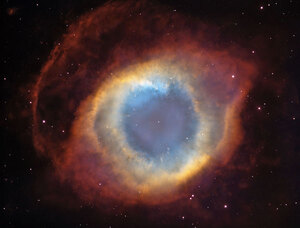
Behold: NGC 7293, aka the Helix nebula, ‘The Eye Of God’ or “The Eye Of Sauron’  – one of the closest to Earth of all the bright planetary nebulae. To wit:

How did a star create the Helix nebula? The shapes of planetary nebula like the Helix are important because they likely hold clues to how stars like the Sun end their lives. Observations by the orbiting Hubble Space Telescope and the 4-meter Blanco Telescope in Chile, however, have shown the Helix is not really a simple helix. Rather, it incorporates two nearly perpendicular disks as well as arcs, shocks, and even features not well understood. Even so, many strikingly geometric symmetries remain. How a single Sun-like star created such beautiful yet geometric complexity is a topic of research. The Helix Nebula is the nearest planetary nebula to Earth, lies only about 700 light years away toward the constellation of Aquarius, and spans about 3 light-years.

(Image: C. R. O’Dell, (Vanderbilt) et al. ESA, NOAO, NASA)

apod

This is what a crescent moon actually looks like. But we never see it this way because our eyes can’t simulataneously discern between such light and dark regions. To wit:

Called earthshine or the ‘da Vinci glow’, the unlit part of a crescent Moon is visible but usually hard to see because it is much dimmer than the sunlit arc. In our digital age, however, the differences in brightness can be artificially reduced. The featured image is actually a digital composite of 15 short exposures of the bright crescent, and 14 longer exposures of the dim remainder. The origin of the da Vinci glow, as explained by Leonardo da Vinci about 510 years ago, is sunlight reflected first by the Earth to the Moon, and then back from the Moon to the Earth.

Now for yeh.

(Image: Miguel Claro (TWAN, Dark Sky Alqueva))

apod