
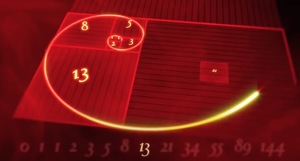


A rather lovely short film by Cristóbal Vila showing how the Fibonacci Sequence manifests itself throughout nature in forms as diverse as sunflowers, nautilus shells and dragonfly wings.



A rather lovely short film by Cristóbal Vila showing how the Fibonacci Sequence manifests itself throughout nature in forms as diverse as sunflowers, nautilus shells and dragonfly wings.
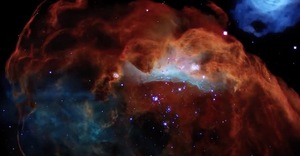

Behold: nebular cloud NGC 2014 in the Large Magellanic Cloud – like a great glowing ocean reef in the sky. To wit:
A detailed image of this distant nebula was taken by the Hubble Space Telescope to help commemorate 30 years of investigating the cosmos. Data and images of this cosmic reef have been combined into the three-dimensional model flown through in the featured video. The computer animated sequence first takes you past a star cluster highlighted by bright blue stars, below pillars of gas and dust slowly being destroyed by the energetic light and winds emitted by these massive stars. Filaments of gas and dust are everywhere, glowing in the red light of hydrogen and nitrogen. The animation next takes you to the blue-coloured nebula NGC 2020, glowing in light emitted by oxygen and surrounding a Wolf-Rayet star about 200,000 times brighter than our Sun — a nebula thought to be the ejected outer atmosphere of this stellar monster. As the animation concludes, the virtual camera pivots to show that NGC 2020 has a familiar hourglass shape when viewed from the side.
(Video: NASA, ESA, and Viz3D Team (STScIi))

Behold: the mighty gas giant Jupiter getting its Hallowe’en pumpkin on: captured in infrared by astronomers at the Gemini North Observatory in Hawaii. To wit:
Gemini was able to produce such a clear image using a technique called lucky imaging, by taking many images and combining only the clearest ones that, by chance, were taken when Earth’s atmosphere was the most calm. Jupiter’s jack-o’-lantern-like appearance is caused by the planet’s different layers of clouds. Infrared light can pass through clouds better than visible light, allowing us to see deeper, hotter layers of Jupiter’s atmosphere, while the thickest clouds appear dark. These pictures, together with ones from the Hubble Space Telescope and the Juno spacecraft, can tell us a lot about weather patterns on Jupiter, like where its massive, planet-sized storms form.
(Image: International Gemini Observatory, NOIRLab, NSF, AURA; M. H. Wong (UC Berkeley) & Team; Acknowledgment: Mahdi Zamani; Text: Alex R. Howe (NASA/USRA, Reader’s History of SciFi Podcast)



TLDR? Adenosine Triphosphate.
A sobering reflection on life, the Universe and everything from the always fascinating German education design studio, Kurzgesagt. To wit:
Picture yourself as a slinky falling down an escalator moving upwards – the falling part represents the self replicating processes of your cells, the escalator represents the laws of physics, driving you forwards. To be alive is to be in motion but never arriving anywhere. If you reach the top of the escalator there is no more falling possible and you are dead forever.
Previously: Coronavirus Explained
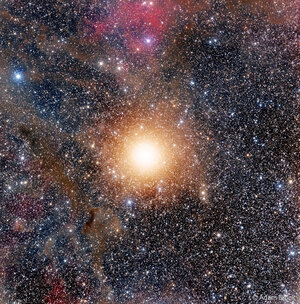
What’s behind Betelgeuse? Quite a few things as it happens. To wit:
One of the brighter and more unusual stars in the sky, the red supergiant star Betelgeuse can be found in the direction of famous constellation Orion. Betelgeuse, however, is actually well in front of many of the constellation’s other bright stars, and also in front of the greater Orion Molecular Cloud Complex. Numerically, light takes about 700 years to reach us from Betelgeuse, but about 1,300 years to reach us from the Orion Nebula and its surrounding dust and gas. All but the largest telescopes see Betelgeuse as only a point of light, but a point so bright that the inherent blurriness created by the telescope and Earth’s atmosphere make it seem extended. In the featured long-exposure image, thousands of stars in our Milky Way Galaxy can be seen in the background behind Betelgeuse, as well as dark dust from the Orion Molecular Cloud, and some red-glowing emission from hydrogen gas on the outskirts of the more distant Lambda Orionis Ring. Betelgeuse has recovered from appearing unusually dim over the past six months, but is still expected to explode in a spectacular supernova sometime in the next (about) 100,000 years.
*popcorn*
(Image: Adam Block, Steward Observatory, University of Arizona)
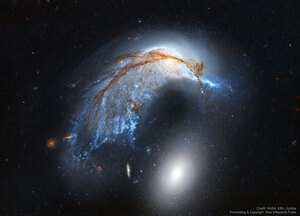
Behold: NGC 2936 – aka, the Porpoise Galaxy – the upper of the two galaxies shown in this image. But why does it look this way? To wit:
Just a few hundred million years ago, NGC 2936, the upper of the two large galaxies shown, was likely a normal spiral galaxy — spinning, creating stars — and minding its own business. But then it got too close to the massive elliptical galaxy NGC 2937 below and took a dive. Dubbed the Porpoise Galaxy for its iconic shape, NGC 2936 is not only being deflected but also being distorted by the close gravitational interaction. A burst of young blue stars forms the nose of the porpoise toward the right of the upper galaxy, while the center of the spiral appears as an eye. Alternatively, the galaxy pair, together known as Arp 142, look to some like a penguin protecting an egg. Either way, intricate dark dust lanes and bright blue star streams trail the troubled galaxy to the lower right. The featured re-processed image showing Arp 142 in unprecedented detail was taken by the Hubble Space Telescope last year. Arp 142 lies about 300 million light years away toward the constellation, coincidently, of the Water Snake (Hydra). In a billion years or so the two galaxies will likely merge into one larger galaxy.
(Image: NASA, ESA, Hubble, HLA; Reprocessing & Copyright: Raul Villaverde)

Behold: LDN 1471 – a windblown star cavity created by a newly forming star which can be seen at the peak of the parabola. To wit:
This protostar is experiencing a stellar outflow which is then interacting with the surrounding material in the Perseus Molecular Cloud, causing it to brighten. We see only one side of the cavity — the other side is hidden by dark dust. The parabolic shape is caused by the widening of the stellar-wind blown cavity over time. Two additional structures can also be seen either side of the protostar, these are known as Herbig-Haro objects, again caused by the interaction of the outflow with the surrounding material. What causes the striations on the cavity walls, though, remains unknown. The featured image was taken by NASA and ESA’s Hubble Space Telescope after an original detection by the Spitzer Space Telescope.
(Image: Hubble, NASA, ESA; Processing & License: Judy Schmidt)

Behold: the Carina Nebula, aka The Grand Nebula – one of the very few nebulas visible to the unaided eye, but you have to be well south, looking south. To wit:
The featured image had to be taken from a very dark location to capture the Carina Nebula with such perspective and so near the horizon. The Great Nebula in Carina, cataloged as NGC 3372, is home to the wildly variable star Eta Carinae that sometimes flares to become one of the brightest stars in the sky. Above Carina is IC 2944, the Running Chicken Nebula, a nebula that not only looks like a chicken, but contains impressive dark knots of dust. Above these red-glowing emission nebulas are the bright stars of the Southern Cross, while on the upper left of the image is the dark Coalsack Nebula. This image was composed from six consecutive exposures taken last summer from Padre Bernardo, Goiás, Brazil. Even with careful planning, the astrophotographer felt lucky to get this shot because clouds — some still visible near the horizon — kept getting in the way.
(Image: Carlos Kiko Fairbairn)
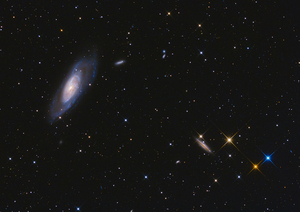
Behold: beautiful spiral galaxy Messier 106 (as it was about 17 million years before the evolution of humans), dominating a cosmic vista toward the well-trained constellation Canes Venatici, near the handle of the Big Dipper. To wit:
Also known as NGC 4258, M106 is about 80,000 light-years across and 23.5 million light-years away, the largest member of the Canes II galaxy group. For a far far away galaxy, the distance to M106 is well-known in part because it can be directly measured by tracking this galaxy’s remarkable maser, or microwave laser emission. Very rare but naturally occurring, the maser emission is produced by water molecules in molecular clouds orbiting its active galactic nucleus. Another prominent spiral galaxy on the scene, viewed nearly edge-on, is NGC 4217 below and right of M106. The distance to NGC 4217 is much less well-known, estimated to be about 60 million light-years, but the bright spiky stars are in the foreground, well inside our own Milky Way galaxy. Even the existence of galaxies beyond the Milky Way was questioned 100 years ago in astronomy’s Great Debate.
A closer look, perhaps?
(Image: Joonhwa Lee)

Behold: newly discovered comet C2020 F8 SWAN, just arrived from the outer solar system and developing a nice ion tail, having already passed inside the orbit path of the Earth. To wit:
…this outgassing interplanetary iceberg will pass its closest to the Earth on May 13, and closest to the Sun on May 27. The comet was first noticed in late March by an astronomy enthusiast looking through images taken by NASA’s Sun-orbiting SOHO spacecraft, and is named for this spacecraft’s Solar Wind Anisotropies (SWAN) camera. The featured image, taken from the dark skies in Namibia in mid-April, captured Comet SWAN‘s green-glowing coma and unexpectedly long, detailed, and blue ion-tail. Although the brightness of comets are notoriously hard to predict, some models have Comet SWAN becoming bright enough to see with the unaided eye during June.
(Image: Gerald Rhemann)






.jpg)


