
Category Archives: Science

Behold: a high definition image of Enceladus – the sixth largest of Saturn’s moons – captured during a flyby by the Cassini spacecraft, which orbited the ringed gas giant from 2004 to 2017. Evidence of extraterrestrial life? To wit:

A reason to think that life may exist there are long features — dubbed ‘tiger stripes’ — that are known to be spewing ice from the moon’s icy interior into space. These surface cracks create clouds of fine ice particles over the moon’s South Pole and create Saturn‘s mysterious E-ring. (/) The unusual surface tiger stripes are shown in false-colour blue. Why Enceladus is active remains a mystery, as the neighbouring moon Mimas, approximately the same size, appears quite dead. A recent analysis of ejected ice grains has yielded evidence that complex organic molecules exist inside Enceladus. These large carbon-rich molecules bolster — but do not prove — that oceans under Enceladus’ surface could contain life. Another Solar System moon that might contain underground life is Europa.

(Image: NASA, ESA, JPL, SSI, Cassini Imaging Team)

apod

Behold: star-forming region NGC 2014, also known as the Cosmic Reef: bright ridges of interstellar gas and dust bathed in energetic starlight. To wit:

Drifting just off shore, the smaller NGC 2020, is an expansive blue-hued structure erupting from a single central Wolf-Rayet star, 200,000 times brighter than the Sun. The cosmic frame spans some 600 light-years within the Large Magellanic Cloud 160,000 light-years away, a satellite galaxy of our Milky Way. A magnificent Hubble Space Telescope portrait, the image was released this week as part of a celebration to mark Hubble’s 30th year exploring the Universe from Earth orbit.

(Image: NASA, ESA, STScI)

apod

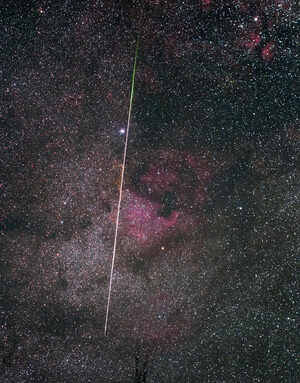
Behold: C/1861 G1, or comet Thatcher – part of Earth’s annual Lyrid meteor shower, which peaked before dawn yesterday. To wit:

In crisp, clear and moonless predawn skies over Brown County, Indiana this streak of vaporising comet dust briefly shared a telephoto field of view with stars and nebulae along the Milky Way. Alpha star of the constellation Cygnus, Deneb lies near the bright meteor’s path along with the region’s dark interstellar clouds of dust and the recognizable glow of the North America nebula (NGC 7000). The meteor’s streak points back to the shower’s radiant, its apparent point of origin on the sky. That would be in the constellation Lyra, near bright star Vega and off the top edge of the frame.

(Image: Zolt Levay)

apod

Maybe a little, but that’s not what’s happening here. To wit:

The featured 27-frame mosaic was taken last July from Ojas de Salar in the Atacama Desert of Chile. The eye is actually a small lagoon captured reflecting the dark night sky as the Milky Way Galaxy arched overhead. The seemingly smooth band of the Milky Way is really composed of billions of stars, but decorated with filaments of light-absorbing dust and red-glowing nebulas. Additionally, both Jupiter (slightly left the galactic arch) and Saturn (slightly to the right) are visible. The lights of small towns dot the unusual vertical horizon. The rocky terrain around the lagoon appears to some more like the surface of Mars than our Earth.

(Image: Miguel Claro (TWAN, Dark Sky Alqueva))

apod

Behold: IC 2944, a gaseous region of star formation also known as the ‘Running Chicken Nebula’ or the ‘λ Centauri Nebula’, if you must. To wit:

…the Running Chicken Nebula spans about 100 light years and lies about 6,000 light years away toward the constellation of the Centaur (Centaurus). The featured image, shown in scientifically assigned colours, was captured recently in a 12-hour exposure. The star cluster Collinder 249 is visible embedded in the nebula’s glowing gas. Although difficult to discern here, several dark molecular clouds with distinct shapes can be found inside the nebula.

(Image: Juan Filas)

apod

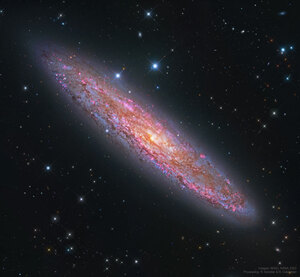
Behold: NGC 253, otherwise known as the ’Silver Coin Galaxy’ – one of the brightest visible spiral galaxies and also the dustiest. To wit:

…it is more formally known as the Sculptor Galaxy for its location within the boundaries of the southern constellation Sculptor. Discovered in 1783 by mathematician and astronomer Caroline Herschel, the dusty island universe lies a mere 10 million light-years away. About 70 thousand light-years across, NGC 253, pictured, is the largest member of the Sculptor Group of Galaxies, the nearest to our own Local Group of galaxies. In addition to its spiral dust lanes, tendrils of dust seem to be rising from a galactic disk laced with young star clusters and star forming regions in this sharp colour image. The high dust content accompanies frantic star formation, earning NGC 253 the designation of a starburst galaxy. NGC 253 is also known to be a strong source of high-energy x-rays and gamma rays, likely due to massive black holes near the galaxy’s centre.

(Image: NAOJ: Subaru, NASA & ESA: Hubble, ESO: VLT & Danish 1.5-m; Processing & Copyright: Robert Gendler & Roberto Colombari)

apod

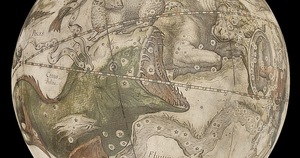
The British Museum has digitised many of its 17th and 18th century globes into spinnable zoomable 3D models for your perusal. To wit:

During the so-called ‘Age of Exploration’, expanding European geographical and astronomical knowledge fuelled the demand for maps and sea charts. It also inspired experimentation in the art of globe-making, and the first half of the 16th century saw the production of several models, both hand-painted and printed. Printing made it possible to produce globes in greater numbers at lower cost so they could be more widely distributed. The printed globe, terrestrial and celestial, soon became established as the standard type of globe, sometimes called the ‘common’ globe, and the methods of manufacture changed surprisingly little from the mid-16th century until the 20th century.

Explore them here.

kottke

Genuinely dark skies are a diminishing rarity given the ubiquity of wasteful artificial lighting, much of which serves to block our vision of space above us. To wit:

This light pollution not only wastes energy, but, when reflected by the Earth’s atmosphere back down, creates a nighttime brightness that disrupts wildlife and harms human health, while doing very little to prevent crime. Light pollution is also making a dark night sky a scarcity for new generations. While there is little that can be done in large cities, rural country areas could benefit from lighting that is fully shielded from exposing the night sky where it is not needed. The featured panorama contains 6 adjacent vertical segments taken from different locations across Slovakia — but with the same equipment and at the same time of night, and then subjected to the same digital post-processing. Although no stars are visible on the left-most city sky, the right-most country sky is magnificently dark. You can help protect the wonders of your night sky by favoring, when possible, dark sky friendly lighting.

(Image: Tomas Slovinsky; Text: Matipon Tangmatitham (NARIT))

apod

A timely feature from The School Of Life. To wit:

Emotional maturity isn’t just something we can achieve in the good times. It’s a quality that can accompany us through the deepest crises.  A key idea to keep in mind is that it isn’t chiefly what happens to us that affects our lives, it’s how we learn to think about what has happened – and that, fortunately, is very much within our control.

Previously: All Together Now

curiousbrain