
Category Archives: Science

Behold: M101, aka The Pinwheel Galaxy – 25 million light years away within the boundaries of the Ursa Minor constellation. One of the last entries in Charles Messier’s catalogue of astronomical objects but by no means the least. To wit:

About 170,000 light-years across, this galaxy is enormous, almost twice the size of our own Milky Way Galaxy. M101 was also one of the original spiral nebulae observed with Lord Rosse’s large 19th century telescope, the Leviathan of Parsonstown (Birr, county Offaly). In contrast, this multiwavelength view of the large island universe is a composite of images recorded by space-based telescopes in the 21st century. Colour coded from X-rays to infrared wavelengths (high to low energies), the image data was taken from the Chandra X-ray Observatory (purple), the Galaxy Evolution Explorer (blue), Hubble Space Telescope (yellow), and the Spitzer Space Telescope(red). While the X-ray data trace the location of multimillion degree gas around M101’s exploded stars and neutron star and black hole binary star systems, the lower energy data follow the stars and dust that define M101’s grand spiral arms.

(Image: NASA, ESA, CXC, JPLCaltech, STScI)

apod

Behold: the six fastest rotating disk galaxies known to man. But why? To wit:

If you estimated each spiral‘s mass by how much light it emits, their fast rotations should break them apart. The leading hypothesis as to why these galaxies don’t break apart is dark matter — mass so dark we can’t see it. But these galaxies are even out-spinning this break-up limit […] It is therefore further hypothesized that their dark matter halos are so massive — and their spins so fast — that it is harder for them to form stars than regular spirals. If so, then these galaxies may be among the most massive spirals possible. Further study of surprising super-spirals like these will continue, likely including observations taken by NASA‘s James Webb Space Telescope scheduled for launch in 2021.

(Images: Top row: NASA, ESA, Hubble, P. Ogle & J. DePasquale (STScI); Bottom row: SDSS, P. Ogle & J. DePasquale (STScI))

apod

Behold: M8, the Lagoon Nebula – a vast interstellar cloud where the stars battle to be seen amid the dust and gas. To wit:

…this photogenic nebula is visible even without binoculars towards the constellation of the Archer (Sagittarius). The energetic processes of star formation create not only the colours but the chaos. The glowing gas results from high-energy starlight striking interstellar hydrogen gas and trace amounts of sulphur, and oxygen gases. The dark dust filaments that lace M8 were created in the atmospheres of cool giant stars and in the debris from supernovae explosions. The light from M8 we see today left about 5,000 years ago. Light takes about 50 years to cross this section of M8.

(Image: Zhuoqun Wu, Chilescope)

apod

Behold: the dusty crowded star nurseries toward Orion’s Belt, 1400 light years away, as observed via X-ray data from the Chandra Observatory and infrared images (inset pic 2) from the Spitzer Space Telescope. To wit:

[the main image] reveals many stars of the recently formed, embedded cluster NGC 2024, ranging in age from 200,000 years to 1.5 million years young. The X-ray/infrared composite image overlay spans about 15 light-years across the Flame’s center. The X-ray/infrared data also indicate that the youngest stars are concentrated near the middle of the Flame Nebula cluster. That’s the opposite of the simplest models of star formation for the stellar nursery that predict star formation begins in the denser centre of a molecular cloud core. The result requires a more complex model; perhaps star formation continues longer in the center, or older stars are ejected from the centre due to subcluster mergers.

(Image: Optical: DSS; Infrared: NASA/JPL-Caltech;  X-ray: NASA/CXC/PSU/ K.Getman, E.Feigelson, M.Kuhn & the MYStIX team)

apod

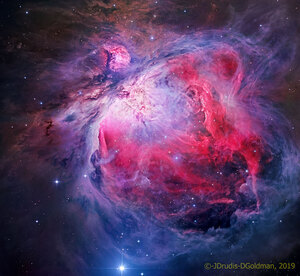
Behold: M42, the great stellar nurseries of the Orion Nebula – the most famous of all astronomical nebulae. To wit:

Here, glowing gas surrounds hot young stars at the edge of an immense interstellar molecular cloud only 1500 light-years away. In the featured deep image in assigned colours highlighted by emission in oxygen and hydrogen, wisps and sheets of dust and gas are particularly evident. The Great Nebula in Orion can be found with the unaided eye near the easily identifiable belt of three stars in the popular constellation Orion. In addition to housing a bright open cluster of stars known as the Trapezium, the Orion Nebula contains many stellar nurseries. These nurseries contain much hydrogen gas, hot young stars, proplyds, and stellar jets spewing material at high speeds. Also known as M42, the Orion Nebula spans about 40 light years and is located in the same spiral arm of our Galaxy as the Sun.

(Image: Josep M. Drudis & Don Goldman)

apod

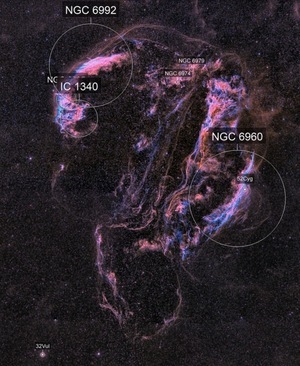
Behold: the glowing spectral remains of shocked gas in the Veil Nebula – the Halloweeniest apparition in the night sky. To wit:

 The nebula itself is a large supernova remnant, an expanding cloud born of the death explosion of a massive star. Light from the original supernova explosion likely reached Earth over 5,000 years ago. Also known as the Cygnus Loop, the Veil Nebula now spans nearly 3 degrees or about 6 times the diameter of the full Moon. That translates to over 70 light-years at its estimated distance of 1,500 light-years. In fact, the Veil is so large its brighter parts are recognized as separate nebulae, including The Witch’s Broom (NGC 6960) below and right of center. At the top left you can find the Spectre of IC 1340.

(Image: Anis Abdul)

apod

Behold: the Cheshire Cat galaxy group in the constellation of Ursa Major – apparently grinning happily at us from 4.6 billion light years away. To wit:

Albert Einstein’s general theory of relativity, published over 100 years ago, predicted the phenomenon of gravitational lensing. And that’s what gives these distant galaxies such a whimsical appearance, seen through the looking glass of X-ray and optical image data from the Chandra and Hubble space telescopes. Nicknamed the Cheshire Cat galaxy group, the group’s two large elliptical galaxies are suggestively framed by arcs. The arcs are optical images of distant background galaxies lensed by the foreground group’s total distribution of gravitational mass. Of course, that gravitational mass is dominated by dark matter. The two large elliptical “eye” galaxies represent the brightest members of their own galaxy groups which are merging. Their relative collisional speed of nearly 1,350 kilometers/second heats gas to millions of degrees producing the X-ray glow shown in purple hues

apod

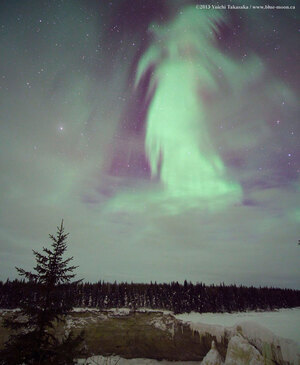
An apparently ghostly aurora recorded over northern Canada back in 2013. To wit:

Regardless of fantastical pareidolic interpretations, the pictured aurora had a typical green colour and was surely caused by the scientifically commonplace action of high energy particles from space interacting with oxygen in Earth’s upper atmosphere. In the image foreground, at the bottom, is a frozen Alexandra Falls, while evergreen trees cross the middle.

(Image: Yuichi Takasaka, TWAN)

apod