
Category Archives: Science

Behold: the filamentary infrared dark cloud known as the Seahorse Nebula. To wit:

Seen toward the royal northern constellation of Cepheus, the dusty, obscuring clouds are part of a Milky Way molecular cloud some 1,200 light-years distant. It is also listed as Barnard 150 (B150), one of 182 dark markings of the sky cataloged in the early 20th century by astronomer E. E. Barnard. Packs of low mass stars are forming within from collapsing cores only visible at long infrared wavelengths. Still, colourful stars in Cepheus add to the pretty, galactic skyscape.

(Image: Sergio Kaminsky)

apod

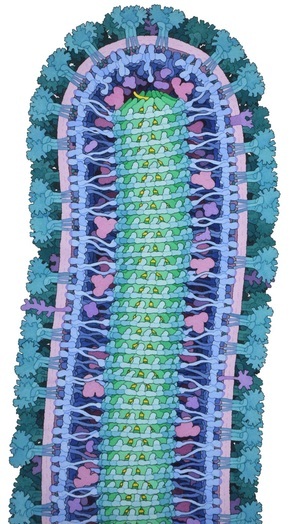
The art (and science) of biologist David Goodsell (what are the chances?): to wit, molecular level depictions of biological processes, cellular structures and viruses like HIV, Ebola and Zika. Of his process, Goodsell sez:

Since the early 1990s, I have been working with a type of illustration that shows portions of living cells magnified so that you can see individual molecules. I try to make these illustrations as accurate as possible, using information from atomic structure analysis, electron microscopy, and biochemical analysis to get the proper number of molecules, in the proper place, and with the proper size and shape.

From top: Zika virus, 2016; Red Blood Cell, 2005; Measles Virus Proteins, 2019; HIV in Blood Plasma, 1999; Ebola Virus, 2014; Mycoplasma mycoides, 2011.

kottke

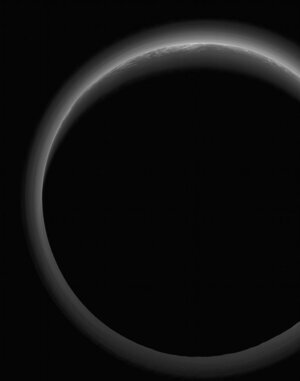
Behold: the night side of Pluto, captured by the New Horizons spacecraft as it flew past in July 2015. Backlighting is provided by Sol  – some 4.9 billion kilometres (4.5 light hours) in the distance.

The spacecraft was at a range of some 21,000 kilometers from Pluto, about 19 minutes after its closest approach. A denizen of the Kuiper Belt in dramatic silhouette, the image also reveals Pluto’s tenuous, surprisingly complex layers of hazy atmosphere. The crescent twilight landscape near the top of the frame includes southern areas of nitrogen ice plains now formally known as Sputnik Planitia and rugged mountains of water-ice in the Norgay Montes.

(Image: NASA, Johns Hopkins Univ./APL, Southwest Research Institute )

apod

An image of five Saturnine moons above the ring plane captured in 2011, by the Cassini spacecraft’s narrow-angle camera. To wit:

Left to right are small moons Janus and Pandora respectively 179 and 81 kilometres across, shiny 504 kilometre diameter Enceladus, and Mimas, 396 kilometres across, seen just next to Rhea. Cut off by the right edge of the frame, Rhea is Saturn’s second largest moon at 1,528 kilometres across. So how many moons does Saturn have? Twenty new found outer satellites bring its total to 82 known moons, and since Jupiter’s moon total stands at 79, Saturn is the Solar System’s new moon king. The newly announced Saturnian satellites are all very small, 5 kilometres or so in diameter, and most are in retrograde orbits inclined to Saturn’s ringplane.

(Image: Cassini Imaging Team, SSI, JPL, NASA )

apod

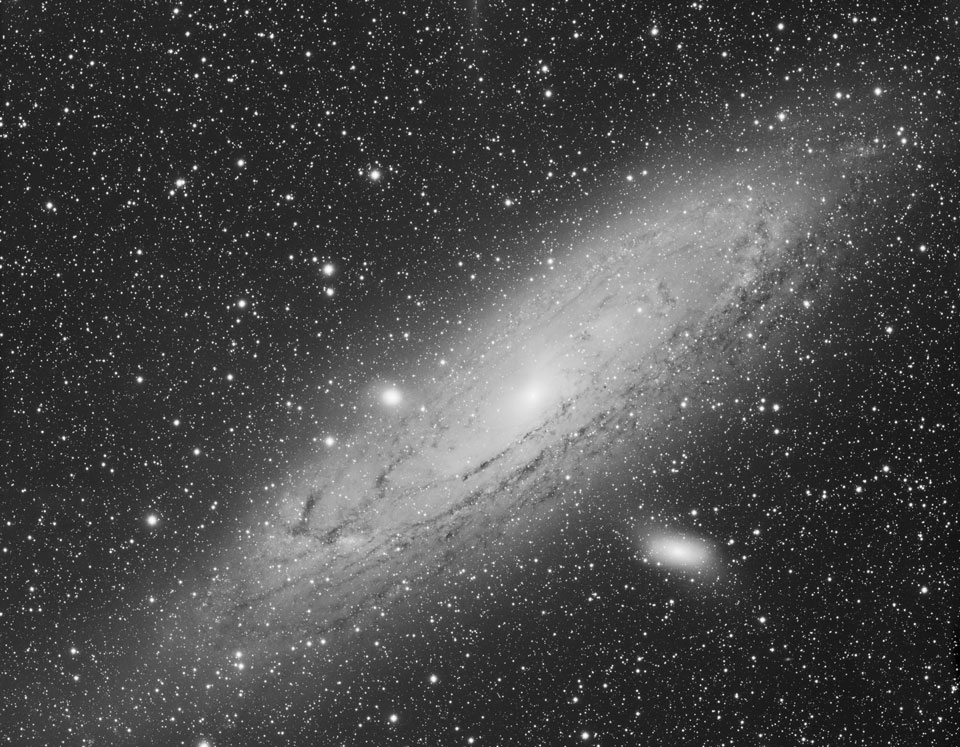
Behold: the Andromeda galaxy, NGC 224 aka Messier 31 – our closest galactic neighbour, before and after image ‘cleanup’. To wit:

The picture is a stack of 223 images, each a 300 second exposure, taken from a garden observatory in Portugal over the past year. Obvious image deficiencies include bright parallel airplane trails, long and continuous satellite trails, short cosmic ray streaks, and bad pixels. These imperfections were actually not removed with Photoshop specifically, but rather greatly reduced with a series of computer software packages that included Astro Pixel Processor, DeepSkyStacker, and PixInsight. All of this work was done not to deceive you with a digital fantasy that has little to do with the real likeness of the Andromeda galaxy (M31), but to minimise Earthly artefacts that have nothing to do with the distant galaxy and so better recreate what M31 really does look like.

(ImageKees Scherer)

apod

Why, they’re luminous spheres of plasma held together by their own gravity.

Behold: NGC 290 – an extremely photogenic open cluster captured in 2006 by the Hubble Space Telescope. To wit:

Open clusters of stars are younger, contain few stars, and contain a much higher fraction of blue stars than do globular clusters of stars. NGC 290 lies about 200,000 light-years distant in a neighbouring galaxy called the Small Cloud of Magellan (SMC). The open cluster contains hundreds of stars and spans about 65 light years across. NGC 290 and other open clusters are good laboratories for studying how stars of different masses evolve, since all the open cluster’s stars were born at about the same time.

(ImageNASAESAHubble; Acknowledgement: E. Olzewski (U. Arizona))

apod

A sobering collaboration between the International Red Cross and our favourite German educational design studio Kurzgesagt. To wit:

Until we did the research. It turned out we were a bit oblivious off the real impact of nuclear weapons in the real world, on a real city. And especially, how helpless even the most developed nations on earth would be if an attack occurred today.

Previously: Argie Bargie

Behold: a very unusual form of large-scale electrical discharge known as red sprite – never before photographed at this level of detail. To wit:

Even though sprites have been recorded for over 30 years, their root cause remains unknown. Some thunderstorms have them, but most don’t. These mysterious bursts of light in the upper atmosphere momentarily resemble gigantic jellyfish. A few years ago high speed videos were taken detailing how red sprites actually develop. The featured image was captured last month in high definition from Italy. One unusual feature of sprites is that they are relatively cold — they operate more like long fluorescent light tubes than hot compact light bulbs. In general, red sprites take only a fraction of a second to occur and are best seen when powerful thunderstorms are visible from the side.

(ImageStephane Vetter (TWAN))

apod