
Category Archives: Science

A spectacular two-image composite of lightning striking communication antennas near the top of Volcán de Agua (Volcano of Water) in Guatemala earlier this month.

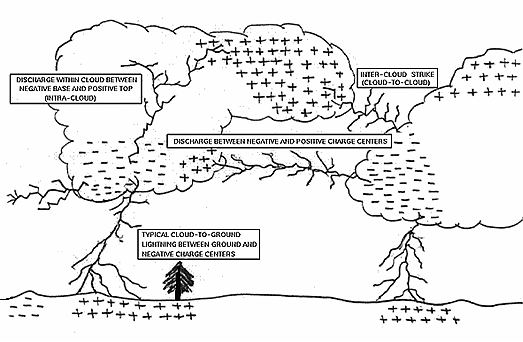
Details of what causes lightning are still being researched, but it is known that inside some clouds, internal updrafts cause collisions between ice and snow that slowlyseparate charges between cloud tops and bottoms The rapid electrical discharges that are lightning soon result. Lightning usually takes a jagged course, rapidly heating a thin column of air to about three times the surface temperature of the Sun. The resulting shock wave starts supersonically and decays into the loud sound known as thunder. On average, around the world, about 6,000 lightning bolts occur between clouds and the Earth every minute.

(ImageSergio Montúfar (Pinceladas Nocturnas)

apod

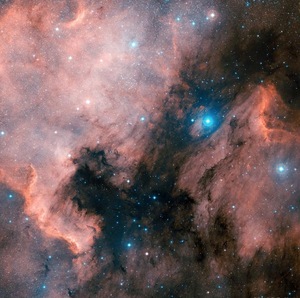
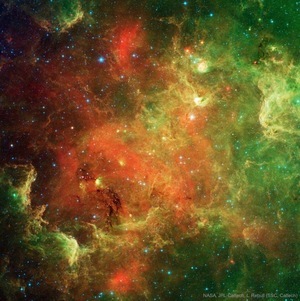
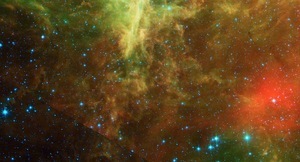
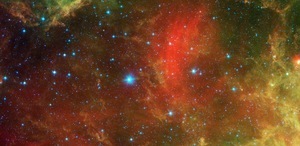
Behold: NGC 7000, aka The North American Nebula (because it looks a little like it) – a star forming region in the constellation of Cygnus. The magnitude of star formation is normally difficult to assess because the nebula contains think dust clouds which block visible light (top pic). But switch the wavelength (pix 2-4) and things get a whole lot more ‘Guardians Of The Galaxy’. To wit:

A view of the North America Nebula in infrared light by the orbiting Spitzer Space Telescope has peered through much of the dust and uncovered thousands of newly formed stars. Rolling your cursor over the above scientifically-colored infrared image will bring up a corresponding optical image of the same region for comparison. The infrared image neatly captures young stars in many stages of formation, from being imbedded in dense knots of gas and dust, to being surrounded bydisks and emitted jets, to being clear of their birth cocoons. The North America Nebula (NGC 7000) spans about 50 light years and lies about 1,500 light years away toward the constellation of the Swan (Cygnus). Still, of all the stars known in the North America Nebula, which massive stars emit the energetic light that gives the ionized red glow is still debated.

Full sized image here (well worth a gander).

(Image: NASAJPL-CaltechL. Rebull (SSC, Caltech); DSS, D. De Martin)

apod

Behold: the painterly tableau of the constellation Cygnus (the Swan) picked out at the northern end of the Great Rift in swirling strokes of interstellar dust and glowing hydrogen gas. To wit:

Composed with three different telescopes and about 90 hours of image data the widefield mosaic spans an impressive 24 degrees across the sky. Alpha star of Cygnus, bright, hot, supergiant Deneb lies near top centre. Crowded with stars and luminous gas clouds Cygnus is also home to the dark, obscuring Northern Coal Sack Nebula, extending from Deneb toward the centre of the view. The reddish glow of star forming regions NGC 7000, the North America Nebula and IC 5070, the Pelican Nebula, are just left of Deneb. The Veil Nebula is a standout below and left of centre. A supernova remnant, the Veil is some 1,400 light years away, but many other nebulae and star clusters are identifiable throughout the cosmic scene. Of course, Deneb itself is also known to northern hemisphere skygazers for its place in two asterisms — marking the top of the Northern Cross and a vertex of the Summer Triangle.

(Image: Alistair Symon)

apod

What’s that eerie glow down the highway? A still from ‘Stranger Things’? No, it’s dust orbiting the sun. To wit:

At certain times of the year, a band of sun-reflecting dust from the inner Solar System appears prominently just after sunset — or just before sunrise — and is called zodiacal light. Although the origin of this dust is still being researched, a leading hypothesis holds that zodiacal dust originates mostly from faint Jupiter-family comets and slowly spirals into the Sun. Recent analysis of dust emitted by Comet 67P, visited by ESA’s roboticRosetta spacecraft, bolster this hypothesis. Pictured when climbing a road up to Teide National Park in the Canary Islands of Spain, a bright triangle of zodiacal light appeared in the distance soon after sunset. Captured on June 21, the scene includes bright Regulus, alpha star of Leo, standing above center toward the left. The Beehive Star Cluster (M44) can be spotted below center, closer to the horizon and also immersed in the zodiacal glow.

(ImageRuslan Merzlyakov (RMS Photography)

apod

Sorry – must’ve been that lentil dahl.

Behold: Messier 82, aka the Cigar Galaxy, smoking away like it had some kind of infinite gas reservoir – fooling no one but itself. To wit:

M82, as this starburst galaxy is also known, was stirred up by a recent pass near large spiral galaxy M81. This doesn’t fully explain the source of the red-glowing outwardly expanding gas and dust, however. Evidence indicates that this gas and dust is being driven out by the combined emerging particle winds of many stars, together creating a galactic superwind. The dust particles are thought to originate in M82’s interstellar medium and are actually similar in size to particles in cigar smoke. The featured photographic mosaic highlights a specific colour of red light strongly emitted by ionised hydrogen gas, showing detailed filaments of this gas and dust. The filaments extend for over 10,000 light years. The 12-million light-year distant Cigar Galaxy is the brightest galaxy in the sky in infrared light, and can be seen in visible light with a small telescope towards the constellation of the Great Bear (Ursa Major).

(ImageNASAESAHubbleDaniel Nobre)

apod

Last week’s full moon or Buck Moon (captured during its partial eclipse by Cristian Fattinnanzi) was very full. How full, you ask?

…it fell almost exactly in a line with the Sun and the Earth. When that happens the Earth casts its shadow onto the Moon. The circularity of the Earth’s shadow on the Moon was commented on by Aristotle and so has been noticed since at least the 4th century BC. What’s new is humanity’s ability to record this shadow with such high dynamic range (HDR).

The featured HDR composite of last week’s partial lunar eclipse combines 15 images and includes an exposure as short as 1/400th of a second — so as not to overexpose the brightest part — and an exposure that lasted five seconds — to bring up the dimmest part. This dimmest part — inside Earth’s umbra — is not completely dark because some light is refracted through the Earth’s atmosphereonto the Moon. A total lunar eclipse will occur next in 2021 May.

Giant image here.

UPDATE: a deliciously moony mashup from 2013.

apod

Aggh! It’s a TIE fighter. No wait, it’s a sunspot. No wait, it’s the International Space Station. But what’s it doing on the Sun? To wit:

Transiting the Sun is not very unusual for the ISS, which orbits the Earth about every 90 minutes, but getting one’s timing and equipment just right for a great image is rare. Strangely, besides that fake spot, in this recent two-image composite, the Sun lacked any real sunspots. The featured picture combines two images — one capturing the space station transiting the Sun — and another taken consecutively capturing details of the Sun’s surface. Sunspots have been rare on the Sun since the dawn of the current Solar Minimum, a period of low solar activity. For reasons not yet fully understood, the number of sunspots occurring during both the previous and current solar minima have been unusually low.

(Image: Rainee Colacurcio)

apod

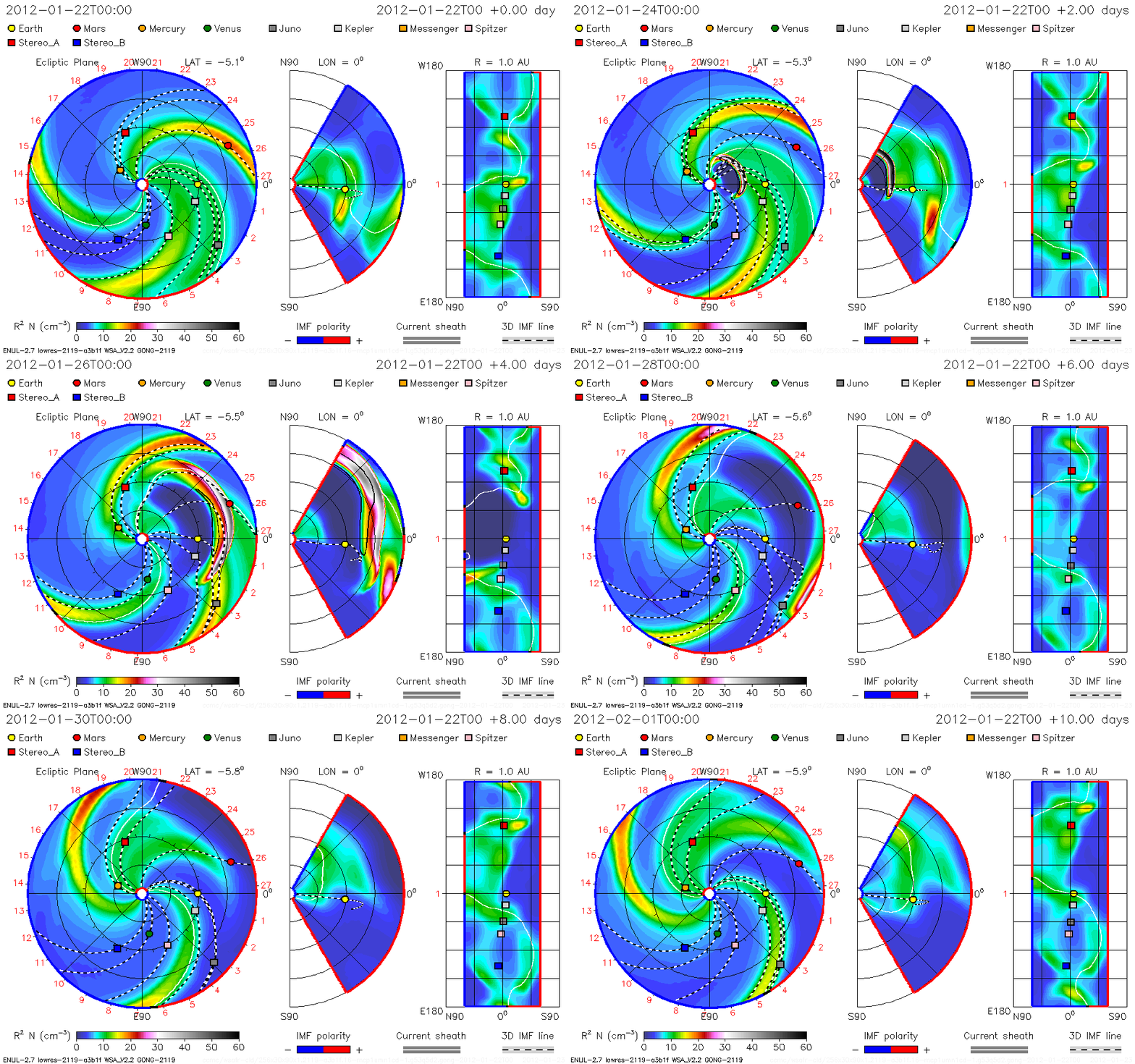
Five days before this image was captured over Norway in 2012, a large coronal mass ejection occurred on the sun, throwing a cloud of fast moving electrons, protons, and ions toward the Earth. To wit:

Although most of this cloud passed above the Earth, some of it impacted our Earth’s magnetosphere and resulted in spectacular auroras being seen at high northern latitudes. Featured here is a particularly photogenic auroral corona captured above GrotfjordNorway. To some, this shimmering green glow of recombining atmospheric oxygen might appear as a large eagle, but feel free to share what it looks like to you. Although the Sun is near Solar Minimum, streams of the solar wind continue to impact the Earth and create impressive auroras visible even last week.

(Image: Bjørn Jørgensen)

apod

Behold: NGC 3242 – the cast off shroud of a dying sun-like star known as The Ghost Of Jupiter Nebula. To wit:

…this deep and wide telescopic view also finds the seldom seen outer halo of the beautiful planetary nebula at the upper left, toward Milky Way stars and background galaxies in the serpentine constellation Hydra. Intense and otherwise invisible ultraviolet radiation from the nebula’s central white dwarf star powers its illusive glow in visible light. In fact, planets of NGC 3242’s evolved white dwarf star may have contributed to the nebula’s symmetric features and shape. Activity beginning in the star’s red giant phase, long before it produced a planetary nebula, is likely the cause of the fainter more extensive halo. About a light-year across NGC 3242 is some 4,500 light-years away. The tenuous clouds of glowing material at the right could well be interstellar gas, by chance close enough to the NGC 3242’s white dwarf to be energized by its ultraviolet radiation.

(ImageCHART32 Team, Johannes Schedler / Volker Wendel)

apod